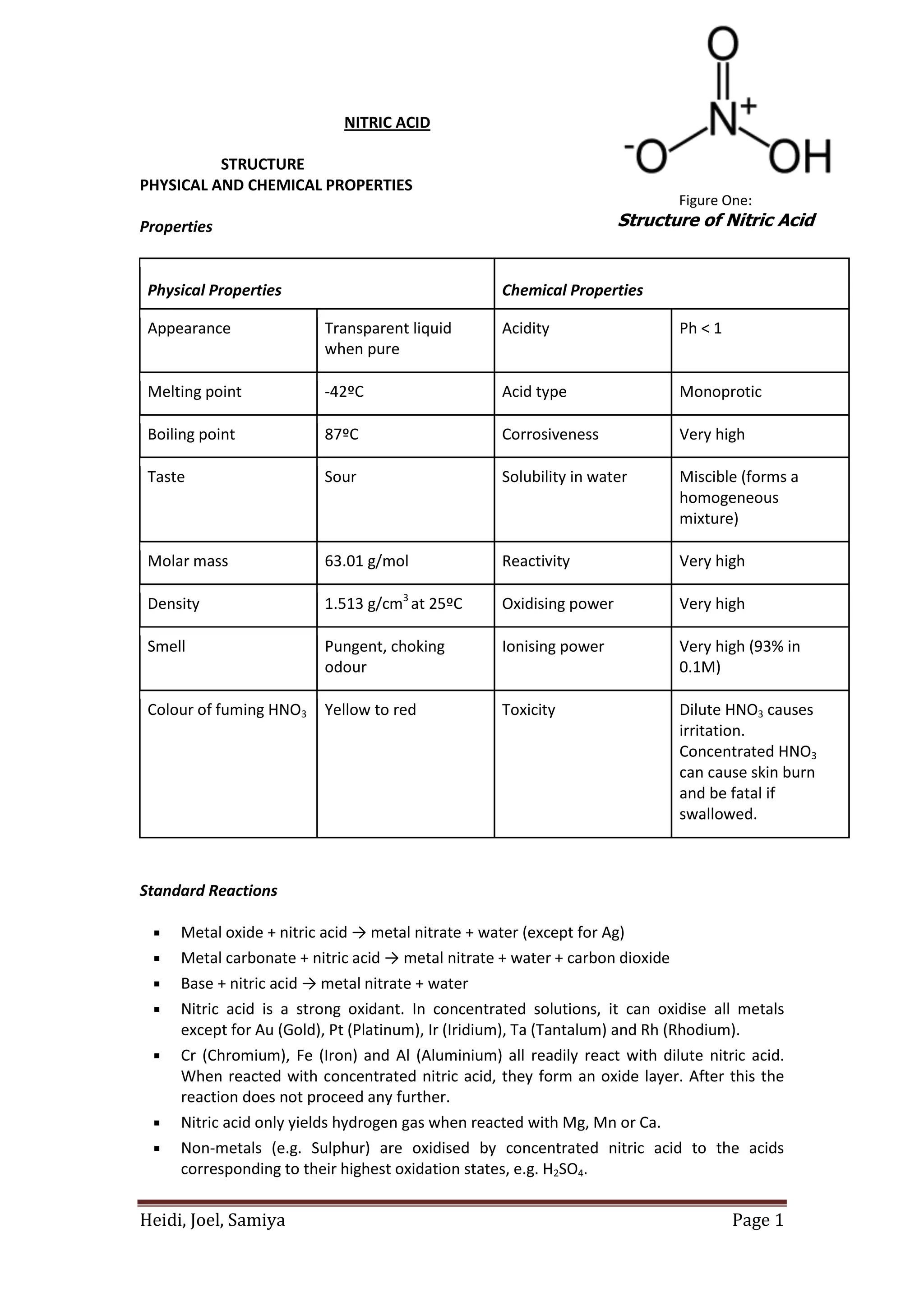
3886200-788670NITRIC ACID<br />                     STRUCTURE<br />Figure One:Structure of Nitric AcidPHYSICAL AND CHEMICAL PROPERTIES<br />Properties<br />Physical PropertiesChemical PropertiesAppearanceTransparent liquid when pureAcidityPh < 1Melting point-42ºCAcid typeMonoproticBoiling point87ºCCorrosivenessVery highTasteSourSolubility in waterMiscible (forms a homogeneous mixture)Molar mass63.01 g/molReactivityVery highDensity1.513 g/cm3 at 25ºCOxidising powerVery highSmellPungent, choking odourIonising powerVery high (93% in 0.1M)Colour of fuming HNO3Yellow to redToxicityDilute HNO3 causes irritation. Concentrated HNO3 can cause skin burn and be fatal if swallowed.<br />Standard Reactions<br />Metal oxide + nitric acid -> metal nitrate + water (except for Ag)<br />Metal carbonate + nitric acid -> metal nitrate + water + carbon dioxide<br />Base + nitric acid -> metal nitrate + water<br />Nitric acid is a strong oxidant. In concentrated solutions, it can oxidise all metals except for Au (Gold), Pt (Platinum), Ir (Iridium), Ta (Tantalum) and Rh (Rhodium).<br />Cr (Chromium), Fe (Iron) and Al (Aluminium) all readily react with dilute nitric acid. When reacted with concentrated nitric acid, they form an oxide layer. After this the reaction does not proceed any further.<br />Nitric acid only yields hydrogen gas when reacted with Mg, Mn or Ca.<br />Non-metals (e.g. Sulphur) are oxidised by concentrated nitric acid to the acids corresponding to their highest oxidation states, e.g. H2SO4.<br />MANUFACTURE<br />Most techniques involve the oxidation of nitric oxide.<br />INDUSTRIAL PROCESSES<br />Commercial grade solutions are between 52% and 68% concentration, made using the Ostwald process:<br />Anhydrous ammonia is oxidised to nitric oxide, which is then oxidised by air to form nitrogen dioxide gas, which is subsequently bubbled through water:<br />3NO2(g) + H2O(l) -> 2HNO3(aq) + NO(g)<br />NO left over is oxidised by air to make NO2<br />NO2 produced from first reaction can be run through water again until maximum concentration (52-68%) using that process is reached, or it can be bubbled through hydrogen peroxide to improve acid yield:<br />NO2(g) + H2O2(l) -> 2HNO3(l)<br />Sometimes water or already manufactured nitric acid is rained down in an absorption tower to absorb rising NO2 gas to make more or increase concentration.<br />LABORATORY SYNTHESIS<br />A reaction between a nitrate salt and almost pure sulphuric acid produces almost pure nitric acid:<br />H2SO4(l) + NO3-(s) -> HSO4-(s) + HNO3(g)<br />The resulting mixture is distilled at nitric acid’s boiling point (83°C) until the hydrogen-sulphate salt remains. Red fuming nitric acid is formed, which can be converted to white nitric acid by reducing atmospheric pressure at room temperature, shifting equilibrium.<br />Early techniques used the Birkeland-Eyde process; using a high voltage electric arc to heat air to 3000ºC, which joins atmospheric oxygen and nitrogen.  The NO2 produced is bubbled through water to produce nitric acid. This process was very energy intensive and the yield was less than 5% of the volume of atmospheric nitrogen and oxygen used.<br />Nitric acid can be purified further by distillation (up to 68%) when in water. It can also be distilled with sulphuric acid or magnesium nitrate (dehydrating agents) to achieve greater concentration. These processes must be carried out in glass apparatuses at reduced pressure to prevent the HNO3 from decomposing.<br />PRODUCTS<br />Red fuming nitric acid is an oxidant used in rocket propellants. It is composed of nitric acid, 13% dinitrogen tetroxide and 3% water. The fumes are from the dinitrogen tetroxide breaking down to form nitrogen dioxide.<br />White nitric acid is a liquid oxidiser used with kerosene rocket fuel. It consists of at least 97% (almost pure) nitric acid, no more than 2% water and less than 0.5% dissolved nitrogen dioxide or dinitrogen tetroxide. To be stored it needs an inhibitor to stop it from dissolving all metals, but it is safer than red fuming nitric acid as it contains less toxic nitrogen tetroxide.<br />INDUSTRY AND ENVIRONMENTAL ISSUES<br />Nitric acid is useful in industry and is commonly used in the manufacture of:<br />Fertilizers<br />Such as calcium nitrate Ca(NO3)2, ammonium nitrate <br />NH4NO3 etc.<br />Plants require a source of nitrogen for the production of proteins to develop.<br />Explosives <br />Such as trinitrotoluene (T.N.T.) nitro glycerine, gun cotton, ammonal etc.<br />Nitrogen is used since they decompose large volumes of gas upon ignition.<br /> Nitrate Salts<br />Such as calcium nitrate Ca(NO3)2, silver nitrate AgNO3, ammonium nitrate NH4NO3  (fertilisers) etc.<br />Coal Tar Products<br />Such as dyes, perfumes, plastics, drugs etc.<br />Sulfuric Acid<br />Lead chamber processes used.<br />Other uses in industry include:<br />Purification of silver, gold, platinum etc.<br />Etch designs on gold, silver, platinum, etc.<br />Oxidizer in liquid fuel rockets.<br />Colorimetric test to distinguish heroin and morphine.<br />Laboratory reagent<br />Prepare ‘aqua regia’ which is used to dissolve the noble elements <br />Nitric Acid reacted with Hydrochloric Acid<br />Environmental issues include:<br />Changing pH of water systems<br />Contaminate groundwater and soil<br />A component of automobile exhaust (creating smog)<br />Nitrogen dioxide reaches higher altitudes in atmosphere, along with sulfate dissolves in water and creates acid rain.<br />Corrodes buildings and statues<br />Causes destruction to forests and lakes<br />
Nitric acid -_summary_sheet[1][1]

Nitric acid -_summary_sheet[1][1]

  • 1.
    3886200-788670NITRIC ACID<br /> STRUCTURE<br />Figure One:Structure of Nitric AcidPHYSICAL AND CHEMICAL PROPERTIES<br />Properties<br />Physical PropertiesChemical PropertiesAppearanceTransparent liquid when pureAcidityPh < 1Melting point-42ºCAcid typeMonoproticBoiling point87ºCCorrosivenessVery highTasteSourSolubility in waterMiscible (forms a homogeneous mixture)Molar mass63.01 g/molReactivityVery highDensity1.513 g/cm3 at 25ºCOxidising powerVery highSmellPungent, choking odourIonising powerVery high (93% in 0.1M)Colour of fuming HNO3Yellow to redToxicityDilute HNO3 causes irritation. Concentrated HNO3 can cause skin burn and be fatal if swallowed.<br />Standard Reactions<br />Metal oxide + nitric acid -> metal nitrate + water (except for Ag)<br />Metal carbonate + nitric acid -> metal nitrate + water + carbon dioxide<br />Base + nitric acid -> metal nitrate + water<br />Nitric acid is a strong oxidant. In concentrated solutions, it can oxidise all metals except for Au (Gold), Pt (Platinum), Ir (Iridium), Ta (Tantalum) and Rh (Rhodium).<br />Cr (Chromium), Fe (Iron) and Al (Aluminium) all readily react with dilute nitric acid. When reacted with concentrated nitric acid, they form an oxide layer. After this the reaction does not proceed any further.<br />Nitric acid only yields hydrogen gas when reacted with Mg, Mn or Ca.<br />Non-metals (e.g. Sulphur) are oxidised by concentrated nitric acid to the acids corresponding to their highest oxidation states, e.g. H2SO4.<br />MANUFACTURE<br />Most techniques involve the oxidation of nitric oxide.<br />INDUSTRIAL PROCESSES<br />Commercial grade solutions are between 52% and 68% concentration, made using the Ostwald process:<br />Anhydrous ammonia is oxidised to nitric oxide, which is then oxidised by air to form nitrogen dioxide gas, which is subsequently bubbled through water:<br />3NO2(g) + H2O(l) -> 2HNO3(aq) + NO(g)<br />NO left over is oxidised by air to make NO2<br />NO2 produced from first reaction can be run through water again until maximum concentration (52-68%) using that process is reached, or it can be bubbled through hydrogen peroxide to improve acid yield:<br />NO2(g) + H2O2(l) -> 2HNO3(l)<br />Sometimes water or already manufactured nitric acid is rained down in an absorption tower to absorb rising NO2 gas to make more or increase concentration.<br />LABORATORY SYNTHESIS<br />A reaction between a nitrate salt and almost pure sulphuric acid produces almost pure nitric acid:<br />H2SO4(l) + NO3-(s) -> HSO4-(s) + HNO3(g)<br />The resulting mixture is distilled at nitric acid’s boiling point (83°C) until the hydrogen-sulphate salt remains. Red fuming nitric acid is formed, which can be converted to white nitric acid by reducing atmospheric pressure at room temperature, shifting equilibrium.<br />Early techniques used the Birkeland-Eyde process; using a high voltage electric arc to heat air to 3000ºC, which joins atmospheric oxygen and nitrogen. The NO2 produced is bubbled through water to produce nitric acid. This process was very energy intensive and the yield was less than 5% of the volume of atmospheric nitrogen and oxygen used.<br />Nitric acid can be purified further by distillation (up to 68%) when in water. It can also be distilled with sulphuric acid or magnesium nitrate (dehydrating agents) to achieve greater concentration. These processes must be carried out in glass apparatuses at reduced pressure to prevent the HNO3 from decomposing.<br />PRODUCTS<br />Red fuming nitric acid is an oxidant used in rocket propellants. It is composed of nitric acid, 13% dinitrogen tetroxide and 3% water. The fumes are from the dinitrogen tetroxide breaking down to form nitrogen dioxide.<br />White nitric acid is a liquid oxidiser used with kerosene rocket fuel. It consists of at least 97% (almost pure) nitric acid, no more than 2% water and less than 0.5% dissolved nitrogen dioxide or dinitrogen tetroxide. To be stored it needs an inhibitor to stop it from dissolving all metals, but it is safer than red fuming nitric acid as it contains less toxic nitrogen tetroxide.<br />INDUSTRY AND ENVIRONMENTAL ISSUES<br />Nitric acid is useful in industry and is commonly used in the manufacture of:<br />Fertilizers<br />Such as calcium nitrate Ca(NO3)2, ammonium nitrate <br />NH4NO3 etc.<br />Plants require a source of nitrogen for the production of proteins to develop.<br />Explosives <br />Such as trinitrotoluene (T.N.T.) nitro glycerine, gun cotton, ammonal etc.<br />Nitrogen is used since they decompose large volumes of gas upon ignition.<br /> Nitrate Salts<br />Such as calcium nitrate Ca(NO3)2, silver nitrate AgNO3, ammonium nitrate NH4NO3 (fertilisers) etc.<br />Coal Tar Products<br />Such as dyes, perfumes, plastics, drugs etc.<br />Sulfuric Acid<br />Lead chamber processes used.<br />Other uses in industry include:<br />Purification of silver, gold, platinum etc.<br />Etch designs on gold, silver, platinum, etc.<br />Oxidizer in liquid fuel rockets.<br />Colorimetric test to distinguish heroin and morphine.<br />Laboratory reagent<br />Prepare ‘aqua regia’ which is used to dissolve the noble elements <br />Nitric Acid reacted with Hydrochloric Acid<br />Environmental issues include:<br />Changing pH of water systems<br />Contaminate groundwater and soil<br />A component of automobile exhaust (creating smog)<br />Nitrogen dioxide reaches higher altitudes in atmosphere, along with sulfate dissolves in water and creates acid rain.<br />Corrodes buildings and statues<br />Causes destruction to forests and lakes<br />