NITRIC ACID
CONTENTS
▶ INTRODUCTION
▶ PHYSICAL PROPERTIES
▶ CHEMICAL PROPERTIES
▶ USES
▶ MANUFACTURING
▶ PROCESS FLOW DIAGRAM ( PFD )
▶ PRODUCTION C O MPANIES IN PAKISTAN
▶ PRODUCTION IN PAKISTAN AS C O MPARED TO WORLD
▶ CONCLUSION
INTRODUCTION
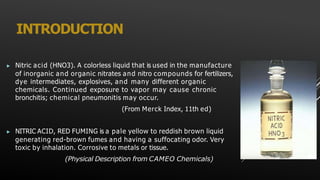
▶ Nitric acid (HNO3). A colorless liquid that is used in the manufacture
of inorganic and organic nitrates and nitro compounds for fertilizers,
dye intermediates, explosives, and many different organic
chemicals. Continued exposure to vapor may cause chronic
bronchitis; chemical pneumonitis may occur.
(From Merck Index, 11th ed)
▶ NITRIC ACID, RED FUMING is a pale yellow to reddish brown liquid
generating red-brown fumes and having a suffocating odor. Very
toxic by inhalation. Corrosive to metals or tissue.
(Physical Description from CAMEO Chemicals)
PHYSICAL PROPERTIES
▶ Appearance: Colorless, yellow or red
▶ Odor:
▶ Density:
Acrid, suffocating
1.5129 g cm−3
▶ Melting point:
▶ Boiling point:
▶ Solubility :
▶ Vapor pressure:
−42 °C (−44 °F; 231 K)
83 °C (181 °F; 356 K)
Com pletely miscible
48 mmHg (20 °C)
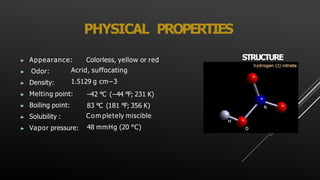
STRUCTURE
CHEMICAL PROPERTIES
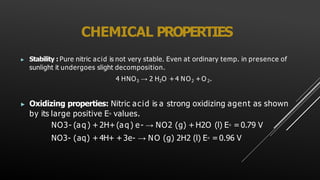
▶ Stability : Pure nitric acid is not very stable. Even at ordinary temp. in presence of
sunlight it undergoes slight decomposition.
4 HNO3 → 2 H2O +4 NO2 +O 2.
▶ Oxidizing properties: Nitric acid is a strong oxidizing agent as shown
by its large positive E◦ values.
NO3- (aq) + 2H+(aq) e- → NO2 (g) + H2O (l) E◦ =0.79 V
NO3- (aq) +4H+ + 3e- → NO (g) 2H2 (l) E◦ = 0.96 V
CHEMICAL PROPERTIES
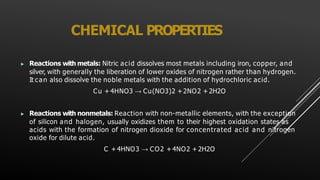
▶ Reactions with metals: Nitric acid dissolves most metals including iron, copper, and
silver, with generally the liberation of lower oxides of nitrogen rather than hydrogen.
It can also dissolve the noble metals with the addition of hydrochloric acid.
Cu + 4HNO3 → Cu(NO3)2 +2NO2 + 2H2O
▶ Reactions with nonmetals: Reaction with non-metallic elements, with the exception
of silicon and halogen, usually oxidizes them to their highest oxidation states as
acids with the formation of nitrogen dioxide for concentrated acid and nitrogen
oxide for dilute acid.
C +4HNO3 → CO2 +4NO2 +2H2O
USES:
 As a starting material in the manufacture of nitrogen fertilizers such as ammonium
nitrate & ammonium etc. Large amounts are reacted with ammonia to yield
ammonium nitrate.
 It is commonly used in science laboratories at schools for experimenting when
specifically testing for chloride
 As a nitrating agent in the preparation of explosives such as TNT, nitroglycerine,
cellulose poly-nitrate, ammonium picrate.
 It is used as a medicine to remove chancres and warts.
 Used in fibers, plastics and dyestuffs industries
 Used in metallurgy and in rocket fuel production.
 It is used in calorimetric test to distinguish between heroin and morphine.
MANUFACTURING OF NITRIC ACID
INDUSTRIALLY NITRIC ACID IS PREPARED BY FOLLOWING 3 METHODS:
• CHILE SALTPETRE METHOD BY NANO3
• BRIKLAND EYDE’S METHOD BY USING AIR
• OSTWALD’S METHOD BY AMMONIA SOLVEY PROCESS
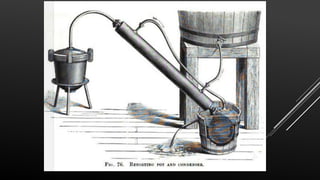
CHILE SALTPETRE METHOD (By NaNO3)
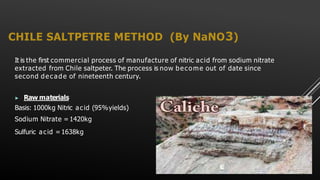
It is the first commercial process of manufacture of nitric acid from sodium nitrate
extracted from Chile saltpeter. The process is now become out of date since
second decade of nineteenth century.
▶ Raw materials
Basis: 1000kg Nitric acid (95%yields)
Sodium Nitrate = 1420kg
Sulfuric acid =1638kg
▶ PROCESS:
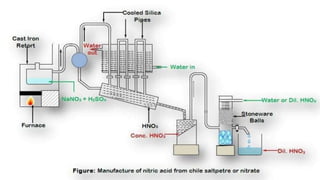
Equal weight of sodium nitrate (or potassium nitrate) and sulfuric acid is charged to
cast iron retort having outlet provided at bottom to take out solution of sodium
bisulfate.
The reactants are heated to about 2000C by the hot furnace gases.
The furnace gases are produced by combustion of coal in the furnace.
Then the vapour of nitric acid are cooled and condensed in water cooled silica
pipes.
The cooled acid is collected in stoneware receiver. The un-condensed vapours are
scrubbed with water in absorption tower which is packed with stone ware balls and
cooled by cold water. The dilute acid is re-circulated till it becomes concentrated.
The residual sodium bisulfate is removed by outlet provided at the bottom of retort.
Reaction:
NaNO3 +H2SO4NaHSO4 +HNO3
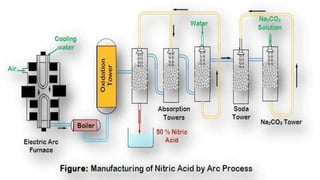
BRIKLAND EYDE’S METHOD
(ARC PROCESS)
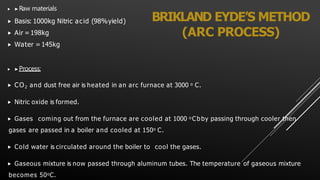
 ▶Raw materials
 Basis: 1000kg Nitric acid (98%yield)
 Air = 198kg
 Water = 145kg
 ▶Process:
 CO2 and dust free air is heated in an arc furnace at 3000 o C.
 Nitric oxide is formed.
 Gases coming out from the furnace are cooled at 1000 o Cbby passing through cooler then
gases are passed in a boiler and cooled at 150o C.
 Cold water is circulated around the boiler to cool the gases.
 Gaseous mixture is now passed through aluminum tubes. The temperature of gaseous mixture
becomes 50oC.
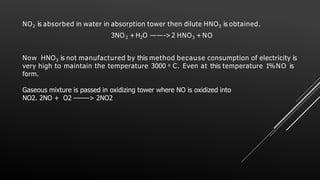
NO2 is absorbed in water in absorption tower then dilute HNO3 is obtained.
3NO 2 + H2O ——->2 HNO3 + NO
Now HNO3 is not manufactured by this method because consumption of electricity is
very high to maintain the temperature 3000 o C. Even at this temperature 1%NO is
form.
Gaseous mixture is passed in oxidizing tower where NO is oxidized into
NO2. 2NO + O2 ——–> 2NO2
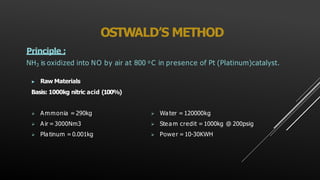
OSTWALD’S METHOD
Principle :
NH3 is oxidized into NO by air at 800 o C in presence of Pt (Platinum)catalyst.
▶ Raw Materials
Basis: 1000kg nitric acid (100%)
 A mmonia = 290kg
 A ir = 3000Nm3
 Pla tinum = 0.001kg
 Wa ter = 120000kg
 Stea m credit = 1000kg @ 200psig
 Power = 10-30KWH
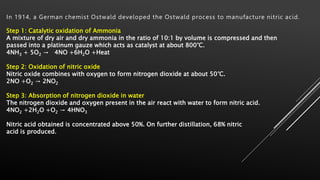
In 1914, a German chemist Ostwald developed the Ostwald process to manufacture nitric acid.
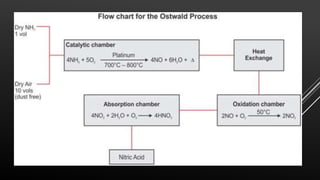
Step 1: Catalytic oxidation of Ammonia
A mixture of dry air and dry ammonia in the ratio of 10:1 by volume is compressed and then
passed into a platinum gauze which acts as catalyst at about 800°C.
4NH3 + 5O2 → 4NO +6H2O +Heat
Step 2: Oxidation of nitric oxide
Nitric oxide combines with oxygen to form nitrogen dioxide at about 50°C.
2NO +O2 → 2NO2
Step 3: Absorption of nitrogen dioxide in water
The nitrogen dioxide and oxygen present in the air react with water to form nitric acid.
4NO2 +2H2O +O2 → 4HNO3
Nitric acid obtained is concentrated above 50%. On further distillation, 68% nitric
acid is produced.
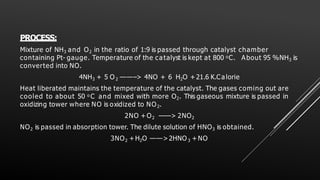
PROCESS:
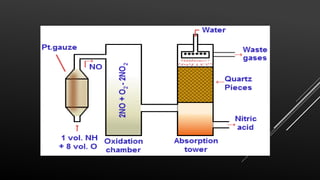
Mixture of NH3 and O2 in the ratio of 1:9 is passed through catalyst chamber
containing Pt- gauge. Temperature of the catalyst is kept at 800 oC. About 95 %NH3 is
converted into NO.
4NH3 + 5 O 2 ——–> 4NO + 6 H2O +21.6 K.Calorie
Heat liberated maintains the temperature of the catalyst. The gases coming out are
cooled to about 50 o C and mixed with more O2. This gaseous mixture is passed in
oxidizing tower where NO is oxidized to NO2.
2NO + O2 ——> 2NO2
NO2 is passed in absorption tower. The dilute solution of HNO3 is obtained.
3NO2 +H2O ——>2HNO 3 +NO
NITRIC ACID SAFETY AND
HANDLING:
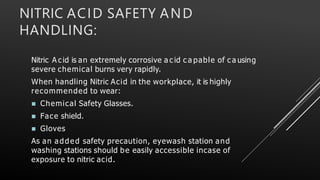
Nitric A cid is an extremely corrosive a c id c a pable of c a using
severe chemical burns very rapidly.
When handling Nitric Acid in the workplace, it is highly
recommended to wear:
 Chemical Safety Glasses.
 Face shield.
 Gloves
As an added safety precaution, eyewash station and
washing stations should be easily accessible incase of
exposure to nitric acid.
FIRST
AID:
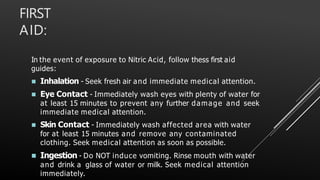
In the event of exposure to Nitric Acid, follow thess first aid
guides:
 Inhalation - Seek fresh air and immediate medical attention.
 Eye Contact - Immediately wash eyes with plenty of water for
at least 15 minutes to prevent any further damage and seek
immediate medical attention.
 Skin Contact - Immediately wash affected area with water
for at least 15 minutes and remove any contaminated
clothing. Seek medical attention as soon as possible.
 Ingestion - Do NOT induce vomiting. Rinse mouth with water
and drink a glass of water or milk. Seek medical attention
immediately.
NITRIC ACID COMPANIES IN PAKISTAN
 ITTEHAD CHEMICALS LTD.
 INTERNATIONAL PETROCHEMICALS LTD.
 ATTA CHEMICALS PVT LTD.
 FATIMA GROUP
 PAK ARAB FERTILIZERS SUPPLIERS
 THIOGLYCOLIC ACID COMPANY
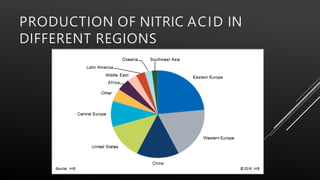
PRODUCTION OF NITRIC ACID IN
DIFFERENT REGIONS
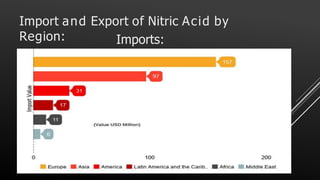
Import and Export of Nitric Acid by
Region: Imports:
EXPORT
S:

Nitic Acid.pptx

  • 1.
  • 2.
    CONTENTS ▶ INTRODUCTION ▶ PHYSICALPROPERTIES ▶ CHEMICAL PROPERTIES ▶ USES ▶ MANUFACTURING ▶ PROCESS FLOW DIAGRAM ( PFD ) ▶ PRODUCTION C O MPANIES IN PAKISTAN ▶ PRODUCTION IN PAKISTAN AS C O MPARED TO WORLD ▶ CONCLUSION
  • 3.
    INTRODUCTION ▶ Nitric acid(HNO3). A colorless liquid that is used in the manufacture of inorganic and organic nitrates and nitro compounds for fertilizers, dye intermediates, explosives, and many different organic chemicals. Continued exposure to vapor may cause chronic bronchitis; chemical pneumonitis may occur. (From Merck Index, 11th ed) ▶ NITRIC ACID, RED FUMING is a pale yellow to reddish brown liquid generating red-brown fumes and having a suffocating odor. Very toxic by inhalation. Corrosive to metals or tissue. (Physical Description from CAMEO Chemicals)
  • 4.
    PHYSICAL PROPERTIES ▶ Appearance:Colorless, yellow or red ▶ Odor: ▶ Density: Acrid, suffocating 1.5129 g cm−3 ▶ Melting point: ▶ Boiling point: ▶ Solubility : ▶ Vapor pressure: −42 °C (−44 °F; 231 K) 83 °C (181 °F; 356 K) Com pletely miscible 48 mmHg (20 °C) STRUCTURE
  • 5.
    CHEMICAL PROPERTIES ▶ Stability: Pure nitric acid is not very stable. Even at ordinary temp. in presence of sunlight it undergoes slight decomposition. 4 HNO3 → 2 H2O +4 NO2 +O 2. ▶ Oxidizing properties: Nitric acid is a strong oxidizing agent as shown by its large positive E◦ values. NO3- (aq) + 2H+(aq) e- → NO2 (g) + H2O (l) E◦ =0.79 V NO3- (aq) +4H+ + 3e- → NO (g) 2H2 (l) E◦ = 0.96 V
  • 6.
    CHEMICAL PROPERTIES ▶ Reactionswith metals: Nitric acid dissolves most metals including iron, copper, and silver, with generally the liberation of lower oxides of nitrogen rather than hydrogen. It can also dissolve the noble metals with the addition of hydrochloric acid. Cu + 4HNO3 → Cu(NO3)2 +2NO2 + 2H2O ▶ Reactions with nonmetals: Reaction with non-metallic elements, with the exception of silicon and halogen, usually oxidizes them to their highest oxidation states as acids with the formation of nitrogen dioxide for concentrated acid and nitrogen oxide for dilute acid. C +4HNO3 → CO2 +4NO2 +2H2O
  • 7.
    USES:  As astarting material in the manufacture of nitrogen fertilizers such as ammonium nitrate & ammonium etc. Large amounts are reacted with ammonia to yield ammonium nitrate.  It is commonly used in science laboratories at schools for experimenting when specifically testing for chloride  As a nitrating agent in the preparation of explosives such as TNT, nitroglycerine, cellulose poly-nitrate, ammonium picrate.  It is used as a medicine to remove chancres and warts.  Used in fibers, plastics and dyestuffs industries  Used in metallurgy and in rocket fuel production.  It is used in calorimetric test to distinguish between heroin and morphine.
  • 8.
    MANUFACTURING OF NITRICACID INDUSTRIALLY NITRIC ACID IS PREPARED BY FOLLOWING 3 METHODS: • CHILE SALTPETRE METHOD BY NANO3 • BRIKLAND EYDE’S METHOD BY USING AIR • OSTWALD’S METHOD BY AMMONIA SOLVEY PROCESS
  • 9.
    CHILE SALTPETRE METHOD(By NaNO3) It is the first commercial process of manufacture of nitric acid from sodium nitrate extracted from Chile saltpeter. The process is now become out of date since second decade of nineteenth century. ▶ Raw materials Basis: 1000kg Nitric acid (95%yields) Sodium Nitrate = 1420kg Sulfuric acid =1638kg
  • 10.
    ▶ PROCESS: Equal weightof sodium nitrate (or potassium nitrate) and sulfuric acid is charged to cast iron retort having outlet provided at bottom to take out solution of sodium bisulfate. The reactants are heated to about 2000C by the hot furnace gases. The furnace gases are produced by combustion of coal in the furnace. Then the vapour of nitric acid are cooled and condensed in water cooled silica pipes. The cooled acid is collected in stoneware receiver. The un-condensed vapours are scrubbed with water in absorption tower which is packed with stone ware balls and cooled by cold water. The dilute acid is re-circulated till it becomes concentrated. The residual sodium bisulfate is removed by outlet provided at the bottom of retort. Reaction: NaNO3 +H2SO4NaHSO4 +HNO3
  • 13.
    BRIKLAND EYDE’S METHOD (ARCPROCESS)  ▶Raw materials  Basis: 1000kg Nitric acid (98%yield)  Air = 198kg  Water = 145kg  ▶Process:  CO2 and dust free air is heated in an arc furnace at 3000 o C.  Nitric oxide is formed.  Gases coming out from the furnace are cooled at 1000 o Cbby passing through cooler then gases are passed in a boiler and cooled at 150o C.  Cold water is circulated around the boiler to cool the gases.  Gaseous mixture is now passed through aluminum tubes. The temperature of gaseous mixture becomes 50oC.
  • 14.
    NO2 is absorbedin water in absorption tower then dilute HNO3 is obtained. 3NO 2 + H2O ——->2 HNO3 + NO Now HNO3 is not manufactured by this method because consumption of electricity is very high to maintain the temperature 3000 o C. Even at this temperature 1%NO is form. Gaseous mixture is passed in oxidizing tower where NO is oxidized into NO2. 2NO + O2 ——–> 2NO2
  • 16.
    OSTWALD’S METHOD Principle : NH3is oxidized into NO by air at 800 o C in presence of Pt (Platinum)catalyst. ▶ Raw Materials Basis: 1000kg nitric acid (100%)  A mmonia = 290kg  A ir = 3000Nm3  Pla tinum = 0.001kg  Wa ter = 120000kg  Stea m credit = 1000kg @ 200psig  Power = 10-30KWH
  • 17.
    In 1914, aGerman chemist Ostwald developed the Ostwald process to manufacture nitric acid. Step 1: Catalytic oxidation of Ammonia A mixture of dry air and dry ammonia in the ratio of 10:1 by volume is compressed and then passed into a platinum gauze which acts as catalyst at about 800°C. 4NH3 + 5O2 → 4NO +6H2O +Heat Step 2: Oxidation of nitric oxide Nitric oxide combines with oxygen to form nitrogen dioxide at about 50°C. 2NO +O2 → 2NO2 Step 3: Absorption of nitrogen dioxide in water The nitrogen dioxide and oxygen present in the air react with water to form nitric acid. 4NO2 +2H2O +O2 → 4HNO3 Nitric acid obtained is concentrated above 50%. On further distillation, 68% nitric acid is produced.
  • 18.
    PROCESS: Mixture of NH3and O2 in the ratio of 1:9 is passed through catalyst chamber containing Pt- gauge. Temperature of the catalyst is kept at 800 oC. About 95 %NH3 is converted into NO. 4NH3 + 5 O 2 ——–> 4NO + 6 H2O +21.6 K.Calorie Heat liberated maintains the temperature of the catalyst. The gases coming out are cooled to about 50 o C and mixed with more O2. This gaseous mixture is passed in oxidizing tower where NO is oxidized to NO2. 2NO + O2 ——> 2NO2 NO2 is passed in absorption tower. The dilute solution of HNO3 is obtained. 3NO2 +H2O ——>2HNO 3 +NO
  • 21.
    NITRIC ACID SAFETYAND HANDLING: Nitric A cid is an extremely corrosive a c id c a pable of c a using severe chemical burns very rapidly. When handling Nitric Acid in the workplace, it is highly recommended to wear:  Chemical Safety Glasses.  Face shield.  Gloves As an added safety precaution, eyewash station and washing stations should be easily accessible incase of exposure to nitric acid.
  • 22.
    FIRST AID: In the eventof exposure to Nitric Acid, follow thess first aid guides:  Inhalation - Seek fresh air and immediate medical attention.  Eye Contact - Immediately wash eyes with plenty of water for at least 15 minutes to prevent any further damage and seek immediate medical attention.  Skin Contact - Immediately wash affected area with water for at least 15 minutes and remove any contaminated clothing. Seek medical attention as soon as possible.  Ingestion - Do NOT induce vomiting. Rinse mouth with water and drink a glass of water or milk. Seek medical attention immediately.
  • 23.
    NITRIC ACID COMPANIESIN PAKISTAN  ITTEHAD CHEMICALS LTD.  INTERNATIONAL PETROCHEMICALS LTD.  ATTA CHEMICALS PVT LTD.  FATIMA GROUP  PAK ARAB FERTILIZERS SUPPLIERS  THIOGLYCOLIC ACID COMPANY
  • 24.
    PRODUCTION OF NITRICACID IN DIFFERENT REGIONS
  • 25.
    Import and Exportof Nitric Acid by Region: Imports:
  • 26.