A R T I C L E W R I T T E N A N D P U B L I S H E D
B Y
W W W . W O R L D O F C H E M I C A L S . C O M
Manufacturing nitric acid by
Ostwald process
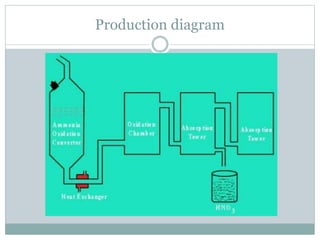
Production diagram
Introduction
 Nitric acid is a colourless liquid that is used in the
manufacture of inorganic and organic nitrates and
nitro compounds for fertilizers, dye intermediates,
explosives, and many different organic chemicals.
Nitric acid is most commonly manufactured by
Ostwald process.
Steps involved in Ostwald process
 Ostwald process converts ammonia to nitric acid and
involves two steps.
 In step 1, ammonia is oxidized to form nitric oxide and
also nitrogen dioxide. Then in step 2, the nitrogen
dioxide that was formed is absorbed in water. This in-
turn forms nitric acid.
 The Ostwald process has many well-known uses in both
the industrial and health field. Through the Ostwald
process, nitric acid is commonly used in fertilizers and
pharmaceuticals, and because of it’s chemical reaction
with some compounds it is used in rocket fuel and
explosives like trinitrotoluene (TNT).
Step 1 - Ostwald process
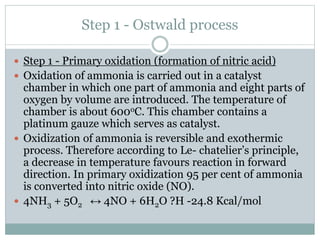
 Step 1 - Primary oxidation (formation of nitric acid)
 Oxidation of ammonia is carried out in a catalyst
chamber in which one part of ammonia and eight parts of
oxygen by volume are introduced. The temperature of
chamber is about 600oC. This chamber contains a
platinum gauze which serves as catalyst.
 Oxidization of ammonia is reversible and exothermic
process. Therefore according to Le- chatelier’s principle,
a decrease in temperature favours reaction in forward
direction. In primary oxidization 95 per cent of ammonia
is converted into nitric oxide (NO).
 4NH3 + 5O2 ↔ 4NO + 6H2O ?H -24.8 Kcal/mol
Step 2 - Ostwald process
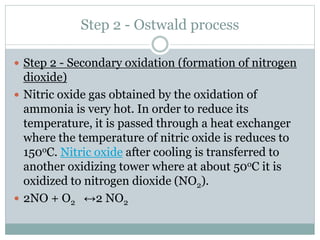
 Step 2 - Secondary oxidation (formation of nitrogen
dioxide)
 Nitric oxide gas obtained by the oxidation of
ammonia is very hot. In order to reduce its
temperature, it is passed through a heat exchanger
where the temperature of nitric oxide is reduces to
150oC. Nitric oxide after cooling is transferred to
another oxidizing tower where at about 50oC it is
oxidized to nitrogen dioxide (NO2).
 2NO + O2 ↔2 NO2
Step 3 - Ostwald process
 Step 3 - Absorption of NO2 (formation of HNO3)
 Nitrogen dioxide from secondary oxidation chamber
is introduced into a special absorption tower.
NO2 gas passed through the tower and water is
showered over it. By the absorption, nitric acid is
obtained.
 3NO2 + H2O -> 2HNO3 + NO
 Nitric acid so obtain is very dilute. It is recycled in
absorption tower so that more and more NO2 get
absorbed. HNO3 after recycle becomes about 68 per
cent concentrated.
Step 4 - Ostwald process
 Step 4 - Concentration
 In order to increase the concentration of HNO3,
vapours of HNO3 are passed over concentrated
H2SO4. Being a dehydrating agent, H2SO4 absorbs
water from HNO3and concentrated HNO3 is
obtained.
Reference
 Reference links –
 http://chemistryhomework.weebly.com/
 http://www.citycollegiate.com/nitricacid.htm

Manufacturing nitric acid by ostwald process

  • 1.
    A R TI C L E W R I T T E N A N D P U B L I S H E D B Y W W W . W O R L D O F C H E M I C A L S . C O M Manufacturing nitric acid by Ostwald process
  • 2.
  • 3.
    Introduction  Nitric acidis a colourless liquid that is used in the manufacture of inorganic and organic nitrates and nitro compounds for fertilizers, dye intermediates, explosives, and many different organic chemicals. Nitric acid is most commonly manufactured by Ostwald process.
  • 4.
    Steps involved inOstwald process  Ostwald process converts ammonia to nitric acid and involves two steps.  In step 1, ammonia is oxidized to form nitric oxide and also nitrogen dioxide. Then in step 2, the nitrogen dioxide that was formed is absorbed in water. This in- turn forms nitric acid.  The Ostwald process has many well-known uses in both the industrial and health field. Through the Ostwald process, nitric acid is commonly used in fertilizers and pharmaceuticals, and because of it’s chemical reaction with some compounds it is used in rocket fuel and explosives like trinitrotoluene (TNT).
  • 5.
    Step 1 -Ostwald process  Step 1 - Primary oxidation (formation of nitric acid)  Oxidation of ammonia is carried out in a catalyst chamber in which one part of ammonia and eight parts of oxygen by volume are introduced. The temperature of chamber is about 600oC. This chamber contains a platinum gauze which serves as catalyst.  Oxidization of ammonia is reversible and exothermic process. Therefore according to Le- chatelier’s principle, a decrease in temperature favours reaction in forward direction. In primary oxidization 95 per cent of ammonia is converted into nitric oxide (NO).  4NH3 + 5O2 ↔ 4NO + 6H2O ?H -24.8 Kcal/mol
  • 6.
    Step 2 -Ostwald process  Step 2 - Secondary oxidation (formation of nitrogen dioxide)  Nitric oxide gas obtained by the oxidation of ammonia is very hot. In order to reduce its temperature, it is passed through a heat exchanger where the temperature of nitric oxide is reduces to 150oC. Nitric oxide after cooling is transferred to another oxidizing tower where at about 50oC it is oxidized to nitrogen dioxide (NO2).  2NO + O2 ↔2 NO2
  • 7.
    Step 3 -Ostwald process  Step 3 - Absorption of NO2 (formation of HNO3)  Nitrogen dioxide from secondary oxidation chamber is introduced into a special absorption tower. NO2 gas passed through the tower and water is showered over it. By the absorption, nitric acid is obtained.  3NO2 + H2O -> 2HNO3 + NO  Nitric acid so obtain is very dilute. It is recycled in absorption tower so that more and more NO2 get absorbed. HNO3 after recycle becomes about 68 per cent concentrated.
  • 8.
    Step 4 -Ostwald process  Step 4 - Concentration  In order to increase the concentration of HNO3, vapours of HNO3 are passed over concentrated H2SO4. Being a dehydrating agent, H2SO4 absorbs water from HNO3and concentrated HNO3 is obtained.
  • 9.
    Reference  Reference links–  http://chemistryhomework.weebly.com/  http://www.citycollegiate.com/nitricacid.htm