Made by:
Engr. Muhammad Rehan
BAHAUDDIN ZAKARIYA UNIVERSITY COLLEGE OF
TEXTILE ENGINEERING MULTAN
Properties of Nitric Acid
(HNO3)
What is Nitric Acid?
 Nitric acid with chemical formula HNO3 is usually known
as strong acid.
 It is also used as strong oxidising agent.
Properties
 Pysical properties
Chemical properties
Physical properties
 HNO3 is usually a fuming liquid.
 It is freely miscible with water.
 It freezes to a snow white solid at -46 C.
 It is a colorless volatile liquid.
 It has a pungent smell.
 Its specific gravity at 15 C is 1.53.
Types of nitric acid depending upon properties:
 Fuming nitric acid:
It is a red liquid made by bubbling NO2 gas
through concentrated HNO3.
 Concentrated nitric acid:
It is of density 1.5, containing 98% HNO3.
 Ordinary strong nitric nitric acid:
It is of density 1.4, containing 65 % HNO3.
Chemical reactions
HNO3 exhibits three types of reactions.
a) It acts as acid.
b) It acts as oxidising agent.
c) It acts as nitrating agent.
a) Acid action of HNO3
i. Decomposition reaction:
It is ionized in aqueous medium to H & NO3 which
indicates its acidic behavior.
HNO3 → H+ + NO3-
ii. Reaction with metal oxide:
Oxides are converted to nitrates.
CuO + 2HNO3 → Cu(NO3)2 +H2O
ZnO + 2HNO3 → Zn(NO3)2 + H2O
ii. Reaction with carbonates:
carbonates also converted to nitrates with
evolution of CO2.
CaCO3 + 2HNO3 → Ca(NO3)2 + H2O
iii. Reaction with hydroxide:
HNO3 neutralizes the hydroxides to give nitrates.
HNO3 + NaOH → NaNO3 + H2O
Ca(OH)2 + 2HNO3 → Ca(NO3)2 + 2H2O
b) Oxidizing action of HNO3
it is a strong oxidizing agent. It oxidizes other substances
and it self reduced to NO2 & NO.
The oxidizing action of HNO3 usually
depend upon concentration of acid and
temperature of the reaction.
For Example
Reactions with metals
i. Zinc reacts with very dilute HNO3 in cold to give N2O.
4Zn + 10HNO3 → 4Zn(NO3)2 + N2O +
5H2O
ii. Moderately dilute HNO3 always react with metals to liberate
NO.
3Cu + 8HNO3 → 3Cu(NO3)2 +2NO + 4H2O
3Ag + 4HNO3 → 3AgNO3 + NO +2H2O
iii. Concentrated and hot HNO3 reacts with metals to liberate
NO2.
Cu + 4HNO3 → Cu(NO3)2 2NO2 + 2H2O
Fe + 6HNO3 → Fe(NO3)3 + 3NO2 + 3H2O
iv. When vapors of HNO3 are passed over heated Cu, nitrogen
gas is evolved.
5Cu + 12HNO3 → 5Cu(NO3)2 + 6H2O + N2
5Cu(NO3)2 → 5CuO + 10NO2 + 2.5O2
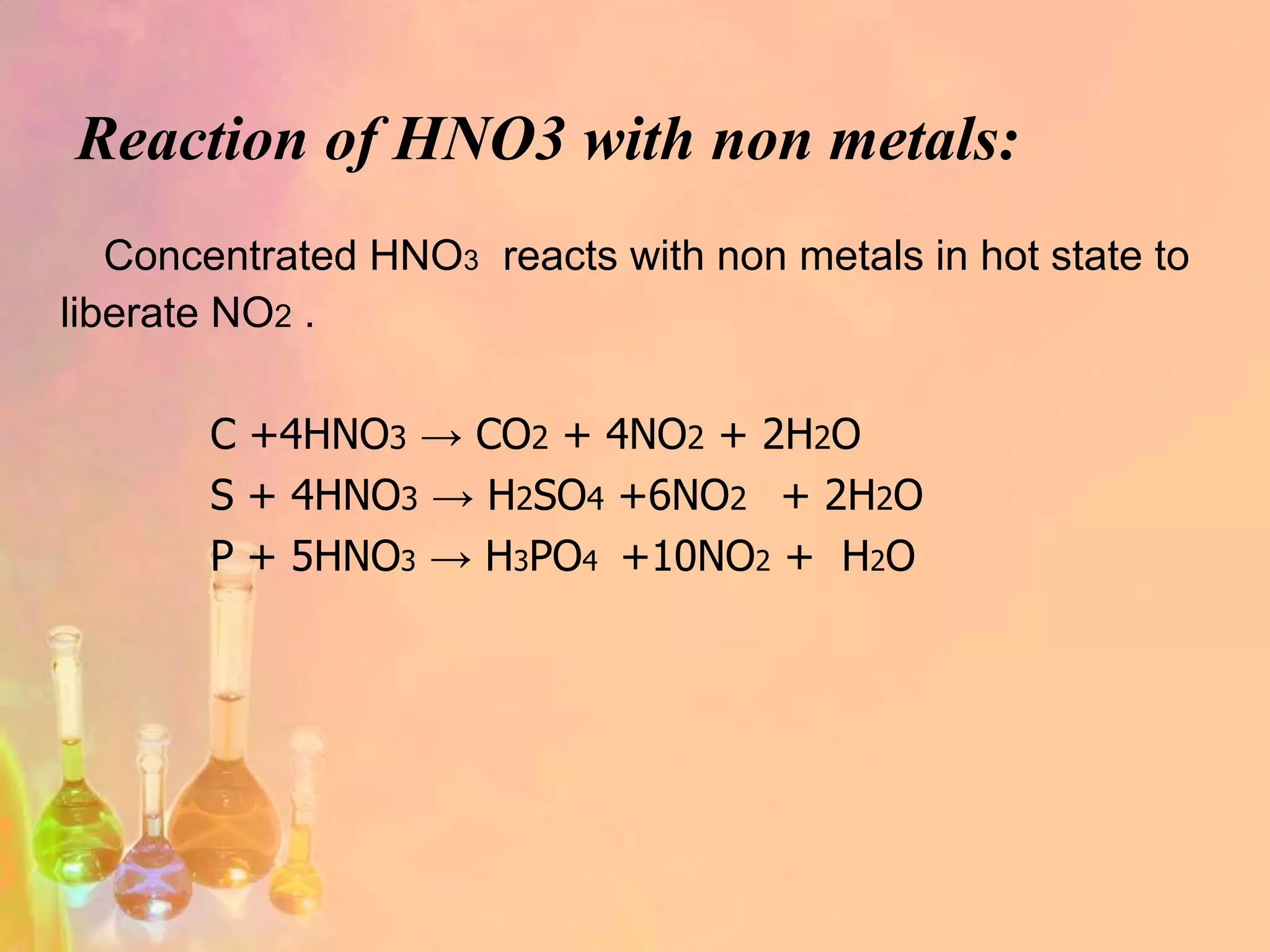
Reaction of HNO3 with non metals:
Concentrated HNO3 reacts with non metals in hot state to
liberate NO2 .
C +4HNO3 → CO2 + 4NO2 + 2H2O
S + 4HNO3 → H2SO4 +6NO2 + 2H2O
P + 5HNO3 → H3PO4 +10NO2 + H2O
c) Action of HNO3 on
organic Compounds:
 It oxidizes many organic compounds to CO2.
 Some times the reaction proceeds with explosion
violence.
 It gives nitro derivatives of organic compounds.
For Example:
Reaction of nitric acid with phenol:
Concentrated nitric acid reacts with phenol to form picric
acid.
(Picric Acid)
Preparation of Aqua Regia:
When one volume of HNO3 is mixed with three volumes
of concentrated of HCI, aqua regia is formed. It is
employed to dissolve gold and platinum.
HNO3 + 3HCl → NOCl + Cl2 +
2H2O
NOCl formed is decomposed giving NO and Cl2.
2NOCl → 2NO + Cl2
Aqua Regia formation:
The liberated Chlorine gas in the above reaction converted nobel
metals such as gold and platinum into their water soluble
chlorides.
2Au + 3Cl2 → 2AuCl3

Properties of hno3

  • 2.
    Made by: Engr. MuhammadRehan BAHAUDDIN ZAKARIYA UNIVERSITY COLLEGE OF TEXTILE ENGINEERING MULTAN
  • 3.
  • 4.
    What is NitricAcid?  Nitric acid with chemical formula HNO3 is usually known as strong acid.  It is also used as strong oxidising agent.
  • 5.
  • 6.
    Physical properties  HNO3is usually a fuming liquid.  It is freely miscible with water.  It freezes to a snow white solid at -46 C.  It is a colorless volatile liquid.  It has a pungent smell.  Its specific gravity at 15 C is 1.53.
  • 7.
    Types of nitricacid depending upon properties:  Fuming nitric acid: It is a red liquid made by bubbling NO2 gas through concentrated HNO3.  Concentrated nitric acid: It is of density 1.5, containing 98% HNO3.  Ordinary strong nitric nitric acid: It is of density 1.4, containing 65 % HNO3.
  • 8.
    Chemical reactions HNO3 exhibitsthree types of reactions. a) It acts as acid. b) It acts as oxidising agent. c) It acts as nitrating agent.
  • 9.
    a) Acid actionof HNO3 i. Decomposition reaction: It is ionized in aqueous medium to H & NO3 which indicates its acidic behavior. HNO3 → H+ + NO3- ii. Reaction with metal oxide: Oxides are converted to nitrates. CuO + 2HNO3 → Cu(NO3)2 +H2O ZnO + 2HNO3 → Zn(NO3)2 + H2O
  • 10.
    ii. Reaction withcarbonates: carbonates also converted to nitrates with evolution of CO2. CaCO3 + 2HNO3 → Ca(NO3)2 + H2O iii. Reaction with hydroxide: HNO3 neutralizes the hydroxides to give nitrates. HNO3 + NaOH → NaNO3 + H2O Ca(OH)2 + 2HNO3 → Ca(NO3)2 + 2H2O
  • 11.
    b) Oxidizing actionof HNO3 it is a strong oxidizing agent. It oxidizes other substances and it self reduced to NO2 & NO. The oxidizing action of HNO3 usually depend upon concentration of acid and temperature of the reaction.
  • 12.
    For Example Reactions withmetals i. Zinc reacts with very dilute HNO3 in cold to give N2O. 4Zn + 10HNO3 → 4Zn(NO3)2 + N2O + 5H2O ii. Moderately dilute HNO3 always react with metals to liberate NO. 3Cu + 8HNO3 → 3Cu(NO3)2 +2NO + 4H2O 3Ag + 4HNO3 → 3AgNO3 + NO +2H2O
  • 13.
    iii. Concentrated andhot HNO3 reacts with metals to liberate NO2. Cu + 4HNO3 → Cu(NO3)2 2NO2 + 2H2O Fe + 6HNO3 → Fe(NO3)3 + 3NO2 + 3H2O iv. When vapors of HNO3 are passed over heated Cu, nitrogen gas is evolved. 5Cu + 12HNO3 → 5Cu(NO3)2 + 6H2O + N2 5Cu(NO3)2 → 5CuO + 10NO2 + 2.5O2
  • 14.
    Reaction of HNO3with non metals: Concentrated HNO3 reacts with non metals in hot state to liberate NO2 . C +4HNO3 → CO2 + 4NO2 + 2H2O S + 4HNO3 → H2SO4 +6NO2 + 2H2O P + 5HNO3 → H3PO4 +10NO2 + H2O
  • 15.
    c) Action ofHNO3 on organic Compounds:  It oxidizes many organic compounds to CO2.  Some times the reaction proceeds with explosion violence.  It gives nitro derivatives of organic compounds.
  • 16.
    For Example: Reaction ofnitric acid with phenol: Concentrated nitric acid reacts with phenol to form picric acid. (Picric Acid)
  • 17.
    Preparation of AquaRegia: When one volume of HNO3 is mixed with three volumes of concentrated of HCI, aqua regia is formed. It is employed to dissolve gold and platinum. HNO3 + 3HCl → NOCl + Cl2 + 2H2O NOCl formed is decomposed giving NO and Cl2. 2NOCl → 2NO + Cl2
  • 18.
    Aqua Regia formation: Theliberated Chlorine gas in the above reaction converted nobel metals such as gold and platinum into their water soluble chlorides. 2Au + 3Cl2 → 2AuCl3