The Ostwald Process
Abigail Abshere
The Process and its Uses
 The Ostwald process is a series of reactions that work to oxidize ammonia until it
produces Nitric Acid. This process is much more economical than reaction
nitrogen with oxygen, which is another way to produce Nitric Acid. Instead, a
three-step reaction beginning with ammonia is often used.
 Nitric Acid is quite versatile, and can be used to manufacture a great number of
other useful compounds, including nitrogen fertilizers (ammonium nitrate) and
explosives (nitroglycerin and trinitrotoluene).
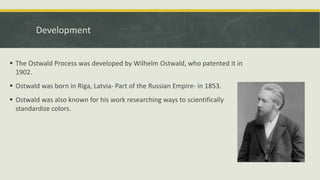
 The Ostwald Process was developed by Wilhelm Ostwald, who patented it in
1902.
 Ostwald was born in Riga, Latvia- Part of the Russian Empire- in 1853.
 Ostwald was also known for his work researching ways to scientifically
standardize colors.
Development
Historical Background
 Nitric Acid is and has been important due to its being a component in
the reaction that creates ammonium nitrate, which is one of the most
important forms of nitrogen fertilizer. With the new Ostwald Process,
production of Nitric Acid became cheap and fast, allowing for the
manufacturing of mass quantities. This increased agricultural activity
considerably. Unfortunately, the sudden ability to cheaply produce nitric
acid in bulk also meant that explosives could be manufactured more
easily, which prolonged World War I as Germany used the method to
continue creating weapons using nitroglycerin and trinitrotoluene.
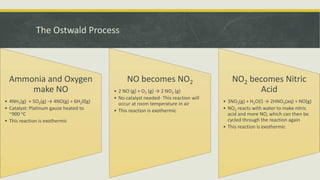
The Ostwald Process
Ammonia and Oxygen
make NO
• 4NH3(g) + 5O2(g) → 4NO(g) + 6H20(g)
• Catalyst: Platinum gauze heated to
~900 oC
• This reaction is exothermic
NO becomes NO2
• 2 NO (g) + O2 (g) → 2 NO2 (g)
• No catalyst needed- This reaction will
occur at room temperature in air
• This reaction is exothermic
NO2 becomes Nitric
Acid
• 3NO2(g) + H2O(l) → 2HNO3(aq) + NO(g)
• NO2 reacts with water to make nitric
acid and more NO, which can then be
cycled through the reaction again
• This reaction is exothermic
Le Châtelier’s Principle
 It can be predicted that favorable conditions for yielding the most product in the
Ostwald Process would be high pressure, are there are less molecules of gas in
the product, and lower temperatures, which decelerates the reaction forming NO
during the final stage of production.
Typical Production Conditions
 Due to nitric acid being a strong acid that is used in the creation of explosives, as
well as the Ostwald Process being highly exothermic, there are limitations that
must be placed on reactions. The temperature and pressure needed to increase
the forward reaction would increase the amount of heat given off as a product of
the reaction, which could be quite dangerous.
Concerns and Considerations
 Nitric acid is incredibly corrosive, making it dangerous to humans and other
forms of life if proper protection and safety measures are not exercised.
 The platinum needed for the catalyst in the reaction is quite expensive.
 Nitric acid is used to make explosives and rocket fuel; if allowed to react with
cyanides, carbides, or metallic powders, it can become explosive. Additionally,
things with many organic compounds can cause it to become a hypergolic
explosive, which is extra dangerous.
Catalyst
 A platinum gauze that is heated to about 900 o C is used as a catalyst in the first
step of this process. Rhodium gauze can also be used.
Works Cited
BBC. (n.d.). Ostwald Process - oxidation of ammonia. Retrieved April 17, 2015.
Dice, D. (n.d.). Manufacturing Nitrates: The Ostwald process. Retrieved April 17,
2015, from
http://www.digipac.ca/chemical/mtom/contents/chapter3/fritzhaber_2.htm
Encyclopædia Britannica. (n.d.). Ostwald process. Retrieved April 17, 2015.
Grandin, K. (Ed.). (n.d.). Wilhelm Ostwald - Biographical. Retrieved April 17, 2015.
The Ostwald Process. (n.d.). Retrieved April 17, 2015.

7.05 la chateliers principle

  • 1.
  • 2.
    The Process andits Uses  The Ostwald process is a series of reactions that work to oxidize ammonia until it produces Nitric Acid. This process is much more economical than reaction nitrogen with oxygen, which is another way to produce Nitric Acid. Instead, a three-step reaction beginning with ammonia is often used.  Nitric Acid is quite versatile, and can be used to manufacture a great number of other useful compounds, including nitrogen fertilizers (ammonium nitrate) and explosives (nitroglycerin and trinitrotoluene).
  • 3.
     The OstwaldProcess was developed by Wilhelm Ostwald, who patented it in 1902.  Ostwald was born in Riga, Latvia- Part of the Russian Empire- in 1853.  Ostwald was also known for his work researching ways to scientifically standardize colors. Development
  • 4.
    Historical Background  NitricAcid is and has been important due to its being a component in the reaction that creates ammonium nitrate, which is one of the most important forms of nitrogen fertilizer. With the new Ostwald Process, production of Nitric Acid became cheap and fast, allowing for the manufacturing of mass quantities. This increased agricultural activity considerably. Unfortunately, the sudden ability to cheaply produce nitric acid in bulk also meant that explosives could be manufactured more easily, which prolonged World War I as Germany used the method to continue creating weapons using nitroglycerin and trinitrotoluene.
  • 5.
    The Ostwald Process Ammoniaand Oxygen make NO • 4NH3(g) + 5O2(g) → 4NO(g) + 6H20(g) • Catalyst: Platinum gauze heated to ~900 oC • This reaction is exothermic NO becomes NO2 • 2 NO (g) + O2 (g) → 2 NO2 (g) • No catalyst needed- This reaction will occur at room temperature in air • This reaction is exothermic NO2 becomes Nitric Acid • 3NO2(g) + H2O(l) → 2HNO3(aq) + NO(g) • NO2 reacts with water to make nitric acid and more NO, which can then be cycled through the reaction again • This reaction is exothermic
  • 6.
    Le Châtelier’s Principle It can be predicted that favorable conditions for yielding the most product in the Ostwald Process would be high pressure, are there are less molecules of gas in the product, and lower temperatures, which decelerates the reaction forming NO during the final stage of production.
  • 7.
    Typical Production Conditions Due to nitric acid being a strong acid that is used in the creation of explosives, as well as the Ostwald Process being highly exothermic, there are limitations that must be placed on reactions. The temperature and pressure needed to increase the forward reaction would increase the amount of heat given off as a product of the reaction, which could be quite dangerous.
  • 8.
    Concerns and Considerations Nitric acid is incredibly corrosive, making it dangerous to humans and other forms of life if proper protection and safety measures are not exercised.  The platinum needed for the catalyst in the reaction is quite expensive.  Nitric acid is used to make explosives and rocket fuel; if allowed to react with cyanides, carbides, or metallic powders, it can become explosive. Additionally, things with many organic compounds can cause it to become a hypergolic explosive, which is extra dangerous.
  • 9.
    Catalyst  A platinumgauze that is heated to about 900 o C is used as a catalyst in the first step of this process. Rhodium gauze can also be used.
  • 10.
    Works Cited BBC. (n.d.).Ostwald Process - oxidation of ammonia. Retrieved April 17, 2015. Dice, D. (n.d.). Manufacturing Nitrates: The Ostwald process. Retrieved April 17, 2015, from http://www.digipac.ca/chemical/mtom/contents/chapter3/fritzhaber_2.htm Encyclopædia Britannica. (n.d.). Ostwald process. Retrieved April 17, 2015. Grandin, K. (Ed.). (n.d.). Wilhelm Ostwald - Biographical. Retrieved April 17, 2015. The Ostwald Process. (n.d.). Retrieved April 17, 2015.