Demand
• To satisfy wants we buy goods and services.
• To buy these goods and services we have to pay a
price.
• Money is limited and choices are many.
• So….
• We have to choose
what goods to buy and at what price.
The study of DEMAND involves
the different habits
of a consumer
in the market.
Meaning of DEMAND:
Demand for a good
is defined
as the quantity
of the good purchased
at a given price
at a given time.
The definition has three parts :
1. Quantity of the good bought/purchased.
2. Price of the good.
3. Time period.(time period may be different sometimes
weeks, month, year etc.)
Let us see few examples and check if it is a demand
1. Varsha purchased 1kg of Rice at Rs.25/- last week.
• In this example we have quantity = 1kg
• Price of the good = Rs.25/-
• And also time = last week
• So this is a demand for rice by Varsha.
2. Nitin bought 2 pairs of shoes last month.
In this example we have quantity = 2 pairs of shoes
Time = Last month
Price =???????
So this is not a demand because there is no price given.
Question review
• Define demand
• Demand for a good is defined
as the Quantity
of good purchased
at a given price
at a given time.
• Name the three components/parts included in the
definition of demand.
• Quantity
• Price
• Time
Difference between demand and desire
• Demand is desire backed by the ability and the willingness to
buy.
• Desire which is not backed by the ability to buy remains a desire
and does not become a demand.
• Varsha desired to buy mangoes: This is only a desire.
• Varsha bought some mangoes last week at Rs. 50 per kg: This is
demand.
Factors affecting individual demand (CRIT)
1. Price of the commodity
2. Price of related goods
3. Income of the buyer
4. Tastes and Preferences
Demand rises as price falls
and demand falls as price rises.
1. Price of the commodity
• If you go to buy something, you will ask for the price of the commodity.
• If you think the price is right, then you will buy the commodity.
• If you think the price is not right i.e. it is higher
• You may not buy or….You may buy less quantity.
People will normally buy MORE at a LESSER PRICE
And buy LESS at a HIGHER PRICE. (other factors remaining constant)
IF THE PRICE OF TEA INCREASES
The Demand for Tea will Decrease
and
THE DEMAND FOR COFFEE WILL
INCREASE.
2. Price of related goods
• The demand for goods is also influenced by the prices of related goods.
Related goods are of two types:
a. Substitute goods They are goods which can be used in place of another good.
If you go to a hotel and you want to order a Pepsi, but there is no Pepsi , so you order a
coke. Here coke is a substitute for Pepsi. Coke and Pepsi are substitutes .
If you want tea and there is no tea so you will drink coffee,
Tea and coffee are substitutes.
If Price of a good Increase, the demand for the good decreases
and the demand for its complementary good also decreases
If the Price of good decreases,the demand for the good increases
and the demand for its complementary good also increases.
• b. Complementary goods They are goods which are used together with another
good. For eg. If you have a car and you want to drive it ,you need petrol/diesel.
• So here car and petrol are complementary goods.
• IF you want to eat bread you may use butter with it.
• So here Bread and butter are complementary goods.
• If you want to write something you will need a paper and pen.
• So here paper and pen are complementary goods.
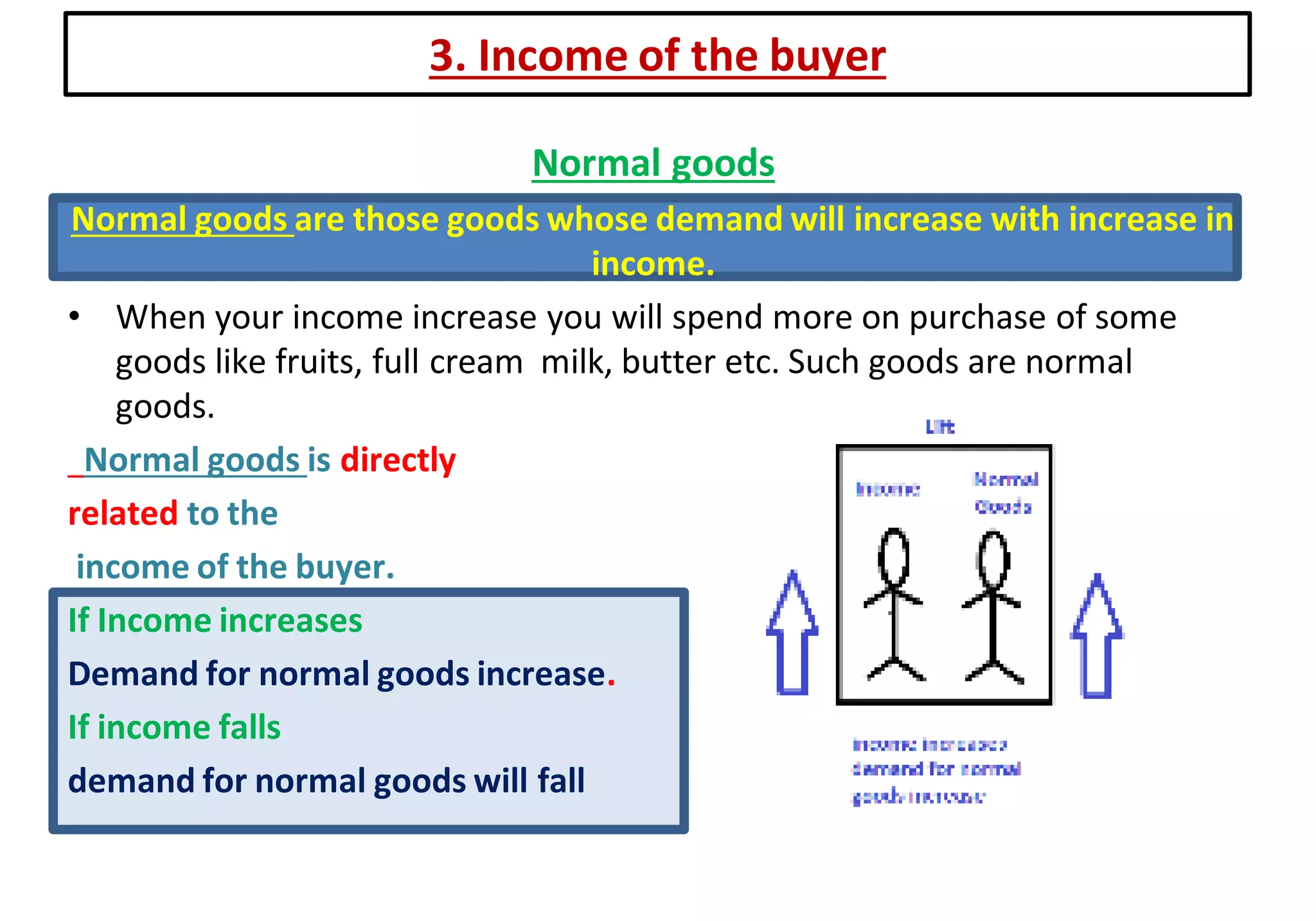
3. Income of the buyer
Normal goods
Normal goods are those goods whose demand will increase with increase in
income.
• When your income increase you will spend more on purchase of some
goods like fruits, full cream milk, butter etc. Such goods are normal
goods.
Normal goods is directly
related to the
income of the buyer.
If Income increases
Demand for normal goods increase.
If income falls
demand for normal goods will fall
Inferior goods
Inferior goods are those goods whose demand will fall with increase in income.
Income Demand
• Eg. When income was less we may buy pav. But with increase in income will
buy better bread.
• So with increase in income demand forpav will fall an demand for bread will
increase.
• Inferior goods are inversely related to the incomeof the buyer
Income Increases demand falls
Income decreases demand increases
4. Tastes, Preferences and fashion.
• People will demand more of those goods which they like and are in
fashion. Example – demand for jeans rises if jeans are in fashion.
For eg.
Tastes
If Ashok likes to eat burgers instead of wada pav, then his demand
for burgers will increase.
Preferences
If Meena prefers wearing salvar khameej then her demand for
salvar khameej will increase.
Fashion:
If the current fashion is jeans and tops,
The demand for jeans and tops will increase
And the demand for skirts will fall.
Substitute goods
Price of Demand of Demand of
Commodity commodity Substitute commodity
Increases Decreases Increases
Complementary Goods
Price of Demand of Demand of
Commodity commodity Complementary
commodity
Increases Decreases Decreases
Decreases Increases Increases
• Income of the buyer
• Income Demand
Increases Increases
Decreases Decreases
• Fashion, Tastes, Preferences
• If goods are in Fashion demand increases
• If the buyers has a taste for the commodity demand
will increase for that in buyer for that commodity
Review……
1. Price of the commodity
When Price is HIGH Demand is LOW
When Price is LOW Demand is HIGH
2. Price of related goods
Substitute Goods
IF THE PRICE INCREASES The Demand will Decrease
And THE DEMAND FOR Substitute WILL INCREASE.
Complementary Goods
If Price Increases the demand decreases,
and the demand for its complementary good also decreases
If the Price decreases the demand increases,
and the demand for its complementary good also increases.
• 3. Income of the buyer
If Income increases, Demand increase.
If income falls, Demand will fall
• 4. Tastes and Preferences
If Tastes increases Demand increases
If Tastes decreases Demand decreases
Question review
1. Demand for a good is defined as the ____________ of the
goods purchased at a given________ at a given _________ .
2. The definition has three parts:
a.___________,b________________ and c.______________.
3. Girish bought 2 pairs of shoes last month. Is this a demand ?
4. Suresh purchased 2 dozens of mangoes last week for Rs. 70/. Is
this a demand?
5. Demand is desire backed by the ___________ and the
_________ to buy.
6. Factors affecting individual demand are :
7. Demand rises as price______ (fall/rises) and demand falls
as price ______(falls/rises).
8. Substitute goods are goods
which_____________________________________
9. An example of substitute good is
______________________.
10. Complementary goods are those goods which
_____________________________________.
11. An example of a complementary good is
____________________________.
12. Normal goods are those goods whose demands will
___________ (fall/rise) when income increases.
13. If income increases demand for normal goods will
_______________(fall/rise).
14. Inferior goods are those goods whose demand will _______
(fall/rise) when income increases.
15. People will demand ______(more/less) of goods which are in
fashion.
16. Law of demand states if price of a good falls, it’s quantity
demanded ________(decreases/increases)
and if price of the good rises, it’s quantity demanded
_______(falls/rises) other factors remaining constant.
Law of demand
If the price of a commodity falls ,
its quantity demanded increases
and if the price of the commodity rises,
its quantity demanded falls,
other things remaining same.
Individual demand schedule
Price of Mangoes (Rs.
Per kg)
Quantity demanded of mangoes
per week(in kg)
80 0.5
70 1
60 1.5
50 2
40 2.5
30 3
Demand for a commodity by an individual is called and individual demand.
A tabular presentation of different quantities demanded at different prices by an
individual is called an individual demand schedule.
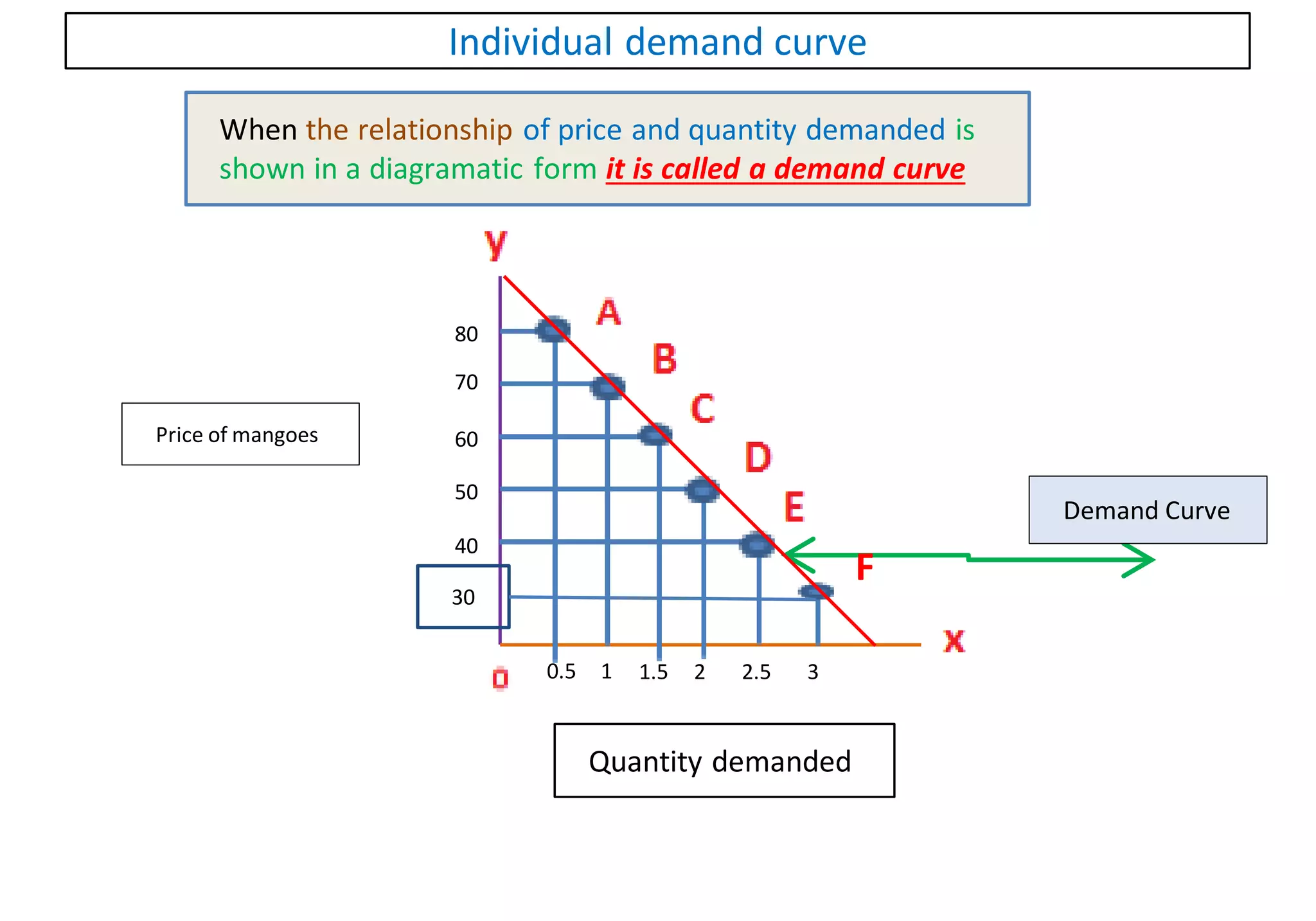
Individual demand curve
30
40
50
60
80
70
0.5 1 1.5 2 2.5 3
Quantity demanded
Price of mangoes
Demand Curve
F
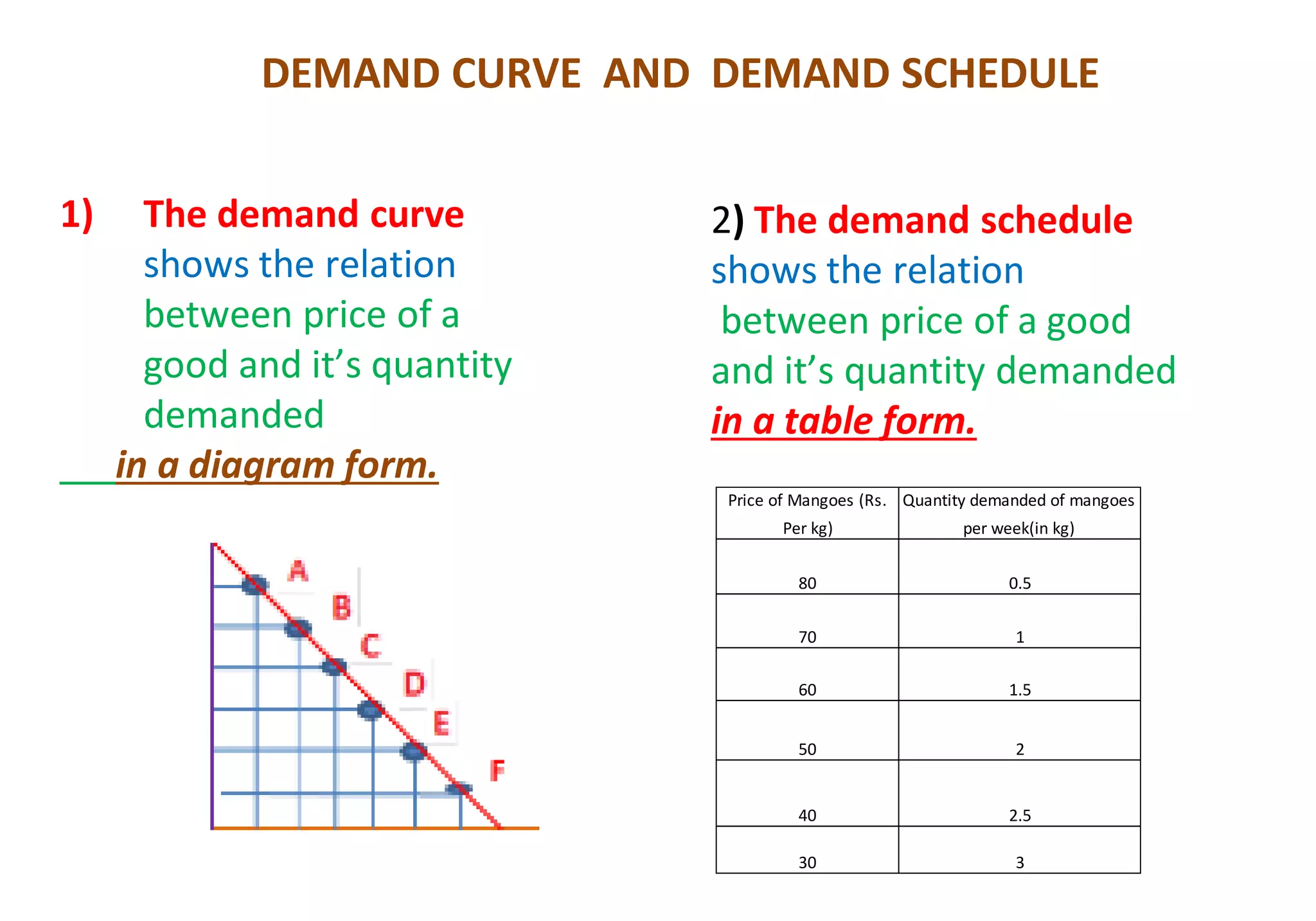
When the relationship of price and quantity demanded is
shown in a diagramatic form it is called a demand curve
DEMAND CURVE AND DEMAND SCHEDULE
1) The demand curve
shows the relation
between price of a
good and it’s quantity
demanded
in a diagram form.
2) The demand schedule
shows the relation
between price of a good
and it’s quantity demanded
in a table form.
Price of Mangoes (Rs.
Per kg)
Quantity demanded of mangoes
per week(in kg)
80 0.5
70 1
60 1.5
50 2
40 2.5
30 3
Shape of individual demand curve
• The demand curve slope downwards from left to right.
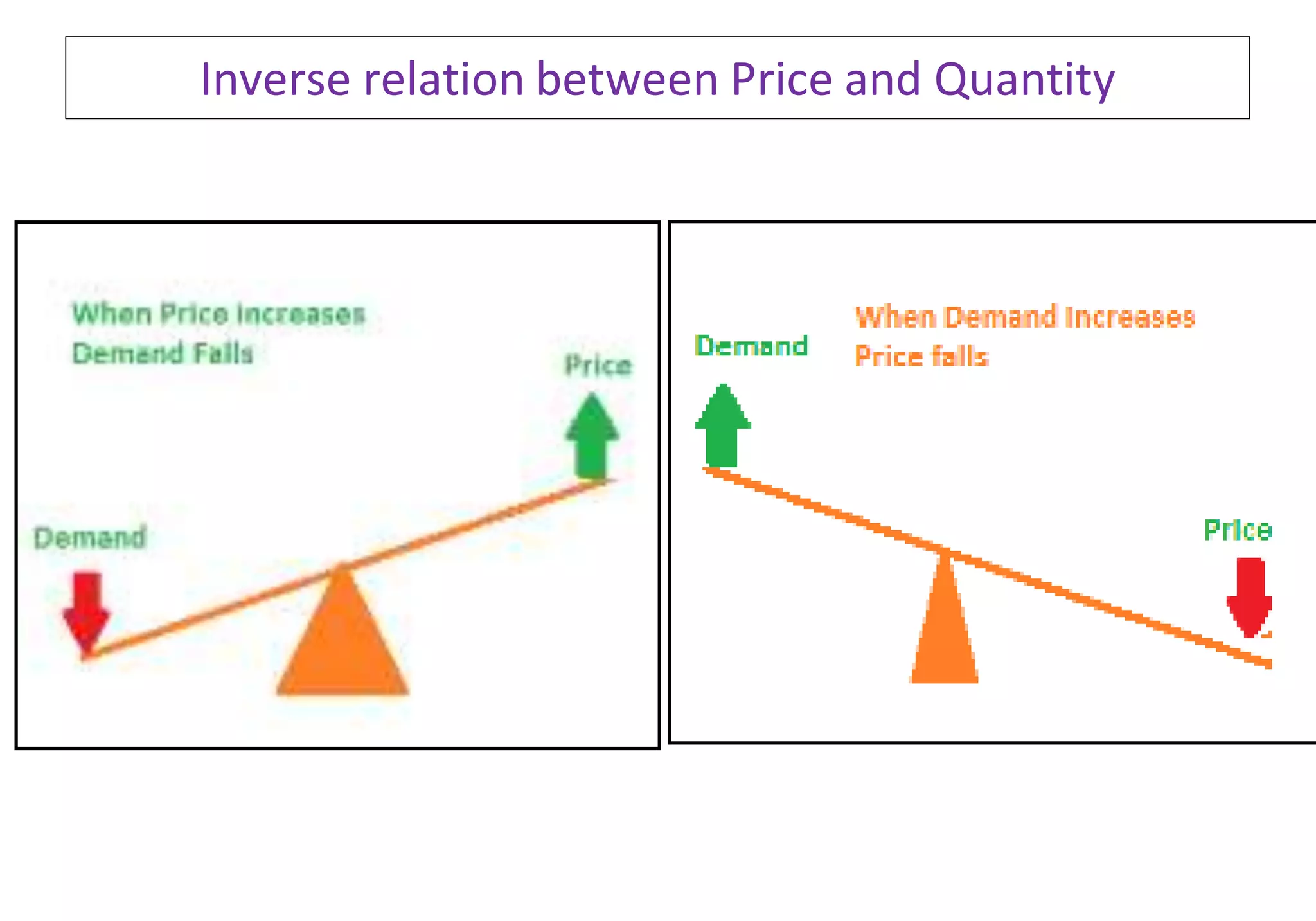
• 1) As price increases, demand falls and
as price decreases, demand rises.
• 2) Hence, there is an inverse (opposite) relation
between price and quantity demanded.
• 3) Therefore, the demand curve slopes downward from left to
right.
Inverse relation between Price and Quantity
Market demand for a good
• Market demand can be defined
as the total quantity demanded
by all individual buyers
in the market
at a given price
at a given time
for a particular good.
Factors affecting market demand (BDC)
• 1) Number of buyers [Buyers demand ]
• If the number of buyers of a good increases, market demand also
increases.
• 2) Distribution of income and wealth
• (i) If the market has more of rich buyers, then market demand will be
more for goods consumed by the rich people.
• (ii) If the market has more of poor buyers, then market demand will be
more for goods consumed by the poor buyers.
• 3) Climatic conditions
• (i) Market demand changes according to climatic changes.
• (ii) Example – market demand for umbrellas and raincoats will be
more during monsoon.
• 1. Name four factors that affect the individual demand for
a commodity.
• Price of a commodity, Price of related goods, Income of
the buyer,
• Tastes, Preferences and fashion.
• 2. What will happen to the demand for tea if price of
sugar increases?
• The demand for tea will Fall
• 3. What will happen to the demand for coke if price of
Pepsi falls?
• The demand for coke Fall
Test Review….
• 6. Fill in the blanks with appropriate words:
• (i) If the income of a buyer falls, his demand for inferior goods will
....................
A. If the income of a buyer falls, his demand for inferior goods will increase
• (ii) When price of ink increases, the demand for fountain pen will
....................
A. When price of ink increases, the demand for fountain pen will decrease
• (iii) .................... is the number of buyers of a commodity in the market,
higher will be the demand for the commodity.
A. More is the number of buyers of a commodity in the market, higher will be
the demand for the commodity.
• (iv) If the distribution of income and wealth is more in favour of the
.................... the demand for goods used by the poor will be more.
A. If the distribution of income and wealth is more in favour of thePoor
the demand for goods used by the poor will be more.
Ch 9 demand

Ch 9 demand

  • 1.
  • 2.
    • To satisfywants we buy goods and services. • To buy these goods and services we have to pay a price. • Money is limited and choices are many. • So…. • We have to choose what goods to buy and at what price. The study of DEMAND involves the different habits of a consumer in the market.
  • 3.
    Meaning of DEMAND: Demandfor a good is defined as the quantity of the good purchased at a given price at a given time. The definition has three parts : 1. Quantity of the good bought/purchased. 2. Price of the good. 3. Time period.(time period may be different sometimes weeks, month, year etc.)
  • 4.
    Let us seefew examples and check if it is a demand 1. Varsha purchased 1kg of Rice at Rs.25/- last week. • In this example we have quantity = 1kg • Price of the good = Rs.25/- • And also time = last week • So this is a demand for rice by Varsha. 2. Nitin bought 2 pairs of shoes last month. In this example we have quantity = 2 pairs of shoes Time = Last month Price =??????? So this is not a demand because there is no price given.
  • 5.
    Question review • Definedemand • Demand for a good is defined as the Quantity of good purchased at a given price at a given time. • Name the three components/parts included in the definition of demand. • Quantity • Price • Time
  • 6.
    Difference between demandand desire • Demand is desire backed by the ability and the willingness to buy. • Desire which is not backed by the ability to buy remains a desire and does not become a demand. • Varsha desired to buy mangoes: This is only a desire. • Varsha bought some mangoes last week at Rs. 50 per kg: This is demand.
  • 7.
    Factors affecting individualdemand (CRIT) 1. Price of the commodity 2. Price of related goods 3. Income of the buyer 4. Tastes and Preferences
  • 8.
    Demand rises asprice falls and demand falls as price rises. 1. Price of the commodity • If you go to buy something, you will ask for the price of the commodity. • If you think the price is right, then you will buy the commodity. • If you think the price is not right i.e. it is higher • You may not buy or….You may buy less quantity. People will normally buy MORE at a LESSER PRICE And buy LESS at a HIGHER PRICE. (other factors remaining constant)
  • 9.
    IF THE PRICEOF TEA INCREASES The Demand for Tea will Decrease and THE DEMAND FOR COFFEE WILL INCREASE. 2. Price of related goods • The demand for goods is also influenced by the prices of related goods. Related goods are of two types: a. Substitute goods They are goods which can be used in place of another good. If you go to a hotel and you want to order a Pepsi, but there is no Pepsi , so you order a coke. Here coke is a substitute for Pepsi. Coke and Pepsi are substitutes . If you want tea and there is no tea so you will drink coffee, Tea and coffee are substitutes.
  • 10.
    If Price ofa good Increase, the demand for the good decreases and the demand for its complementary good also decreases If the Price of good decreases,the demand for the good increases and the demand for its complementary good also increases. • b. Complementary goods They are goods which are used together with another good. For eg. If you have a car and you want to drive it ,you need petrol/diesel. • So here car and petrol are complementary goods. • IF you want to eat bread you may use butter with it. • So here Bread and butter are complementary goods. • If you want to write something you will need a paper and pen. • So here paper and pen are complementary goods.
  • 11.
    3. Income ofthe buyer Normal goods Normal goods are those goods whose demand will increase with increase in income. • When your income increase you will spend more on purchase of some goods like fruits, full cream milk, butter etc. Such goods are normal goods. Normal goods is directly related to the income of the buyer. If Income increases Demand for normal goods increase. If income falls demand for normal goods will fall
  • 12.
    Inferior goods Inferior goodsare those goods whose demand will fall with increase in income. Income Demand • Eg. When income was less we may buy pav. But with increase in income will buy better bread. • So with increase in income demand forpav will fall an demand for bread will increase. • Inferior goods are inversely related to the incomeof the buyer Income Increases demand falls Income decreases demand increases
  • 13.
    4. Tastes, Preferencesand fashion. • People will demand more of those goods which they like and are in fashion. Example – demand for jeans rises if jeans are in fashion. For eg. Tastes If Ashok likes to eat burgers instead of wada pav, then his demand for burgers will increase. Preferences If Meena prefers wearing salvar khameej then her demand for salvar khameej will increase. Fashion: If the current fashion is jeans and tops, The demand for jeans and tops will increase And the demand for skirts will fall.
  • 14.
    Substitute goods Price ofDemand of Demand of Commodity commodity Substitute commodity Increases Decreases Increases Complementary Goods Price of Demand of Demand of Commodity commodity Complementary commodity Increases Decreases Decreases Decreases Increases Increases
  • 15.
    • Income ofthe buyer • Income Demand Increases Increases Decreases Decreases • Fashion, Tastes, Preferences • If goods are in Fashion demand increases • If the buyers has a taste for the commodity demand will increase for that in buyer for that commodity
  • 16.
    Review…… 1. Price ofthe commodity When Price is HIGH Demand is LOW When Price is LOW Demand is HIGH 2. Price of related goods Substitute Goods IF THE PRICE INCREASES The Demand will Decrease And THE DEMAND FOR Substitute WILL INCREASE. Complementary Goods If Price Increases the demand decreases, and the demand for its complementary good also decreases If the Price decreases the demand increases, and the demand for its complementary good also increases. • 3. Income of the buyer If Income increases, Demand increase. If income falls, Demand will fall • 4. Tastes and Preferences If Tastes increases Demand increases If Tastes decreases Demand decreases
  • 17.
  • 18.
    1. Demand fora good is defined as the ____________ of the goods purchased at a given________ at a given _________ . 2. The definition has three parts: a.___________,b________________ and c.______________. 3. Girish bought 2 pairs of shoes last month. Is this a demand ? 4. Suresh purchased 2 dozens of mangoes last week for Rs. 70/. Is this a demand? 5. Demand is desire backed by the ___________ and the _________ to buy. 6. Factors affecting individual demand are :
  • 19.
    7. Demand risesas price______ (fall/rises) and demand falls as price ______(falls/rises). 8. Substitute goods are goods which_____________________________________ 9. An example of substitute good is ______________________. 10. Complementary goods are those goods which _____________________________________. 11. An example of a complementary good is ____________________________.
  • 20.
    12. Normal goodsare those goods whose demands will ___________ (fall/rise) when income increases. 13. If income increases demand for normal goods will _______________(fall/rise). 14. Inferior goods are those goods whose demand will _______ (fall/rise) when income increases. 15. People will demand ______(more/less) of goods which are in fashion. 16. Law of demand states if price of a good falls, it’s quantity demanded ________(decreases/increases) and if price of the good rises, it’s quantity demanded _______(falls/rises) other factors remaining constant.
  • 21.
    Law of demand Ifthe price of a commodity falls , its quantity demanded increases and if the price of the commodity rises, its quantity demanded falls, other things remaining same.
  • 22.
    Individual demand schedule Priceof Mangoes (Rs. Per kg) Quantity demanded of mangoes per week(in kg) 80 0.5 70 1 60 1.5 50 2 40 2.5 30 3 Demand for a commodity by an individual is called and individual demand. A tabular presentation of different quantities demanded at different prices by an individual is called an individual demand schedule.
  • 23.
    Individual demand curve 30 40 50 60 80 70 0.51 1.5 2 2.5 3 Quantity demanded Price of mangoes Demand Curve F When the relationship of price and quantity demanded is shown in a diagramatic form it is called a demand curve
  • 24.
    DEMAND CURVE ANDDEMAND SCHEDULE 1) The demand curve shows the relation between price of a good and it’s quantity demanded in a diagram form. 2) The demand schedule shows the relation between price of a good and it’s quantity demanded in a table form. Price of Mangoes (Rs. Per kg) Quantity demanded of mangoes per week(in kg) 80 0.5 70 1 60 1.5 50 2 40 2.5 30 3
  • 25.
    Shape of individualdemand curve • The demand curve slope downwards from left to right. • 1) As price increases, demand falls and as price decreases, demand rises. • 2) Hence, there is an inverse (opposite) relation between price and quantity demanded. • 3) Therefore, the demand curve slopes downward from left to right.
  • 26.
    Inverse relation betweenPrice and Quantity
  • 27.
    Market demand fora good • Market demand can be defined as the total quantity demanded by all individual buyers in the market at a given price at a given time for a particular good.
  • 28.
    Factors affecting marketdemand (BDC) • 1) Number of buyers [Buyers demand ] • If the number of buyers of a good increases, market demand also increases. • 2) Distribution of income and wealth • (i) If the market has more of rich buyers, then market demand will be more for goods consumed by the rich people. • (ii) If the market has more of poor buyers, then market demand will be more for goods consumed by the poor buyers. • 3) Climatic conditions • (i) Market demand changes according to climatic changes. • (ii) Example – market demand for umbrellas and raincoats will be more during monsoon.
  • 29.
    • 1. Namefour factors that affect the individual demand for a commodity. • Price of a commodity, Price of related goods, Income of the buyer, • Tastes, Preferences and fashion. • 2. What will happen to the demand for tea if price of sugar increases? • The demand for tea will Fall • 3. What will happen to the demand for coke if price of Pepsi falls? • The demand for coke Fall Test Review….
  • 30.
    • 6. Fillin the blanks with appropriate words: • (i) If the income of a buyer falls, his demand for inferior goods will .................... A. If the income of a buyer falls, his demand for inferior goods will increase • (ii) When price of ink increases, the demand for fountain pen will .................... A. When price of ink increases, the demand for fountain pen will decrease • (iii) .................... is the number of buyers of a commodity in the market, higher will be the demand for the commodity. A. More is the number of buyers of a commodity in the market, higher will be the demand for the commodity. • (iv) If the distribution of income and wealth is more in favour of the .................... the demand for goods used by the poor will be more. A. If the distribution of income and wealth is more in favour of thePoor the demand for goods used by the poor will be more.