


By
Prof. R. V. Kolhe
Civil Engineering Department
Sanjivani College of Engineering, Kopargaon
06/04/2020 1R. V. Kolhe
 Important factor in indenting, purchasing and
issuing activities.
 Wrong identification results in wrong
purchases.
 Words description can be used but they are
too long,totally inadequate and Prone to
errors.
06/04/2020 2R. V. Kolhe
 Codification in an industry is the
systematic concise representation
of equipment, raw materials,
tools, spares, supplies etc.in an
abbreviated form employing
alphabets, numerals, colours,
symbols etc.
06/04/2020 3R. V. Kolhe
 Accurate and logical identification.
 Avoidance of Long and unweilding
description.
 Prevention of duplication.
 Product Simplification.
 Efficient Purchasing.
06/04/2020 4R. V. Kolhe
 Minimizing of clerical work.
 Efficient Purchasing.
 Accurate ane reliable accounting and
recording.
 Easier computerisation.
 Better alternative selection
 Simplifies Costing
06/04/2020 5R. V. Kolhe
 An electrical firm found that a simple item of
a screw with a width of 3/8" and length of 6"
had as many as 118 names depending on the
type of usage and the department using the
screw.
 A proper codification removed the 117
stocking points and with it the associated
inventories, entries, obsolete item, etc.
06/04/2020R. V. Kolhe 6
 Identification – To know the type of material
in detail
 Classification – Description, Nature, Source or
origin.
 Codification – As per the requirement and the
system
06/04/2020 7R. V. Kolhe
 Codification is a process of representing each
item by a number, the digits of which indicate
the group, the subgroup, the type and the
dimension of the item.
 Many organisations in the public and private
sectors, railways and DGS & D, have their own
system of codification, varying from eight to
thirteen digits.
06/04/2020R. V. Kolhe 8
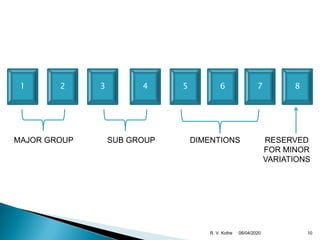
 The first two digits normally represent the
major groups, such as raw materials, spare
parts.
 The next two digits indicate the sub-groups,
such as ferrous, non-ferrous, etc.
 Dimensional characteristics of length, width,
head diameter usually constitute the further
three digits and
 The last digit is reserved for minor variations.
06/04/2020R. V. Kolhe 9
06/04/2020R. V. Kolhe 10
1 2 3 4 5 6 7 8
MAJOR GROUP SUB GROUP DIMENTIONS RESERVED
FOR MINOR
VARIATIONS
 Nature of items, grouping all items of the same metal
content.
 End use of items, that is, items grouped according to
maintenance, spinning, packing, foundry, shop, etc.
 Source of purchasing where items obtained from one
source of purchasing are grouped together and given
codes.
 Alphabetical listing.
 Numerical digits or by a combination of English letters and
numericals.
06/04/2020R. V. Kolhe 11
 Simple
 Brief
 Flexible
 Unique
 Layout should be easy to handle
 Self Decoding
 Objective Oriented
06/04/2020 12R. V. Kolhe
 Alphabetical System
Each material is assigned with a specific
group.
Then they are alloted sub group based on
there basic characteristics.
The advantage of the system is that it is
very easy to use.
06/04/2020 13R. V. Kolhe
 Alphabetical System
Difficult to remember, duplication,
confusing and cannot be amplified.
06/04/2020 14R. V. Kolhe
 Numerical System
 Sequential Code
 Block Code
 Decimal Code
 Alphanumeric Code
06/04/2020 15R. V. Kolhe
 Concieved by Mr.E.G.Brisch with J.Gombinski.
 Divides all facets of organisation into number
of main categories according to nature of
business.
 The first block gives major classification e.g
packing, raw materials etc.
06/04/2020 16R. V. Kolhe
 The second block gives next level of
classification based on the type of materials.
 The third block gives the lowest level of
classification normally the specifications.
06/04/2020 17R. V. Kolhe
 Originated by Eastman Kodak Company.
 Based on numerical system of codification
and combines all good other points.
 The system employs ten digit codes.
 The Materials are classified according to
Purchase categorisation rather than their
nature.
06/04/2020 18R. V. Kolhe
 Divided into few broad classification called
Basic Classification.
 The basic classification is restricted to 100.
 Each class is then further divided into sub
classes.
 Eg – 40(Cutting Tools)0(drills)
 Each sub class is again further sub divided
 Eg – 400-00(Augers)
06/04/2020 19R. V. Kolhe
 Here colours are used to identify the content.
 Generally is used for Pipelines, Rawmaterials,
lubricants etc.
 GI pipes
 RED Class I
 BLUE Class II
 YEllOW Class III
06/04/2020 20R. V. Kolhe
06/04/2020 21R. V. Kolhe
 Process of establishing agreement upon the
acceptable levels of various characteristics on
the basis of study, experiment, statutary
requirements etc.
 Standard is different from specification.
 Standard may relate to dimensions,
Performance req, design, safety, code of
Practice.
06/04/2020 22R. V. Kolhe
 Individual Standard – Laid down by the
individual user, department or a firm.
 Industry Standard – Prepared by a group of
related interest in a given trade or profession.
 National Standard – Standard evolved at
national level by manufacturers, scientists,
users and government dept.
 International Standards – Standards evolved
by international bodies such as ISO.
06/04/2020 23R. V. Kolhe
 Establishing the need for standard – BIS
genrally form IS and they are the ones who
initiate the process.The request can be also
made by a manufacturer to BIS. BIS can also
make suggestions in the said matter.
 Scrutiny of request by Divisional Council- BIS
has a divisional council according to the
subject matter scrutiny is made along with
technical council.
06/04/2020 24R. V. Kolhe
 Preparation of Draft standard –
◦ This is done by relevant technical sectional
committee.
◦ They submit a draft as per the format of BIS.
◦ A minimum of three months are allowed for the
draft to be revised and correction to be made.
 Publication of Standard –
◦ The draft is received by divisional council who
accept it, receive it and publish it.
06/04/2020 25R. V. Kolhe
 Provides absolute clarity to the supplier as to
what is required by the buyer.
 Eleminates need to create company‘s
specifications.
 Allows accurate comparison of quotes.
 Variety reduction
 Allows buying from more than one
manufacturer.
06/04/2020 26R. V. Kolhe
 Reduces inspection and quality costs.
 Allows firm to enter into a running contract.
 Ensures interchangability of Parts.
 Routinises procurement efforts and reduces
clerical work.
 Reduces procurement lead time.
06/04/2020 27R. V. Kolhe
 Standardisation helps reduce inventory items.
 It helps in evolving better means of
communication about an item in the
company.
 It forms a base for further inventory analysis.
 The specification of items can be more clearly
spelled out, making quality control firm.
06/04/2020R. V. Kolhe 28
 In a developing economy like ours, where the
need is to promote exports, insistence on
standards helps in creating confidence in the
international market.
06/04/2020R. V. Kolhe 29
06/04/2020R. V. Kolhe 30
THANK
YOU

Materials Codification and Classification

  • 1.
    By Prof. R. V.Kolhe Civil Engineering Department Sanjivani College of Engineering, Kopargaon 06/04/2020 1R. V. Kolhe
  • 2.
     Important factorin indenting, purchasing and issuing activities.  Wrong identification results in wrong purchases.  Words description can be used but they are too long,totally inadequate and Prone to errors. 06/04/2020 2R. V. Kolhe
  • 3.
     Codification inan industry is the systematic concise representation of equipment, raw materials, tools, spares, supplies etc.in an abbreviated form employing alphabets, numerals, colours, symbols etc. 06/04/2020 3R. V. Kolhe
  • 4.
     Accurate andlogical identification.  Avoidance of Long and unweilding description.  Prevention of duplication.  Product Simplification.  Efficient Purchasing. 06/04/2020 4R. V. Kolhe
  • 5.
     Minimizing ofclerical work.  Efficient Purchasing.  Accurate ane reliable accounting and recording.  Easier computerisation.  Better alternative selection  Simplifies Costing 06/04/2020 5R. V. Kolhe
  • 6.
     An electricalfirm found that a simple item of a screw with a width of 3/8" and length of 6" had as many as 118 names depending on the type of usage and the department using the screw.  A proper codification removed the 117 stocking points and with it the associated inventories, entries, obsolete item, etc. 06/04/2020R. V. Kolhe 6
  • 7.
     Identification –To know the type of material in detail  Classification – Description, Nature, Source or origin.  Codification – As per the requirement and the system 06/04/2020 7R. V. Kolhe
  • 8.
     Codification isa process of representing each item by a number, the digits of which indicate the group, the subgroup, the type and the dimension of the item.  Many organisations in the public and private sectors, railways and DGS & D, have their own system of codification, varying from eight to thirteen digits. 06/04/2020R. V. Kolhe 8
  • 9.
     The firsttwo digits normally represent the major groups, such as raw materials, spare parts.  The next two digits indicate the sub-groups, such as ferrous, non-ferrous, etc.  Dimensional characteristics of length, width, head diameter usually constitute the further three digits and  The last digit is reserved for minor variations. 06/04/2020R. V. Kolhe 9
  • 10.
    06/04/2020R. V. Kolhe10 1 2 3 4 5 6 7 8 MAJOR GROUP SUB GROUP DIMENTIONS RESERVED FOR MINOR VARIATIONS
  • 11.
     Nature ofitems, grouping all items of the same metal content.  End use of items, that is, items grouped according to maintenance, spinning, packing, foundry, shop, etc.  Source of purchasing where items obtained from one source of purchasing are grouped together and given codes.  Alphabetical listing.  Numerical digits or by a combination of English letters and numericals. 06/04/2020R. V. Kolhe 11
  • 12.
     Simple  Brief Flexible  Unique  Layout should be easy to handle  Self Decoding  Objective Oriented 06/04/2020 12R. V. Kolhe
  • 13.
     Alphabetical System Eachmaterial is assigned with a specific group. Then they are alloted sub group based on there basic characteristics. The advantage of the system is that it is very easy to use. 06/04/2020 13R. V. Kolhe
  • 14.
     Alphabetical System Difficultto remember, duplication, confusing and cannot be amplified. 06/04/2020 14R. V. Kolhe
  • 15.
     Numerical System Sequential Code  Block Code  Decimal Code  Alphanumeric Code 06/04/2020 15R. V. Kolhe
  • 16.
     Concieved byMr.E.G.Brisch with J.Gombinski.  Divides all facets of organisation into number of main categories according to nature of business.  The first block gives major classification e.g packing, raw materials etc. 06/04/2020 16R. V. Kolhe
  • 17.
     The secondblock gives next level of classification based on the type of materials.  The third block gives the lowest level of classification normally the specifications. 06/04/2020 17R. V. Kolhe
  • 18.
     Originated byEastman Kodak Company.  Based on numerical system of codification and combines all good other points.  The system employs ten digit codes.  The Materials are classified according to Purchase categorisation rather than their nature. 06/04/2020 18R. V. Kolhe
  • 19.
     Divided intofew broad classification called Basic Classification.  The basic classification is restricted to 100.  Each class is then further divided into sub classes.  Eg – 40(Cutting Tools)0(drills)  Each sub class is again further sub divided  Eg – 400-00(Augers) 06/04/2020 19R. V. Kolhe
  • 20.
     Here coloursare used to identify the content.  Generally is used for Pipelines, Rawmaterials, lubricants etc.  GI pipes  RED Class I  BLUE Class II  YEllOW Class III 06/04/2020 20R. V. Kolhe
  • 21.
  • 22.
     Process ofestablishing agreement upon the acceptable levels of various characteristics on the basis of study, experiment, statutary requirements etc.  Standard is different from specification.  Standard may relate to dimensions, Performance req, design, safety, code of Practice. 06/04/2020 22R. V. Kolhe
  • 23.
     Individual Standard– Laid down by the individual user, department or a firm.  Industry Standard – Prepared by a group of related interest in a given trade or profession.  National Standard – Standard evolved at national level by manufacturers, scientists, users and government dept.  International Standards – Standards evolved by international bodies such as ISO. 06/04/2020 23R. V. Kolhe
  • 24.
     Establishing theneed for standard – BIS genrally form IS and they are the ones who initiate the process.The request can be also made by a manufacturer to BIS. BIS can also make suggestions in the said matter.  Scrutiny of request by Divisional Council- BIS has a divisional council according to the subject matter scrutiny is made along with technical council. 06/04/2020 24R. V. Kolhe
  • 25.
     Preparation ofDraft standard – ◦ This is done by relevant technical sectional committee. ◦ They submit a draft as per the format of BIS. ◦ A minimum of three months are allowed for the draft to be revised and correction to be made.  Publication of Standard – ◦ The draft is received by divisional council who accept it, receive it and publish it. 06/04/2020 25R. V. Kolhe
  • 26.
     Provides absoluteclarity to the supplier as to what is required by the buyer.  Eleminates need to create company‘s specifications.  Allows accurate comparison of quotes.  Variety reduction  Allows buying from more than one manufacturer. 06/04/2020 26R. V. Kolhe
  • 27.
     Reduces inspectionand quality costs.  Allows firm to enter into a running contract.  Ensures interchangability of Parts.  Routinises procurement efforts and reduces clerical work.  Reduces procurement lead time. 06/04/2020 27R. V. Kolhe
  • 28.
     Standardisation helpsreduce inventory items.  It helps in evolving better means of communication about an item in the company.  It forms a base for further inventory analysis.  The specification of items can be more clearly spelled out, making quality control firm. 06/04/2020R. V. Kolhe 28
  • 29.
     In adeveloping economy like ours, where the need is to promote exports, insistence on standards helps in creating confidence in the international market. 06/04/2020R. V. Kolhe 29
  • 30.