CH : 22 Peoples Participation
• Meaning of people’s participation is:-
• 1. People must participate in the decision
making process of government.
• 2. Without people’s participation there can be
no democracy.
• 3. When people vote in elections they elect their
own people.
• 4. People’s participation is also expressed
through debates, newspapers,
demonstration.
• Importance of people’s participation
• 1. The Government work smoothly.
• 2. Development happens fast because people
participate actively.
• 3. People can check government.
• 4. People develop a sense of ownership.
• Mode of people’s participation
• 1. Voting during elections.
• 2. Joining political parties.
• 3. Meeting elected representatives and
discussing problems.
• 4. Taking part in public meetings
• 5. Joining NGO’s
• 6. Keeping a check on the development projects
of the government.
• Public opinion is the opinion of people on
different public issues.
• Importance of public opinion:-
• 1. People share their opinion with local
elected leaders.
• 2. The Government then takes care of the
needy people.
• 3. If the Government does not take care then
there will be no development.
• Public opinion cannot be called the voice of the
people because:
• 1. It is not the opinion of all the people in the
country.
• 2. It is a collection of opinion of different people.
• 3. It aims at the welfare of he whole community.
• 4. It helps to influences the decisions of the
government.
Agencies of public opinion:-
• 1. Print Media:- Newspapers, magazines etc. through news articles,
news stories and letters to the editors they contribute to the
formulation of public opinion.
• They present public views, criticism, suggestions of Government
policies.
• 2. Electronic Media: Cinema,T.V and radio is an important tool to
• 3. Political parties: they feed the people with ideas and facts and
help contribute in formulating public opinion..
• 4. Legislatures: These are places where discussions and debates on
all important public policy and welfare take place.
• 5. Educational institutes: They impart political education and
contribute to the formulation of public opinion.
ELECTIONS In India
• Members of the Lok Sabha, Vidhan sabha and
representatives of the Gram Panchayat get or
Municipal bodies get elected directly by the
people.
• The people in a democratic country have a
right to elect their representatives. This right
is called Adult Franchise. When the state gives
this right to all adult citizens, it is called
Universal Adult Franchise.
• Kinds of elections
• 1. Direct Election:- People vote using the
ballot to choose their representative. For eg:-
Lok Sabha and State Assemblies.
• 2. Indirect Election:- The elected members
from Lok Sabha or state assemblies vote and
elect members to the Rajya Sabha And Vidhan
Parishad. The President and the Vice President
of our country are also elected indirectly.
the various stages of electoral process
in India
• 1. Marking constituencies.
• 2. Preparing new electoral lists and checking old
ones.
• 3. Announcement of election schedules.
• 4. Filing of papers by candidates
• 5. Checking of papers and giving symbols to
candidates.
• 6. Withdrawal of nominations.
• 7. Campaigning by candidates
• 8. Voting by public
• 9. results being declared.
The returning officer:-
• To help the elections happen easily the
government appoints a Returning officer. He is
nominated by the Election Commission of India.
• 1. Fixes voting booths.
• 2. checks the printing of ballot papers
• 3. arranges for voting machines
• 4. employs security officers and voting officers.
• 5. Distributes voting material.
Election commission of India
• The “Election Commission of India” is responsible
for conducting elections. It is also called the ECI.
• Composition of Election commission of India:-
• 1. There is a Chief Election Commissioner and
many Election Commissioners.
• 2. The President appoints them.
• 3. Some regional Commissioners are also
appointed.
• 4. There is a chief electoral officer in every state.
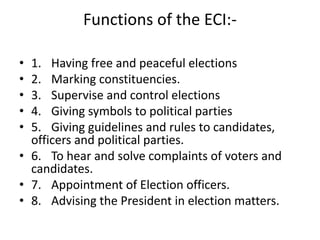
Functions of the ECI:-
• 1. Having free and peaceful elections
• 2. Marking constituencies.
• 3. Supervise and control elections
• 4. Giving symbols to political parties
• 5. Giving guidelines and rules to candidates,
officers and political parties.
• 6. To hear and solve complaints of voters and
candidates.
• 7. Appointment of Election officers.
• 8. Advising the President in election matters.

Ch 22 peoples participation

  • 1.
    CH : 22Peoples Participation
  • 2.
    • Meaning ofpeople’s participation is:- • 1. People must participate in the decision making process of government. • 2. Without people’s participation there can be no democracy. • 3. When people vote in elections they elect their own people. • 4. People’s participation is also expressed through debates, newspapers, demonstration.
  • 3.
    • Importance ofpeople’s participation • 1. The Government work smoothly. • 2. Development happens fast because people participate actively. • 3. People can check government. • 4. People develop a sense of ownership.
  • 4.
    • Mode ofpeople’s participation • 1. Voting during elections. • 2. Joining political parties. • 3. Meeting elected representatives and discussing problems. • 4. Taking part in public meetings • 5. Joining NGO’s • 6. Keeping a check on the development projects of the government.
  • 5.
    • Public opinionis the opinion of people on different public issues. • Importance of public opinion:- • 1. People share their opinion with local elected leaders. • 2. The Government then takes care of the needy people. • 3. If the Government does not take care then there will be no development.
  • 6.
    • Public opinioncannot be called the voice of the people because: • 1. It is not the opinion of all the people in the country. • 2. It is a collection of opinion of different people. • 3. It aims at the welfare of he whole community. • 4. It helps to influences the decisions of the government.
  • 7.
    Agencies of publicopinion:- • 1. Print Media:- Newspapers, magazines etc. through news articles, news stories and letters to the editors they contribute to the formulation of public opinion. • They present public views, criticism, suggestions of Government policies. • 2. Electronic Media: Cinema,T.V and radio is an important tool to • 3. Political parties: they feed the people with ideas and facts and help contribute in formulating public opinion.. • 4. Legislatures: These are places where discussions and debates on all important public policy and welfare take place. • 5. Educational institutes: They impart political education and contribute to the formulation of public opinion.
  • 8.
    ELECTIONS In India •Members of the Lok Sabha, Vidhan sabha and representatives of the Gram Panchayat get or Municipal bodies get elected directly by the people. • The people in a democratic country have a right to elect their representatives. This right is called Adult Franchise. When the state gives this right to all adult citizens, it is called Universal Adult Franchise.
  • 9.
    • Kinds ofelections • 1. Direct Election:- People vote using the ballot to choose their representative. For eg:- Lok Sabha and State Assemblies. • 2. Indirect Election:- The elected members from Lok Sabha or state assemblies vote and elect members to the Rajya Sabha And Vidhan Parishad. The President and the Vice President of our country are also elected indirectly.
  • 10.
    the various stagesof electoral process in India • 1. Marking constituencies. • 2. Preparing new electoral lists and checking old ones. • 3. Announcement of election schedules. • 4. Filing of papers by candidates • 5. Checking of papers and giving symbols to candidates. • 6. Withdrawal of nominations. • 7. Campaigning by candidates • 8. Voting by public • 9. results being declared.
  • 11.
    The returning officer:- •To help the elections happen easily the government appoints a Returning officer. He is nominated by the Election Commission of India. • 1. Fixes voting booths. • 2. checks the printing of ballot papers • 3. arranges for voting machines • 4. employs security officers and voting officers. • 5. Distributes voting material.
  • 12.
    Election commission ofIndia • The “Election Commission of India” is responsible for conducting elections. It is also called the ECI. • Composition of Election commission of India:- • 1. There is a Chief Election Commissioner and many Election Commissioners. • 2. The President appoints them. • 3. Some regional Commissioners are also appointed. • 4. There is a chief electoral officer in every state.
  • 13.
    Functions of theECI:- • 1. Having free and peaceful elections • 2. Marking constituencies. • 3. Supervise and control elections • 4. Giving symbols to political parties • 5. Giving guidelines and rules to candidates, officers and political parties. • 6. To hear and solve complaints of voters and candidates. • 7. Appointment of Election officers. • 8. Advising the President in election matters.