Collection and Presentation of
data
Information
• Major source of knowledge
• Helps in making decisions
• With development of Science and technology
the sources of information has increased.
• Books, magazines, internet, mobile phones,
T.V, newspapers are all medium of providing
information.
Meaning of Data
• Information is both qualitative and
quantitative.
• In the study of economics quantitative
information's are mostly used for analysis.
• Data means quantitative information which is
expressed as a total.
• Data is useful for making decisions.
• It is also called statistical data.
Features/ Characteristics of Data
1. Statistics are aggregate of facts.
– A single fact cannot be considered as a data.
– For e.g. : Suresh got 56 marks in economics.
– This is only a fact not a data.
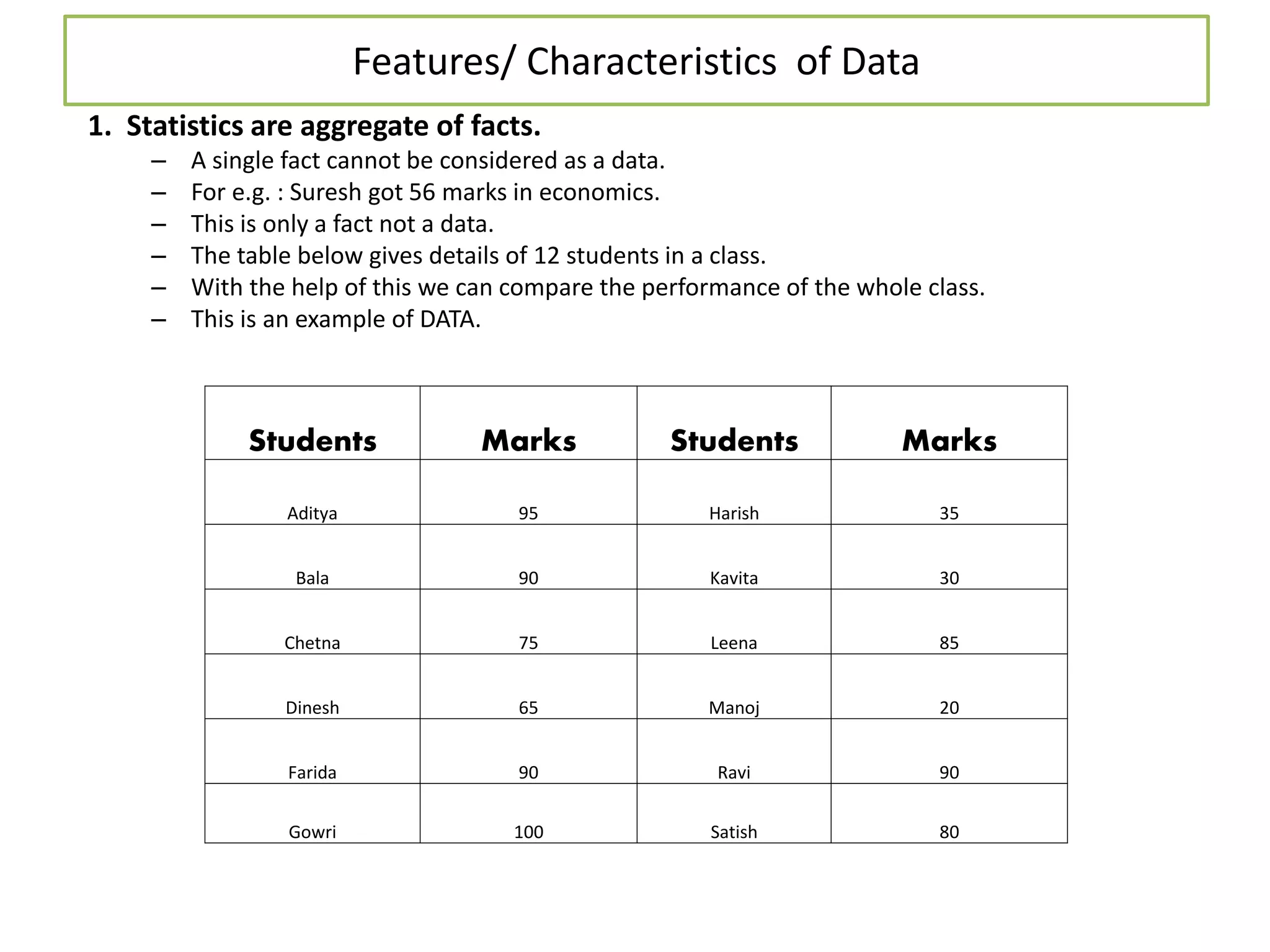
– The table below gives details of 12 students in a class.
– With the help of this we can compare the performance of the whole class.
– This is an example of DATA.
Students Marks Students Marks
Aditya 95 Harish 35
Bala 90 Kavita 30
Chetna 75 Leena 85
Dinesh 65 Manoj 20
Farida 90 Ravi 90
Gowri 100 Satish 80
3. Data are affected by multiple causes.
• Data are affected by many factors.
• Example: rise in price can be due to rise in demand or fall in supply
or rise in taxes.
2. They are expressed as numbers.
(a) When facts are given by counting or calculation, then it is called data.
(b) Hence data is quantitative and not qualitative.
Features/ Characteristics of Data
4. Statistics does not give 100% accuracy.
– If a doctor invents a medicine to control diabetes and after conducting
a research he states that 90% of the people responded well to the
medicine.
– This medicine is then considered good.
5. Data is always collected for a predetermined purpose.
Features/ Characteristics of Data
Statistics important in Economics
• In economics statistics is important –
• 1) In economic planning.
– The data of the previous years are used to prepare plans
for the future.
– Forecasting is done on the basis of economic planning.
• 2) In calculating national income.
– In order to know the state of the economy it is important
to know the national income.
• 3) In making government policies.
• Statistical data are widely used by governments to frame
policies for economic development of the country.
• On the basis of Data collected the government had to make
policy to remove poverty and unemployment.
• The government introduced the National Employment
Guarantee Scheme, by which the government guarantees an
unemployed person at least 100 days of employment in a year.
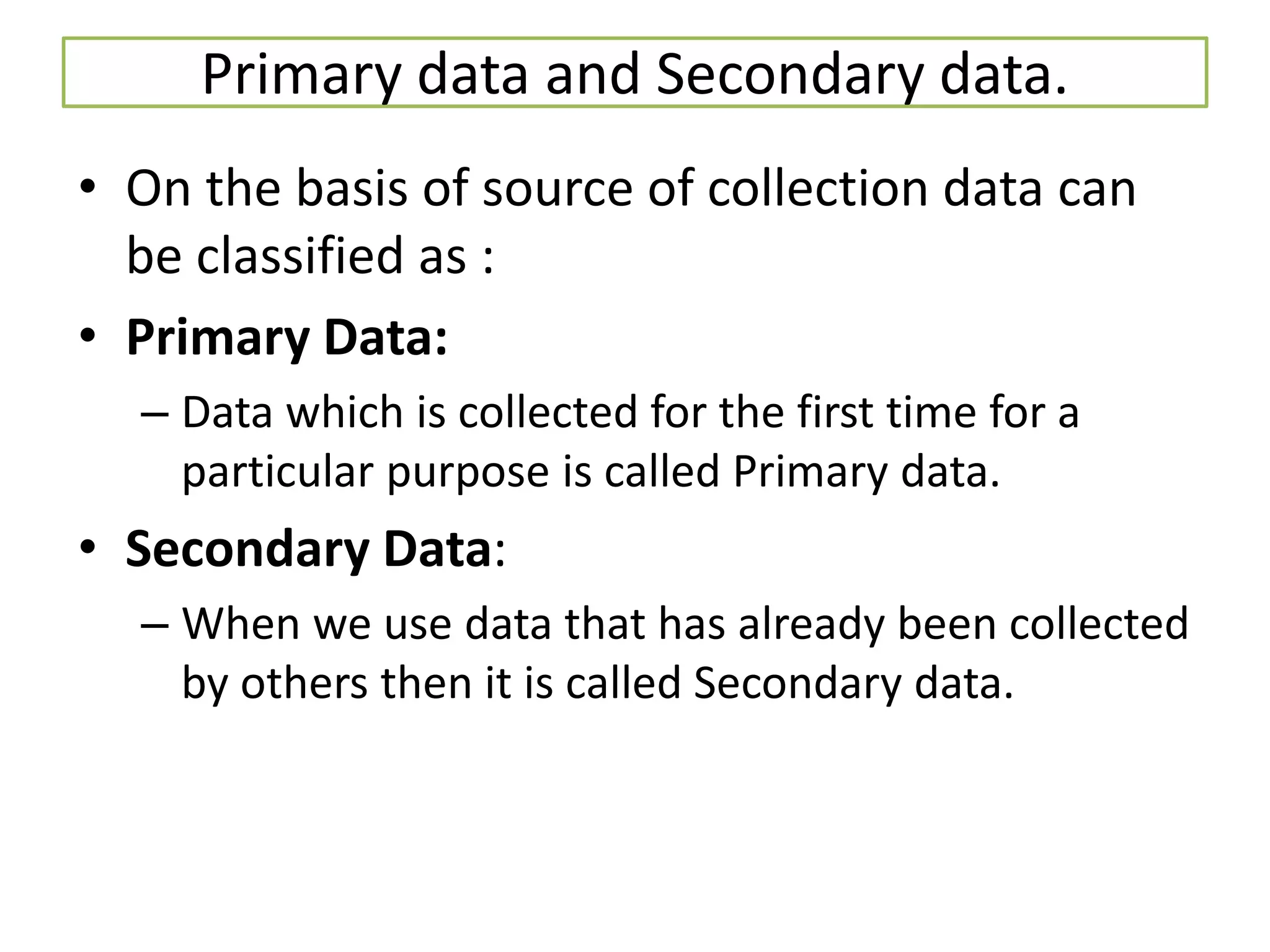
Primary data and Secondary data.
• On the basis of source of collection data can
be classified as :
• Primary Data:
– Data which is collected for the first time for a
particular purpose is called Primary data.
• Secondary Data:
– When we use data that has already been collected
by others then it is called Secondary data.
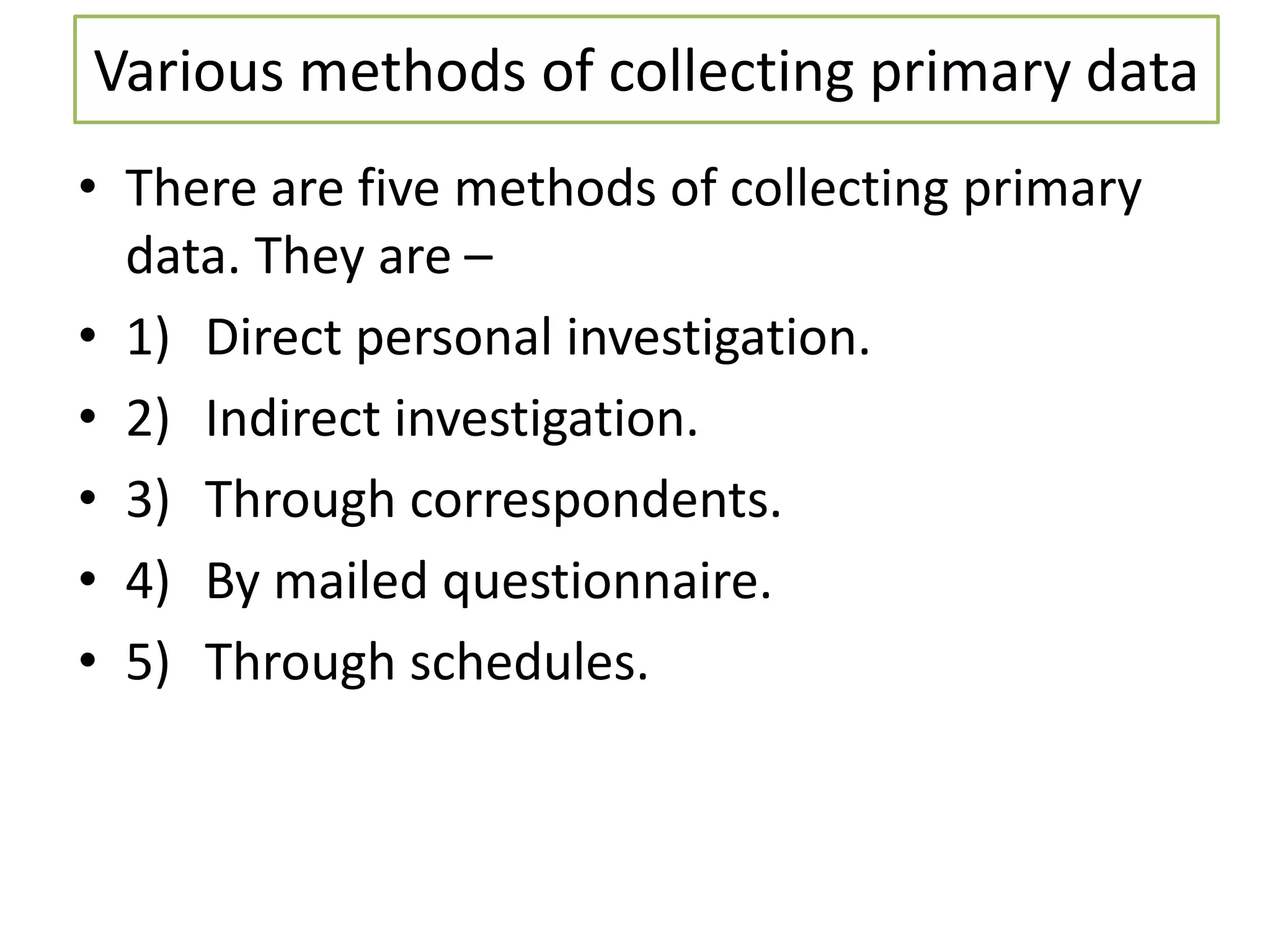
Various methods of collecting primary data
• There are five methods of collecting primary
data. They are –
• 1) Direct personal investigation.
• 2) Indirect investigation.
• 3) Through correspondents.
• 4) By mailed questionnaire.
• 5) Through schedules.
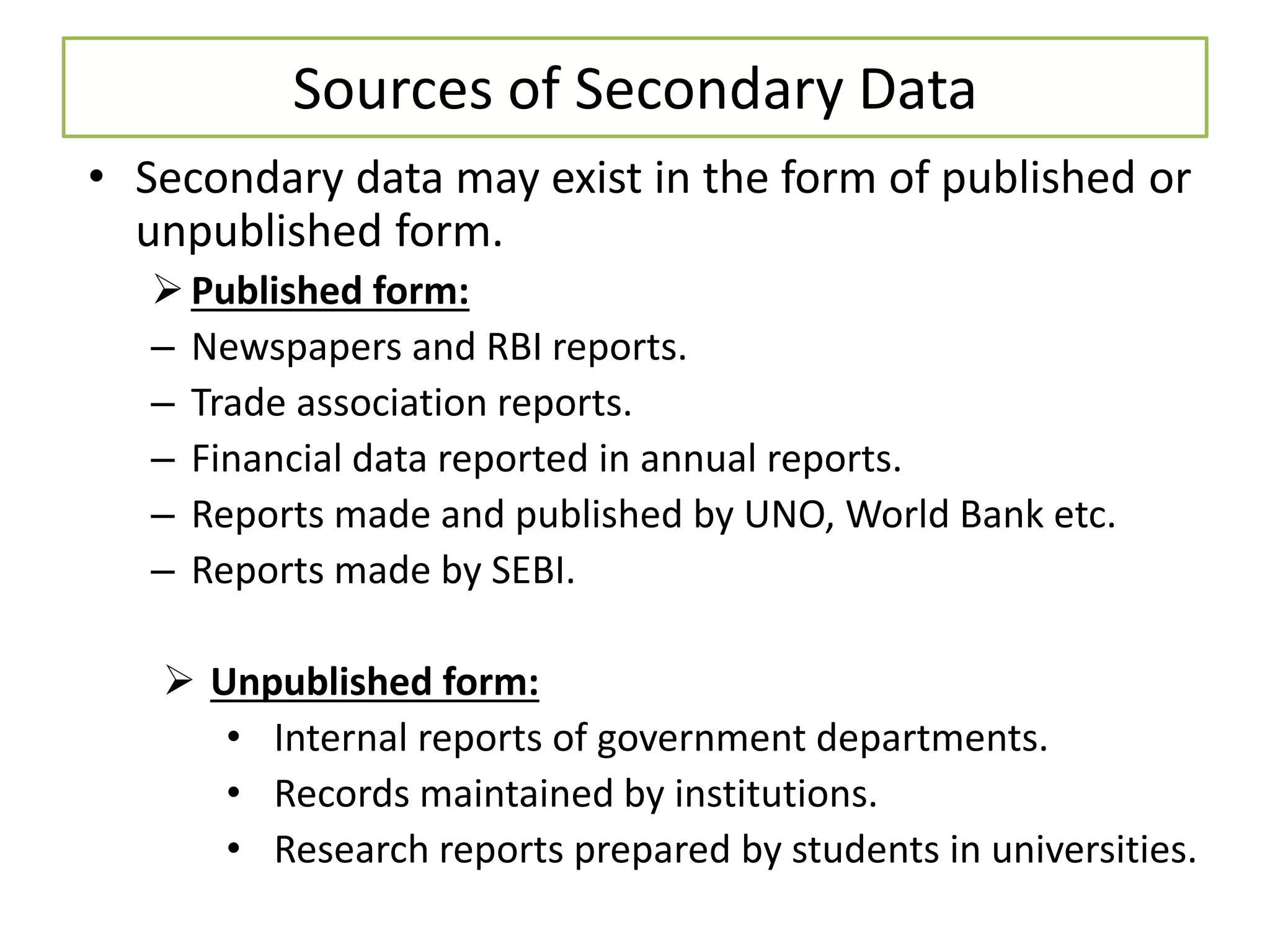
Sources of Secondary Data
• Secondary data may exist in the form of published or
unpublished form.
Published form:
– Newspapers and RBI reports.
– Trade association reports.
– Financial data reported in annual reports.
– Reports made and published by UNO, World Bank etc.
– Reports made by SEBI.
 Unpublished form:
• Internal reports of government departments.
• Records maintained by institutions.
• Research reports prepared by students in universities.
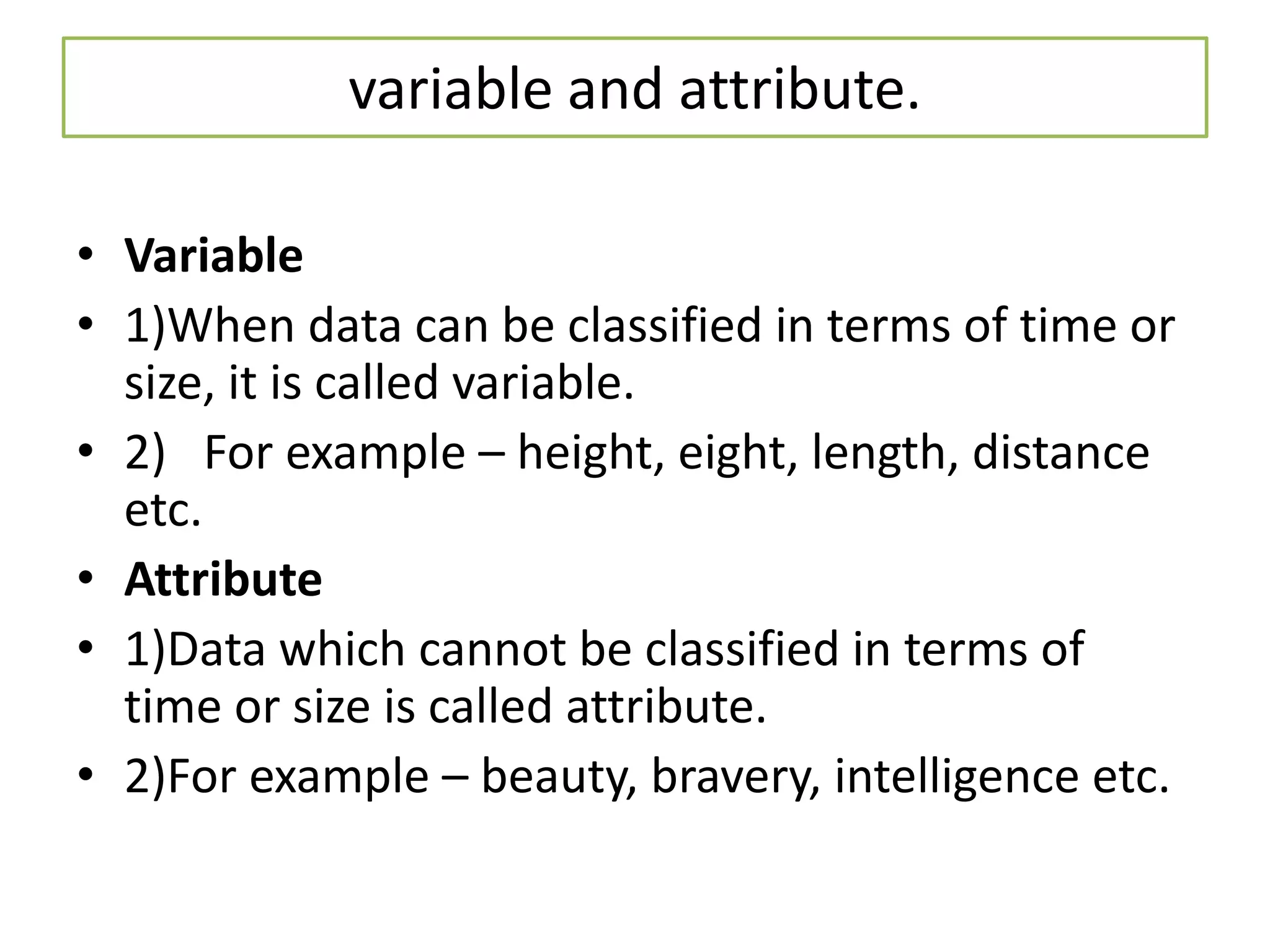
variable and attribute.
• Variable
• 1)When data can be classified in terms of time or
size, it is called variable.
• 2) For example – height, eight, length, distance
etc.
• Attribute
• 1)Data which cannot be classified in terms of
time or size is called attribute.
• 2)For example – beauty, bravery, intelligence etc.
Classification
• The process of arranging raw data into classes
or groups to make it usable is called
classification.
• Data can be classified in the following ways –
• (i) Individual series
• (ii) Discrete series
• (iii) Continuous series
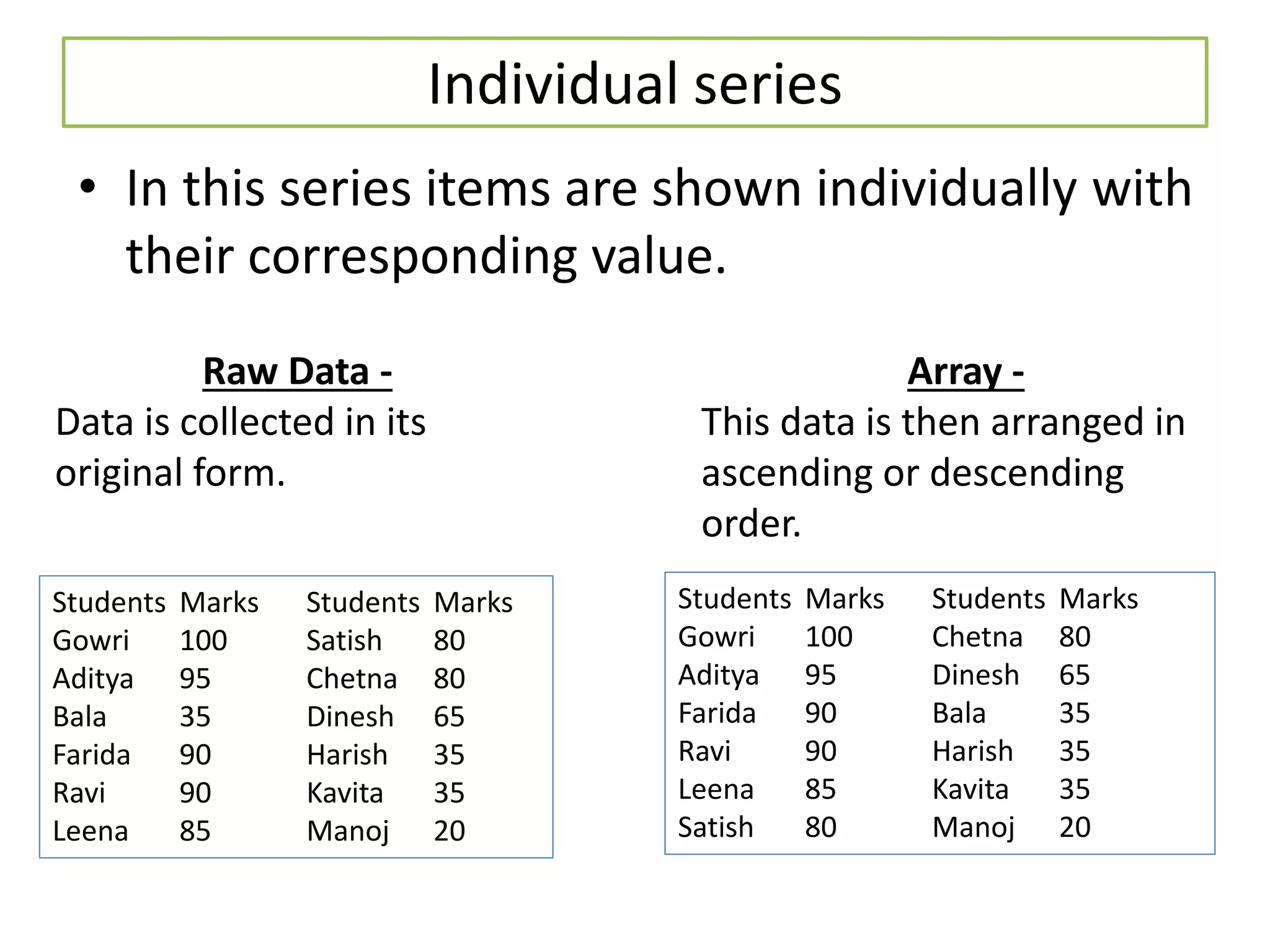
Individual series
• In this series items are shown individually with
their corresponding value.
Raw Data -
Data is collected in its
original form.
Array -
This data is then arranged in
ascending or descending
order.
Students Marks Students Marks
Gowri 100 Satish 80
Aditya 95 Chetna 80
Bala 35 Dinesh 65
Farida 90 Harish 35
Ravi 90 Kavita 35
Leena 85 Manoj 20
Students Marks Students Marks
Gowri 100 Chetna 80
Aditya 95 Dinesh 65
Farida 90 Bala 35
Ravi 90 Harish 35
Leena 85 Kavita 35
Satish 80 Manoj 20
Discrete Series
• This series shows variables with definite
breaks with their frequencies.
Marks No. of Students
100 1
95 1
90 2
85 1
80 2
65 1
35 3
20 1
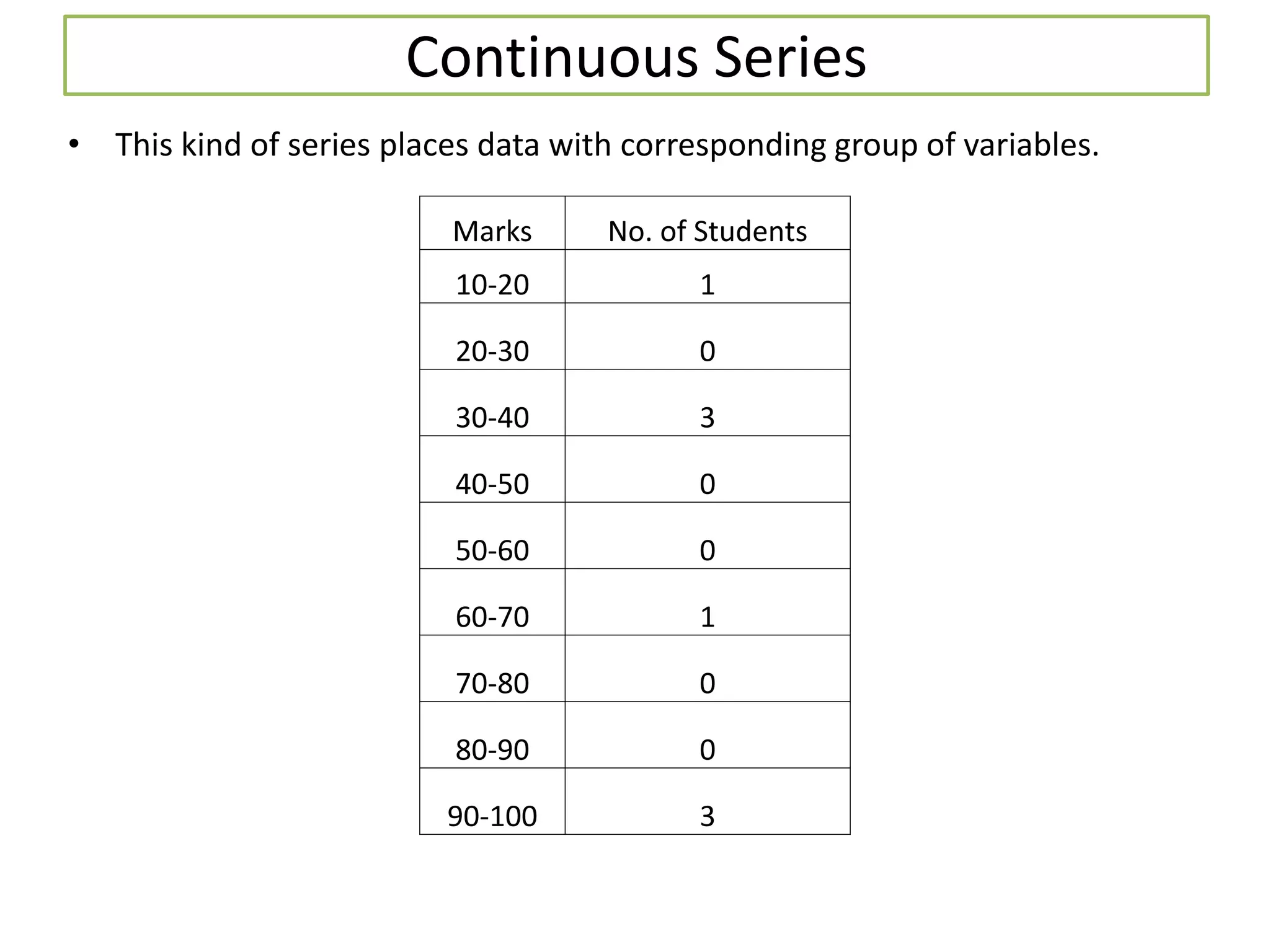
Continuous Series
• This kind of series places data with corresponding group of variables.
Marks No. of Students
10-20 1
20-30 0
30-40 3
40-50 0
50-60 0
60-70 1
70-80 0
80-90 0
90-100 3
Tabulation
• Once data is collected and classified, it can be
put into rows and columns. This process is
called tabulation.
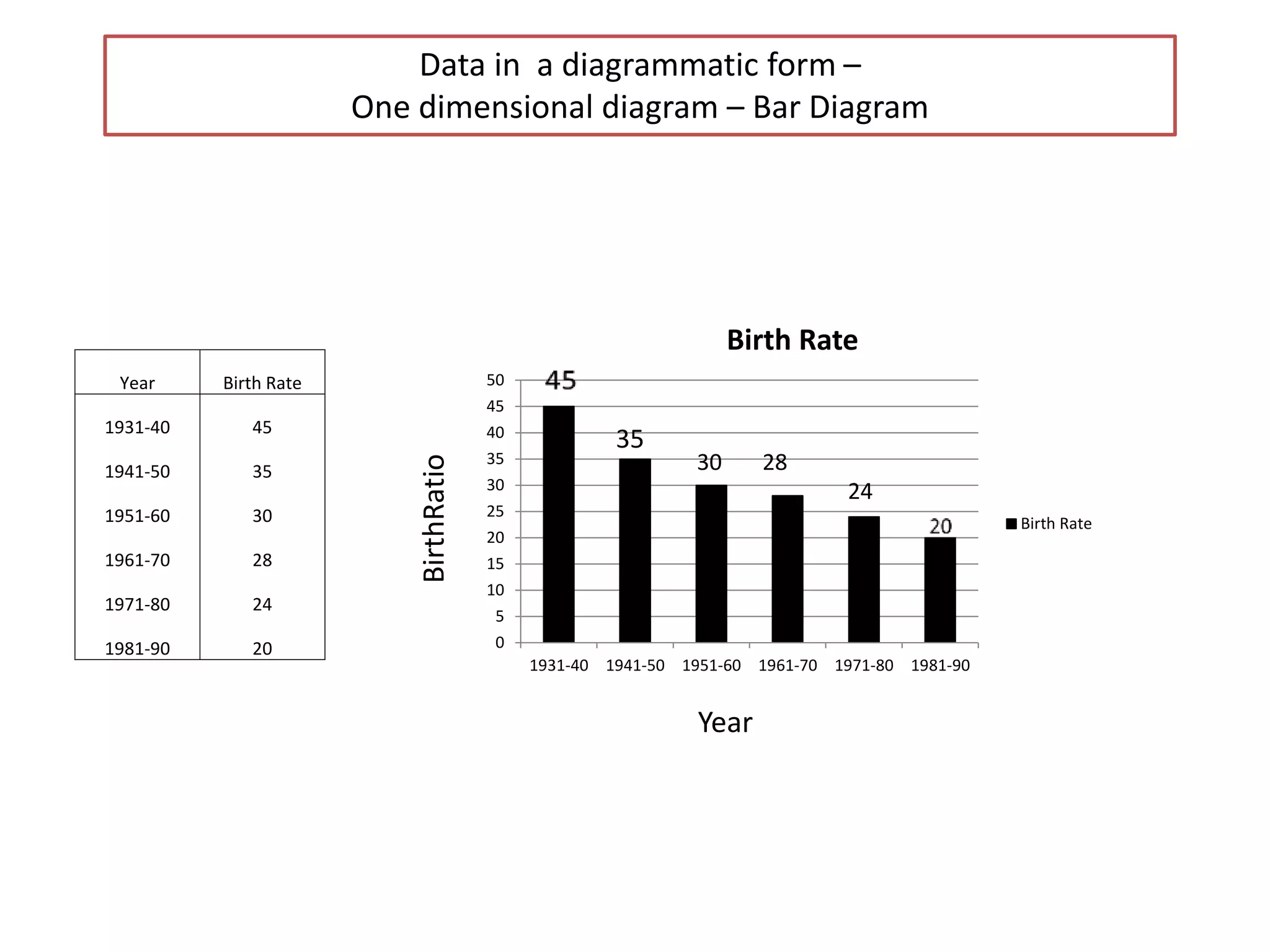
Diagrammatic presentation
• The geometrical version of data is diagrammatic
presentation.
• Example – bar diagram is a one dimensional
diagram.
Data in a diagrammatic form –
One dimensional diagram – Bar Diagram
Year Birth Rate
1931-40 45
1941-50 35
1951-60 30
1961-70 28
1971-80 24
1981-90 20 0
5
10
15
20
25
30
35
40
45
50
1931-40 1941-50 1951-60 1961-70 1971-80 1981-90
Birth Rate
Birth Rate
Year
BirthRatio
24 24
2830
35
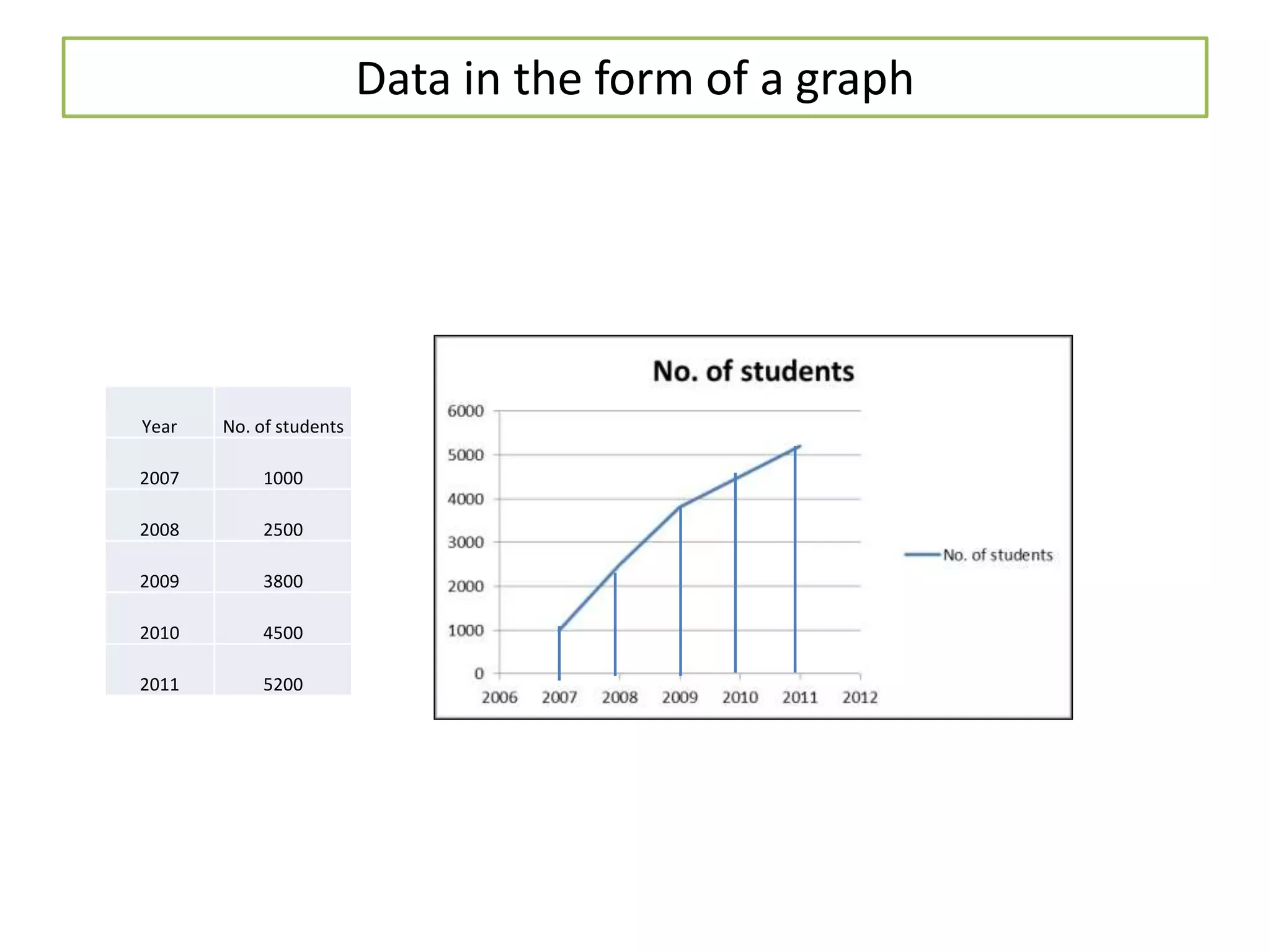
Data in the form of a graph
Year No. of students
2007 1000
2008 2500
2009 3800
2010 4500
2011 5200
Analysis of Data
• Analysis of Data
• After Data has been collected, classified,
tabulated and presented, it is studied to reach
a conclusion.
• This is called analysis of data.
Central tendency
• One of the main aims of statistical analysis is
to get one single value that describes the
whole data.
• This single value is called average or mean.
• An average measures the tendency of data to
move in a particular direction.
• The tendency of data to group around the
central value or valve is called central
tendency.
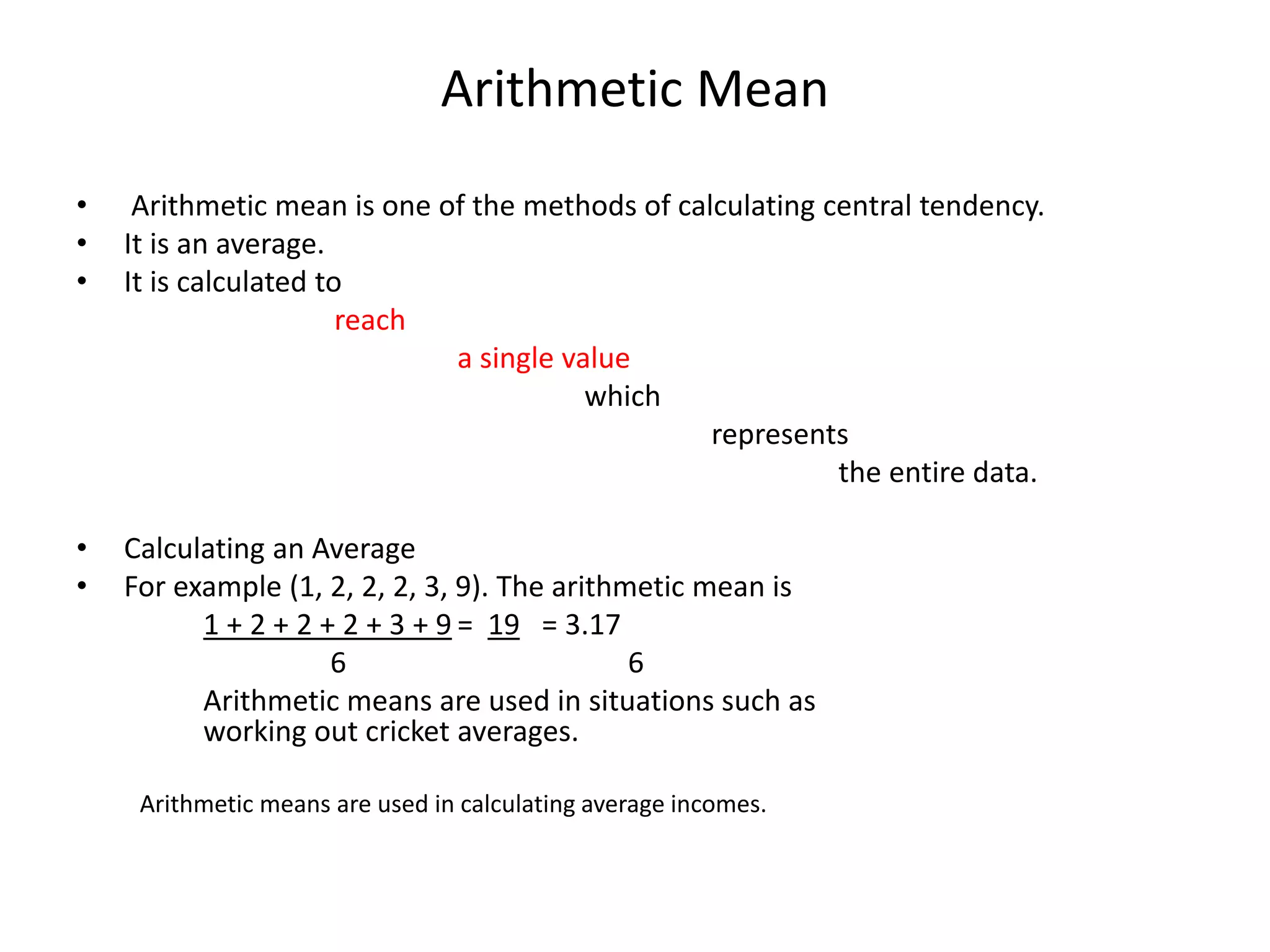
Arithmetic Mean
• Arithmetic mean is one of the methods of calculating central tendency.
• It is an average.
• It is calculated to
reach
a single value
which
represents
the entire data.
• Calculating an Average
• For example (1, 2, 2, 2, 3, 9). The arithmetic mean is
1 + 2 + 2 + 2 + 3 + 9 = 19 = 3.17
6 6
Arithmetic means are used in situations such as
working out cricket averages.
Arithmetic means are used in calculating average incomes.
Functions and purpose of average
• To make a summary of the collected information.
• To make comparisons between two or more groups
• To reach a value that represents the entire data.
• To make future policy and programme.
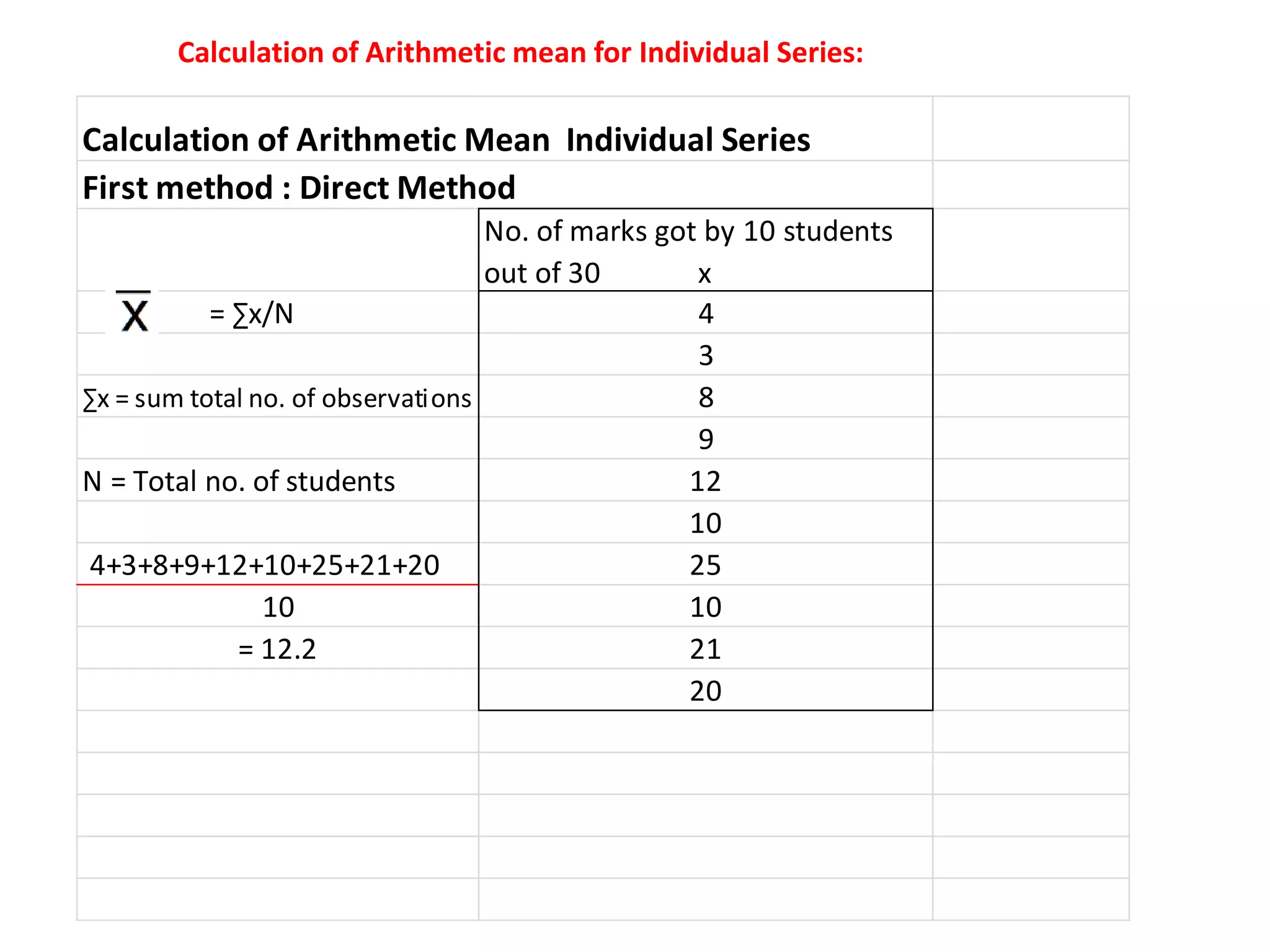
Calculation of Arithmetic Mean Individual Series
First method : Direct Method
No. of marks got by 10 students
out of 30 x
= ∑x/N 4
3
∑x = sum total no. of observations 8
9
N = Total no. of students 12
10
4+3+8+9+12+10+25+21+20 25
10 10
= 12.2 21
20
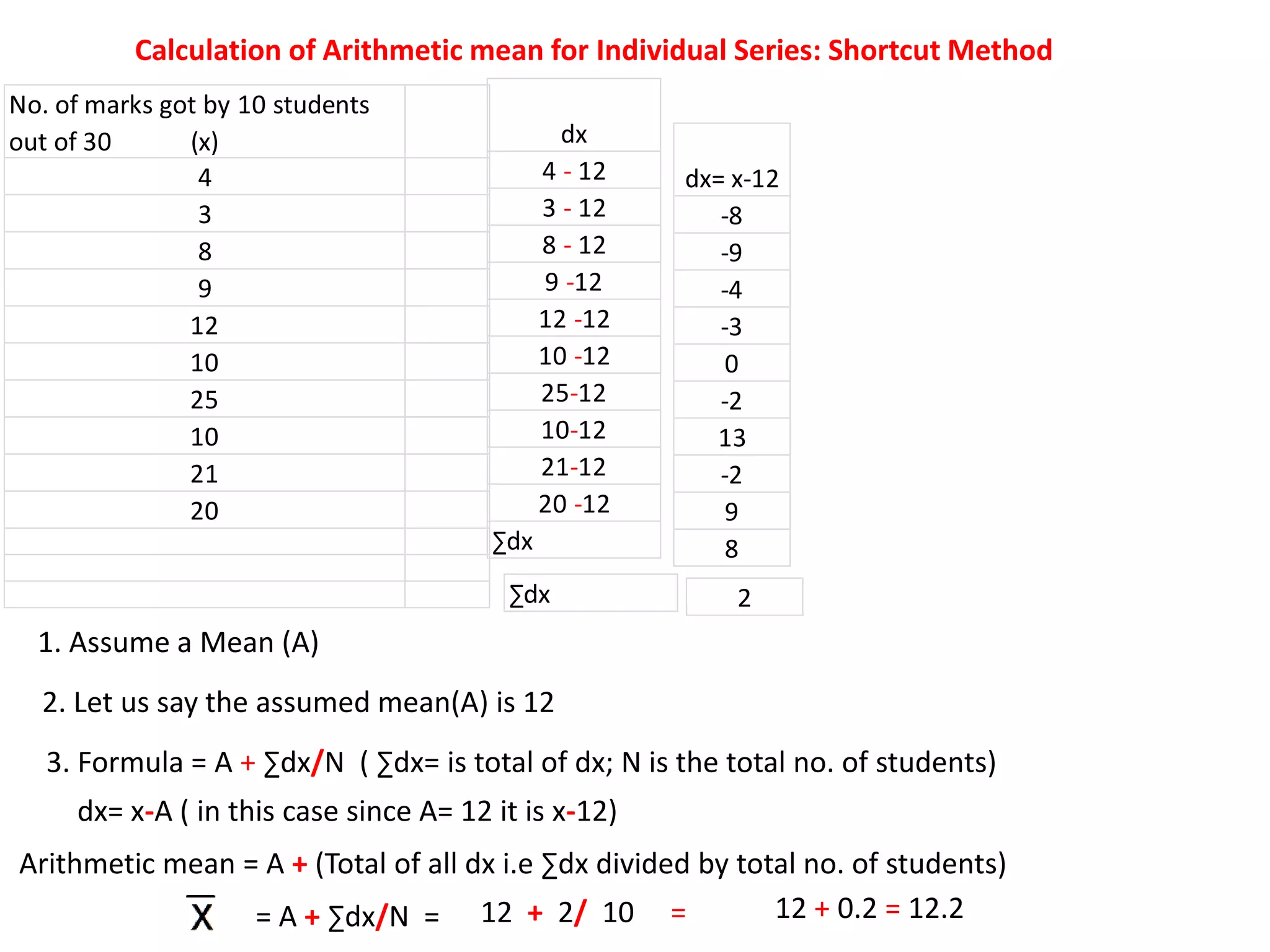
Calculation of Arithmetic mean for Individual Series:
No. of marks got by 10 students
out of 30 (x)
4
3
8
9
12
10
25
10
21
20
1. Assume a Mean (A)
2. Let us say the assumed mean(A) is 12
3. Formula = A + ∑dx/N ( ∑dx= is total of dx; N is the total no. of students)
dx= x-A ( in this case since A= 12 it is x-12)
Arithmetic mean = A + (Total of all dx i.e ∑dx divided by total no. of students)
12 + 2/ 10 = 12 + 0.2 = 12.2
dx
4 - 12
3 - 12
8 - 12
9 -12
12 -12
10 -12
25-12
10-12
21-12
20 -12
∑dx
dx= x-12
-8
-9
-4
-3
0
-2
13
-2
9
8
∑dx 2
= A + ∑dx/N =
Calculation of Arithmetic mean for Individual Series: Shortcut Method
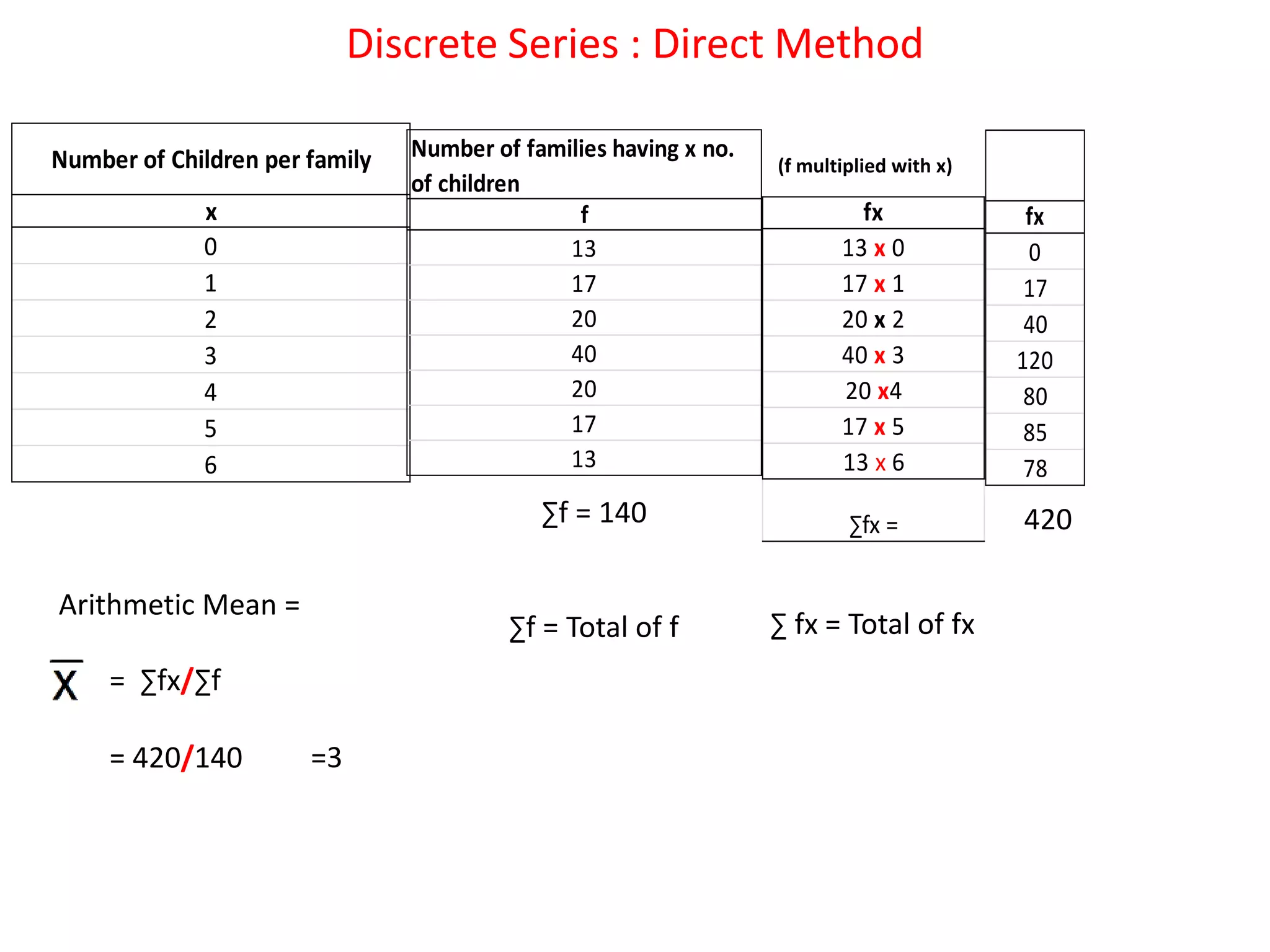
Discrete Series : Direct Method
Number of Children per family
x
0
1
2
3
4
5
6
Number of families having x no.
of children
f
13
17
20
40
20
17
13
fx
13 x 0
17 x 1
20 x 2
40 x 3
20 x4
17 x 5
13 x 6
∑fx =
fx
0
17
40
120
80
85
78
∑f = 140 420
∑f = Total of f ∑ fx = Total of fx
Arithmetic Mean =
= ∑fx/∑f
= 420/140 =3
(f multiplied with x)
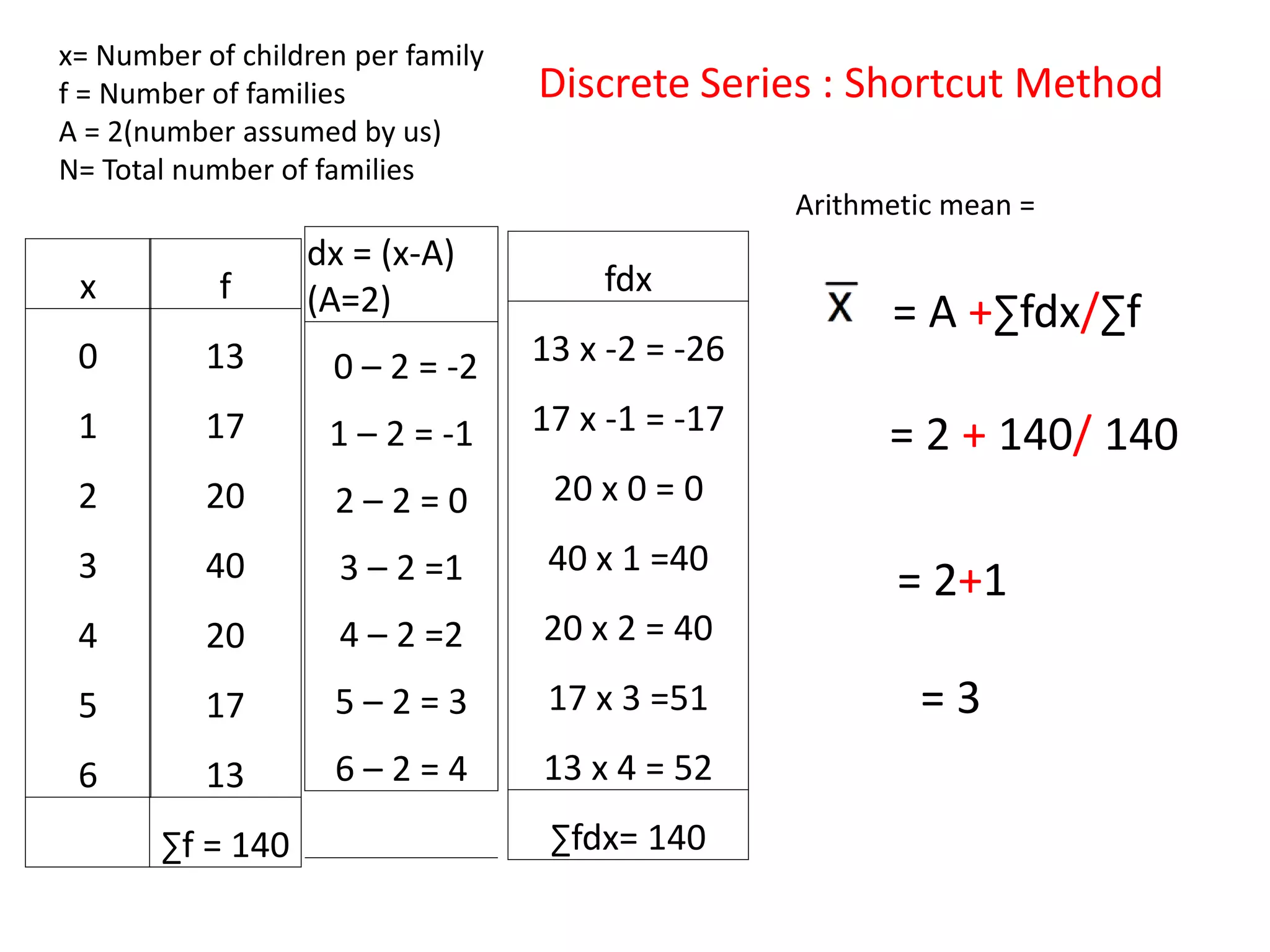
Discrete Series : Shortcut Method
x= Number of children per family
f = Number of families
A = 2(number assumed by us)
N= Total number of families
x
0
1
2
3
4
5
6
f
13
17
20
40
20
17
13
∑f = 140
dx = (x-A)
(A=2)
0 – 2 = -2
1 – 2 = -1
2 – 2 = 0
3 – 2 =1
4 – 2 =2
5 – 2 = 3
6 – 2 = 4
fdx
13 x -2 = -26
17 x -1 = -17
20 x 0 = 0
40 x 1 =40
20 x 2 = 40
17 x 3 =51
13 x 4 = 52
∑fdx= 140
= A +∑fdx/∑f
= 2 + 140/ 140
= 2+1
= 3
Arithmetic mean =
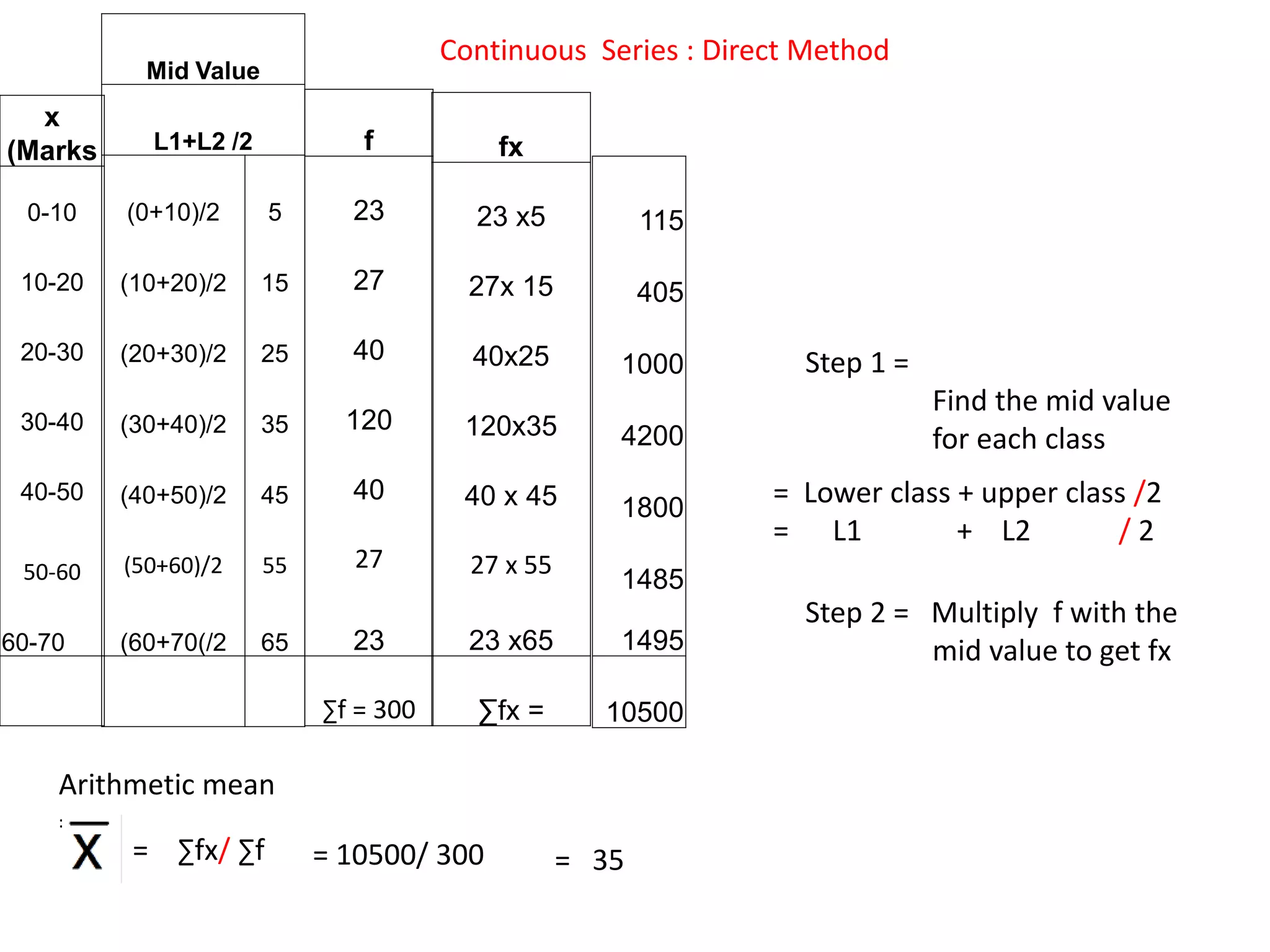
Continuous Series : Direct Method
x
(Marks
0-10
10-20
20-30
30-40
40-50
50-60
60-70
Mid Value
L1+L2 /2
(0+10)/2 5
(10+20)/2 15
(20+30)/2 25
(30+40)/2 35
(40+50)/2 45
(50+60)/2 55
(60+70(/2 65
f
23
27
40
120
40
27
23
∑f = 300
fx
23 x5
27x 15
40x25
120x35
40 x 45
27 x 55
23 x65
∑fx =
Step 1 =
Find the mid value
for each class
= Lower class + upper class /2
= L1 + L2 / 2
Step 2 = Multiply f with the
mid value to get fx
Arithmetic mean
=
= ∑fx/ ∑f = 35= 10500/ 300
115
405
1000
4200
1800
1485
1495
10500
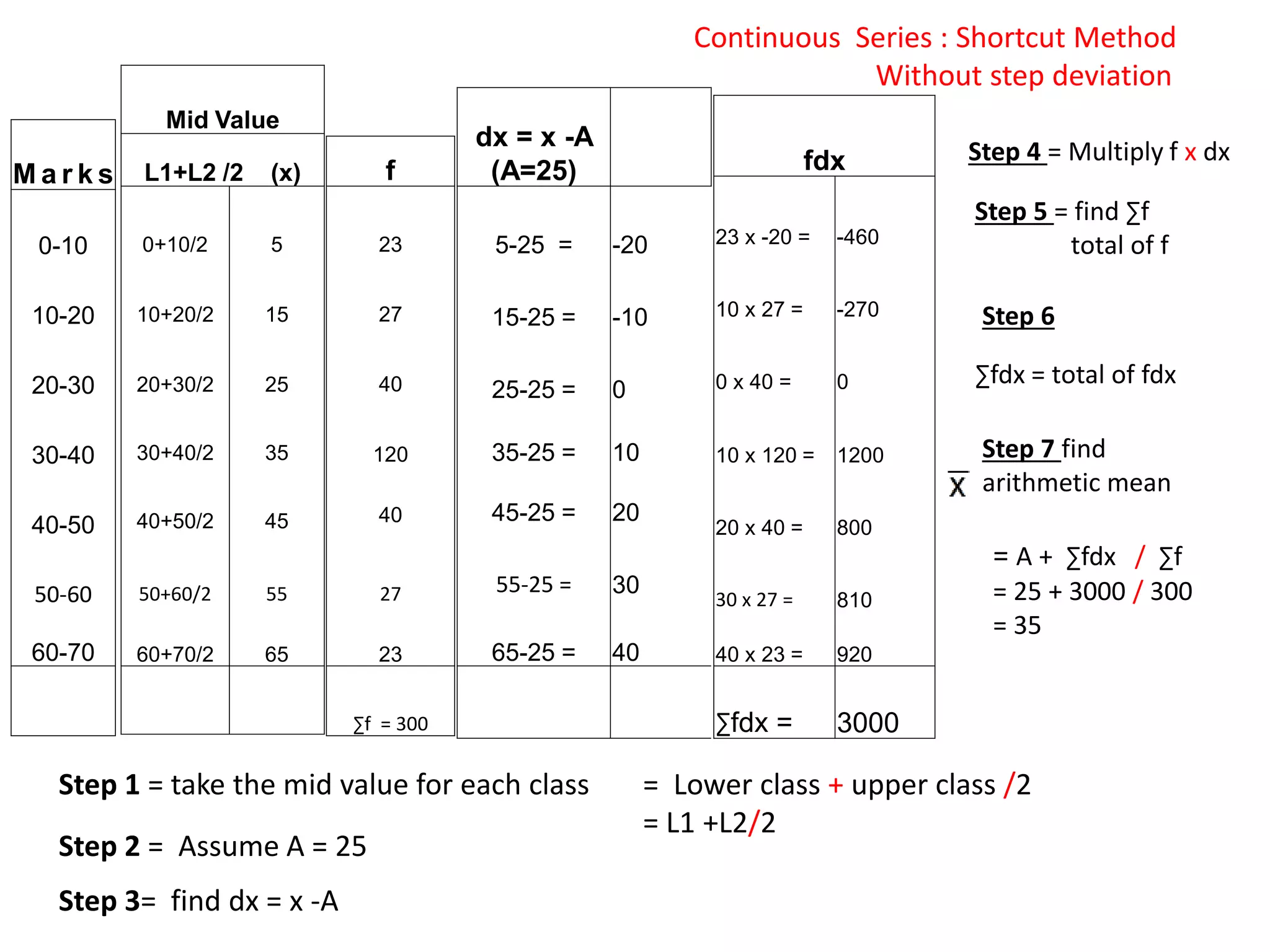
Continuous Series : Shortcut Method
Without step deviation
M a r k s
0-10
10-20
20-30
30-40
40-50
50-60
60-70
Mid Value
L1+L2 /2 (x)
0+10/2 5
10+20/2 15
20+30/2 25
30+40/2 35
40+50/2 45
50+60/2 55
60+70/2 65
f
23
27
40
120
40
27
23
∑f = 300
dx = x -A
(A=25)
5-25 = -20
15-25 = -10
25-25 = 0
35-25 = 10
45-25 = 20
55-25 = 30
65-25 = 40
fdx
23 x -20 = -460
10 x 27 = -270
0 x 40 = 0
10 x 120 = 1200
20 x 40 = 800
30 x 27 = 810
40 x 23 = 920
∑fdx = 3000
Step 1 = take the mid value for each class = Lower class + upper class /2
= L1 +L2/2
Step 2 = Assume A = 25
Step 3= find dx = x -A
Step 4 = Multiply f x dx
Step 5 = find ∑f
total of f
∑fdx = total of fdx
Step 6
Step 7 find
arithmetic mean
= A + ∑fdx / ∑f
= 25 + 3000 / 300
= 35
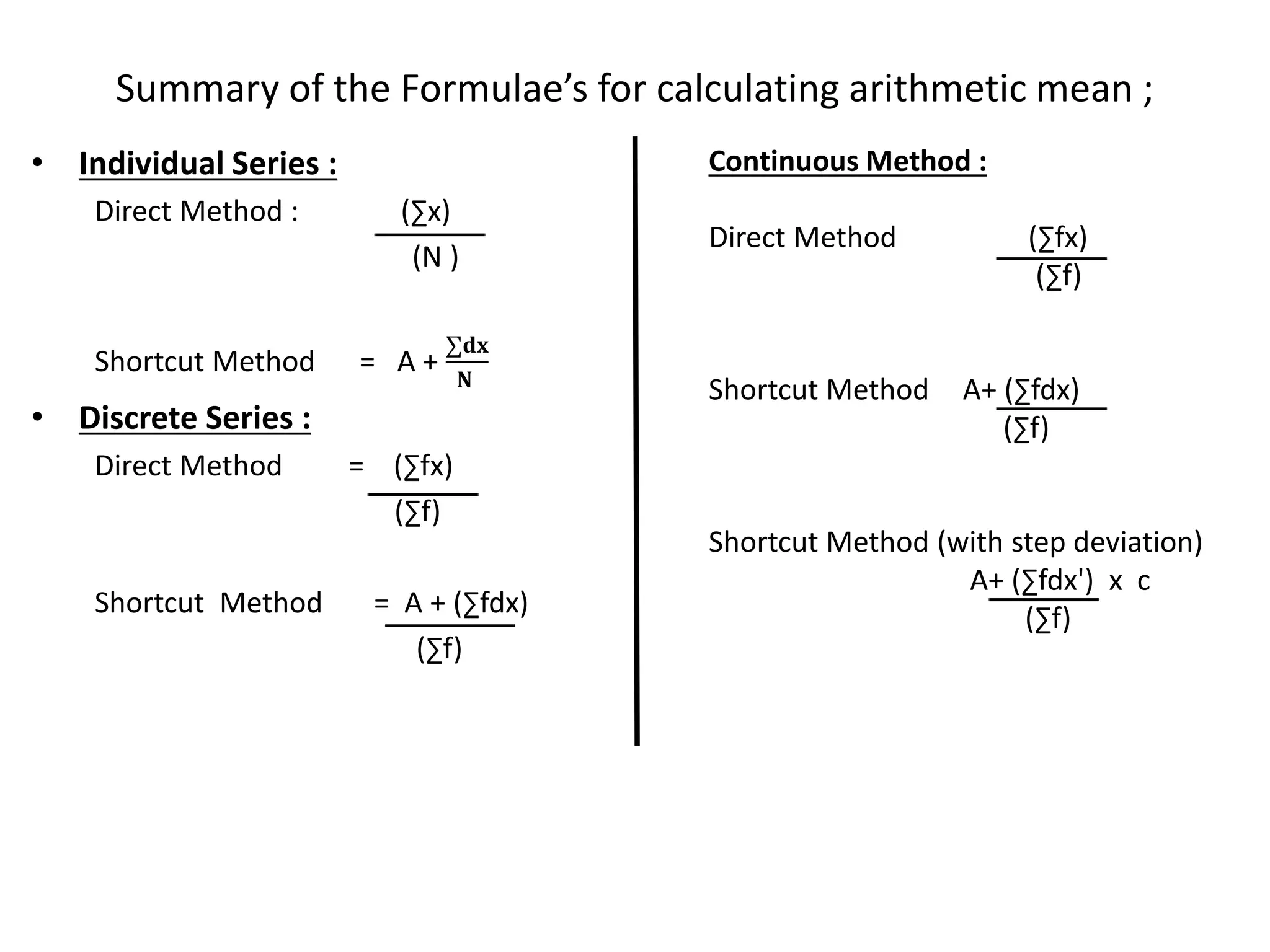
Summary of the Formulae’s for calculating arithmetic mean ;
• Individual Series :
Direct Method : (∑x)
(N )
Shortcut Method = A +
∑𝐝𝐱
𝐍
• Discrete Series :
Direct Method = (∑fx)
(∑f)
Shortcut Method = A + (∑fdx)
(∑f)
Continuous Method :
Direct Method (∑fx)
(∑f)
Shortcut Method A+ (∑fdx)
(∑f)
Shortcut Method (with step deviation)
A+ (∑fdx') x c
(∑f)
Thank You

Mod 6 ch 17 18

  • 1.
  • 2.
    Information • Major sourceof knowledge • Helps in making decisions • With development of Science and technology the sources of information has increased. • Books, magazines, internet, mobile phones, T.V, newspapers are all medium of providing information.
  • 3.
    Meaning of Data •Information is both qualitative and quantitative. • In the study of economics quantitative information's are mostly used for analysis. • Data means quantitative information which is expressed as a total. • Data is useful for making decisions. • It is also called statistical data.
  • 4.
    Features/ Characteristics ofData 1. Statistics are aggregate of facts. – A single fact cannot be considered as a data. – For e.g. : Suresh got 56 marks in economics. – This is only a fact not a data. – The table below gives details of 12 students in a class. – With the help of this we can compare the performance of the whole class. – This is an example of DATA. Students Marks Students Marks Aditya 95 Harish 35 Bala 90 Kavita 30 Chetna 75 Leena 85 Dinesh 65 Manoj 20 Farida 90 Ravi 90 Gowri 100 Satish 80
  • 5.
    3. Data areaffected by multiple causes. • Data are affected by many factors. • Example: rise in price can be due to rise in demand or fall in supply or rise in taxes. 2. They are expressed as numbers. (a) When facts are given by counting or calculation, then it is called data. (b) Hence data is quantitative and not qualitative. Features/ Characteristics of Data
  • 6.
    4. Statistics doesnot give 100% accuracy. – If a doctor invents a medicine to control diabetes and after conducting a research he states that 90% of the people responded well to the medicine. – This medicine is then considered good. 5. Data is always collected for a predetermined purpose. Features/ Characteristics of Data
  • 7.
    Statistics important inEconomics • In economics statistics is important – • 1) In economic planning. – The data of the previous years are used to prepare plans for the future. – Forecasting is done on the basis of economic planning. • 2) In calculating national income. – In order to know the state of the economy it is important to know the national income.
  • 8.
    • 3) Inmaking government policies. • Statistical data are widely used by governments to frame policies for economic development of the country. • On the basis of Data collected the government had to make policy to remove poverty and unemployment. • The government introduced the National Employment Guarantee Scheme, by which the government guarantees an unemployed person at least 100 days of employment in a year.
  • 9.
    Primary data andSecondary data. • On the basis of source of collection data can be classified as : • Primary Data: – Data which is collected for the first time for a particular purpose is called Primary data. • Secondary Data: – When we use data that has already been collected by others then it is called Secondary data.
  • 10.
    Various methods ofcollecting primary data • There are five methods of collecting primary data. They are – • 1) Direct personal investigation. • 2) Indirect investigation. • 3) Through correspondents. • 4) By mailed questionnaire. • 5) Through schedules.
  • 11.
    Sources of SecondaryData • Secondary data may exist in the form of published or unpublished form. Published form: – Newspapers and RBI reports. – Trade association reports. – Financial data reported in annual reports. – Reports made and published by UNO, World Bank etc. – Reports made by SEBI.  Unpublished form: • Internal reports of government departments. • Records maintained by institutions. • Research reports prepared by students in universities.
  • 12.
    variable and attribute. •Variable • 1)When data can be classified in terms of time or size, it is called variable. • 2) For example – height, eight, length, distance etc. • Attribute • 1)Data which cannot be classified in terms of time or size is called attribute. • 2)For example – beauty, bravery, intelligence etc.
  • 13.
    Classification • The processof arranging raw data into classes or groups to make it usable is called classification. • Data can be classified in the following ways – • (i) Individual series • (ii) Discrete series • (iii) Continuous series
  • 14.
    Individual series • Inthis series items are shown individually with their corresponding value. Raw Data - Data is collected in its original form. Array - This data is then arranged in ascending or descending order. Students Marks Students Marks Gowri 100 Satish 80 Aditya 95 Chetna 80 Bala 35 Dinesh 65 Farida 90 Harish 35 Ravi 90 Kavita 35 Leena 85 Manoj 20 Students Marks Students Marks Gowri 100 Chetna 80 Aditya 95 Dinesh 65 Farida 90 Bala 35 Ravi 90 Harish 35 Leena 85 Kavita 35 Satish 80 Manoj 20
  • 15.
    Discrete Series • Thisseries shows variables with definite breaks with their frequencies. Marks No. of Students 100 1 95 1 90 2 85 1 80 2 65 1 35 3 20 1
  • 16.
    Continuous Series • Thiskind of series places data with corresponding group of variables. Marks No. of Students 10-20 1 20-30 0 30-40 3 40-50 0 50-60 0 60-70 1 70-80 0 80-90 0 90-100 3
  • 17.
    Tabulation • Once datais collected and classified, it can be put into rows and columns. This process is called tabulation.
  • 18.
    Diagrammatic presentation • Thegeometrical version of data is diagrammatic presentation. • Example – bar diagram is a one dimensional diagram.
  • 19.
    Data in adiagrammatic form – One dimensional diagram – Bar Diagram Year Birth Rate 1931-40 45 1941-50 35 1951-60 30 1961-70 28 1971-80 24 1981-90 20 0 5 10 15 20 25 30 35 40 45 50 1931-40 1941-50 1951-60 1961-70 1971-80 1981-90 Birth Rate Birth Rate Year BirthRatio 24 24 2830 35
  • 20.
    Data in theform of a graph Year No. of students 2007 1000 2008 2500 2009 3800 2010 4500 2011 5200
  • 21.
  • 22.
    • Analysis ofData • After Data has been collected, classified, tabulated and presented, it is studied to reach a conclusion. • This is called analysis of data.
  • 23.
    Central tendency • Oneof the main aims of statistical analysis is to get one single value that describes the whole data. • This single value is called average or mean. • An average measures the tendency of data to move in a particular direction. • The tendency of data to group around the central value or valve is called central tendency.
  • 24.
    Arithmetic Mean • Arithmeticmean is one of the methods of calculating central tendency. • It is an average. • It is calculated to reach a single value which represents the entire data. • Calculating an Average • For example (1, 2, 2, 2, 3, 9). The arithmetic mean is 1 + 2 + 2 + 2 + 3 + 9 = 19 = 3.17 6 6 Arithmetic means are used in situations such as working out cricket averages. Arithmetic means are used in calculating average incomes.
  • 25.
    Functions and purposeof average • To make a summary of the collected information. • To make comparisons between two or more groups • To reach a value that represents the entire data. • To make future policy and programme.
  • 26.
    Calculation of ArithmeticMean Individual Series First method : Direct Method No. of marks got by 10 students out of 30 x = ∑x/N 4 3 ∑x = sum total no. of observations 8 9 N = Total no. of students 12 10 4+3+8+9+12+10+25+21+20 25 10 10 = 12.2 21 20 Calculation of Arithmetic mean for Individual Series:
  • 27.
    No. of marksgot by 10 students out of 30 (x) 4 3 8 9 12 10 25 10 21 20 1. Assume a Mean (A) 2. Let us say the assumed mean(A) is 12 3. Formula = A + ∑dx/N ( ∑dx= is total of dx; N is the total no. of students) dx= x-A ( in this case since A= 12 it is x-12) Arithmetic mean = A + (Total of all dx i.e ∑dx divided by total no. of students) 12 + 2/ 10 = 12 + 0.2 = 12.2 dx 4 - 12 3 - 12 8 - 12 9 -12 12 -12 10 -12 25-12 10-12 21-12 20 -12 ∑dx dx= x-12 -8 -9 -4 -3 0 -2 13 -2 9 8 ∑dx 2 = A + ∑dx/N = Calculation of Arithmetic mean for Individual Series: Shortcut Method
  • 28.
    Discrete Series :Direct Method Number of Children per family x 0 1 2 3 4 5 6 Number of families having x no. of children f 13 17 20 40 20 17 13 fx 13 x 0 17 x 1 20 x 2 40 x 3 20 x4 17 x 5 13 x 6 ∑fx = fx 0 17 40 120 80 85 78 ∑f = 140 420 ∑f = Total of f ∑ fx = Total of fx Arithmetic Mean = = ∑fx/∑f = 420/140 =3 (f multiplied with x)
  • 29.
    Discrete Series :Shortcut Method x= Number of children per family f = Number of families A = 2(number assumed by us) N= Total number of families x 0 1 2 3 4 5 6 f 13 17 20 40 20 17 13 ∑f = 140 dx = (x-A) (A=2) 0 – 2 = -2 1 – 2 = -1 2 – 2 = 0 3 – 2 =1 4 – 2 =2 5 – 2 = 3 6 – 2 = 4 fdx 13 x -2 = -26 17 x -1 = -17 20 x 0 = 0 40 x 1 =40 20 x 2 = 40 17 x 3 =51 13 x 4 = 52 ∑fdx= 140 = A +∑fdx/∑f = 2 + 140/ 140 = 2+1 = 3 Arithmetic mean =
  • 30.
    Continuous Series :Direct Method x (Marks 0-10 10-20 20-30 30-40 40-50 50-60 60-70 Mid Value L1+L2 /2 (0+10)/2 5 (10+20)/2 15 (20+30)/2 25 (30+40)/2 35 (40+50)/2 45 (50+60)/2 55 (60+70(/2 65 f 23 27 40 120 40 27 23 ∑f = 300 fx 23 x5 27x 15 40x25 120x35 40 x 45 27 x 55 23 x65 ∑fx = Step 1 = Find the mid value for each class = Lower class + upper class /2 = L1 + L2 / 2 Step 2 = Multiply f with the mid value to get fx Arithmetic mean = = ∑fx/ ∑f = 35= 10500/ 300 115 405 1000 4200 1800 1485 1495 10500
  • 31.
    Continuous Series :Shortcut Method Without step deviation M a r k s 0-10 10-20 20-30 30-40 40-50 50-60 60-70 Mid Value L1+L2 /2 (x) 0+10/2 5 10+20/2 15 20+30/2 25 30+40/2 35 40+50/2 45 50+60/2 55 60+70/2 65 f 23 27 40 120 40 27 23 ∑f = 300 dx = x -A (A=25) 5-25 = -20 15-25 = -10 25-25 = 0 35-25 = 10 45-25 = 20 55-25 = 30 65-25 = 40 fdx 23 x -20 = -460 10 x 27 = -270 0 x 40 = 0 10 x 120 = 1200 20 x 40 = 800 30 x 27 = 810 40 x 23 = 920 ∑fdx = 3000 Step 1 = take the mid value for each class = Lower class + upper class /2 = L1 +L2/2 Step 2 = Assume A = 25 Step 3= find dx = x -A Step 4 = Multiply f x dx Step 5 = find ∑f total of f ∑fdx = total of fdx Step 6 Step 7 find arithmetic mean = A + ∑fdx / ∑f = 25 + 3000 / 300 = 35
  • 32.
    Summary of theFormulae’s for calculating arithmetic mean ; • Individual Series : Direct Method : (∑x) (N ) Shortcut Method = A + ∑𝐝𝐱 𝐍 • Discrete Series : Direct Method = (∑fx) (∑f) Shortcut Method = A + (∑fdx) (∑f) Continuous Method : Direct Method (∑fx) (∑f) Shortcut Method A+ (∑fdx) (∑f) Shortcut Method (with step deviation) A+ (∑fdx') x c (∑f)
  • 33.