Nickel & Ni alloys
Contents
● Introduction to Nickel
● Nickel - Copper alloys
● Nickel - Chromium alloys
● Conclusion
Element Symbol: Ni
Atomic Number: 28
Classification: D-block transition metal
Appearance: Solid silver-colored metal
Discovery: Axel Frederik Cronstedt (1751)
Electron Configuration: [Ar] 3d8 4s2
Crystal Structure: FCC Lattice
Introduction to Nickel
Commercially pure Nickel
● Contains 99.5% Ni (+Cr)
● Microstructure contains solid solution phase in
annealed condition
● Corrosion resistant
● Used to make food-processing equipment,
electronic parts and caustic handling equipment
● Is carcinogenic, causes skin and asthma-like
allergies
Classification of Nickel Alloys
⮚Nickel-Copper Alloys (Monel)
⮚Nickel-Chromium Alloys
⮚Nickel-Aluminium Alloys
⮚Nickel-Based Superalloys
⮚Nickel-Iron Superalloys
Nickel-Copper Alloys
Nickel-Copper Phase Diagram
• Forms the basis of Monel alloys
• Addition of Copper (28-34%)
improves corrosion resistance of
Ni
• Microstructural changes can
occur depending upon the speed
of cooling
Monel
• A group of Nickel alloys primarily composed of Nickel(52-67%) and Copper
• Single phase alloy
• It is an expensive alloy.
• There are different kinds of monel classified on the basis of their composition-
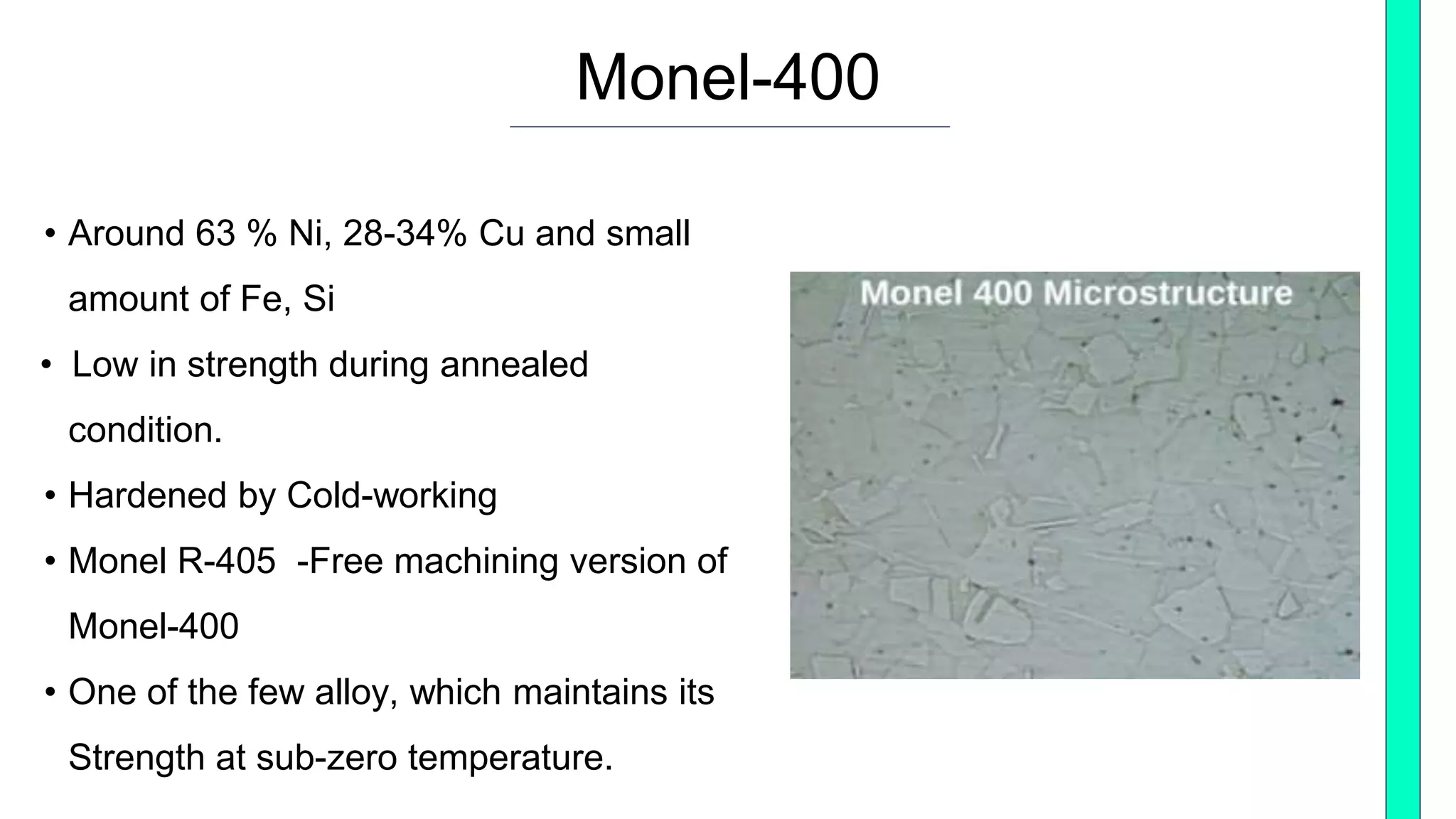
Monel-400
• Around 63 % Ni, 28-34% Cu and small
amount of Fe, Si
• Low in strength during annealed
condition.
• Hardened by Cold-working
• Monel R-405 -Free machining version of
Monel-400
• One of the few alloy, which maintains its
Strength at sub-zero temperature.
Properties:
• High Strength and Toughness over a
range of temperature
• Good weldability
• Excellent Corrosion Resistance
• Resistant to seawater, chlorine and alkali
• Good mechanical properties at low
temperature
Applications:
● Steam Turbine Blades
● High Temperature Valves
● Centrifugal Pump impellers
● Frame for eyeglasses
● Aerospace-related items
K-Monel
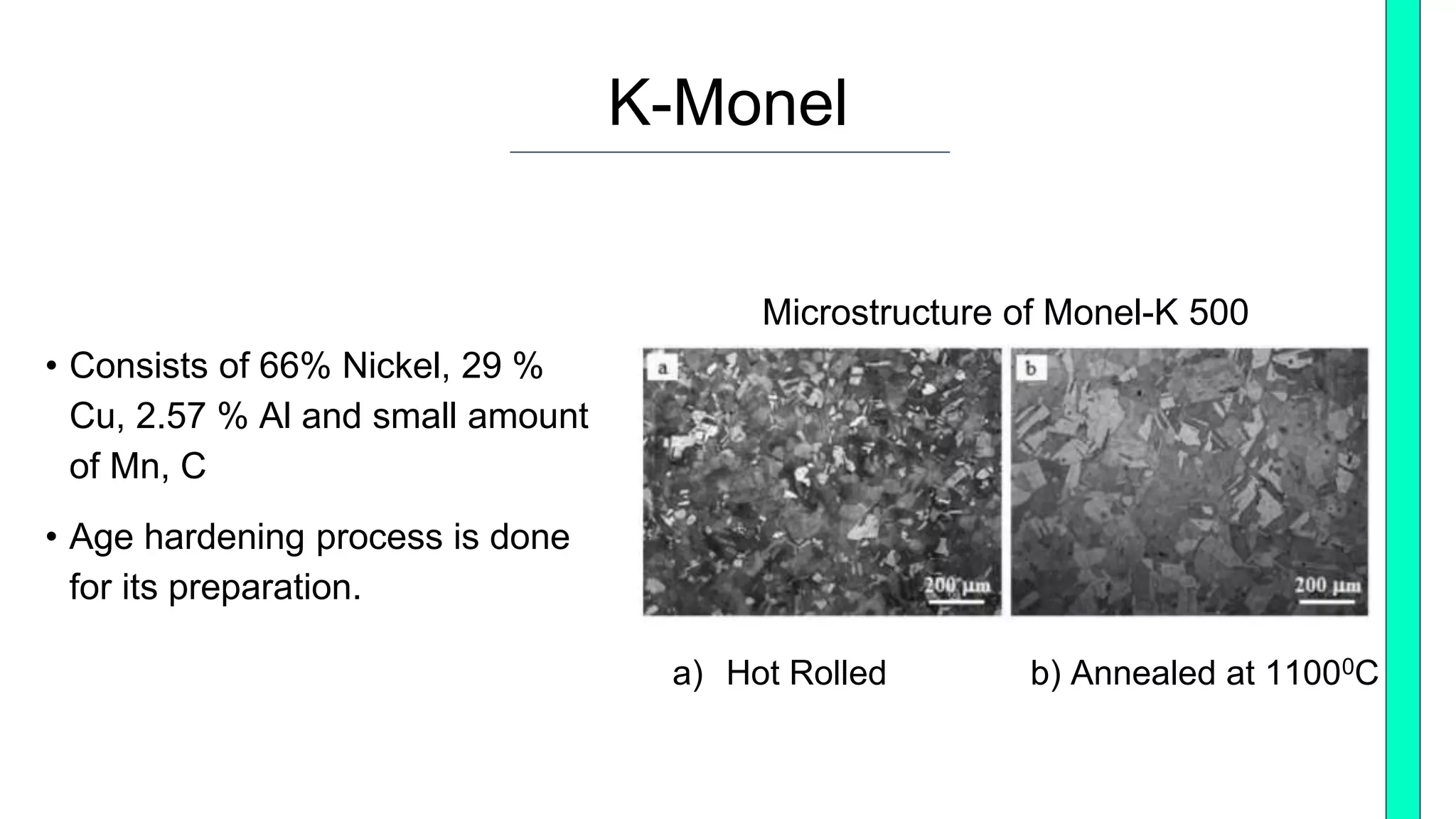
Microstructure of Monel-K 500
• Consists of 66% Nickel, 29 %
Cu, 2.57 % Al and small amount
of Mn, C
• Age hardening process is done
for its preparation.
a) Hot Rolled b) Annealed at 11000C
• Wholly Non-Magnetic
• Excellent corrosion-resistant properties
• Presence of Al increases strength and hardness
• Pump shafts, springs & valve stems etc.
• Electronic components where extra hardness is
required.
• Oil-well drill collars
Properties and applications
Nickel Chromium Alloys
● Higher chromium is necessary when the temperature
increases.
● Cr forms solid solution with Ni up to~30% at room
temperature.
● High corrosion resistance is due to high Cr addition.
(Passivation).
● Commercial alloys mainly contain 20–30% Cr and it’s
minor addition improves the mechanical and/or
chemical properties of alloys (typical ‘Nichrome’).
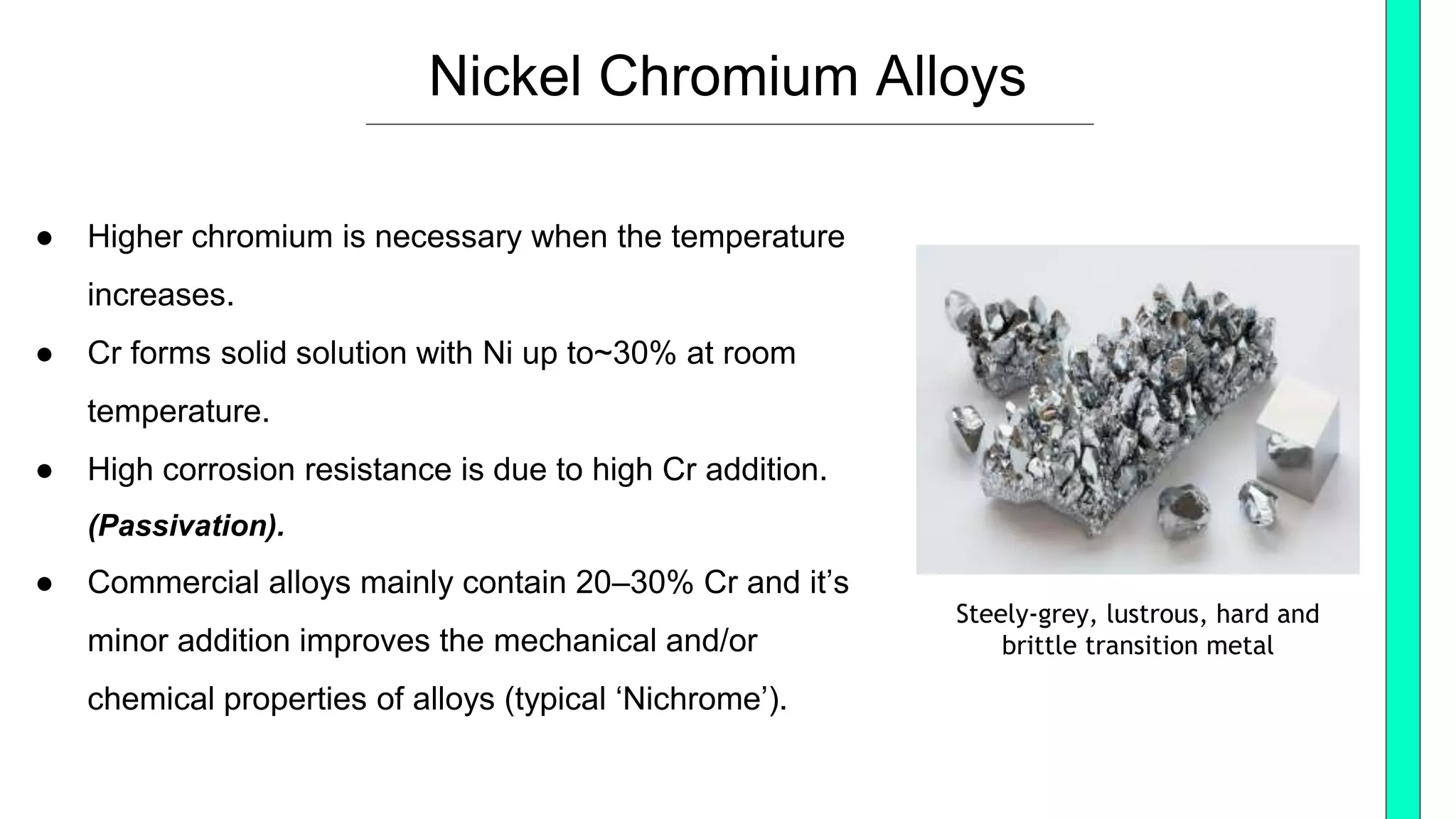
Steely-grey, lustrous, hard and
brittle transition metal
Nickel-Chromium
(Ni-Cr)
Phase diagram
● Consists of 80% Ni + 20% Cr
● Also known as Nichrome 80/20
Properties
● High melting point
● High electrical resistivity
● Good stability from deforming at high temperatures
● High mechanical strength and their high creep strength
Applications
● Resistance heating coils
● As explosives and fireworks in rocket igniters
● In microbiological laboratories
● Ceramic manufacturing industry (furnaces and hot wire cutters)
Nichrome
● Made of approx. 90% Ni and 10% Cr
Properties
● High electrical resistance
● Corrosion resistance
Applications
● Heating devices
● Thermocouples
● Hot wire cutters
● In oxidising conditions at high temperatures
Chromel
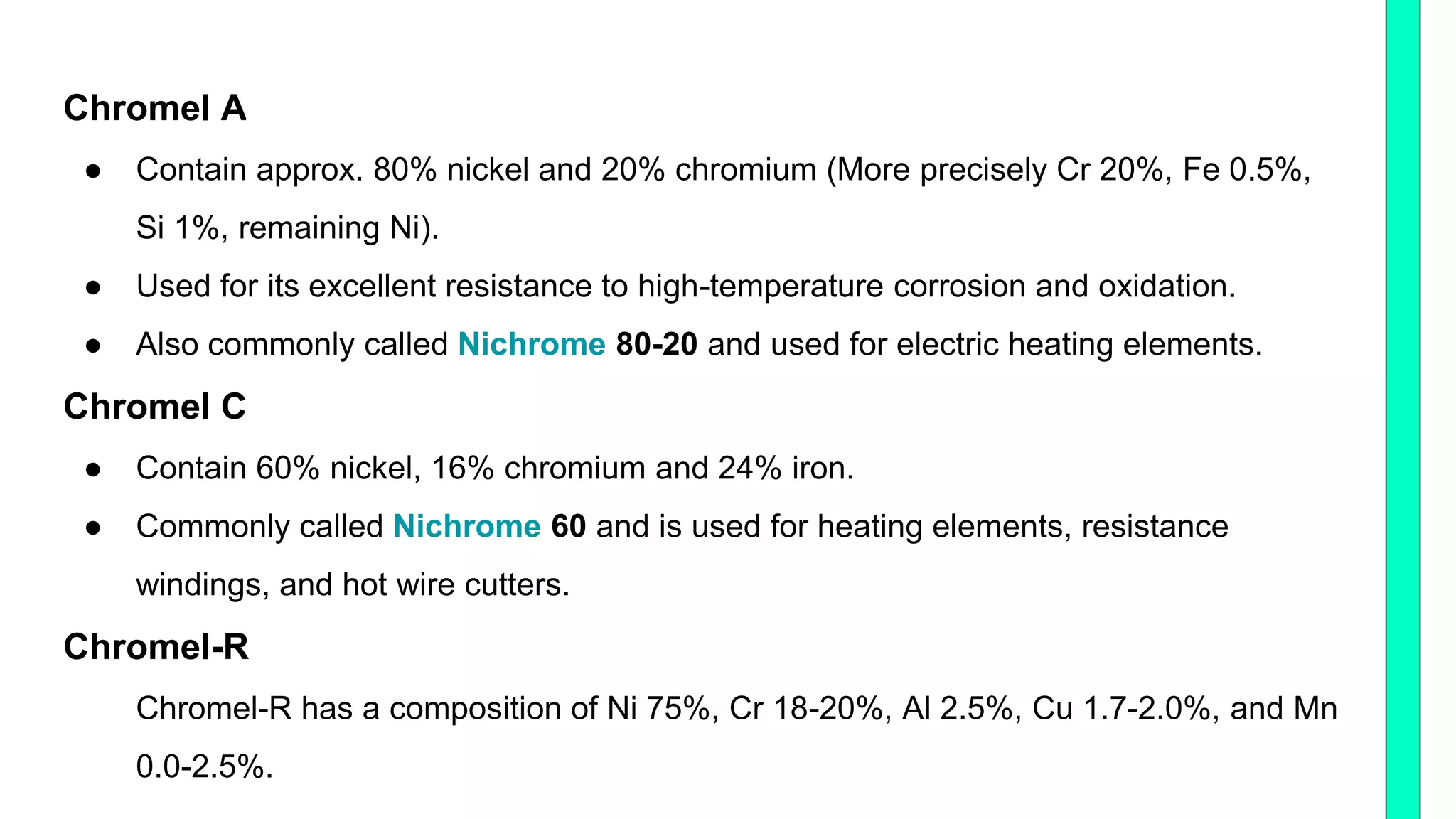
Chromel A
● Contain approx. 80% nickel and 20% chromium (More precisely Cr 20%, Fe 0.5%,
Si 1%, remaining Ni).
● Used for its excellent resistance to high-temperature corrosion and oxidation.
● Also commonly called Nichrome 80-20 and used for electric heating elements.
Chromel C
● Contain 60% nickel, 16% chromium and 24% iron.
● Commonly called Nichrome 60 and is used for heating elements, resistance
windings, and hot wire cutters.
Chromel-R
Chromel-R has a composition of Ni 75%, Cr 18-20%, Al 2.5%, Cu 1.7-2.0%, and Mn
0.0-2.5%.
Gemini space suit
The legs are covered with Chromel-R, which is a
cloth woven from stainless steel metal fibers, used to
protect the astronaut and suit from the hot exhaust
thrust of the Astronaut Maneuvering
Apollo 11 lunar EVA glove
Other Ni-based alloys
● Nickel-Iron Alloys
Applications include the desired property is a low rate of thermal
expansion.
● Nickel-Molybdenum Alloys
Offer high chemical resistance to strong acids and other reducers such
as hydrochloric acid, hydrogen chloride, sulfuric acid, and phosphoric
acid.
● Nickel-Titanium Alloys
Feature shape retention of shape memory properties.
Ni and ni based alloys

Ni and ni based alloys

  • 1.
  • 2.
    Contents ● Introduction toNickel ● Nickel - Copper alloys ● Nickel - Chromium alloys ● Conclusion
  • 3.
    Element Symbol: Ni AtomicNumber: 28 Classification: D-block transition metal Appearance: Solid silver-colored metal Discovery: Axel Frederik Cronstedt (1751) Electron Configuration: [Ar] 3d8 4s2 Crystal Structure: FCC Lattice Introduction to Nickel
  • 4.
    Commercially pure Nickel ●Contains 99.5% Ni (+Cr) ● Microstructure contains solid solution phase in annealed condition ● Corrosion resistant ● Used to make food-processing equipment, electronic parts and caustic handling equipment ● Is carcinogenic, causes skin and asthma-like allergies
  • 5.
    Classification of NickelAlloys ⮚Nickel-Copper Alloys (Monel) ⮚Nickel-Chromium Alloys ⮚Nickel-Aluminium Alloys ⮚Nickel-Based Superalloys ⮚Nickel-Iron Superalloys
  • 6.
  • 7.
    • Forms thebasis of Monel alloys • Addition of Copper (28-34%) improves corrosion resistance of Ni • Microstructural changes can occur depending upon the speed of cooling
  • 8.
    Monel • A groupof Nickel alloys primarily composed of Nickel(52-67%) and Copper • Single phase alloy • It is an expensive alloy. • There are different kinds of monel classified on the basis of their composition-
  • 9.
    Monel-400 • Around 63% Ni, 28-34% Cu and small amount of Fe, Si • Low in strength during annealed condition. • Hardened by Cold-working • Monel R-405 -Free machining version of Monel-400 • One of the few alloy, which maintains its Strength at sub-zero temperature.
  • 10.
    Properties: • High Strengthand Toughness over a range of temperature • Good weldability • Excellent Corrosion Resistance • Resistant to seawater, chlorine and alkali • Good mechanical properties at low temperature Applications: ● Steam Turbine Blades ● High Temperature Valves ● Centrifugal Pump impellers ● Frame for eyeglasses ● Aerospace-related items
  • 11.
    K-Monel Microstructure of Monel-K500 • Consists of 66% Nickel, 29 % Cu, 2.57 % Al and small amount of Mn, C • Age hardening process is done for its preparation. a) Hot Rolled b) Annealed at 11000C
  • 12.
    • Wholly Non-Magnetic •Excellent corrosion-resistant properties • Presence of Al increases strength and hardness • Pump shafts, springs & valve stems etc. • Electronic components where extra hardness is required. • Oil-well drill collars Properties and applications
  • 13.
    Nickel Chromium Alloys ●Higher chromium is necessary when the temperature increases. ● Cr forms solid solution with Ni up to~30% at room temperature. ● High corrosion resistance is due to high Cr addition. (Passivation). ● Commercial alloys mainly contain 20–30% Cr and it’s minor addition improves the mechanical and/or chemical properties of alloys (typical ‘Nichrome’). Steely-grey, lustrous, hard and brittle transition metal
  • 14.
  • 15.
    ● Consists of80% Ni + 20% Cr ● Also known as Nichrome 80/20 Properties ● High melting point ● High electrical resistivity ● Good stability from deforming at high temperatures ● High mechanical strength and their high creep strength Applications ● Resistance heating coils ● As explosives and fireworks in rocket igniters ● In microbiological laboratories ● Ceramic manufacturing industry (furnaces and hot wire cutters) Nichrome
  • 16.
    ● Made ofapprox. 90% Ni and 10% Cr Properties ● High electrical resistance ● Corrosion resistance Applications ● Heating devices ● Thermocouples ● Hot wire cutters ● In oxidising conditions at high temperatures Chromel
  • 17.
    Chromel A ● Containapprox. 80% nickel and 20% chromium (More precisely Cr 20%, Fe 0.5%, Si 1%, remaining Ni). ● Used for its excellent resistance to high-temperature corrosion and oxidation. ● Also commonly called Nichrome 80-20 and used for electric heating elements. Chromel C ● Contain 60% nickel, 16% chromium and 24% iron. ● Commonly called Nichrome 60 and is used for heating elements, resistance windings, and hot wire cutters. Chromel-R Chromel-R has a composition of Ni 75%, Cr 18-20%, Al 2.5%, Cu 1.7-2.0%, and Mn 0.0-2.5%.
  • 18.
    Gemini space suit Thelegs are covered with Chromel-R, which is a cloth woven from stainless steel metal fibers, used to protect the astronaut and suit from the hot exhaust thrust of the Astronaut Maneuvering Apollo 11 lunar EVA glove
  • 19.
    Other Ni-based alloys ●Nickel-Iron Alloys Applications include the desired property is a low rate of thermal expansion. ● Nickel-Molybdenum Alloys Offer high chemical resistance to strong acids and other reducers such as hydrochloric acid, hydrogen chloride, sulfuric acid, and phosphoric acid. ● Nickel-Titanium Alloys Feature shape retention of shape memory properties.