Superalloys
Properties and Applications
Contents
Classification of
Superalloys
Properties
Applications
Application in Oil-
Gas sector

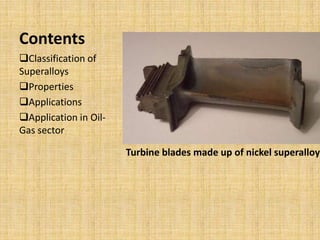
                       Turbine blades made up of nickel superalloy
Classification of Superalloys
• These alloys have austenitic FCC structure which have
   base alloying element of nickel, cobalt and iron.
• Further they are classified on the basis of pre-
   dominant element present in it.
• Alloying elements are Fe, Co, Ni, Cr, W (tungsten),
   Mo (molybdenum), Nb (niobium) and Ta (tantalum).
• Iron based alloys:
(a) 9-38 % nickel
(b) 15-22 % chromium
(c) 32-67 % iron
Common type of Iron based alloy is Incoloy
series.
• Cobalt based alloys:
(a) Up to 35% nickel
(b) 19-30 % chromium
(c) 30-65 % cobalt
Cobalt based alloys can retain their strength at
high temperature but they are not as strong as
nickel based alloys.
• Nickel based alloys:
(a) 38-76% nickel
(b) Up to 27 % chromium
(c) Up to 20 % cobalt.
Some of the common type of nickel based alloys
are Nimonic, Hastelloy and Inconel.
These are the most common types of
Superalloy which are widely used in turbine
blades
Properties of Superalloys
• Excellent mechanical strength and wear
  resistance at high temperature.
• Resistance to corrosion and oxidation at very
  high temperature.
• Good surface stability.
Applications of Superalloys
• In Aerospace : blades of turbines and in
  jet/rocket engines.
• In Marine : wide use in Submarines.
• In Chemical processing industries.
• Heat exchanger tubing
• Industrial gas turbines
• Nuclear Reactors
Superalloys

Superalloys

  • 1.
  • 2.
    Contents Classification of Superalloys Properties Applications Application inOil- Gas sector Turbine blades made up of nickel superalloy
  • 3.
    Classification of Superalloys •These alloys have austenitic FCC structure which have base alloying element of nickel, cobalt and iron. • Further they are classified on the basis of pre- dominant element present in it. • Alloying elements are Fe, Co, Ni, Cr, W (tungsten), Mo (molybdenum), Nb (niobium) and Ta (tantalum). • Iron based alloys: (a) 9-38 % nickel (b) 15-22 % chromium (c) 32-67 % iron Common type of Iron based alloy is Incoloy series.
  • 4.
    • Cobalt basedalloys: (a) Up to 35% nickel (b) 19-30 % chromium (c) 30-65 % cobalt Cobalt based alloys can retain their strength at high temperature but they are not as strong as nickel based alloys.
  • 5.
    • Nickel basedalloys: (a) 38-76% nickel (b) Up to 27 % chromium (c) Up to 20 % cobalt. Some of the common type of nickel based alloys are Nimonic, Hastelloy and Inconel. These are the most common types of Superalloy which are widely used in turbine blades
  • 6.
    Properties of Superalloys •Excellent mechanical strength and wear resistance at high temperature. • Resistance to corrosion and oxidation at very high temperature. • Good surface stability.
  • 7.
    Applications of Superalloys •In Aerospace : blades of turbines and in jet/rocket engines. • In Marine : wide use in Submarines. • In Chemical processing industries. • Heat exchanger tubing • Industrial gas turbines • Nuclear Reactors