SUPER ALLOYS
PREPARED BY:
Syed Nooruddin (D-12-MT-347)
Ali Asad Zaheer(D-12-MT-355)
Khurram Khan(D-12-MT-349)
Faisal Shabir (D-12-MT-384)
Manzoor Ahmed (D-12-MT-385)
Department of Metallurgy & Materials
Dawood University Of Engineering & Tech.(Karachi)
Contents
 Introduction
 Development
 Composition
 Types
 Processing & Properties
 Applications
 References
Introduction
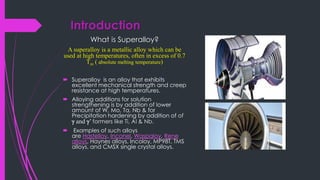
What is Superalloy?
A superalloy is a metallic alloy which can be
used at high temperatures, often in excess of 0.7
Tm ( absolute melting temperature)
 Superalloy is an alloy that exhibits
excellent mechanical strength and creep
resistance at high temperatures.
 Alloying additions for solution
strengthening is by addition of lower
amount of W, Mo, Ta, Nb & for
Precipitation hardening by addition of of
g and g’ formers like Ti, Al & Nb.
 Examples of such alloys
are Hastelloy, Inconel, Waspaloy, Rene
alloys, Haynes alloys, Incoloy, MP98T, TMS
alloys, and CMSX single crystal alloys.
Development of Super Alloys
 Superalloys develop high temperature strength through Solid
solution strengthening(SSS).
 SSS is a type of alloying that can be used to improve the strength of
the metals. It is the hardening mechanism process.
 The technique works by adding atoms of one element (alloying
element) to the crystalline lattice of another element (the base
metal).
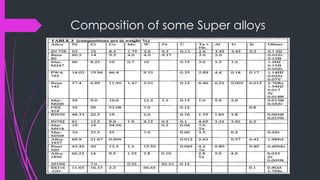
Composition of some Super alloys
Types of Super Alloys
 Ni – Based Superalloy.
 Co – Based Superalloy.
 Fe-Ni – Based Superalloy.
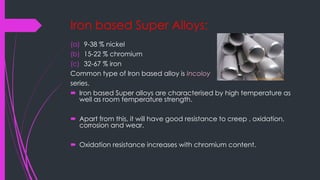
Iron based Super Alloys:
(a) 9-38 % nickel
(b) 15-22 % chromium
(c) 32-67 % iron
Common type of Iron based alloy is Incoloy
series.
 Iron based Super alloys are characterised by high temperature as
well as room temperature strength.
 Apart from this, it will have good resistance to creep , oxidation,
corrosion and wear.
 Oxidation resistance increases with chromium content.
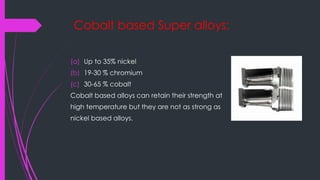
Cobalt based Super alloys:
(a) Up to 35% nickel
(b) 19-30 % chromium
(c) 30-65 % cobalt
Cobalt based alloys can retain their strength at
high temperature but they are not as strong as
nickel based alloys.
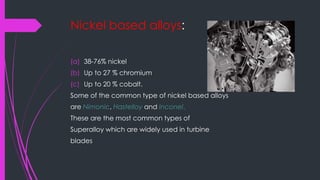
Nickel based alloys:
(a) 38-76% nickel
(b) Up to 27 % chromium
(c) Up to 20 % cobalt.
Some of the common type of nickel based alloys
are Nimonic, Hastelloy and Inconel.
These are the most common types of
Superalloy which are widely used in turbine
blades
Major phases in Nickel Superalloys
 Gamma (g)
 Gamma Prime (g')
 Carbides
 Topologically Close-Packed Phases
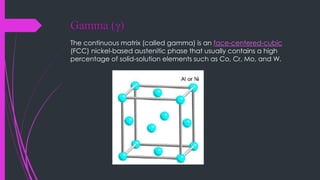
Gamma (g)
The continuous matrix (called gamma) is an face-centered-cubic
(FCC) nickel-based austenitic phase that usually contains a high
percentage of solid-solution elements such as Co, Cr, Mo, and W.
SEM micrograph of minor microstructural
constituents of the alloy in the g matrix.
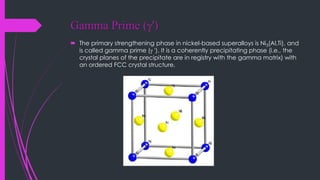
Gamma Prime (g')
 The primary strengthening phase in nickel-based superalloys is Ni3(Al,Ti), and
is called gamma prime (g '). It is a coherently precipitating phase (i.e., the
crystal planes of the precipitate are in registry with the gamma matrix) with
an ordered FCC crystal structure.
Carbides
Carbon, added at levels of 0.05-0.2%, combines with reactive
elements such as titanium, tantalum, and hafnium to form carbides
(e.g., TiC, TaC, or HfC). During heat treatment and service, these begin
to decompose and form lower carbides such as M23C6 and M6C,
which tend to form on the grain boundaries. These common carbides
all have an fcc crystal structure.
The general opinion is that in superalloys with grain boundaries,
carbides are beneficial by increasing rupture strength at high
tempeature.
Topologically Close-Packed Phases
These are generally undesirable, brittle phases that can form during
heat treatment or service.
TCPs (Sigma, Mu, Laves, etc.) usually form as plates (which
appear as needles on a single-plane microstructure).
TCPs are potentially damaging for two reasons: they tie up g
and g ' strengthening elements in a non-useful form, thus reducing
creep strength, and they can act as crack initiators because of their
brittle nature.
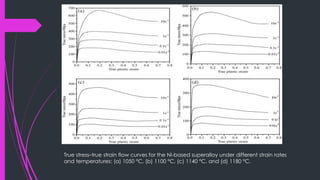
True stress–true strain flow curves for the Ni-based superalloy under different strain rates
and temperatures: (a) 1050 °C, (b) 1100 °C, (c) 1140 °C, and (d) 1180 °C.
Properties of Superalloys
 Excellent mechanical strength and wear resistance at high
temperature.
 Resistance to corrosion and oxidation at very high temperature.
 Good surface stability.
 High Impact toughness
APPLICATIONS
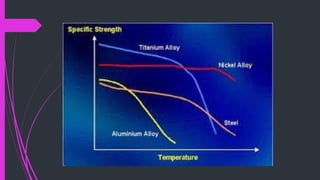
Nickel-based super alloys are widely used in load-bearing
structures to the highest homologous temperature
0.9 Tm, or 90% of their melting point.
 Aerospace
 Turbine blades and jet/rocket engines
 Marine industry
 Submarines
 Nuclear reactors
 Heat exchanger tubing
 Industrial gas turbines
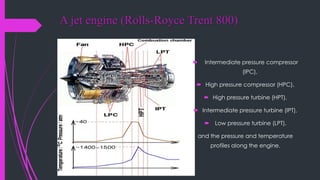
A jet engine (Rolls-Royce Trent 800)
 Intermediate pressure compressor
(IPC),
 High pressure compressor (HPC),
 High pressure turbine (HPT),
 Intermediate pressure turbine (IPT),
 Low pressure turbine (LPT),
and the pressure and temperature
profiles along the engine.
Gas Turbine for Marine Propulsion
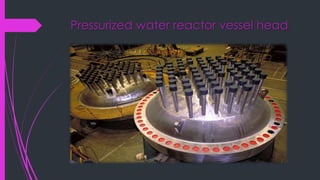
Pressurized water reactor vessel head
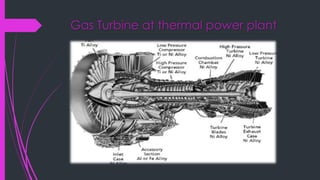
Gas Turbine at thermal power plant
Rocket Motor Engine
Turbine Blades (Jet Engine)
Nickel-based superalloy, about 65% of gamma-prime
precipitates in a polycrystalline gamma matrix.
References
 http://www.msm.cam.ac.uk/phase-trans/2003/Superalloys/superalloys.html.
 http://www.patentstorm.us/patents/5366695.html
 Manufacturing process for engineering materials by Kalpakjian
 Material science and Engg by William Callister
 F. Zupani, T. Bonˇcina, G. Lojen, B. Markoli, S. Spai, Structure of the continuously
cast Ni-based superalloy GMR 235, Journal of Materials Processing Technology
186 (2007) 200–206
 Dayong Cai, Liangyin Xiong, Wenchang Liu, Guidong Sun, Mei Yao,
Development of processing maps for a Ni-based superalloy, Materials
Characterization 58 (2007) 941–946
 F. Zupanic, T. B oncina, A. Krizman, B. Markoli, S. Spaic, Microstructural
constituents of the Ni-based superalloyGMR 235 in the as-cast condition, Scripta
Materialia 46 (2002) 667–672
Presentation on Supper Alloys

Presentation on Supper Alloys

  • 1.
    SUPER ALLOYS PREPARED BY: SyedNooruddin (D-12-MT-347) Ali Asad Zaheer(D-12-MT-355) Khurram Khan(D-12-MT-349) Faisal Shabir (D-12-MT-384) Manzoor Ahmed (D-12-MT-385) Department of Metallurgy & Materials Dawood University Of Engineering & Tech.(Karachi)
  • 3.
    Contents  Introduction  Development Composition  Types  Processing & Properties  Applications  References
  • 4.
    Introduction What is Superalloy? Asuperalloy is a metallic alloy which can be used at high temperatures, often in excess of 0.7 Tm ( absolute melting temperature)  Superalloy is an alloy that exhibits excellent mechanical strength and creep resistance at high temperatures.  Alloying additions for solution strengthening is by addition of lower amount of W, Mo, Ta, Nb & for Precipitation hardening by addition of of g and g’ formers like Ti, Al & Nb.  Examples of such alloys are Hastelloy, Inconel, Waspaloy, Rene alloys, Haynes alloys, Incoloy, MP98T, TMS alloys, and CMSX single crystal alloys.
  • 5.
    Development of SuperAlloys  Superalloys develop high temperature strength through Solid solution strengthening(SSS).  SSS is a type of alloying that can be used to improve the strength of the metals. It is the hardening mechanism process.  The technique works by adding atoms of one element (alloying element) to the crystalline lattice of another element (the base metal).
  • 6.
    Composition of someSuper alloys
  • 7.
    Types of SuperAlloys  Ni – Based Superalloy.  Co – Based Superalloy.  Fe-Ni – Based Superalloy.
  • 8.
    Iron based SuperAlloys: (a) 9-38 % nickel (b) 15-22 % chromium (c) 32-67 % iron Common type of Iron based alloy is Incoloy series.  Iron based Super alloys are characterised by high temperature as well as room temperature strength.  Apart from this, it will have good resistance to creep , oxidation, corrosion and wear.  Oxidation resistance increases with chromium content.
  • 9.
    Cobalt based Superalloys: (a) Up to 35% nickel (b) 19-30 % chromium (c) 30-65 % cobalt Cobalt based alloys can retain their strength at high temperature but they are not as strong as nickel based alloys.
  • 10.
    Nickel based alloys: (a)38-76% nickel (b) Up to 27 % chromium (c) Up to 20 % cobalt. Some of the common type of nickel based alloys are Nimonic, Hastelloy and Inconel. These are the most common types of Superalloy which are widely used in turbine blades
  • 11.
    Major phases inNickel Superalloys  Gamma (g)  Gamma Prime (g')  Carbides  Topologically Close-Packed Phases
  • 12.
    Gamma (g) The continuousmatrix (called gamma) is an face-centered-cubic (FCC) nickel-based austenitic phase that usually contains a high percentage of solid-solution elements such as Co, Cr, Mo, and W.
  • 13.
    SEM micrograph ofminor microstructural constituents of the alloy in the g matrix.
  • 14.
    Gamma Prime (g') The primary strengthening phase in nickel-based superalloys is Ni3(Al,Ti), and is called gamma prime (g '). It is a coherently precipitating phase (i.e., the crystal planes of the precipitate are in registry with the gamma matrix) with an ordered FCC crystal structure.
  • 15.
    Carbides Carbon, added atlevels of 0.05-0.2%, combines with reactive elements such as titanium, tantalum, and hafnium to form carbides (e.g., TiC, TaC, or HfC). During heat treatment and service, these begin to decompose and form lower carbides such as M23C6 and M6C, which tend to form on the grain boundaries. These common carbides all have an fcc crystal structure. The general opinion is that in superalloys with grain boundaries, carbides are beneficial by increasing rupture strength at high tempeature.
  • 16.
    Topologically Close-Packed Phases Theseare generally undesirable, brittle phases that can form during heat treatment or service. TCPs (Sigma, Mu, Laves, etc.) usually form as plates (which appear as needles on a single-plane microstructure). TCPs are potentially damaging for two reasons: they tie up g and g ' strengthening elements in a non-useful form, thus reducing creep strength, and they can act as crack initiators because of their brittle nature.
  • 17.
    True stress–true strainflow curves for the Ni-based superalloy under different strain rates and temperatures: (a) 1050 °C, (b) 1100 °C, (c) 1140 °C, and (d) 1180 °C.
  • 19.
    Properties of Superalloys Excellent mechanical strength and wear resistance at high temperature.  Resistance to corrosion and oxidation at very high temperature.  Good surface stability.  High Impact toughness
  • 20.
    APPLICATIONS Nickel-based super alloysare widely used in load-bearing structures to the highest homologous temperature 0.9 Tm, or 90% of their melting point.  Aerospace  Turbine blades and jet/rocket engines  Marine industry  Submarines  Nuclear reactors  Heat exchanger tubing  Industrial gas turbines
  • 21.
    A jet engine(Rolls-Royce Trent 800)  Intermediate pressure compressor (IPC),  High pressure compressor (HPC),  High pressure turbine (HPT),  Intermediate pressure turbine (IPT),  Low pressure turbine (LPT), and the pressure and temperature profiles along the engine.
  • 22.
    Gas Turbine forMarine Propulsion
  • 23.
  • 24.
    Gas Turbine atthermal power plant
  • 25.
  • 26.
    Turbine Blades (JetEngine) Nickel-based superalloy, about 65% of gamma-prime precipitates in a polycrystalline gamma matrix.
  • 27.
    References  http://www.msm.cam.ac.uk/phase-trans/2003/Superalloys/superalloys.html.  http://www.patentstorm.us/patents/5366695.html Manufacturing process for engineering materials by Kalpakjian  Material science and Engg by William Callister  F. Zupani, T. Bonˇcina, G. Lojen, B. Markoli, S. Spai, Structure of the continuously cast Ni-based superalloy GMR 235, Journal of Materials Processing Technology 186 (2007) 200–206  Dayong Cai, Liangyin Xiong, Wenchang Liu, Guidong Sun, Mei Yao, Development of processing maps for a Ni-based superalloy, Materials Characterization 58 (2007) 941–946  F. Zupanic, T. B oncina, A. Krizman, B. Markoli, S. Spaic, Microstructural constituents of the Ni-based superalloyGMR 235 in the as-cast condition, Scripta Materialia 46 (2002) 667–672