Engineering Materials
Syllabus: Classification, properties, criteria for material selection. (no. of lectures- 1)
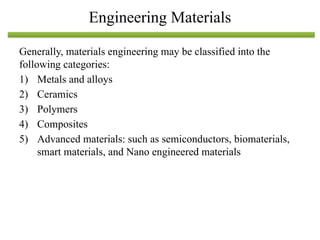
Generally, materials engineering may be classified into the
following categories:
1) Metals and alloys
2) Ceramics
3) Polymers
4) Composites
5) Advanced materials: such as semiconductors, biomaterials,
smart materials, and Nano engineered materials
Engineering Materials
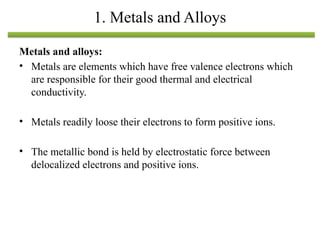
Metals and alloys:
• Metals are elements which have free valence electrons which
are responsible for their good thermal and electrical
conductivity.
• Metals readily loose their electrons to form positive ions.
• The metallic bond is held by electrostatic force between
delocalized electrons and positive ions.
1. Metals and Alloys
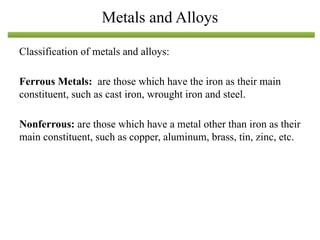
Classification of metals and alloys:
Ferrous Metals: are those which have the iron as their main
constituent, such as cast iron, wrought iron and steel.
Nonferrous: are those which have a metal other than iron as their
main constituent, such as copper, aluminum, brass, tin, zinc, etc.
Metals and Alloys
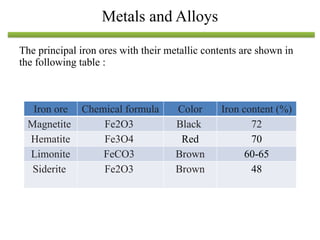
The principal iron ores with their metallic contents are shown in
the following table :
Iron ore Chemical formula Color Iron content (%)
Magnetite Fe2O3 Black 72
Hematite Fe3O4 Red 70
Limonite FeCO3 Brown 60-65
Siderite Fe2O3 Brown 48
Metals and Alloys
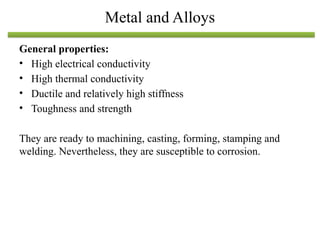
General properties:
• High electrical conductivity
• High thermal conductivity
• Ductile and relatively high stiffness
• Toughness and strength
They are ready to machining, casting, forming, stamping and
welding. Nevertheless, they are susceptible to corrosion.
Metal and Alloys
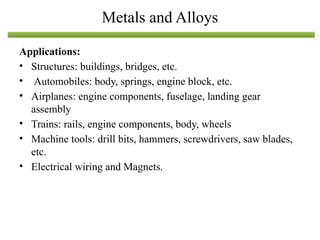
Applications:
• Structures: buildings, bridges, etc.
• Automobiles: body, springs, engine block, etc.
• Airplanes: engine components, fuselage, landing gear
assembly
• Trains: rails, engine components, body, wheels
• Machine tools: drill bits, hammers, screwdrivers, saw blades,
etc.
• Electrical wiring and Magnets.
Metals and Alloys
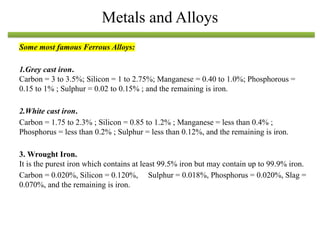
Some most famous Ferrous Alloys:
1.Grey cast iron.
Carbon = 3 to 3.5%; Silicon = 1 to 2.75%; Manganese = 0.40 to 1.0%; Phosphorous =
0.15 to 1% ; Sulphur = 0.02 to 0.15% ; and the remaining is iron.
2.White cast iron.
Carbon = 1.75 to 2.3% ; Silicon = 0.85 to 1.2% ; Manganese = less than 0.4% ;
Phosphorus = less than 0.2% ; Sulphur = less than 0.12%, and the remaining is iron.
3. Wrought Iron.
It is the purest iron which contains at least 99.5% iron but may contain up to 99.9% iron.
Carbon = 0.020%, Silicon = 0.120%, Sulphur = 0.018%, Phosphorus = 0.020%, Slag =
0.070%, and the remaining is iron.
Metals and Alloys
4. Steel
It is an alloy of iron and carbon, with carbon content up to a
maximum of 1.5%.
• Types of carbon steel
1. Dead mild steel — up to 0.15% carbon
2. Low carbon or mild steel — 0.15% to 0.45% carbon
3. Medium carbon steel — 0.45% to 0.8% carbon
4. High carbon steel — 0.8% to 1.5% carbon
Ferrous Metals
5. Alloy Steel
An alloy steel may be defined as a steel to which elements other
than carbon are added in sufficient amount to produce an
improvement in properties.
Mostly used to alloy steels are :
Nickel. It increases the strength and toughness of the steel. These
steels contain 2 to 5% nickel and from 0.1 to 0.5% carbon.
Chromium.
The most common chrome steels contains from 0.5 to 2%
chromium and 0.1 to 1.5% carbon. To enhance strength and
hardness.
Ferrous Metals
• Tungsten.
Steel containing 3 to 18% tungsten and 0.2 to 1.5% carbon is
used for cutting tools.
• Vanadium.
The addition of a very small amount of vanadium (less than
0.2%) produces a marked increase in tensile strength and
elastic limit in low and medium carbon steels without a loss of
ductility.
• Manganese.
containing over 1.5% manganese with a carbon range of 0.40
to 0.55%. It enhances high strength combined with fair
ductility.
Ferrous Metals
• Vanadium.
It aids in obtaining a fine grain structure in tool steel. The
addition of a very small amount of vanadium (less than 0.2%)
produces a marked increase in tensile strength and elastic limit
in low and medium carbon steels without a loss of ductility.
• Manganese.
The manganese alloy steels containing over 1.5% manganese
with a carbon range of 0.40 to 0.55% are used extensively in
gears, axles, shafts and other parts where high strength
combined with fair ductility is required.
Ferrous Metals
• Silicon.
Silicon steels containing from 1 to 2% silicon and 0.1 to 0.4%
carbon and other alloying elements are used for electrical
machinery, valves in I.C. engines, springs and corrosion
resisting materials.
Ferrous Metals
• Non-ferrous Metals
1. Aluminium
It is a light metal having specific gravity 2.7 and melting
point 658°C. The tensile strength of the metal varies from 90
MPa to 150 MPa.
Aluminum Alloys
Duralumin.
Metals and Alloys
2. Copper
It is one of the most widely used non-ferrous metals in industry.
It is a soft, malleable and ductile material with a reddish-brown
appearance. Its specific gravity is 8.9 and melting point is
1083°C. The tensile strength varies from 150 MPa to 400 MPa
under different conditions.
• Copper Alloys
• Copper-zinc alloys (Brass). This is fundamentally a binary
alloy of copper with zinc each 50%.
Metals and Alloys
• Copper-tin alloys (Bronze). The useful range of composition
is 75 to 95% copper and 5 to 25% tin.
• Gun Metal (Cu-Tin-Zinc)
It usually contains 88% copper, 10% tin and 2% zinc.
Metals and Alloys
• 3 Lead
The lead base alloys are employed where a cheap and
corrosion resistant material is required. An alloy containing
83% lead, 15% antimony, 1.5% tin and 0.5% copper is used
for large bearings subjected to light service.
• 4.Tin
It is brightly shining white metal. It is soft, malleable and
ductile. It can be rolled into very thin sheets. It is used for
making important alloys, fine solder, as a protective coating
for iron and steel sheets and for making tin foil used as
moisture proof packing.
Metals and Alloys
5 Nickel Base Alloys
• Monel metal. It is an important alloy of nickel and copper. It
contains 68% nickel, 29% copper and 3% other constituents
like iron, manganese, silicon and carbon.
• Inconel. It consists of 80% nickel, 14% chromium, and 6%
iron.
• Nichrome. It consists of 65% nickel, 15% chromium and 20%
iron.
• Nimonic. It consists of 80% nickel and 20% chromium.
Metals and Alloys
Ceramics:
Inorganic, non-metallic crystalline compounds, usually oxides
(SiO2, Al2O3, MgO, TiO2, BaO), Carbides (SiC), Nitrides
(Si3N4), Borides (TiB2), Silicide (WSi2, MoSi2).
Some literature includes glasses in the same category, however;
glasses are amorphous (nano crystalline) compounds.
2. Ceramics
Classification:
There are various classification systems of ceramic materials,
which may be attributed to one of two principal categories:
(i)application base system
(ii) composition base system.
Ceramics
General properties :
• Light weight
• Hard
• High strength
• Stronger in compression than tension
• Tend to be brittle
• Low electrical conductivity
• High temperature resistance
• Corrosion resistance
Ceramics
Applications:
• Electrical insulators
• Thermal insulation, coatings and windows
• Television screens
• Optical fibers (glass) and corrosion resistant
• Electrical devices: capacitors, resistors, transducers, etc.
• Highways and roads (concrete) and Building blocks (bricks)
• Building binders (cement, gypsum)
• Biocompatible coatings (fusion to bone)
• Magnetic materials (audio/video tapes, hard disks, etc.)
Ceramics
A polymer is long chain molecule made up many repeating units,
called monomers. Polymers can be natural (organic) or synthetic.
The properties of polymers are linked directly to their structure,
which is dictated mostly by intermolecular bonds.
Examples: Polymers are everywhere: in plastics (bottles, toys,
packaging), cosmetics, shampoos and other hair care products,
contact lenses, nature (crab shells, amber), food (proteins,
starches, gelatin, gum, gluten), fabric, balls, sneakers, and even in
your DNA!
3. Polymers
General properties:
• Compared with metals: Polymers have lower density, lower
stiffness and tend to creep.
• High thermal expansion and corrosion resistance.
• Low electrical and thermal conductivities.
• The prime weakness is that polymers do not withstand high
temperatures.
Polymers
Applications and Examples :
• Adhesives and glues
• Containers
• Moldable products (computer casings, telephone handsets,
disposable razors)
• Clothing and upholstery material (vinyl's, polyesters, nylon)
• Water-resistant coatings (latex)
• Biomaterials (organic/inorganic interfaces)
• Liquid crystals
• Low-friction materials (Teflon)
• Synthetic oils and greases
• Soaps and surfactants
Polymers
Composite:
A combination of two or more materials to achieve better
properties than that of the original materials. These materials are
usually composed of a “Matrix” and one or more of “Filler”
material.
• The primary objective of engineering composites is to increase
strength to weight ratio.
• Composite material properties are not necessarily isotropic,
i.e., directional properties can be synthesized according to the
type of filler materials and the method of fabrication.
4. Composite
General properties:
• Low weight
• High stiffness.
• Brittle
• Low thermal conductivity
• High fatigue resistance
Their properties can be tailored according to the component
materials.
Composites
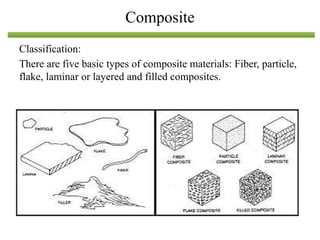
Classification:
There are five basic types of composite materials: Fiber, particle,
flake, laminar or layered and filled composites.
Composite
Applications :
• Sports equipment (golf club shafts, tennis rackets, bicycle frames)
• Aerospace materials
• Thermal insulation
• Concrete
• "Smart" materials (sensing and responding)
• Brake materials
Examples :
Reinforced cement concrete, a structural composite obtained by
combining cement (the matrix, i.e., the binder, obtained by a reaction
known as hydration, between cement and water), sand (fine
aggregate), gravel (coarse aggregate), and, thick steel fibers.
Composite
5.) Advanced Materials:
Materials that are utilized in high-technology (or high-tech)
applications are sometimes termed advanced materials. High
technology mean a device or product that operates or functions
using relatively intricate and sophisticated principles; examples
include electronic equipment (camcorders, CD/DVD players,
etc.), fiber-optic systems, spacecraft, aircraft, and military
rocketry.
These advanced materials are typically traditional materials
whose properties have been enhanced, and also newly developed,
high-performance materials. They may be of all material types
(e.g., metals, ceramics, polymers), and are normally expensive.
Composite
5.) Advanced Materials:
Advanced materials include:
Semiconductors (having electrical conductivities intermediate
between conductors and insulators).
Biomaterials (which must be compatible with body tissues).
Smart materials (those that sense and respond to changes in their
environments in predetermined manners).
Nano materials (those that have structural features on the order
of a nanometer, some of which may be designed on the
atomic/molecular level).
Advanced Materials
Mechanical Properties :
• Strength
• Stiffness
• Elasticity
• Plasticity
• Ductility
• Brittleness
• Malleability
• Toughness
• Machinability
• Resilience
• Creep
• Fatigue
• Hardness
Engineering Materials
 Strength. It is the ability of a material to resist the externally
applied forces without breaking or yielding. The internal
resistance offered by a part to an externally applied force is
called stress.
 Stiffness. It is the ability of a material to resist deformation
under stress. The modulus of elasticity is the measure of
stiffness.
 Elasticity. It is the property of a material to regain its original
shape after deformation when the external forces are removed.
This property is desirable for materials used in tools and
machines. It may be noted that steel is more elastic than
rubber.
Engineering Materials
 Plasticity. It is property of a material which retains the
deformation produced under load permanently. This property
of the material is necessary for forgings, in stamping images
on coins and in ornamental work.
 Ductility. It is the property of a material enabling it to be
drawn into wire with the application of a tensile force. A
ductile material must be both strong and plastic. The ductility
is usually measured by the terms, percentage elongation and
percentage reduction in area. The ductile material commonly
used in engineering practice (in order of diminishing ductility)
are mild steel, copper, aluminum, nickel, zinc, tin and lead.
Engineering Materials
 Brittleness. It is the property of a material opposite to
ductility. It is the property of breaking of a material with little
permanent distortion. Brittle materials when subjected to
tensile loads, snap off without giving any sensible elongation.
Cast iron is a brittle material.
 Malleability. It is a special case of ductility which permits
materials to be rolled or hammered into thin sheets. A
malleable material should be plastic but it is not essential to be
so strong. The malleable materials commonly used in
engineering practice (in order of diminishing malleability) are
lead, soft steel, wrought iron, copper and aluminum.
Engineering Materials
 Toughness. It is the property of a material to resist fracture
due to high impact loads like hammer blows. The toughness of
the material decreases when it is heated. It is measured by the
amount of energy that a unit volume of the material has
absorbed after being stressed up to the point of fracture. This
property is desirable in parts subjected to shock and impact
loads.
 Machinability. It is the property of a material which refers to
a relative case with which a material can be cut. The
machinability of a material can be measured in a number of
ways such as comparing the tool life for cutting different
materials or thrust required to remove the material at some
given rate or the energy required to remove a unit volume of
the material. It may be noted that brass can be easily machined
than steel.
Engineering Materials
 Resilience. It is the property of a material to absorb energy
and to resist shock and impact loads. It is measured by the
amount of energy absorbed per unit volume within elastic
limit. This property is essential for spring materials.
 Creep. When a part is subjected to a constant stress at high
temperature for a long period of time, it will undergo a slow
and permanent deformation called creep. This property is
considered in designing internal combustion engines, boilers
and turbines.
Engineering Materials
 Fatigue. When a material is subjected to repeated stresses, it
fails at stresses below the yield point stresses. Such type of
failure of a material is known as Fatigue. The failure is caused
by means of a progressive crack formation which are usually
fine and of microscopic size. This property is considered in
designing shafts, connecting rods, springs, gears, etc.
 Hardness. It is a very important property of the metals and
has a wide variety of meanings. It embraces many different
properties such as resistance to wear, scratching, deformation
and machinability etc. It also means the ability of a metal to
cut another metal.
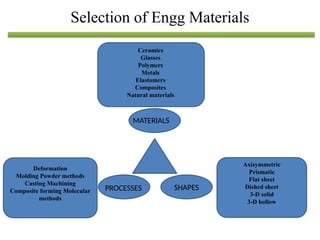
Engineering Materials
Ceramics
Glasses
Polymers
Metals
Elastomers
Composites
Natural materials
Deformation
Molding Powder methods
Casting Machining
Composite forming Molecular
methods
Axisymmetric
Prismatic
Flat sheet
Dished sheet
3-D solid
3-D hollow
MATERIALS
SHAPES
PROCESSES
Selection of Engg Materials
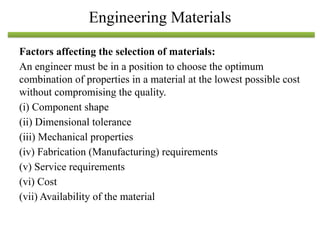
Factors affecting the selection of materials:
An engineer must be in a position to choose the optimum
combination of properties in a material at the lowest possible cost
without compromising the quality.
(i) Component shape
(ii) Dimensional tolerance
(iii) Mechanical properties
(iv) Fabrication (Manufacturing) requirements
(v) Service requirements
(vi) Cost
(vii) Availability of the material
Engineering Materials
Procedure for materials selection:
• The selection of an appropriate material and its subsequent
conversion into a useful product with desired shape and
properties can be a rather complex process.
• Nearly every engineered item goes through a sequence of
activities that includes: design, material selection, process
selection, production evaluation and possible redesign or
modification.
• Selection of a specific material for a particular use is a very
complex process. However, one can simplify the choice if the
details about following parameters are known:
(i) operating parameters, (ii) manufacturing processes, (iii)
functional requirements (iv) cost considerations
Engineering Materials

Introduction to Engineering materials properties

  • 1.
    Engineering Materials Syllabus: Classification,properties, criteria for material selection. (no. of lectures- 1)
  • 2.
    Generally, materials engineeringmay be classified into the following categories: 1) Metals and alloys 2) Ceramics 3) Polymers 4) Composites 5) Advanced materials: such as semiconductors, biomaterials, smart materials, and Nano engineered materials Engineering Materials
  • 3.
    Metals and alloys: •Metals are elements which have free valence electrons which are responsible for their good thermal and electrical conductivity. • Metals readily loose their electrons to form positive ions. • The metallic bond is held by electrostatic force between delocalized electrons and positive ions. 1. Metals and Alloys
  • 4.
    Classification of metalsand alloys: Ferrous Metals: are those which have the iron as their main constituent, such as cast iron, wrought iron and steel. Nonferrous: are those which have a metal other than iron as their main constituent, such as copper, aluminum, brass, tin, zinc, etc. Metals and Alloys
  • 5.
    The principal ironores with their metallic contents are shown in the following table : Iron ore Chemical formula Color Iron content (%) Magnetite Fe2O3 Black 72 Hematite Fe3O4 Red 70 Limonite FeCO3 Brown 60-65 Siderite Fe2O3 Brown 48 Metals and Alloys
  • 6.
    General properties: • Highelectrical conductivity • High thermal conductivity • Ductile and relatively high stiffness • Toughness and strength They are ready to machining, casting, forming, stamping and welding. Nevertheless, they are susceptible to corrosion. Metal and Alloys
  • 7.
    Applications: • Structures: buildings,bridges, etc. • Automobiles: body, springs, engine block, etc. • Airplanes: engine components, fuselage, landing gear assembly • Trains: rails, engine components, body, wheels • Machine tools: drill bits, hammers, screwdrivers, saw blades, etc. • Electrical wiring and Magnets. Metals and Alloys
  • 8.
    Some most famousFerrous Alloys: 1.Grey cast iron. Carbon = 3 to 3.5%; Silicon = 1 to 2.75%; Manganese = 0.40 to 1.0%; Phosphorous = 0.15 to 1% ; Sulphur = 0.02 to 0.15% ; and the remaining is iron. 2.White cast iron. Carbon = 1.75 to 2.3% ; Silicon = 0.85 to 1.2% ; Manganese = less than 0.4% ; Phosphorus = less than 0.2% ; Sulphur = less than 0.12%, and the remaining is iron. 3. Wrought Iron. It is the purest iron which contains at least 99.5% iron but may contain up to 99.9% iron. Carbon = 0.020%, Silicon = 0.120%, Sulphur = 0.018%, Phosphorus = 0.020%, Slag = 0.070%, and the remaining is iron. Metals and Alloys
  • 9.
    4. Steel It isan alloy of iron and carbon, with carbon content up to a maximum of 1.5%. • Types of carbon steel 1. Dead mild steel — up to 0.15% carbon 2. Low carbon or mild steel — 0.15% to 0.45% carbon 3. Medium carbon steel — 0.45% to 0.8% carbon 4. High carbon steel — 0.8% to 1.5% carbon Ferrous Metals
  • 10.
    5. Alloy Steel Analloy steel may be defined as a steel to which elements other than carbon are added in sufficient amount to produce an improvement in properties. Mostly used to alloy steels are : Nickel. It increases the strength and toughness of the steel. These steels contain 2 to 5% nickel and from 0.1 to 0.5% carbon. Chromium. The most common chrome steels contains from 0.5 to 2% chromium and 0.1 to 1.5% carbon. To enhance strength and hardness. Ferrous Metals
  • 11.
    • Tungsten. Steel containing3 to 18% tungsten and 0.2 to 1.5% carbon is used for cutting tools. • Vanadium. The addition of a very small amount of vanadium (less than 0.2%) produces a marked increase in tensile strength and elastic limit in low and medium carbon steels without a loss of ductility. • Manganese. containing over 1.5% manganese with a carbon range of 0.40 to 0.55%. It enhances high strength combined with fair ductility. Ferrous Metals
  • 12.
    • Vanadium. It aidsin obtaining a fine grain structure in tool steel. The addition of a very small amount of vanadium (less than 0.2%) produces a marked increase in tensile strength and elastic limit in low and medium carbon steels without a loss of ductility. • Manganese. The manganese alloy steels containing over 1.5% manganese with a carbon range of 0.40 to 0.55% are used extensively in gears, axles, shafts and other parts where high strength combined with fair ductility is required. Ferrous Metals
  • 13.
    • Silicon. Silicon steelscontaining from 1 to 2% silicon and 0.1 to 0.4% carbon and other alloying elements are used for electrical machinery, valves in I.C. engines, springs and corrosion resisting materials. Ferrous Metals
  • 14.
    • Non-ferrous Metals 1.Aluminium It is a light metal having specific gravity 2.7 and melting point 658°C. The tensile strength of the metal varies from 90 MPa to 150 MPa. Aluminum Alloys Duralumin. Metals and Alloys
  • 15.
    2. Copper It isone of the most widely used non-ferrous metals in industry. It is a soft, malleable and ductile material with a reddish-brown appearance. Its specific gravity is 8.9 and melting point is 1083°C. The tensile strength varies from 150 MPa to 400 MPa under different conditions. • Copper Alloys • Copper-zinc alloys (Brass). This is fundamentally a binary alloy of copper with zinc each 50%. Metals and Alloys
  • 16.
    • Copper-tin alloys(Bronze). The useful range of composition is 75 to 95% copper and 5 to 25% tin. • Gun Metal (Cu-Tin-Zinc) It usually contains 88% copper, 10% tin and 2% zinc. Metals and Alloys
  • 17.
    • 3 Lead Thelead base alloys are employed where a cheap and corrosion resistant material is required. An alloy containing 83% lead, 15% antimony, 1.5% tin and 0.5% copper is used for large bearings subjected to light service. • 4.Tin It is brightly shining white metal. It is soft, malleable and ductile. It can be rolled into very thin sheets. It is used for making important alloys, fine solder, as a protective coating for iron and steel sheets and for making tin foil used as moisture proof packing. Metals and Alloys
  • 18.
    5 Nickel BaseAlloys • Monel metal. It is an important alloy of nickel and copper. It contains 68% nickel, 29% copper and 3% other constituents like iron, manganese, silicon and carbon. • Inconel. It consists of 80% nickel, 14% chromium, and 6% iron. • Nichrome. It consists of 65% nickel, 15% chromium and 20% iron. • Nimonic. It consists of 80% nickel and 20% chromium. Metals and Alloys
  • 19.
    Ceramics: Inorganic, non-metallic crystallinecompounds, usually oxides (SiO2, Al2O3, MgO, TiO2, BaO), Carbides (SiC), Nitrides (Si3N4), Borides (TiB2), Silicide (WSi2, MoSi2). Some literature includes glasses in the same category, however; glasses are amorphous (nano crystalline) compounds. 2. Ceramics
  • 20.
    Classification: There are variousclassification systems of ceramic materials, which may be attributed to one of two principal categories: (i)application base system (ii) composition base system. Ceramics
  • 21.
    General properties : •Light weight • Hard • High strength • Stronger in compression than tension • Tend to be brittle • Low electrical conductivity • High temperature resistance • Corrosion resistance Ceramics
  • 22.
    Applications: • Electrical insulators •Thermal insulation, coatings and windows • Television screens • Optical fibers (glass) and corrosion resistant • Electrical devices: capacitors, resistors, transducers, etc. • Highways and roads (concrete) and Building blocks (bricks) • Building binders (cement, gypsum) • Biocompatible coatings (fusion to bone) • Magnetic materials (audio/video tapes, hard disks, etc.) Ceramics
  • 23.
    A polymer islong chain molecule made up many repeating units, called monomers. Polymers can be natural (organic) or synthetic. The properties of polymers are linked directly to their structure, which is dictated mostly by intermolecular bonds. Examples: Polymers are everywhere: in plastics (bottles, toys, packaging), cosmetics, shampoos and other hair care products, contact lenses, nature (crab shells, amber), food (proteins, starches, gelatin, gum, gluten), fabric, balls, sneakers, and even in your DNA! 3. Polymers
  • 24.
    General properties: • Comparedwith metals: Polymers have lower density, lower stiffness and tend to creep. • High thermal expansion and corrosion resistance. • Low electrical and thermal conductivities. • The prime weakness is that polymers do not withstand high temperatures. Polymers
  • 25.
    Applications and Examples: • Adhesives and glues • Containers • Moldable products (computer casings, telephone handsets, disposable razors) • Clothing and upholstery material (vinyl's, polyesters, nylon) • Water-resistant coatings (latex) • Biomaterials (organic/inorganic interfaces) • Liquid crystals • Low-friction materials (Teflon) • Synthetic oils and greases • Soaps and surfactants Polymers
  • 26.
    Composite: A combination oftwo or more materials to achieve better properties than that of the original materials. These materials are usually composed of a “Matrix” and one or more of “Filler” material. • The primary objective of engineering composites is to increase strength to weight ratio. • Composite material properties are not necessarily isotropic, i.e., directional properties can be synthesized according to the type of filler materials and the method of fabrication. 4. Composite
  • 27.
    General properties: • Lowweight • High stiffness. • Brittle • Low thermal conductivity • High fatigue resistance Their properties can be tailored according to the component materials. Composites
  • 28.
    Classification: There are fivebasic types of composite materials: Fiber, particle, flake, laminar or layered and filled composites. Composite
  • 29.
    Applications : • Sportsequipment (golf club shafts, tennis rackets, bicycle frames) • Aerospace materials • Thermal insulation • Concrete • "Smart" materials (sensing and responding) • Brake materials Examples : Reinforced cement concrete, a structural composite obtained by combining cement (the matrix, i.e., the binder, obtained by a reaction known as hydration, between cement and water), sand (fine aggregate), gravel (coarse aggregate), and, thick steel fibers. Composite
  • 30.
    5.) Advanced Materials: Materialsthat are utilized in high-technology (or high-tech) applications are sometimes termed advanced materials. High technology mean a device or product that operates or functions using relatively intricate and sophisticated principles; examples include electronic equipment (camcorders, CD/DVD players, etc.), fiber-optic systems, spacecraft, aircraft, and military rocketry. These advanced materials are typically traditional materials whose properties have been enhanced, and also newly developed, high-performance materials. They may be of all material types (e.g., metals, ceramics, polymers), and are normally expensive. Composite
  • 31.
    5.) Advanced Materials: Advancedmaterials include: Semiconductors (having electrical conductivities intermediate between conductors and insulators). Biomaterials (which must be compatible with body tissues). Smart materials (those that sense and respond to changes in their environments in predetermined manners). Nano materials (those that have structural features on the order of a nanometer, some of which may be designed on the atomic/molecular level). Advanced Materials
  • 32.
    Mechanical Properties : •Strength • Stiffness • Elasticity • Plasticity • Ductility • Brittleness • Malleability • Toughness • Machinability • Resilience • Creep • Fatigue • Hardness Engineering Materials
  • 33.
     Strength. Itis the ability of a material to resist the externally applied forces without breaking or yielding. The internal resistance offered by a part to an externally applied force is called stress.  Stiffness. It is the ability of a material to resist deformation under stress. The modulus of elasticity is the measure of stiffness.  Elasticity. It is the property of a material to regain its original shape after deformation when the external forces are removed. This property is desirable for materials used in tools and machines. It may be noted that steel is more elastic than rubber. Engineering Materials
  • 34.
     Plasticity. Itis property of a material which retains the deformation produced under load permanently. This property of the material is necessary for forgings, in stamping images on coins and in ornamental work.  Ductility. It is the property of a material enabling it to be drawn into wire with the application of a tensile force. A ductile material must be both strong and plastic. The ductility is usually measured by the terms, percentage elongation and percentage reduction in area. The ductile material commonly used in engineering practice (in order of diminishing ductility) are mild steel, copper, aluminum, nickel, zinc, tin and lead. Engineering Materials
  • 35.
     Brittleness. Itis the property of a material opposite to ductility. It is the property of breaking of a material with little permanent distortion. Brittle materials when subjected to tensile loads, snap off without giving any sensible elongation. Cast iron is a brittle material.  Malleability. It is a special case of ductility which permits materials to be rolled or hammered into thin sheets. A malleable material should be plastic but it is not essential to be so strong. The malleable materials commonly used in engineering practice (in order of diminishing malleability) are lead, soft steel, wrought iron, copper and aluminum. Engineering Materials
  • 36.
     Toughness. Itis the property of a material to resist fracture due to high impact loads like hammer blows. The toughness of the material decreases when it is heated. It is measured by the amount of energy that a unit volume of the material has absorbed after being stressed up to the point of fracture. This property is desirable in parts subjected to shock and impact loads.  Machinability. It is the property of a material which refers to a relative case with which a material can be cut. The machinability of a material can be measured in a number of ways such as comparing the tool life for cutting different materials or thrust required to remove the material at some given rate or the energy required to remove a unit volume of the material. It may be noted that brass can be easily machined than steel. Engineering Materials
  • 37.
     Resilience. Itis the property of a material to absorb energy and to resist shock and impact loads. It is measured by the amount of energy absorbed per unit volume within elastic limit. This property is essential for spring materials.  Creep. When a part is subjected to a constant stress at high temperature for a long period of time, it will undergo a slow and permanent deformation called creep. This property is considered in designing internal combustion engines, boilers and turbines. Engineering Materials
  • 38.
     Fatigue. Whena material is subjected to repeated stresses, it fails at stresses below the yield point stresses. Such type of failure of a material is known as Fatigue. The failure is caused by means of a progressive crack formation which are usually fine and of microscopic size. This property is considered in designing shafts, connecting rods, springs, gears, etc.  Hardness. It is a very important property of the metals and has a wide variety of meanings. It embraces many different properties such as resistance to wear, scratching, deformation and machinability etc. It also means the ability of a metal to cut another metal. Engineering Materials
  • 39.
    Ceramics Glasses Polymers Metals Elastomers Composites Natural materials Deformation Molding Powdermethods Casting Machining Composite forming Molecular methods Axisymmetric Prismatic Flat sheet Dished sheet 3-D solid 3-D hollow MATERIALS SHAPES PROCESSES Selection of Engg Materials
  • 40.
    Factors affecting theselection of materials: An engineer must be in a position to choose the optimum combination of properties in a material at the lowest possible cost without compromising the quality. (i) Component shape (ii) Dimensional tolerance (iii) Mechanical properties (iv) Fabrication (Manufacturing) requirements (v) Service requirements (vi) Cost (vii) Availability of the material Engineering Materials
  • 41.
    Procedure for materialsselection: • The selection of an appropriate material and its subsequent conversion into a useful product with desired shape and properties can be a rather complex process. • Nearly every engineered item goes through a sequence of activities that includes: design, material selection, process selection, production evaluation and possible redesign or modification. • Selection of a specific material for a particular use is a very complex process. However, one can simplify the choice if the details about following parameters are known: (i) operating parameters, (ii) manufacturing processes, (iii) functional requirements (iv) cost considerations Engineering Materials