Non-Ferrous Metals
and Their alloys
Aluminium and its alloys
Aluminium
• Large growth in use since 1950 (6 times)
• Abundant metal - 8% of earth’s crust
• Light weight SG = 2.7
• Moderate to high strength (depending on alloy)
• Conductivity high (pure metal & low alloys)
• Corrosion resistant (Al2O3 coating)
• Reflectivity high
• Non-magnetic
Extraction
• Al2O3 obtained from bauxite by the Bayer process
• Al2O3 reduced electrolytically by the Hall-Heroult process to
make aluminium
– The large energy requirement for this process is the major
proportion of the cost of aluminium, even with cheap
energy sources.
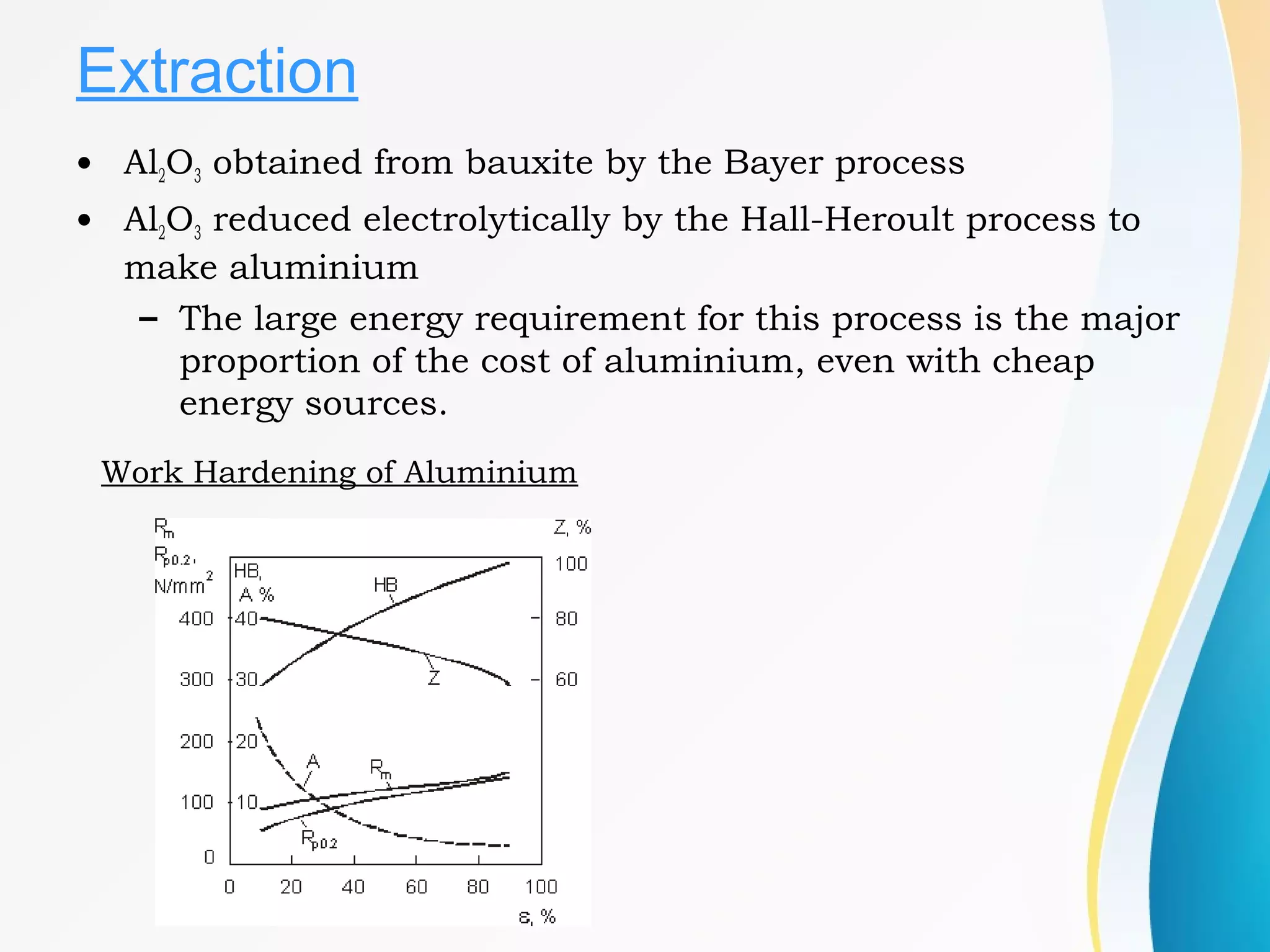
Work Hardening of Aluminium
Fabrication
• Ductile metal easily fabricated by rolling and extrusion
– Commercially pure metal can undertake a cold reduction
of 80 - 90% without annealing
– Anneal at 350˚C
• Machineability is good, but limited by the tendency to gall
Aluminium alloys
Deformable and heat treatable
1) Al-Cu-Mg-alloys (duraluminium)
2) Al-Cu-Mg-Si-alloys (forgable)
3) Al-Mg-Si-alloys (corrosion resistance)
4) Al-Zn-Mg-Cu-alloys (high strength)
5) Al-Cu-Mg-Ni-Fe-alloys (heat resistance)
Rm → 500 N/mm2
; Rp0,2 → 390 N/mm2
; A → 25%
Deformable and non heat treatable
1) Al-Mn-alloys
2) Al-Mg-alloys (magnalium)
Rm → 300 N/mm2; Rp0,2 → 150 N/mm2; A → 25%
Plane bearing alloys (for mono- and bimetallic bearing shells)
Al-Sn; Al-Ni; Al-Cu-Sb Typical structure of bearing material
Aluminium alloys
Cast alloys
1) Al-Si-alloys ↓ Rm (250), A = 1,7 % Pumps and engine
bodies, cylinder heads
2) Al-Cu-alloys Rm ↑ than I group
↓ high temp. strength
Cylinder heads,
apparatures bodies
3) Al-Si-Cu-alloys Rm ↑ than I group
↓ high temp. strength
→ 350 °C
4) Al-Mg-alloys
(magnalium)
Rm, A; good corr. resist.;
↓ castability
→ 100 °C
5) Al- other inclusions high temperature
strength
→ 350 °C
parts of aircraft engines
Rm → 340 N/mm2
; A → 8% (depending on casting mode)
Aluminium Lithium
• 1 to 4% Lithium raises strength, raises elastic modulus by up to
6%, lowers density by up to 4%
• Strengthened by Al3Li, Al2CuMg, AL2CuLi precipitates on aging
(depending on composition)
– Up to 585 MPa yield typical
• Good weldability as well as high strength
• Inferior toughness, ductility & stress corrosion performance
• Aerospace applications
Fabrication
• Machineability better than steel
• Cold and hot workability excellent
• Complex extrusion forms common
• Joined by fusion and non-fusion welding, brazing, soldering,
adhesive bonding and mechanical methods
Aluminium alloy designations
Deformable alloys
Series 1000 – pure Al
2000 – Al-Cu-alloys (for ex EN-AW-2014)
3000 – Al-Mn-alloys
4000 – Al-Si-alloys
5000 – Al-Mg-alloys
6000 – Al-Mg-Si-alloys
7000 – Al-Zn-alloys
8000 – Al-Fe-alloys
Cast alloys
Series 10000 – pure Al
20000 – Al-Cu-alloys
40000-48000 – Al-Si-alloys (for ex EN-AC-44000)
50000 – Al-Mg-alloys
70000 – Al-Zn-alloys
Designation (chemical composition based)
• deformable alloys – EN-AW...(EN-AW-AlCu4Mg1)
• cast alloys – EN-AC...(EN-AC-AlSi11)
Designation of heat treatment (EN515)
• O – annealed (for ex. 01, 02, 03)
• H – work hardened (for ex. H1, H2...H9)
• W – quenched
• T – heat treated (for ex. T1, T2...T10, T31, T3510)
Mainly used: T4 – quenching + natural ageing
T6 – quenching + artificial ageing
5000 series alloy applications
• Very popular alloys
• Marine, auto and aircraft applications
• Pressure vessels, cryogenics
• Communication towers
• Armour plate
• Some alloys prone to exfoliation or stress corrosion if Al8Mg5
forms in grain boundaries
– Avoid high Mg over 65˚C
Alclad
• Many multiphase alloys have inferior corrosion resistance
• These alloys are available as Alclad sheet or plate
• This material has a thin layer of pure aluminium roll bonded
to one or both surfaces to provide corrosion resistance
• Fabrication must be undertaken so as to maintain the
integrity of this coating
Alloy types and properties
• Strain hardened alloys (plus solid solution hardening)
• Precipitation (age) hardened alloys
• Dispersion strengthened alloys
• Yield strength from 28 MPa for 1050-O to 455 MPa for 2024-
T815
• Strength increases at low temperature
• No ductile-brittle transition
Precipitation (age) hardening
• Solution treatment - α+β
alloy is heated into a
temperature range to
dissolve all B. Quenching
retains B in solution
(supersaturated)
– Soft & ductile condition
• Aging - holding solution
treated alloy at a
temperature at which fine
precipitates of β are formed
– Strengthened condition
T (deg C)
Percentage BPure A
Liquid
L + α
α + β
α
Composition effects
• Alloys with low levels of B will only display a weak age
hardening effect
• Alloys with a high level of b, which cannot be dissolved on
solution treatment only display a weak hardening effect
• Alloys with with intermediate levels of B have the highest
strengthening effect
• These alloys only display a narrow temperature range for the
single phase phase field
• These alloys also have a wide solidification range, are likely to
crack during welding, and therefore have low weldability and
castability
Heat treatment of Al-alloys
Quenching → water → α-structure Rm, Rp0,2 ↓; A, Z ↑
Ageing: Naturally aged (20 °C) → structure α + Guinier`-Preston zones
artificially aged Rm, Rp0,2↑, A, Z ↓
low (100...150 °C) high (200...250 °C)
(Rp0,2/Rm = 0,6...0,7) (Rp0,2/Rm=0,90...95)
Result –
precipitation
hardening
Casting processes
• Die casting
• Permanent mould casting
• Sand mould casting
• Plaster casting
• Investment casting
– Lost wax
• Centrifugal
• Continuous casting
Cutting and machining
• Plasma cutting - edges require further dressing
• Shearing
• Sawing
– Extra clearance for chip release
• Planing and milling
– Power plane or rotary tungsten burrs
• Filing and scraping
Joining
• GTAW and GMAW are the most common processes
• OFW and MMAW require powerful fluxes
• Resistance and pressure processes can be used for many
alloys
• Brazing and soldering some application
• Adhesives and mechanical fastening widely applicable
• Depends on welding process and alloy composition
• Varies from readily weldable to not recommended
• Tenacious oxide film
• Prone to contamination
by O2, N2, H2
• High conductivity, low
melting temperature
• Slags are tenacious,
corrosive
• Welds tend to under
match strength
• Solidification cracking,
particularly of many
heat treatable alloys
Weldability
Fusion WeldingSolid Phase Welding
• Cold welding - 75% thickness
reduction at lap joint
• Ultrasonic welding - 1.5mm lap
joints
• Explosion welding - cladding and
lap joints
• Friction welding - Low weldability
alloys and dissimilar
combinations,
• Friction-stir welding
Brazing
• Restricted range of alloys
– 1000, 3000, 5000 with <2% Mg, 6000
• Al-Si filler materials
• Torch, dip, furnace or vacuum processes
• Clean parts by etching
• Fluxes are fluoride and chloride salts
– Residues MUST be removed
• Temperature control is critical
Mechanical properties
• Depend on
– Casting process
– Composition
• Alloy modification with sodium finer grain
– Heat treatment
• Up 435 MPa Yield strength possible
• Ductility up to 20%, but mostly <5%
Aluminium Products
• Cast alloys
• Wrought products
– Sheet, plate, foil
– Rod, bar, wire, tube
– Standard and special extruded shapes
– Forgings, impacts (combined extrusion and forging)
• Powder metallurgy (dispersion strengthened) products
Structural applications
• Static building structures (AS1664 series)
• Scaffolding and ladders
• Transportation
– Aerospace, road (trucks, buses, trailers), railway
• Machinery and industrial equipment
– Non-sparking tools, roofs to tanks, chemical process
vessels, jigs, patterns, instruments
• Consumer durables
– Structure of appliances: refrigerators, furniture, cooking
utensils
Thermal and Electrical
• Electrical
– Pure Al has 200% of the conductivity of copper weight for
weight
– Conductors, heat sinks, capacitors, wave guides,
antennas
• Reflectors
– Mirrors, search lights, loft insulation
Miscellaneous applications
• Packaging
– Drink cans, foil, hermetically sealed packs
• Powders and pastes
– Reflective paint, printing inks, pyrotechnics, thermit
welding
Limitations
• Temperature range of -240˚C to +200˚C for normal alloys
• Up to 350˚C for special alloys
• Up to 480˚C for short periods for dispersion strengthened
alloys
• Low modulus of elasticity, requires stiffening
• Inferior wear, creep, & fatigue properties to steel
Aluminium and its alloys

Aluminium and its alloys

  • 1.
  • 2.
  • 3.
    Aluminium • Large growthin use since 1950 (6 times) • Abundant metal - 8% of earth’s crust • Light weight SG = 2.7 • Moderate to high strength (depending on alloy) • Conductivity high (pure metal & low alloys) • Corrosion resistant (Al2O3 coating) • Reflectivity high • Non-magnetic
  • 4.
    Extraction • Al2O3 obtainedfrom bauxite by the Bayer process • Al2O3 reduced electrolytically by the Hall-Heroult process to make aluminium – The large energy requirement for this process is the major proportion of the cost of aluminium, even with cheap energy sources. Work Hardening of Aluminium
  • 5.
    Fabrication • Ductile metaleasily fabricated by rolling and extrusion – Commercially pure metal can undertake a cold reduction of 80 - 90% without annealing – Anneal at 350˚C • Machineability is good, but limited by the tendency to gall
  • 6.
    Aluminium alloys Deformable andheat treatable 1) Al-Cu-Mg-alloys (duraluminium) 2) Al-Cu-Mg-Si-alloys (forgable) 3) Al-Mg-Si-alloys (corrosion resistance) 4) Al-Zn-Mg-Cu-alloys (high strength) 5) Al-Cu-Mg-Ni-Fe-alloys (heat resistance) Rm → 500 N/mm2 ; Rp0,2 → 390 N/mm2 ; A → 25% Deformable and non heat treatable 1) Al-Mn-alloys 2) Al-Mg-alloys (magnalium) Rm → 300 N/mm2; Rp0,2 → 150 N/mm2; A → 25% Plane bearing alloys (for mono- and bimetallic bearing shells) Al-Sn; Al-Ni; Al-Cu-Sb Typical structure of bearing material
  • 7.
    Aluminium alloys Cast alloys 1)Al-Si-alloys ↓ Rm (250), A = 1,7 % Pumps and engine bodies, cylinder heads 2) Al-Cu-alloys Rm ↑ than I group ↓ high temp. strength Cylinder heads, apparatures bodies 3) Al-Si-Cu-alloys Rm ↑ than I group ↓ high temp. strength → 350 °C 4) Al-Mg-alloys (magnalium) Rm, A; good corr. resist.; ↓ castability → 100 °C 5) Al- other inclusions high temperature strength → 350 °C parts of aircraft engines Rm → 340 N/mm2 ; A → 8% (depending on casting mode)
  • 8.
    Aluminium Lithium • 1to 4% Lithium raises strength, raises elastic modulus by up to 6%, lowers density by up to 4% • Strengthened by Al3Li, Al2CuMg, AL2CuLi precipitates on aging (depending on composition) – Up to 585 MPa yield typical • Good weldability as well as high strength • Inferior toughness, ductility & stress corrosion performance • Aerospace applications Fabrication • Machineability better than steel • Cold and hot workability excellent • Complex extrusion forms common • Joined by fusion and non-fusion welding, brazing, soldering, adhesive bonding and mechanical methods
  • 9.
    Aluminium alloy designations Deformablealloys Series 1000 – pure Al 2000 – Al-Cu-alloys (for ex EN-AW-2014) 3000 – Al-Mn-alloys 4000 – Al-Si-alloys 5000 – Al-Mg-alloys 6000 – Al-Mg-Si-alloys 7000 – Al-Zn-alloys 8000 – Al-Fe-alloys Cast alloys Series 10000 – pure Al 20000 – Al-Cu-alloys 40000-48000 – Al-Si-alloys (for ex EN-AC-44000) 50000 – Al-Mg-alloys 70000 – Al-Zn-alloys Designation (chemical composition based) • deformable alloys – EN-AW...(EN-AW-AlCu4Mg1) • cast alloys – EN-AC...(EN-AC-AlSi11) Designation of heat treatment (EN515) • O – annealed (for ex. 01, 02, 03) • H – work hardened (for ex. H1, H2...H9) • W – quenched • T – heat treated (for ex. T1, T2...T10, T31, T3510) Mainly used: T4 – quenching + natural ageing T6 – quenching + artificial ageing
  • 10.
    5000 series alloyapplications • Very popular alloys • Marine, auto and aircraft applications • Pressure vessels, cryogenics • Communication towers • Armour plate • Some alloys prone to exfoliation or stress corrosion if Al8Mg5 forms in grain boundaries – Avoid high Mg over 65˚C
  • 11.
    Alclad • Many multiphasealloys have inferior corrosion resistance • These alloys are available as Alclad sheet or plate • This material has a thin layer of pure aluminium roll bonded to one or both surfaces to provide corrosion resistance • Fabrication must be undertaken so as to maintain the integrity of this coating
  • 12.
    Alloy types andproperties • Strain hardened alloys (plus solid solution hardening) • Precipitation (age) hardened alloys • Dispersion strengthened alloys • Yield strength from 28 MPa for 1050-O to 455 MPa for 2024- T815 • Strength increases at low temperature • No ductile-brittle transition
  • 13.
    Precipitation (age) hardening •Solution treatment - α+β alloy is heated into a temperature range to dissolve all B. Quenching retains B in solution (supersaturated) – Soft & ductile condition • Aging - holding solution treated alloy at a temperature at which fine precipitates of β are formed – Strengthened condition T (deg C) Percentage BPure A Liquid L + α α + β α
  • 14.
    Composition effects • Alloyswith low levels of B will only display a weak age hardening effect • Alloys with a high level of b, which cannot be dissolved on solution treatment only display a weak hardening effect • Alloys with with intermediate levels of B have the highest strengthening effect • These alloys only display a narrow temperature range for the single phase phase field • These alloys also have a wide solidification range, are likely to crack during welding, and therefore have low weldability and castability
  • 15.
    Heat treatment ofAl-alloys Quenching → water → α-structure Rm, Rp0,2 ↓; A, Z ↑ Ageing: Naturally aged (20 °C) → structure α + Guinier`-Preston zones artificially aged Rm, Rp0,2↑, A, Z ↓ low (100...150 °C) high (200...250 °C) (Rp0,2/Rm = 0,6...0,7) (Rp0,2/Rm=0,90...95) Result – precipitation hardening
  • 16.
    Casting processes • Diecasting • Permanent mould casting • Sand mould casting • Plaster casting • Investment casting – Lost wax • Centrifugal • Continuous casting
  • 17.
    Cutting and machining •Plasma cutting - edges require further dressing • Shearing • Sawing – Extra clearance for chip release • Planing and milling – Power plane or rotary tungsten burrs • Filing and scraping Joining • GTAW and GMAW are the most common processes • OFW and MMAW require powerful fluxes • Resistance and pressure processes can be used for many alloys • Brazing and soldering some application • Adhesives and mechanical fastening widely applicable
  • 18.
    • Depends onwelding process and alloy composition • Varies from readily weldable to not recommended • Tenacious oxide film • Prone to contamination by O2, N2, H2 • High conductivity, low melting temperature • Slags are tenacious, corrosive • Welds tend to under match strength • Solidification cracking, particularly of many heat treatable alloys Weldability Fusion WeldingSolid Phase Welding • Cold welding - 75% thickness reduction at lap joint • Ultrasonic welding - 1.5mm lap joints • Explosion welding - cladding and lap joints • Friction welding - Low weldability alloys and dissimilar combinations, • Friction-stir welding
  • 19.
    Brazing • Restricted rangeof alloys – 1000, 3000, 5000 with <2% Mg, 6000 • Al-Si filler materials • Torch, dip, furnace or vacuum processes • Clean parts by etching • Fluxes are fluoride and chloride salts – Residues MUST be removed • Temperature control is critical
  • 20.
    Mechanical properties • Dependon – Casting process – Composition • Alloy modification with sodium finer grain – Heat treatment • Up 435 MPa Yield strength possible • Ductility up to 20%, but mostly <5%
  • 21.
    Aluminium Products • Castalloys • Wrought products – Sheet, plate, foil – Rod, bar, wire, tube – Standard and special extruded shapes – Forgings, impacts (combined extrusion and forging) • Powder metallurgy (dispersion strengthened) products
  • 22.
    Structural applications • Staticbuilding structures (AS1664 series) • Scaffolding and ladders • Transportation – Aerospace, road (trucks, buses, trailers), railway • Machinery and industrial equipment – Non-sparking tools, roofs to tanks, chemical process vessels, jigs, patterns, instruments • Consumer durables – Structure of appliances: refrigerators, furniture, cooking utensils
  • 23.
    Thermal and Electrical •Electrical – Pure Al has 200% of the conductivity of copper weight for weight – Conductors, heat sinks, capacitors, wave guides, antennas • Reflectors – Mirrors, search lights, loft insulation Miscellaneous applications • Packaging – Drink cans, foil, hermetically sealed packs • Powders and pastes – Reflective paint, printing inks, pyrotechnics, thermit welding
  • 24.
    Limitations • Temperature rangeof -240˚C to +200˚C for normal alloys • Up to 350˚C for special alloys • Up to 480˚C for short periods for dispersion strengthened alloys • Low modulus of elasticity, requires stiffening • Inferior wear, creep, & fatigue properties to steel