WIND TUNNEL AND ITS TYPES
GUIDED BY, PRESENTED BY,
MR.RATHEESH R GROUP NO:9
ASSO.PROFESSOR ME A, S7
DEPARTMENT OF MECHANICAL ENGINEERING ROLL NO:45-49
SBCE, PATTOOR
12/31/2019 1DEPARTMENT OF MECHANICAL ENGINEERING
INTRODUCTION
 WIND TUNNEL
 Wind tunnel is a laboratory facility for producing high
velocity flow that can be used for simulating different flow
Mach number situations for testing of turbine blades, aerofoil
sections, and for simulating flight conditions of jet engines
,missiles ,etc.
 Wind tunnel can be subsonic, transonic or supersonic,
depending on the flow Mach no: in the test section.
12/31/20192
DEPARTMENT OF MECHANICAL ENGINEERING
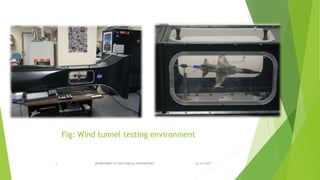
Fig: Wind tunnel testing environment
12/31/20193 DEPARTMENT OF MECHANICAL ENGINEERING
TYPES OF WIND TUNNELS
1. Blow Down Wind Tunnel
2. Atmospheric Entry Wind Tunnel
3. High Enthalpy Wind Tunnel
4. Continuous Flow Wind Tunnel
a. Open Circuit Wind Tunnel for Subsonic Testing
b. Open Circuit Wind Tunnel for Supersonic Testing
c. Closed Circuit Wind Tunnel
12/31/2019 4DEPARTMENT OF MECHANICAL ENGINEERING
1. Blow Down Wind Tunnel
12/31/2019 5DEPARTMENT OF MECHANICAL ENGINEERING
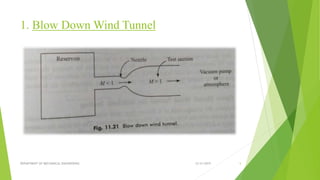
 High pressure air (or gas ) stored in large reservoirs are used for
supplying fluid to the test section through a convergent –
divergent nozzle .
 A quick opening valve between the reservoir and nozzle allows
flow of high pressure air (or gas) through the nozzle and test
section. In this type testing time depends on the capacity of
reservoir.
12/31/2019 6DEPARTMENT OF MECHANICAL ENGINEERING
2.Atmospheric Entry Wind Tunnel
12/31/2019 7DEPARTMENT OF MECHANICAL ENGINEERING
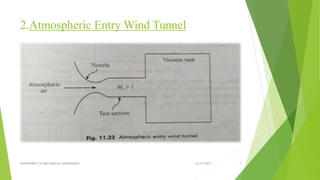
 Atmospheric air enters the test section through a convergent-
divergent nozzle.
 The low back pressure required for flow expansion in nozzle is
created by discharging the air directly into an evacuated tank.
 The testing time in this type of wind tunnel can be increased by
continuously operating vacuum pump fitted to the tank.
12/31/2019DEPARTMENT OF MECHANICAL ENGINEERING 8
3.High Enthalpy Wind Tunnel
12/31/2019DEPARTMENT OF MECHANICAL ENGINEERING 9
 In a high enthalpy wind tunnel, a shock tube is employed for
generating a high pressure, high enthalpy fluid for expansion in
the nozzle to get the required conditions in the test section.
 A shock tube is a duct in which Mach number flow is generated
by passing a shock wave through it.
12/31/2019DEPARTMENT OF MECHANICAL ENGINEERING 10
4.Continuous Flow Wind Tunnel
 Continuous floe wind tunnels are employed when test is to be
conducted for longer duration . The limiting factor for continuous
flow wind tunnel is the power available for running the
compressor , since for larger sections several hundred MW of
power is required.
 Continuous flow wind tunnel can be open type or closed type. In
open type wind tunnel the atmospheric air is taken in and
exhausted to the atmosphere.
12/31/2019DEPARTMENT OF MECHANICAL ENGINEERING 11
A. Open Circuit Wind Tunnel for Subsonic
Testing
12/31/2019DEPARTMENT OF MECHANICAL ENGINEERING 12
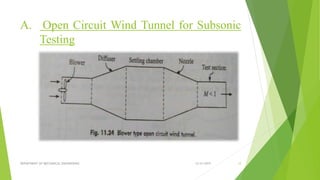
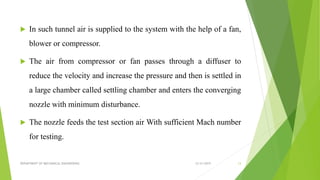
 In such tunnel air is supplied to the system with the help of a fan,
blower or compressor.
 The air from compressor or fan passes through a diffuser to
reduce the velocity and increase the pressure and then is settled in
a large chamber called settling chamber and enters the converging
nozzle with minimum disturbance.
 The nozzle feeds the test section air With sufficient Mach number
for testing.
12/31/2019DEPARTMENT OF MECHANICAL ENGINEERING 13
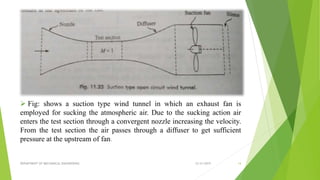
 Fig: shows a suction type wind tunnel in which an exhaust fan is
employed for sucking the atmospheric air. Due to the sucking action air
enters the test section through a convergent nozzle increasing the velocity.
From the test section the air passes through a diffuser to get sufficient
pressure at the upstream of fan.
12/31/2019DEPARTMENT OF MECHANICAL ENGINEERING 14
B. Open Circuit wind Tunnel for Supersonic
Testing
12/31/2019DEPARTMENT OF MECHANICAL ENGINEERING 15
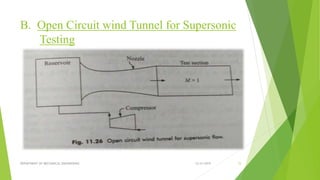
 It is similar to blow down type except that the reservoir is
continuously supplied with the high pressure air using a
compressor. From the reservoir, the convergent-divergent nozzle
feeds air at supersonic Mach number to the test section
 The shortcoming of this type of wind tunnel is that a continuous
amount of energy is thrown away into the atmosphere, thus
requiring a high pressure ratio and power of compressor.
12/31/2019DEPARTMENT OF MECHANICAL ENGINEERING 16
C. Closed Circuit Wind Tunnel
12/31/2019DEPARTMENT OF MECHANICAL ENGINEERING 17
 This type of wind tunnel overcome some of the problem
mentioned in open circuit systems.
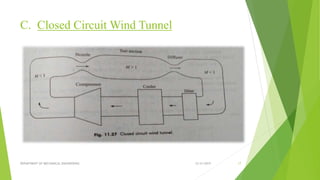
 The arrangement of the tunnel consist of a compressor, a
convergent-divergent nozzle, test section, diffuser and a cooler.
 On account of closed circuit any gas besides air can be used.
 The K.E at the exit of the test section is discovered by a
supersonic diffuser.
12/31/2019DEPARTMENT OF MECHANICAL ENGINEERING 18
THANK YOU
12/31/2019DEPARTMENT OF MECHANICAL ENGINEERING 19

Types of Wind tunnels

  • 1.
    WIND TUNNEL ANDITS TYPES GUIDED BY, PRESENTED BY, MR.RATHEESH R GROUP NO:9 ASSO.PROFESSOR ME A, S7 DEPARTMENT OF MECHANICAL ENGINEERING ROLL NO:45-49 SBCE, PATTOOR 12/31/2019 1DEPARTMENT OF MECHANICAL ENGINEERING
  • 2.
    INTRODUCTION  WIND TUNNEL Wind tunnel is a laboratory facility for producing high velocity flow that can be used for simulating different flow Mach number situations for testing of turbine blades, aerofoil sections, and for simulating flight conditions of jet engines ,missiles ,etc.  Wind tunnel can be subsonic, transonic or supersonic, depending on the flow Mach no: in the test section. 12/31/20192 DEPARTMENT OF MECHANICAL ENGINEERING
  • 3.
    Fig: Wind tunneltesting environment 12/31/20193 DEPARTMENT OF MECHANICAL ENGINEERING
  • 4.
    TYPES OF WINDTUNNELS 1. Blow Down Wind Tunnel 2. Atmospheric Entry Wind Tunnel 3. High Enthalpy Wind Tunnel 4. Continuous Flow Wind Tunnel a. Open Circuit Wind Tunnel for Subsonic Testing b. Open Circuit Wind Tunnel for Supersonic Testing c. Closed Circuit Wind Tunnel 12/31/2019 4DEPARTMENT OF MECHANICAL ENGINEERING
  • 5.
    1. Blow DownWind Tunnel 12/31/2019 5DEPARTMENT OF MECHANICAL ENGINEERING
  • 6.
     High pressureair (or gas ) stored in large reservoirs are used for supplying fluid to the test section through a convergent – divergent nozzle .  A quick opening valve between the reservoir and nozzle allows flow of high pressure air (or gas) through the nozzle and test section. In this type testing time depends on the capacity of reservoir. 12/31/2019 6DEPARTMENT OF MECHANICAL ENGINEERING
  • 7.
    2.Atmospheric Entry WindTunnel 12/31/2019 7DEPARTMENT OF MECHANICAL ENGINEERING
  • 8.
     Atmospheric airenters the test section through a convergent- divergent nozzle.  The low back pressure required for flow expansion in nozzle is created by discharging the air directly into an evacuated tank.  The testing time in this type of wind tunnel can be increased by continuously operating vacuum pump fitted to the tank. 12/31/2019DEPARTMENT OF MECHANICAL ENGINEERING 8
  • 9.
    3.High Enthalpy WindTunnel 12/31/2019DEPARTMENT OF MECHANICAL ENGINEERING 9
  • 10.
     In ahigh enthalpy wind tunnel, a shock tube is employed for generating a high pressure, high enthalpy fluid for expansion in the nozzle to get the required conditions in the test section.  A shock tube is a duct in which Mach number flow is generated by passing a shock wave through it. 12/31/2019DEPARTMENT OF MECHANICAL ENGINEERING 10
  • 11.
    4.Continuous Flow WindTunnel  Continuous floe wind tunnels are employed when test is to be conducted for longer duration . The limiting factor for continuous flow wind tunnel is the power available for running the compressor , since for larger sections several hundred MW of power is required.  Continuous flow wind tunnel can be open type or closed type. In open type wind tunnel the atmospheric air is taken in and exhausted to the atmosphere. 12/31/2019DEPARTMENT OF MECHANICAL ENGINEERING 11
  • 12.
    A. Open CircuitWind Tunnel for Subsonic Testing 12/31/2019DEPARTMENT OF MECHANICAL ENGINEERING 12
  • 13.
     In suchtunnel air is supplied to the system with the help of a fan, blower or compressor.  The air from compressor or fan passes through a diffuser to reduce the velocity and increase the pressure and then is settled in a large chamber called settling chamber and enters the converging nozzle with minimum disturbance.  The nozzle feeds the test section air With sufficient Mach number for testing. 12/31/2019DEPARTMENT OF MECHANICAL ENGINEERING 13
  • 14.
     Fig: showsa suction type wind tunnel in which an exhaust fan is employed for sucking the atmospheric air. Due to the sucking action air enters the test section through a convergent nozzle increasing the velocity. From the test section the air passes through a diffuser to get sufficient pressure at the upstream of fan. 12/31/2019DEPARTMENT OF MECHANICAL ENGINEERING 14
  • 15.
    B. Open Circuitwind Tunnel for Supersonic Testing 12/31/2019DEPARTMENT OF MECHANICAL ENGINEERING 15
  • 16.
     It issimilar to blow down type except that the reservoir is continuously supplied with the high pressure air using a compressor. From the reservoir, the convergent-divergent nozzle feeds air at supersonic Mach number to the test section  The shortcoming of this type of wind tunnel is that a continuous amount of energy is thrown away into the atmosphere, thus requiring a high pressure ratio and power of compressor. 12/31/2019DEPARTMENT OF MECHANICAL ENGINEERING 16
  • 17.
    C. Closed CircuitWind Tunnel 12/31/2019DEPARTMENT OF MECHANICAL ENGINEERING 17
  • 18.
     This typeof wind tunnel overcome some of the problem mentioned in open circuit systems.  The arrangement of the tunnel consist of a compressor, a convergent-divergent nozzle, test section, diffuser and a cooler.  On account of closed circuit any gas besides air can be used.  The K.E at the exit of the test section is discovered by a supersonic diffuser. 12/31/2019DEPARTMENT OF MECHANICAL ENGINEERING 18
  • 19.
    THANK YOU 12/31/2019DEPARTMENT OFMECHANICAL ENGINEERING 19