Population Ecology : Characteristics and
Dynamics .Ecological Speciation
By
N. Sannigrahi, Associate Professor
Department of Botany
Nistarini College, Purulia (W.B) India
ECOLOGY
INTRODUCTION
 Species is the foundation of any ecological study. Ecological
factors invariably govern the distribution of the organisms, and
details of the requirements and reactions of an individual
species- autecology. The organisms, however, rarely grow as an
independent unit. They are interconnected upon one another in
course of their journey in an ecosystem. The mutual
interactions between the abiotic and biotic systems build up a
good interactive network to make a sustainable and dynamic
equilibrium in this regard. The biosphere of the earth is
consisting of a varied number of ecosystems ,Each ecosystems
further contains many communities, the basic structure of
which is constituted by still smaller units called population.
Population is generally a group of individuals of a particular
species occupying a particular area at a specific time.
POPULATION
 Population generally indicates ca group of individuals of the
same kind of species. The definition of population has been
given by different ecologists in different forms:
 “ A population is a group of interacting and interbreeding
individuals which normally has no contact with other group of
the same species. It is a discrete dynamic unit of a species
population” (Nicholson, 1957).
 “ The population is an ultimately self-reproducing grouping of
con-specific individuals which occupies a definite area over an
evolutionary long span of time to form an independent genetic
system and an ecological niche of its own”( Yablokov, 1986).
 “ A population is a group of interbreeding organisms belonging
to the same species” (Krebs, 1988)
POPULATION
 “ A population is defined as any group of organisms of the
same species that occupy a particular space and function as a
part of biotic community” ( Odum & Barrett, 2005).
 “A group of individuals of the same species that occupies a
particular location at a given time that forms a reproductive
system or gene pool is called population: ( Lampart and
Sommer, 2007).
 But some of the ecologists , however, recognize two types of
population-
 Monospecific -population of individuals of only one species,
 Mixed or polyspecific- Population of more than one species but
it is very often confused with community. Basically, population
always indicates individuals of any kind of organism.
POPULATION ECOLOGY
 Population ecology is the study of the structure and dynamics
of species population and how these populations interact with
the environment. It also deals with the study of how the
population sizes of species over time and space. Population
ecology shares a contribution from the other fields like
population genetics, physiology, systems ecology, community
ecology as well as landscape ecology. Evolutionary ecology is
also one of the important domain that also to be addressed here.
 MAIN AXIOM
 Organisms undergo the same life-cycle
 Organisms in a particular stage of the life cycle involved in the
same set of ecological process,
 The rates of these process are basically the same if organisms
are put into the same environment.
CHARACTERISTICS
 The population is a collective group of organisms of the same
species occupying a particular space and it is the sum total
derived from the individual organisms. It can be characterized
by the following features:
 Population size and density,
 Dispersion,
 Age structure,
 Natality (Birth rate),
 Mortality ( death rate),
 Life tables.
 Each of the aforesaid component contributes a lot to determine
the characteristics of a particular population dynamics along
with its regulation.
POPULATION SIZE
 It is the number of individual organisms in a population as
denoted by N. Generally small population are greater risk of
extinction and large population may be more stable and the
least chance of extinction. The large population has greater
genetic variability and thus bears more potentiality to adapt the
changes in the environment through the passage of evolution as
a part of natural selection. However, the size of the population
may be less important than its density. The effective population
size(Ne) defined as ‘ the number of inbreeding individuals in
an idealized population that would show the same amount of
dispersion of allele frequencies under random genetic drift or
the same amount of inbreeding as the population under
consideration'. Small population size results in increased
genetic drift. Overpopulation indicate any case in which the
population of any species of animal may exceed the carrying
capacity of its ecological niche.
POPULATION DENSITY
 Population density refers to the size of the population per unit
area or volume or space and it is generally expressed in terms
of number of individuals or biomass / unit area. It invariably
changes with space and time. It can be measured by-
 Abundance-absolute number of individuals,
 Numerical density-individual per unit area or volume,
 Biomass density-Expressed in terms of dry weight or wet eight
and carbon and nitrogen weight per unit area.
 Population density can be expressed in two ways-
 Crude density-Density is expressed with reference to unit total
area at a particular time.
 Ecological density-It is the density per unit of habitat space that
can be actually colonized by the population. Ecological density
always refers to the desired habitat of the particular species.
POPULATION DENSITY
 Population density is calculated by the following equation:
 Population density (PD)= No of individual in a region (N)/No.
of unit area in the region (S)= N/S, expressed per unit time. For
example, Netherlands is smaller but high density (488/sq.km)
than India (383 /sq.km). Population density is affected by a
number of environmental factors like geographical factors,
mortality, natality, emigration, immigration and socio-
economic factors.
 Natality- It is the number of births during a given period in the
population that are added to initial density,
 Mortality- the number of deaths in the population during a
given period,
 Immigration-number of individuals of same species that have
added into the habitat from elsewhere
 Emigration-number of population individuals left the habitat
POPULATION DENSITY
 So, if PD=Population density, t=time, then its density at a time
t+1 is: PD(t+1)=PDt +| (B+I)-(D+E)|
 Where PD= population density, B=Birth rate, I=Immigration,
D=Death rate, E=Emigration, t=time.
 So, from the above equation, population density increases if
(B+I) is more than (D+E).
 Size and density –both are important to describe the current
status of the population, For predictions about it changing
nature due to 1. Larger population is more stable than smaller
population,
 A number of low density population, where organisms are
sparely spread out, might have more trouble in finding a mate
to reproduce with than an individual in a high density
population.
POPULATION DENSITY
 A rate is generally obtained by dividing the change by a period
of time elapsed during change. Thus, growth rate of a
population is the number of organisms added to the population
per time. It is represented by ∆.
 Thus if N=number of organisms, t=time, then
 ∆= the change in the number of organisms,
 ∆N/ ∆t=the average rate of change in the number of organisms
per time. This is growth rate
 ∆N/N ∆t= the average rate of change in the number of
organisms per time, per organisms. Thus is often called specific
growth rate.
 Population size and density is measured by Quadrate and Mark
–recapture method. But quadrate or transect method is very
convenient in measuring plants population density and size.
SPECIES DISTRIBUTION OR DISPERSION
 Dispersion is the spatial pattern of individuals in a population
relative to one another in a space at a given time.
 It may be three patterns-
 Regular dispersion-Individuals are more or less spaced at a
equal distance from one another ; most rare but more common
in artificially managed ecosystems,
 Random dispersion-Position of one individual is unrelated to
the positions of neighbor, relatively rare in nature. Most
common example is the dandelions and other plants having
wind dispersal.
 Clumped dispersion-Individuals are clustered in groups. It may
be found in plants that drops their seeds straight to the ground
such as oak trees.
SPECIES DISTRIBUTION OR DISPERSION
 Clumped dispersion in turn may be variously distributed giving
rise to further pattern as random clumped, uniform clumped
and aggregate clumped.
 The nature of population dispersion can be assessed by
Mortisan’s Index(Is) by the following formulae:
 Is= N∑x2-∑x/ (∑x)2- ∑x
 Where N= Population size,
 X=no. of individuals
 If Is=1, the dispersion is random,
 Is >1, the dispersion is clumped,
 Is <1, the dispersion is uniform.
 To know the dispersion, the aforesaid values are important to
remember in course of understanding this.
AGE STRUCTURE
 Age structure is also called age composition or age distribution,
is the proportionate numbers of persons in successive
categories in a particular given population. The relative
abundance of organisms of various ages in population is called
age distribution. The population of different categories like
seedlings, saplings, old-adults or old in a particular species
population of a habitat.ge distribution of the population. Age
distribution is very important age it influences both natality,
mortality ,migrations. Mortality induces negative growth
whereas natality tends to be positive. The ratio of the various
groups in a population determines the current reproductive
status of the population, thus anticipating its future. The pre-
reproductive, reproductive and post reproductive populations
are key indicators of the stability of the population. These are
called ecological ages or functional ages. The distribution may
be constant or variable.
AGE PYRAMIDS
 It is directly related to the growth rate of the population. There
are three major groups of population-expanding population,
stable population and diminishing population. This was first
proposed by Bodenheim (1958) on the visualizations of bees
population.
 AGE PYRAMIDS
 The model representing geometrically the proportions of
different age group in the population of any organism is called
age pyramid. There are three types hypothetical pyramids are
given-
 A pyramid with broad base-Indicates high % pf young
individuals with an exponential growth rate and it indicates
expanding population.
 Bell shaped pyramid-Moderate population of young to old
with slow but stable growth rate. Post remaining group remains
the smallest .
NATALITY
 Pyramid with narrow base or an urn-shaped figure-Indicates
low % of individual, birth rate is drastically reduced the pre-
reproductive group dwindles in proportion to the other two
groups and results urn-shaped figure. It is indicative of
diminishing population. In this type of pyramid, the population
has drastically reduced birth rate .
 NATALITY
 It is simply indicates the production of new individuals of any
organism. The new individuals are born. Natality rate in the
number of offspring produced per family per unit time.
 Natality(B)= number of births per unit time/Average
population.
 It is generally expressed 1000/year.
NATALITY
 TYPES OF NATALITY
 There are two types of natality;
 Absolute or maximum natality-It is the theoretical maximum
production of new individual under ideal conditions. It is also
called reproductive or biotic potential or maximum natality. It
is constant for a given population. This is also called fecundity
rate. It is measured by the following:
 ∆Nn/∆t
 Where N= initial number of organisms,
 N= new individuals in the population,
 t= time
 Ecological or relised natality-Refers to population increase
under an actual, existing specific conditions. This is called
fertility rate.
MORTALITY
 Mortality refers to the number of deaths in the population per
unit time. It can be expressed as D/t where D= no. of deaths
during time, t.
 Mortality can be –Minimum mortality or specific or potential
mortality-It represents the theoretical minimum loss under ideal
or non-limiting conditions. It is constant for population.
Generally, specific mortality is expressed as a percent of the
initial population dying within a given time or as a percent of
average population.
 Ecological or Realized mortality-It refers to the actual loss of
individuals under a given environmental condition. It is, like
ecological natality, not constant and varies with population and
environmental conditions. When the death rate of natality is
equal to the rate of mortality, the population is stationery. A
birth death ratio(Birth/Death * 100) is called vital index.
SURVIVORSHIP CURVES
 In any population, death is less important than survivors and it
is measured in survivorship curves. There are three
survivorship curves-
 A. Highly convex curves( initial low mortality)- Here the
species in the population having low mortality rate near the end
of the life span. Thus, such species tend to live throughout their
life span, with low mortality.
 B. Highly concave curve(initial high mortality)- The curve is
the characteristic of such species where mortality rate is high
during young stage but constant in all other age-groups. This
type of characteristics with high biotic potentiality.
 C. Diagonal or Linear curve( Constant mortality)-Constant
proportion of organisms dying per unit time. Probably, no
population in the real world has a constant age-specific survival
rate throughout the whole life span.
LIFE TABLES
 Information of natality and mortality in different ages and
sexes can be combined in the form of life tables. From this, it is
possible to estimate the growth or decline of a population. As
with survivorship curves, life tables are standardized to follow
the progress of cohort. In each table, there are columns for age
group of individuals; number of surviving to each age; the
number of dying in each age group; the proportion of dying
from the previous age category; fertility rate; and the number
of young born in each age group. This information obtained
from these figures provides the net reproductive rate of the
population i.e. offering left by each individual. Similarly, from
life table, mortality in a logarithmic from is also obtained .
These are very important statistical data used to calculate the
rate of population growth.
BIOTIC POTENTIAL
 It is the ability of a population of a living species to increase
under ideal environmental conditions. It is potential power of
an organism to reproduce and survive in its environment.
Biotic potential is the highest possible vital index of a species;
when the species has its highest birth rate and lowest mortality
rate. It can be divided into two components-reproductive and
survival potential The survival potential can be divided under
two parts-nutritive and protective potential. Biotic potential is a
quantitative expression and it can be denoted as :
 Number of individuals= Biotic potential/ Resistance of the
environment(Biotic and Abiotic).
 Organisms which encounter higher resistance from the
environment must have high biotic potential , so that. There
would be some survivors to replace required organisms to
maintain the population.
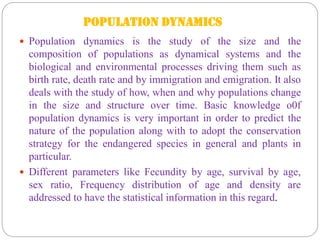
POPULATION DYNAMICS
 Population dynamics is the study of the size and the
composition of populations as dynamical systems and the
biological and environmental processes driving them such as
birth rate, death rate and by immigration and emigration. It also
deals with the study of how, when and why populations change
in the size and structure over time. Basic knowledge o0f
population dynamics is very important in order to predict the
nature of the population along with to adopt the conservation
strategy for the endangered species in general and plants in
particular.
 Different parameters like Fecundity by age, survival by age,
sex ratio, Frequency distribution of age and density are
addressed to have the statistical information in this regard.
INTRINSIC RATE OF INCREASE
 The rate at which a population increases in size, if there are no
density-dependent forces regulating the population is known as
intrinsic rate of increase. It is quite analogous to the ban
account’s interest which accrues interest over time. It can be
measured by
 dN / dT*1/N=r
 Where dN /dT is the rate of increase of the population, N= size
of the population, t=equal time and r=intrinsic rate of increase.
This is a theoretical maximum rate of increase of a population
per individual. This concept is used in insect population
biology to determine how environmental factors affect the rate
at which pest population increases.
 For population studies, mathematical models, laboratory
models and field studies are used in this regard.
POPULATION GROWTH
 Population growth is mainly two types-
 1. Exponential population growth,
 2. Logistic population growth
 EXPONENTIAL GROWTH
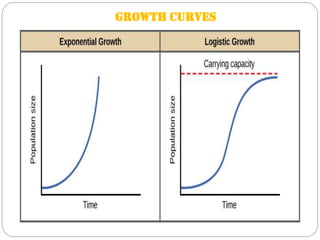
 It is also called Malthusian growth that states the growth of the
population grow exponentially as long as the environment
experienced by all individuals in the population remains
constant. It occurs where each generation’s increase is constant
percentage of the total population size and the larger the
population, the faster it grows. The exponential population
experiences J-shaped curve. However, exponential growth can
not continue indefinitely in a resource limited environment.
Although, the pattern of exponential growth curve is similar to
geometric growth curve. The intrinsic rate of natural increase is
easy to calculate if the natality and mortality rates are known.
GROWTH CURVES
GROWTH CURVES
 LOGISTIC GROWTH
 It occurs when the growth rate decreases as the population reaches
carrying capacity. Carrying capacity is the capacity to carry
maximum number of individuals in an population in terms of basic
needs. As population density approaches the carrying capacity,
competition become more intense, mortality increases, birth rate
drops, and the population may level out and stabilize below the
carrying capacity. As a consequence, if a plot is developed, S –
shaped growth curve generates treated as logistic growth curve. The
logistic equation was devised by Verhulst (1838) to describe
population with an upper limit. The logistic equation assumes that
the intrinsic rate of natural increase is progressively reduced as
population size increases. Toward the carrying capacity. If there are
10 individuals already present(N=10), and K=100, the remaining
resources can support a further K-N=90 individuals and the
proportion of the remaining resources is K-N/K=0.9
GROWTH CURVES
 Homeostasis is the set point or carrying capacity defined as K.
The logistic population growth are of 2 types-
 Continuous time model- Population growth rate is highest at ½
K and the population rate is zero around K. The optimum
harvesting rate is a close rate to ½ K where the population will
grow the fastest. Above K, the population growth rate is
negative. The logistic models also show density dependence,
meaning the per capita population growth rates decline as the
population density increases.
 Discrete time model- If r (intrinsic rate of increase) gets very
high, there are oscillations and deterministic chaos.
Deterministic chaos is large changes in population dynamics
when there is a very small change in r. This makes it hard to
make predictions at high r values because a very small r results
in a massive error in population dynamics.
REGULATION OF POPULATION
 What regulates population? It is very important to know the
regulation of population dynamics. Krebs(1985) accounted the
following factors in this regard-
 Nature of factors that influence population density-Density
dependent factors increase in their proportional effect as
population increases including competition and predation.
Inverse density dependence also occurs density independent
factors do not vary systematically in their effect of density
changes
 Key factor analysis-The K-values for each mortality factor
together , to find out may be regulatory. the k-factor that most
closely follows the pattern of k is called key factor.
 Self regulation of populations- Intra-specific-density density
dependent interactions regulate many populations in the
laboratory. Accumulation of waste product may depress
population growth.
REGULATION OF POPULATION
 Immigration, emigration and population dynamics-Besides
natality and mortality, emigration and immigration also affect
on population density. These both are features of disposal.
Whereby individuals move from one population and die in no
environment is found; establish a new population or join an
existing one at a new locale.
 UNIQUE FEATURES TO PLANT POPULATIONS
 There are number of features unique to plant populations as
listed below:
 Most higher plants are modular organisms due to number of
developmental phases,
 Two level of populations structure-a genet (single cell) and
ramet or tiller , the vegetative offshoots
REGULATION OF POPULATION
 Plants can not move to mate or disperse. Thus, they may have
evolved means as gravity, wind, water flow or animals for
dispersal of pollen,
 Most aspects of growth population are density related. One
important generalizations applied is the 3/2 thinning law.
 Interactions between different populations of different species
is the most concern areas. Most of the ecosystems contain
population of many species that interact in vital ways so that
changes in one population will have effect on many others.
Three distinct classes of interactions are recognized-
Competition, predation and mutualism. In addition to these,
two more interactions are observed-Commensalism &
amensalism.
ECOLOGICAL SPECIATION
 It is the process by which barriers of gene evolve between
populations as a result of ecologically based divergent
selection(Rundle & Nosil, 2005). Speciation is the formation of
new and distinct species in the passage of evolution. Ecology
contributes a lot in the process of long term speciation pathway.
 FEATURES
 Ecologically based divergent selection between different
environments leads to the creation of reproductive barriiers
between populations.
 Adaptive divergence is the divergence of new forms from a
common ancestral form due to adaptation to different
environmental conditions.
 Ecological selection is the interaction of individuals with their
environment during resource acquisition. Natural selection is
the key component of this process.
ECOLOGICAL SPECIATION
 Populations in different environments , or populations in
exploiting different resources , experiencing contrasting natural
selection pressure on the traits that directly or indirectly bring
about the evolution of reproductive isolation.
 The key difference between ecological speciation and other
kind of speciation , is that it is triggered by divergent natural
selection among different habitats; as opposed to other kinds of
speciation processes like random genetic drift, the fixation of
incompatible mutations in populations experiencing similarly
selective pressures or various forms of sexual selection not
involving selection on ecologically relevant traits.
 Thus, the above features play very regulatory role in the
domain of the ecological speciation
TYPES OF SPECIATION
 1. Allpoatric - It is the phenomenon of the occurrence of
population of related organisms in separate, non overlapping
geographical area so that thy are unable to interbred due to
geographic isolation.
 Sympatric-Two species or populations are considered
sympatric when they exist in the same geographic area and thus
frequently encounter one another. An initially interbreeding
population that splits into two or more distinct species sharing
a common range exemplifies sympatric speciation where as in
allopatric speciation development of new species as a result of
geographical separation of populations occurs.
 Paeripatric- It is the form of speciation where formation of new
species occur through evolution. In this type, new species are
formed in isolated peripheral populations. This is similar to
allopatric speciation in that populations that are isolated and
prevented from exchange of genes.
TYPES OF SPECIATION
 Para-patric -It refers to the relationship between organisms
whose ranges do not significantly overlap but are immediately
adjacent to each other. They do not occur together except in a
narrow contact zone.
 Parallel speciation- It is defined as a special form of speciation
in which traits that determine the reproductive isolation evolve
repeatedly in independent, closely related populations as a by-
product of adaptation to different environments. Parallel
evolution is the independent evolution of similar traits, starting
from a similar ancestral condition . Frequently, this is the
situation in more closely related lineages where several species
respond to similar changes in a similar way.
 Parallel speciation refers to greater reproductive isolation
evolving between independent populations adapting to
contrasting environments. It is established that ecological
SUMMARY
 Speciation occurs and accumulated from top-down studies of
adaptation and reproductive isolation.
 SUMMARY
 The population ecology is very interesting domain that needs
the4 understanding of the species along with other statistical
parameters to draw a rigid conclusion in this analysis. Natality,
mortality, Immigration, emigration along with the carrying
capacity play a very crucial role in the dynamics of ecology. In
addition to that, the population growth curve is an interesting
measurement for the analysis of the population along with
other parameters. Ecological speciation needs the
understanding of the different components that play a very
crucial role in this regard in the long passage of evolution.
THANKS FOR YOUr visit
 ACKNOWLEDGEMENT
 1.Google for images
 2.Different WebPages for content
 3.Ecology & environment- P.D.Sharma
 4.Ecology & Environmental Biology- T.K.saha
 5. A text book of Ecology- S. Chand & Company.
 6. Plant Ecology & Phytogeography - Arun Chandra Sahu
 Disclaimer: This PPT has made as a free learning resources
for academicians, teachers, students and others without any
financial interest.

Population Ecology.pdf

  • 1.
    Population Ecology :Characteristics and Dynamics .Ecological Speciation By N. Sannigrahi, Associate Professor Department of Botany Nistarini College, Purulia (W.B) India ECOLOGY
  • 2.
    INTRODUCTION  Species isthe foundation of any ecological study. Ecological factors invariably govern the distribution of the organisms, and details of the requirements and reactions of an individual species- autecology. The organisms, however, rarely grow as an independent unit. They are interconnected upon one another in course of their journey in an ecosystem. The mutual interactions between the abiotic and biotic systems build up a good interactive network to make a sustainable and dynamic equilibrium in this regard. The biosphere of the earth is consisting of a varied number of ecosystems ,Each ecosystems further contains many communities, the basic structure of which is constituted by still smaller units called population. Population is generally a group of individuals of a particular species occupying a particular area at a specific time.
  • 3.
    POPULATION  Population generallyindicates ca group of individuals of the same kind of species. The definition of population has been given by different ecologists in different forms:  “ A population is a group of interacting and interbreeding individuals which normally has no contact with other group of the same species. It is a discrete dynamic unit of a species population” (Nicholson, 1957).  “ The population is an ultimately self-reproducing grouping of con-specific individuals which occupies a definite area over an evolutionary long span of time to form an independent genetic system and an ecological niche of its own”( Yablokov, 1986).  “ A population is a group of interbreeding organisms belonging to the same species” (Krebs, 1988)
  • 4.
    POPULATION  “ Apopulation is defined as any group of organisms of the same species that occupy a particular space and function as a part of biotic community” ( Odum & Barrett, 2005).  “A group of individuals of the same species that occupies a particular location at a given time that forms a reproductive system or gene pool is called population: ( Lampart and Sommer, 2007).  But some of the ecologists , however, recognize two types of population-  Monospecific -population of individuals of only one species,  Mixed or polyspecific- Population of more than one species but it is very often confused with community. Basically, population always indicates individuals of any kind of organism.
  • 5.
    POPULATION ECOLOGY  Populationecology is the study of the structure and dynamics of species population and how these populations interact with the environment. It also deals with the study of how the population sizes of species over time and space. Population ecology shares a contribution from the other fields like population genetics, physiology, systems ecology, community ecology as well as landscape ecology. Evolutionary ecology is also one of the important domain that also to be addressed here.  MAIN AXIOM  Organisms undergo the same life-cycle  Organisms in a particular stage of the life cycle involved in the same set of ecological process,  The rates of these process are basically the same if organisms are put into the same environment.
  • 6.
    CHARACTERISTICS  The populationis a collective group of organisms of the same species occupying a particular space and it is the sum total derived from the individual organisms. It can be characterized by the following features:  Population size and density,  Dispersion,  Age structure,  Natality (Birth rate),  Mortality ( death rate),  Life tables.  Each of the aforesaid component contributes a lot to determine the characteristics of a particular population dynamics along with its regulation.
  • 7.
    POPULATION SIZE  Itis the number of individual organisms in a population as denoted by N. Generally small population are greater risk of extinction and large population may be more stable and the least chance of extinction. The large population has greater genetic variability and thus bears more potentiality to adapt the changes in the environment through the passage of evolution as a part of natural selection. However, the size of the population may be less important than its density. The effective population size(Ne) defined as ‘ the number of inbreeding individuals in an idealized population that would show the same amount of dispersion of allele frequencies under random genetic drift or the same amount of inbreeding as the population under consideration'. Small population size results in increased genetic drift. Overpopulation indicate any case in which the population of any species of animal may exceed the carrying capacity of its ecological niche.
  • 8.
    POPULATION DENSITY  Populationdensity refers to the size of the population per unit area or volume or space and it is generally expressed in terms of number of individuals or biomass / unit area. It invariably changes with space and time. It can be measured by-  Abundance-absolute number of individuals,  Numerical density-individual per unit area or volume,  Biomass density-Expressed in terms of dry weight or wet eight and carbon and nitrogen weight per unit area.  Population density can be expressed in two ways-  Crude density-Density is expressed with reference to unit total area at a particular time.  Ecological density-It is the density per unit of habitat space that can be actually colonized by the population. Ecological density always refers to the desired habitat of the particular species.
  • 9.
    POPULATION DENSITY  Populationdensity is calculated by the following equation:  Population density (PD)= No of individual in a region (N)/No. of unit area in the region (S)= N/S, expressed per unit time. For example, Netherlands is smaller but high density (488/sq.km) than India (383 /sq.km). Population density is affected by a number of environmental factors like geographical factors, mortality, natality, emigration, immigration and socio- economic factors.  Natality- It is the number of births during a given period in the population that are added to initial density,  Mortality- the number of deaths in the population during a given period,  Immigration-number of individuals of same species that have added into the habitat from elsewhere  Emigration-number of population individuals left the habitat
  • 10.
    POPULATION DENSITY  So,if PD=Population density, t=time, then its density at a time t+1 is: PD(t+1)=PDt +| (B+I)-(D+E)|  Where PD= population density, B=Birth rate, I=Immigration, D=Death rate, E=Emigration, t=time.  So, from the above equation, population density increases if (B+I) is more than (D+E).  Size and density –both are important to describe the current status of the population, For predictions about it changing nature due to 1. Larger population is more stable than smaller population,  A number of low density population, where organisms are sparely spread out, might have more trouble in finding a mate to reproduce with than an individual in a high density population.
  • 11.
    POPULATION DENSITY  Arate is generally obtained by dividing the change by a period of time elapsed during change. Thus, growth rate of a population is the number of organisms added to the population per time. It is represented by ∆.  Thus if N=number of organisms, t=time, then  ∆= the change in the number of organisms,  ∆N/ ∆t=the average rate of change in the number of organisms per time. This is growth rate  ∆N/N ∆t= the average rate of change in the number of organisms per time, per organisms. Thus is often called specific growth rate.  Population size and density is measured by Quadrate and Mark –recapture method. But quadrate or transect method is very convenient in measuring plants population density and size.
  • 12.
    SPECIES DISTRIBUTION ORDISPERSION  Dispersion is the spatial pattern of individuals in a population relative to one another in a space at a given time.  It may be three patterns-  Regular dispersion-Individuals are more or less spaced at a equal distance from one another ; most rare but more common in artificially managed ecosystems,  Random dispersion-Position of one individual is unrelated to the positions of neighbor, relatively rare in nature. Most common example is the dandelions and other plants having wind dispersal.  Clumped dispersion-Individuals are clustered in groups. It may be found in plants that drops their seeds straight to the ground such as oak trees.
  • 13.
    SPECIES DISTRIBUTION ORDISPERSION  Clumped dispersion in turn may be variously distributed giving rise to further pattern as random clumped, uniform clumped and aggregate clumped.  The nature of population dispersion can be assessed by Mortisan’s Index(Is) by the following formulae:  Is= N∑x2-∑x/ (∑x)2- ∑x  Where N= Population size,  X=no. of individuals  If Is=1, the dispersion is random,  Is >1, the dispersion is clumped,  Is <1, the dispersion is uniform.  To know the dispersion, the aforesaid values are important to remember in course of understanding this.
  • 14.
    AGE STRUCTURE  Agestructure is also called age composition or age distribution, is the proportionate numbers of persons in successive categories in a particular given population. The relative abundance of organisms of various ages in population is called age distribution. The population of different categories like seedlings, saplings, old-adults or old in a particular species population of a habitat.ge distribution of the population. Age distribution is very important age it influences both natality, mortality ,migrations. Mortality induces negative growth whereas natality tends to be positive. The ratio of the various groups in a population determines the current reproductive status of the population, thus anticipating its future. The pre- reproductive, reproductive and post reproductive populations are key indicators of the stability of the population. These are called ecological ages or functional ages. The distribution may be constant or variable.
  • 15.
    AGE PYRAMIDS  Itis directly related to the growth rate of the population. There are three major groups of population-expanding population, stable population and diminishing population. This was first proposed by Bodenheim (1958) on the visualizations of bees population.  AGE PYRAMIDS  The model representing geometrically the proportions of different age group in the population of any organism is called age pyramid. There are three types hypothetical pyramids are given-  A pyramid with broad base-Indicates high % pf young individuals with an exponential growth rate and it indicates expanding population.  Bell shaped pyramid-Moderate population of young to old with slow but stable growth rate. Post remaining group remains the smallest .
  • 16.
    NATALITY  Pyramid withnarrow base or an urn-shaped figure-Indicates low % of individual, birth rate is drastically reduced the pre- reproductive group dwindles in proportion to the other two groups and results urn-shaped figure. It is indicative of diminishing population. In this type of pyramid, the population has drastically reduced birth rate .  NATALITY  It is simply indicates the production of new individuals of any organism. The new individuals are born. Natality rate in the number of offspring produced per family per unit time.  Natality(B)= number of births per unit time/Average population.  It is generally expressed 1000/year.
  • 17.
    NATALITY  TYPES OFNATALITY  There are two types of natality;  Absolute or maximum natality-It is the theoretical maximum production of new individual under ideal conditions. It is also called reproductive or biotic potential or maximum natality. It is constant for a given population. This is also called fecundity rate. It is measured by the following:  ∆Nn/∆t  Where N= initial number of organisms,  N= new individuals in the population,  t= time  Ecological or relised natality-Refers to population increase under an actual, existing specific conditions. This is called fertility rate.
  • 18.
    MORTALITY  Mortality refersto the number of deaths in the population per unit time. It can be expressed as D/t where D= no. of deaths during time, t.  Mortality can be –Minimum mortality or specific or potential mortality-It represents the theoretical minimum loss under ideal or non-limiting conditions. It is constant for population. Generally, specific mortality is expressed as a percent of the initial population dying within a given time or as a percent of average population.  Ecological or Realized mortality-It refers to the actual loss of individuals under a given environmental condition. It is, like ecological natality, not constant and varies with population and environmental conditions. When the death rate of natality is equal to the rate of mortality, the population is stationery. A birth death ratio(Birth/Death * 100) is called vital index.
  • 19.
    SURVIVORSHIP CURVES  Inany population, death is less important than survivors and it is measured in survivorship curves. There are three survivorship curves-  A. Highly convex curves( initial low mortality)- Here the species in the population having low mortality rate near the end of the life span. Thus, such species tend to live throughout their life span, with low mortality.  B. Highly concave curve(initial high mortality)- The curve is the characteristic of such species where mortality rate is high during young stage but constant in all other age-groups. This type of characteristics with high biotic potentiality.  C. Diagonal or Linear curve( Constant mortality)-Constant proportion of organisms dying per unit time. Probably, no population in the real world has a constant age-specific survival rate throughout the whole life span.
  • 20.
    LIFE TABLES  Informationof natality and mortality in different ages and sexes can be combined in the form of life tables. From this, it is possible to estimate the growth or decline of a population. As with survivorship curves, life tables are standardized to follow the progress of cohort. In each table, there are columns for age group of individuals; number of surviving to each age; the number of dying in each age group; the proportion of dying from the previous age category; fertility rate; and the number of young born in each age group. This information obtained from these figures provides the net reproductive rate of the population i.e. offering left by each individual. Similarly, from life table, mortality in a logarithmic from is also obtained . These are very important statistical data used to calculate the rate of population growth.
  • 21.
    BIOTIC POTENTIAL  Itis the ability of a population of a living species to increase under ideal environmental conditions. It is potential power of an organism to reproduce and survive in its environment. Biotic potential is the highest possible vital index of a species; when the species has its highest birth rate and lowest mortality rate. It can be divided into two components-reproductive and survival potential The survival potential can be divided under two parts-nutritive and protective potential. Biotic potential is a quantitative expression and it can be denoted as :  Number of individuals= Biotic potential/ Resistance of the environment(Biotic and Abiotic).  Organisms which encounter higher resistance from the environment must have high biotic potential , so that. There would be some survivors to replace required organisms to maintain the population.
  • 22.
    POPULATION DYNAMICS  Populationdynamics is the study of the size and the composition of populations as dynamical systems and the biological and environmental processes driving them such as birth rate, death rate and by immigration and emigration. It also deals with the study of how, when and why populations change in the size and structure over time. Basic knowledge o0f population dynamics is very important in order to predict the nature of the population along with to adopt the conservation strategy for the endangered species in general and plants in particular.  Different parameters like Fecundity by age, survival by age, sex ratio, Frequency distribution of age and density are addressed to have the statistical information in this regard.
  • 23.
    INTRINSIC RATE OFINCREASE  The rate at which a population increases in size, if there are no density-dependent forces regulating the population is known as intrinsic rate of increase. It is quite analogous to the ban account’s interest which accrues interest over time. It can be measured by  dN / dT*1/N=r  Where dN /dT is the rate of increase of the population, N= size of the population, t=equal time and r=intrinsic rate of increase. This is a theoretical maximum rate of increase of a population per individual. This concept is used in insect population biology to determine how environmental factors affect the rate at which pest population increases.  For population studies, mathematical models, laboratory models and field studies are used in this regard.
  • 24.
    POPULATION GROWTH  Populationgrowth is mainly two types-  1. Exponential population growth,  2. Logistic population growth  EXPONENTIAL GROWTH  It is also called Malthusian growth that states the growth of the population grow exponentially as long as the environment experienced by all individuals in the population remains constant. It occurs where each generation’s increase is constant percentage of the total population size and the larger the population, the faster it grows. The exponential population experiences J-shaped curve. However, exponential growth can not continue indefinitely in a resource limited environment. Although, the pattern of exponential growth curve is similar to geometric growth curve. The intrinsic rate of natural increase is easy to calculate if the natality and mortality rates are known.
  • 25.
  • 26.
    GROWTH CURVES  LOGISTICGROWTH  It occurs when the growth rate decreases as the population reaches carrying capacity. Carrying capacity is the capacity to carry maximum number of individuals in an population in terms of basic needs. As population density approaches the carrying capacity, competition become more intense, mortality increases, birth rate drops, and the population may level out and stabilize below the carrying capacity. As a consequence, if a plot is developed, S – shaped growth curve generates treated as logistic growth curve. The logistic equation was devised by Verhulst (1838) to describe population with an upper limit. The logistic equation assumes that the intrinsic rate of natural increase is progressively reduced as population size increases. Toward the carrying capacity. If there are 10 individuals already present(N=10), and K=100, the remaining resources can support a further K-N=90 individuals and the proportion of the remaining resources is K-N/K=0.9
  • 27.
    GROWTH CURVES  Homeostasisis the set point or carrying capacity defined as K. The logistic population growth are of 2 types-  Continuous time model- Population growth rate is highest at ½ K and the population rate is zero around K. The optimum harvesting rate is a close rate to ½ K where the population will grow the fastest. Above K, the population growth rate is negative. The logistic models also show density dependence, meaning the per capita population growth rates decline as the population density increases.  Discrete time model- If r (intrinsic rate of increase) gets very high, there are oscillations and deterministic chaos. Deterministic chaos is large changes in population dynamics when there is a very small change in r. This makes it hard to make predictions at high r values because a very small r results in a massive error in population dynamics.
  • 28.
    REGULATION OF POPULATION What regulates population? It is very important to know the regulation of population dynamics. Krebs(1985) accounted the following factors in this regard-  Nature of factors that influence population density-Density dependent factors increase in their proportional effect as population increases including competition and predation. Inverse density dependence also occurs density independent factors do not vary systematically in their effect of density changes  Key factor analysis-The K-values for each mortality factor together , to find out may be regulatory. the k-factor that most closely follows the pattern of k is called key factor.  Self regulation of populations- Intra-specific-density density dependent interactions regulate many populations in the laboratory. Accumulation of waste product may depress population growth.
  • 29.
    REGULATION OF POPULATION Immigration, emigration and population dynamics-Besides natality and mortality, emigration and immigration also affect on population density. These both are features of disposal. Whereby individuals move from one population and die in no environment is found; establish a new population or join an existing one at a new locale.  UNIQUE FEATURES TO PLANT POPULATIONS  There are number of features unique to plant populations as listed below:  Most higher plants are modular organisms due to number of developmental phases,  Two level of populations structure-a genet (single cell) and ramet or tiller , the vegetative offshoots
  • 30.
    REGULATION OF POPULATION Plants can not move to mate or disperse. Thus, they may have evolved means as gravity, wind, water flow or animals for dispersal of pollen,  Most aspects of growth population are density related. One important generalizations applied is the 3/2 thinning law.  Interactions between different populations of different species is the most concern areas. Most of the ecosystems contain population of many species that interact in vital ways so that changes in one population will have effect on many others. Three distinct classes of interactions are recognized- Competition, predation and mutualism. In addition to these, two more interactions are observed-Commensalism & amensalism.
  • 31.
    ECOLOGICAL SPECIATION  Itis the process by which barriers of gene evolve between populations as a result of ecologically based divergent selection(Rundle & Nosil, 2005). Speciation is the formation of new and distinct species in the passage of evolution. Ecology contributes a lot in the process of long term speciation pathway.  FEATURES  Ecologically based divergent selection between different environments leads to the creation of reproductive barriiers between populations.  Adaptive divergence is the divergence of new forms from a common ancestral form due to adaptation to different environmental conditions.  Ecological selection is the interaction of individuals with their environment during resource acquisition. Natural selection is the key component of this process.
  • 32.
    ECOLOGICAL SPECIATION  Populationsin different environments , or populations in exploiting different resources , experiencing contrasting natural selection pressure on the traits that directly or indirectly bring about the evolution of reproductive isolation.  The key difference between ecological speciation and other kind of speciation , is that it is triggered by divergent natural selection among different habitats; as opposed to other kinds of speciation processes like random genetic drift, the fixation of incompatible mutations in populations experiencing similarly selective pressures or various forms of sexual selection not involving selection on ecologically relevant traits.  Thus, the above features play very regulatory role in the domain of the ecological speciation
  • 33.
    TYPES OF SPECIATION 1. Allpoatric - It is the phenomenon of the occurrence of population of related organisms in separate, non overlapping geographical area so that thy are unable to interbred due to geographic isolation.  Sympatric-Two species or populations are considered sympatric when they exist in the same geographic area and thus frequently encounter one another. An initially interbreeding population that splits into two or more distinct species sharing a common range exemplifies sympatric speciation where as in allopatric speciation development of new species as a result of geographical separation of populations occurs.  Paeripatric- It is the form of speciation where formation of new species occur through evolution. In this type, new species are formed in isolated peripheral populations. This is similar to allopatric speciation in that populations that are isolated and prevented from exchange of genes.
  • 34.
    TYPES OF SPECIATION Para-patric -It refers to the relationship between organisms whose ranges do not significantly overlap but are immediately adjacent to each other. They do not occur together except in a narrow contact zone.  Parallel speciation- It is defined as a special form of speciation in which traits that determine the reproductive isolation evolve repeatedly in independent, closely related populations as a by- product of adaptation to different environments. Parallel evolution is the independent evolution of similar traits, starting from a similar ancestral condition . Frequently, this is the situation in more closely related lineages where several species respond to similar changes in a similar way.  Parallel speciation refers to greater reproductive isolation evolving between independent populations adapting to contrasting environments. It is established that ecological
  • 35.
    SUMMARY  Speciation occursand accumulated from top-down studies of adaptation and reproductive isolation.  SUMMARY  The population ecology is very interesting domain that needs the4 understanding of the species along with other statistical parameters to draw a rigid conclusion in this analysis. Natality, mortality, Immigration, emigration along with the carrying capacity play a very crucial role in the dynamics of ecology. In addition to that, the population growth curve is an interesting measurement for the analysis of the population along with other parameters. Ecological speciation needs the understanding of the different components that play a very crucial role in this regard in the long passage of evolution.
  • 36.
    THANKS FOR YOUrvisit  ACKNOWLEDGEMENT  1.Google for images  2.Different WebPages for content  3.Ecology & environment- P.D.Sharma  4.Ecology & Environmental Biology- T.K.saha  5. A text book of Ecology- S. Chand & Company.  6. Plant Ecology & Phytogeography - Arun Chandra Sahu  Disclaimer: This PPT has made as a free learning resources for academicians, teachers, students and others without any financial interest.