LTE Uplink Power Control
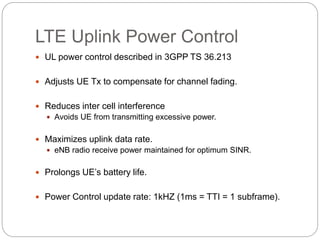
 UL power control described in 3GPP TS 36.213
 Adjusts UE Tx to compensate for channel fading.
 Reduces inter cell interference
 Avoids UE from transmitting excessive power.
 Maximizes uplink data rate.
 eNB radio receive power maintained for optimum SINR.
 Prolongs UE’s battery life.
 Power Control update rate: 1kHZ (1ms = TTI = 1 subframe).
Open-loop & Close-loop power
control
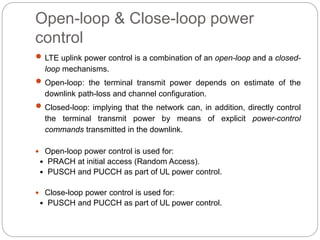
 LTE uplink power control is a combination of an open-loop and a closed-
loop mechanisms.
 Open-loop: the terminal transmit power depends on estimate of the
downlink path-loss and channel configuration.
 Closed-loop: implying that the network can, in addition, directly control
the terminal transmit power by means of explicit power-control
commands transmitted in the downlink.
 Open-loop power control is used for:
․ PRACH at initial access (Random Access).
․ PUSCH and PUCCH as part of UL power control.
 Close-loop power control is used for:
․ PUSCH and PUCCH as part of UL power control.
UE PRACH TX Power
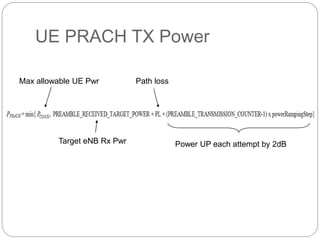
Max allowable UE Pwr
Target eNB Rx Pwr
Path loss
Power UP each attempt by 2dB
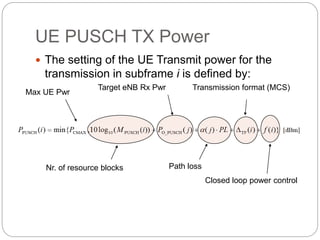
UE PUSCH TX Power
 The setting of the UE Transmit power for the
transmission in subframe i is defined by:
Max UE Pwr
Nr. of resource blocks
Target eNB Rx Pwr
Path loss
Transmission format (MCS)
Closed loop power control
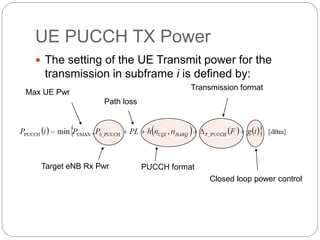
UE PUCCH TX Power
 The setting of the UE Transmit power for the
transmission in subframe i is defined by:
Max UE Pwr
Target eNB Rx Pwr
Path loss
PUCCH format
Closed loop power control
Transmission format
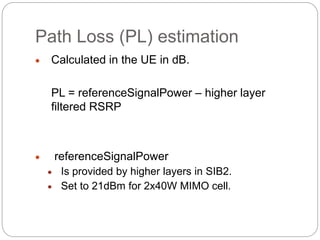
Path Loss (PL) estimation
 Calculated in the UE in dB.
PL = referenceSignalPower – higher layer
filtered RSRP
 referenceSignalPower
 Is provided by higher layers in SIB2.
 Set to 21dBm for 2x40W MIMO cell.
referenceSignalPower
 Downlink reference-signal EPRE (Energy Per
Resource Element).
 Why 21dBm?
10MHz LTE carrier -> 50 RB
1 RB = 12 sub carriers (12 symbols)
Assuming 40W RDLT, then 40 [W]/50 [RB]= 0.8 [W/RB]
Pwr per symbol = 0.8 [W]/12 [symbols] = 0.0667 [W]/[symbol]
0.0667 [W] = 18.24 [dBm]
2 TX antennas = 18.24 [dBm] + 3 [dB] = 21.24 [dBm]
“The downlink reference-signal EPRE can be derived from the downlink reference-signal transmit
power given by the parameter Reference-signal-power provided by higher layers. The downlink
reference-signal transmit power is defined as the linear average over the power contributions (in
[W]) of all resource elements that carry cell-specific reference signals within the operating system
bandwidth.”(2x2 MIMO: 4 RS out of 14 in every 3rd sub-carrier 9.6% of total
power 46dBm)
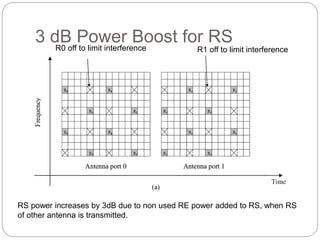
3 dB Power Boost for RSR0 off to limit interference R1 off to limit interference
RS power increases by 3dB due to non used RE power added to RS, when RS
of other antenna is transmitted.
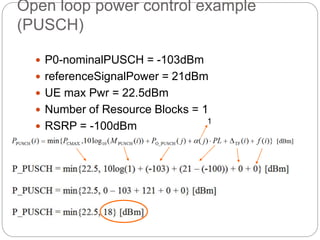
Open loop power control example
(PUSCH)
 P0-nominalPUSCH = -103dBm
 referenceSignalPower = 21dBm
 UE max Pwr = 22.5dBm
 Number of Resource Blocks = 1
 RSRP = -100dBm
1
UL Power control (PUSCH) – Open
loop
 UE transmit power for PUSCH transmission:
 is the maximum allowable UE power;
 M is the number of scheduled resource blocks; (broadcasted on PDCCH)
 PL is the downlink pathloss, estimated by UE. The UE can use
measurements of DL pathloss for estimation of UL pathloss. (Open-
loop)
 is to enable fractional pathloss compensation;
 PO_PUSCH set according to SINRtarget. SINRtarget is a parameter set to fulfill
the HARQ operating Point (OPP) quality requirements using the most
efficient MCS. PO_PUSCH is broadcasted on BCCH SIB2
 is a Transport Format (TF) specific offset.
][)}(log10,min{ TFO_PUSCH10MAXPUSCH dBmifPLPMPP  
O_UE_PUSCHPUSCHO_NOMINAL__
argarg_ )1(
PPP
NSINRPSDP
PUSCHO
ettetRXtPUSCHO


TF

MAXP
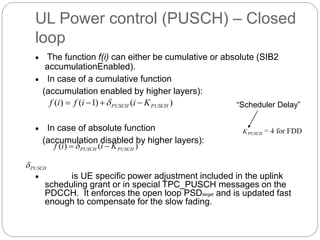
UL Power control (PUSCH) – Closed
loop
 The function f(i) can either be cumulative or absolute (SIB2
accumulationEnabled).
 In case of a cumulative function
(accumulation enabled by higher layers):
 In case of absolute function
(accumulation disabled by higher layers):
 is UE specific power adjustment included in the uplink
scheduling grant or in special TPC_PUSCH messages on the
PDCCH. It enforces the open loop PSDtarget and is updated fast
enough to compensate for the slow fading.
)()1()( PUSCHPUSCH Kiifif  
)()( PUSCHPUSCH Kiif  
PUSCH
“Scheduler Delay”
PUSCH
PUSCHTPC Command
Accumulated
[dB]
Absolute [dB]
0 -1 -4
1 0 -1
2 1 1
3 3 4
UL Power control (PUSCH) – Closed
loop
PUSCH
is set according to:
UL Power Control (PUCCH) – Open
loop
UE transmit power for PUCCH transmission:
 is the maximum allowable UE power;
 PL is the downlink pathloss, estimated by UE. The UE can use
measurements of DL pathloss for estimation of UL pathloss. (Open-
loop)
 h(n) is a PUCCH format dependent value where n(cqi) corresponds to
the number of information bits for the CQI, and n(harq) the number of
HARQ bits. For PUCCH formats 1, 1a and 1b, h(n) is always 0. For
PUCCH format 2, h(n) is 0 for normal cyclic prefix and n(cqi)<4, but
may take on other values with extended cyclic prefix or for n(cqi)>4.
 corresponds to a PUCCH format offset. Provided by
higher layers.
][)}()(),(,min{ F_PUCCHO_PUCCHMAXPUCCH dBmigFnnhPLPPP harqcqi 
)(_ FPUCCHF
MAXP
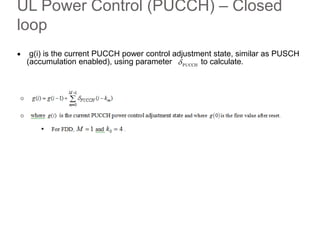
UL Power Control (PUCCH) – Closed
loop
 g(i) is the current PUCCH power control adjustment state, similar as PUSCH
(accumulation enabled), using parameter to calculate.PUCCH
UL Power Control (PUCCH) – Closed
loop
PUCCHTPC Command Accumulated [dB]
0 -1
1 0
2 1
3 3
 The open loop part controls PO_PUCCH, and the closed loop part controls g(i). This
function works much the same way as for PUSCH, except the TPC commands
for PUCCH can be transmitted in the downlink scheduling assignments, and
w i t h o u t a n y u p l i n k g r a n t .
CLPC Testing
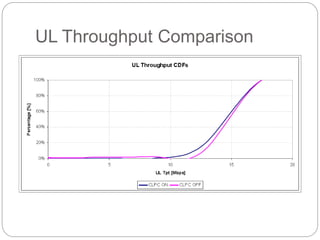
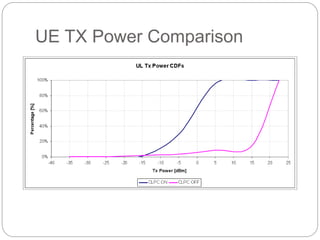
 The test is done in downtown Bellevue loop with
20 Mbps UL UDP data.
 Following slides show comparative analysis
between CLPC active and inactive in the same
graph.
UL Throughput Comparison
UE TX Power Comparison
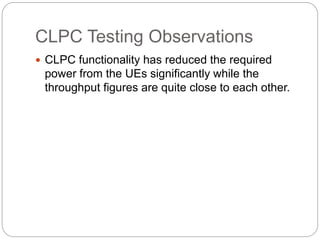
CLPC Testing Observations
 CLPC functionality has reduced the required
power from the UEs significantly while the
throughput figures are quite close to each other.
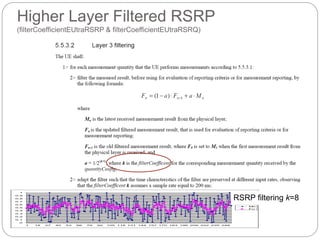
Higher Layer Filtered RSRP
(filterCoefficientEUtraRSRP & filterCoefficientEUtraRSRQ)
0
0.1
0.2
0.3
0.4
0.5
0.6
0.7
0.8
0.9
1
1 14 27 40 53 66 79 92 105 118 131 144 157 170 183 196 209 222 235 248
Mn
Fn
RSRP filtering k=8
EUtranCellFDD PM Counters
 pmRadioRecInterferencePwr
 The measured Noise and Interference Power on PUSCH, according to 36.214
PDF ranges:
[0]: N+I <= -121
[1]: -121 < N+I <= -120
[2]: -120 < N+I <= -119
[3]: -119 < N+I <= -118
[4]: -118 < N+I <= -117
[5]: -117 < N+I <= -116
[6]: -116 < N+I <= -115
[7]: -115 < N+I <= -114
[8]: -114< N+I <= -113
[9]: -113 < N+I <= -112
[10]: -112 < N+I <= -108
[11]: -108 < N+I <= -104
[12]: -104 < N+I <= -100
[13]: -100 < N+I <= -96
[14]: -96 < N+I <= -92
[15]: -92 < N+I
Condition: An average value is measured on a TTI basis
Unit: dBm/PRB
Report from 2011-02-16 14:00 UTC to 2011-02-16 14:14 UTC
Time Object pmRadioRecInterferencePwr
14:00 EUtranCellFDD=172169_1 5664,880660,8739,3020,1372,364,21,0,0,0,0,0,0,0,0,0
14:00 EUtranCellFDD=172169_2 617247,282277,309,7,0,0,0,0,0,0,0,0,0,0,0,0
14:00 EUtranCellFDD=172169_3 761490,138350,0,0,0,0,0,0,0,0,0,0,0,0,0,0
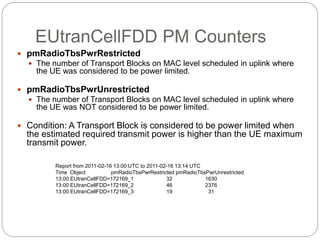
EUtranCellFDD PM Counters
 pmRadioTbsPwrRestricted
 The number of Transport Blocks on MAC level scheduled in uplink where
the UE was considered to be power limited.
 pmRadioTbsPwrUnrestricted
 The number of Transport Blocks on MAC level scheduled in uplink where
the UE was NOT considered to be power limited.
 Condition: A Transport Block is considered to be power limited when
the estimated required transmit power is higher than the UE maximum
transmit power.
Report from 2011-02-16 13:00 UTC to 2011-02-16 13:14 UTC
Time Object pmRadioTbsPwrRestricted pmRadioTbsPwrUnrestricted
13:00 EUtranCellFDD=172169_1 32 1630
13:00 EUtranCellFDD=172169_2 46 2376
13:00 EUtranCellFDD=172169_3 19 31
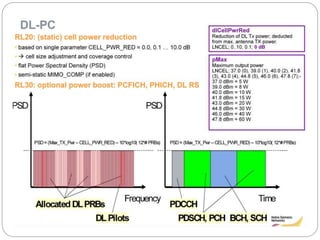
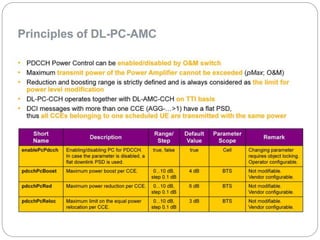
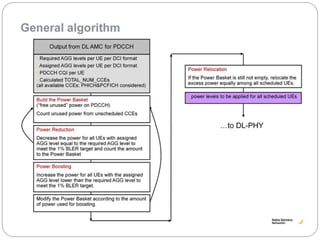
DL-PC
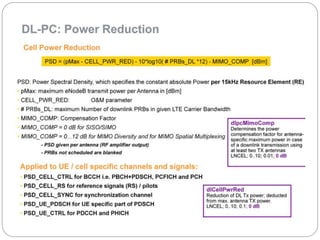
DL-PC:PC ON PDCCH
Thank You

Lte power control

  • 1.
  • 2.
    LTE Uplink PowerControl  UL power control described in 3GPP TS 36.213  Adjusts UE Tx to compensate for channel fading.  Reduces inter cell interference  Avoids UE from transmitting excessive power.  Maximizes uplink data rate.  eNB radio receive power maintained for optimum SINR.  Prolongs UE’s battery life.  Power Control update rate: 1kHZ (1ms = TTI = 1 subframe).
  • 3.
    Open-loop & Close-looppower control  LTE uplink power control is a combination of an open-loop and a closed- loop mechanisms.  Open-loop: the terminal transmit power depends on estimate of the downlink path-loss and channel configuration.  Closed-loop: implying that the network can, in addition, directly control the terminal transmit power by means of explicit power-control commands transmitted in the downlink.  Open-loop power control is used for: ․ PRACH at initial access (Random Access). ․ PUSCH and PUCCH as part of UL power control.  Close-loop power control is used for: ․ PUSCH and PUCCH as part of UL power control.
  • 4.
    UE PRACH TXPower Max allowable UE Pwr Target eNB Rx Pwr Path loss Power UP each attempt by 2dB
  • 5.
    UE PUSCH TXPower  The setting of the UE Transmit power for the transmission in subframe i is defined by: Max UE Pwr Nr. of resource blocks Target eNB Rx Pwr Path loss Transmission format (MCS) Closed loop power control
  • 6.
    UE PUCCH TXPower  The setting of the UE Transmit power for the transmission in subframe i is defined by: Max UE Pwr Target eNB Rx Pwr Path loss PUCCH format Closed loop power control Transmission format
  • 7.
    Path Loss (PL)estimation  Calculated in the UE in dB. PL = referenceSignalPower – higher layer filtered RSRP  referenceSignalPower  Is provided by higher layers in SIB2.  Set to 21dBm for 2x40W MIMO cell.
  • 8.
    referenceSignalPower  Downlink reference-signalEPRE (Energy Per Resource Element).  Why 21dBm? 10MHz LTE carrier -> 50 RB 1 RB = 12 sub carriers (12 symbols) Assuming 40W RDLT, then 40 [W]/50 [RB]= 0.8 [W/RB] Pwr per symbol = 0.8 [W]/12 [symbols] = 0.0667 [W]/[symbol] 0.0667 [W] = 18.24 [dBm] 2 TX antennas = 18.24 [dBm] + 3 [dB] = 21.24 [dBm] “The downlink reference-signal EPRE can be derived from the downlink reference-signal transmit power given by the parameter Reference-signal-power provided by higher layers. The downlink reference-signal transmit power is defined as the linear average over the power contributions (in [W]) of all resource elements that carry cell-specific reference signals within the operating system bandwidth.”(2x2 MIMO: 4 RS out of 14 in every 3rd sub-carrier 9.6% of total power 46dBm)
  • 9.
    3 dB PowerBoost for RSR0 off to limit interference R1 off to limit interference RS power increases by 3dB due to non used RE power added to RS, when RS of other antenna is transmitted.
  • 10.
    Open loop powercontrol example (PUSCH)  P0-nominalPUSCH = -103dBm  referenceSignalPower = 21dBm  UE max Pwr = 22.5dBm  Number of Resource Blocks = 1  RSRP = -100dBm 1
  • 11.
    UL Power control(PUSCH) – Open loop  UE transmit power for PUSCH transmission:  is the maximum allowable UE power;  M is the number of scheduled resource blocks; (broadcasted on PDCCH)  PL is the downlink pathloss, estimated by UE. The UE can use measurements of DL pathloss for estimation of UL pathloss. (Open- loop)  is to enable fractional pathloss compensation;  PO_PUSCH set according to SINRtarget. SINRtarget is a parameter set to fulfill the HARQ operating Point (OPP) quality requirements using the most efficient MCS. PO_PUSCH is broadcasted on BCCH SIB2  is a Transport Format (TF) specific offset. ][)}(log10,min{ TFO_PUSCH10MAXPUSCH dBmifPLPMPP   O_UE_PUSCHPUSCHO_NOMINAL__ argarg_ )1( PPP NSINRPSDP PUSCHO ettetRXtPUSCHO   TF  MAXP
  • 12.
    UL Power control(PUSCH) – Closed loop  The function f(i) can either be cumulative or absolute (SIB2 accumulationEnabled).  In case of a cumulative function (accumulation enabled by higher layers):  In case of absolute function (accumulation disabled by higher layers):  is UE specific power adjustment included in the uplink scheduling grant or in special TPC_PUSCH messages on the PDCCH. It enforces the open loop PSDtarget and is updated fast enough to compensate for the slow fading. )()1()( PUSCHPUSCH Kiifif   )()( PUSCHPUSCH Kiif   PUSCH “Scheduler Delay”
  • 13.
    PUSCH PUSCHTPC Command Accumulated [dB] Absolute [dB] 0-1 -4 1 0 -1 2 1 1 3 3 4 UL Power control (PUSCH) – Closed loop PUSCH is set according to:
  • 14.
    UL Power Control(PUCCH) – Open loop UE transmit power for PUCCH transmission:  is the maximum allowable UE power;  PL is the downlink pathloss, estimated by UE. The UE can use measurements of DL pathloss for estimation of UL pathloss. (Open- loop)  h(n) is a PUCCH format dependent value where n(cqi) corresponds to the number of information bits for the CQI, and n(harq) the number of HARQ bits. For PUCCH formats 1, 1a and 1b, h(n) is always 0. For PUCCH format 2, h(n) is 0 for normal cyclic prefix and n(cqi)<4, but may take on other values with extended cyclic prefix or for n(cqi)>4.  corresponds to a PUCCH format offset. Provided by higher layers. ][)}()(),(,min{ F_PUCCHO_PUCCHMAXPUCCH dBmigFnnhPLPPP harqcqi  )(_ FPUCCHF MAXP
  • 15.
    UL Power Control(PUCCH) – Closed loop  g(i) is the current PUCCH power control adjustment state, similar as PUSCH (accumulation enabled), using parameter to calculate.PUCCH
  • 16.
    UL Power Control(PUCCH) – Closed loop PUCCHTPC Command Accumulated [dB] 0 -1 1 0 2 1 3 3  The open loop part controls PO_PUCCH, and the closed loop part controls g(i). This function works much the same way as for PUSCH, except the TPC commands for PUCCH can be transmitted in the downlink scheduling assignments, and w i t h o u t a n y u p l i n k g r a n t .
  • 17.
    CLPC Testing  Thetest is done in downtown Bellevue loop with 20 Mbps UL UDP data.  Following slides show comparative analysis between CLPC active and inactive in the same graph.
  • 18.
  • 19.
    UE TX PowerComparison
  • 20.
    CLPC Testing Observations CLPC functionality has reduced the required power from the UEs significantly while the throughput figures are quite close to each other.
  • 21.
    Higher Layer FilteredRSRP (filterCoefficientEUtraRSRP & filterCoefficientEUtraRSRQ) 0 0.1 0.2 0.3 0.4 0.5 0.6 0.7 0.8 0.9 1 1 14 27 40 53 66 79 92 105 118 131 144 157 170 183 196 209 222 235 248 Mn Fn RSRP filtering k=8
  • 22.
    EUtranCellFDD PM Counters pmRadioRecInterferencePwr  The measured Noise and Interference Power on PUSCH, according to 36.214 PDF ranges: [0]: N+I <= -121 [1]: -121 < N+I <= -120 [2]: -120 < N+I <= -119 [3]: -119 < N+I <= -118 [4]: -118 < N+I <= -117 [5]: -117 < N+I <= -116 [6]: -116 < N+I <= -115 [7]: -115 < N+I <= -114 [8]: -114< N+I <= -113 [9]: -113 < N+I <= -112 [10]: -112 < N+I <= -108 [11]: -108 < N+I <= -104 [12]: -104 < N+I <= -100 [13]: -100 < N+I <= -96 [14]: -96 < N+I <= -92 [15]: -92 < N+I Condition: An average value is measured on a TTI basis Unit: dBm/PRB Report from 2011-02-16 14:00 UTC to 2011-02-16 14:14 UTC Time Object pmRadioRecInterferencePwr 14:00 EUtranCellFDD=172169_1 5664,880660,8739,3020,1372,364,21,0,0,0,0,0,0,0,0,0 14:00 EUtranCellFDD=172169_2 617247,282277,309,7,0,0,0,0,0,0,0,0,0,0,0,0 14:00 EUtranCellFDD=172169_3 761490,138350,0,0,0,0,0,0,0,0,0,0,0,0,0,0
  • 23.
    EUtranCellFDD PM Counters pmRadioTbsPwrRestricted  The number of Transport Blocks on MAC level scheduled in uplink where the UE was considered to be power limited.  pmRadioTbsPwrUnrestricted  The number of Transport Blocks on MAC level scheduled in uplink where the UE was NOT considered to be power limited.  Condition: A Transport Block is considered to be power limited when the estimated required transmit power is higher than the UE maximum transmit power. Report from 2011-02-16 13:00 UTC to 2011-02-16 13:14 UTC Time Object pmRadioTbsPwrRestricted pmRadioTbsPwrUnrestricted 13:00 EUtranCellFDD=172169_1 32 1630 13:00 EUtranCellFDD=172169_2 46 2376 13:00 EUtranCellFDD=172169_3 19 31
  • 25.
  • 30.
  • 34.

Editor's Notes