Optical Networks Infrastructure 
Tal Lavian
Area of interest 
 Need for building new services utilizing agile optical 
 What are the new services? 
Optical Service and Applications - 2 
 Impendence mismatch 
 Static Provisioning 
 Carrier Hotels 
 Optical Ethernet - 802.17 RPR – Resilient Packet Ring 
 ASON – Automatically Switched Optical Networks 
 EFM - Ethernet First Mile 
 Where are the bottlenecks - it is changing 
 OXC – Optical Cross Connects – long hope – move intelligence to the edge
Need for new services 
Optical Service and Applications - 3 

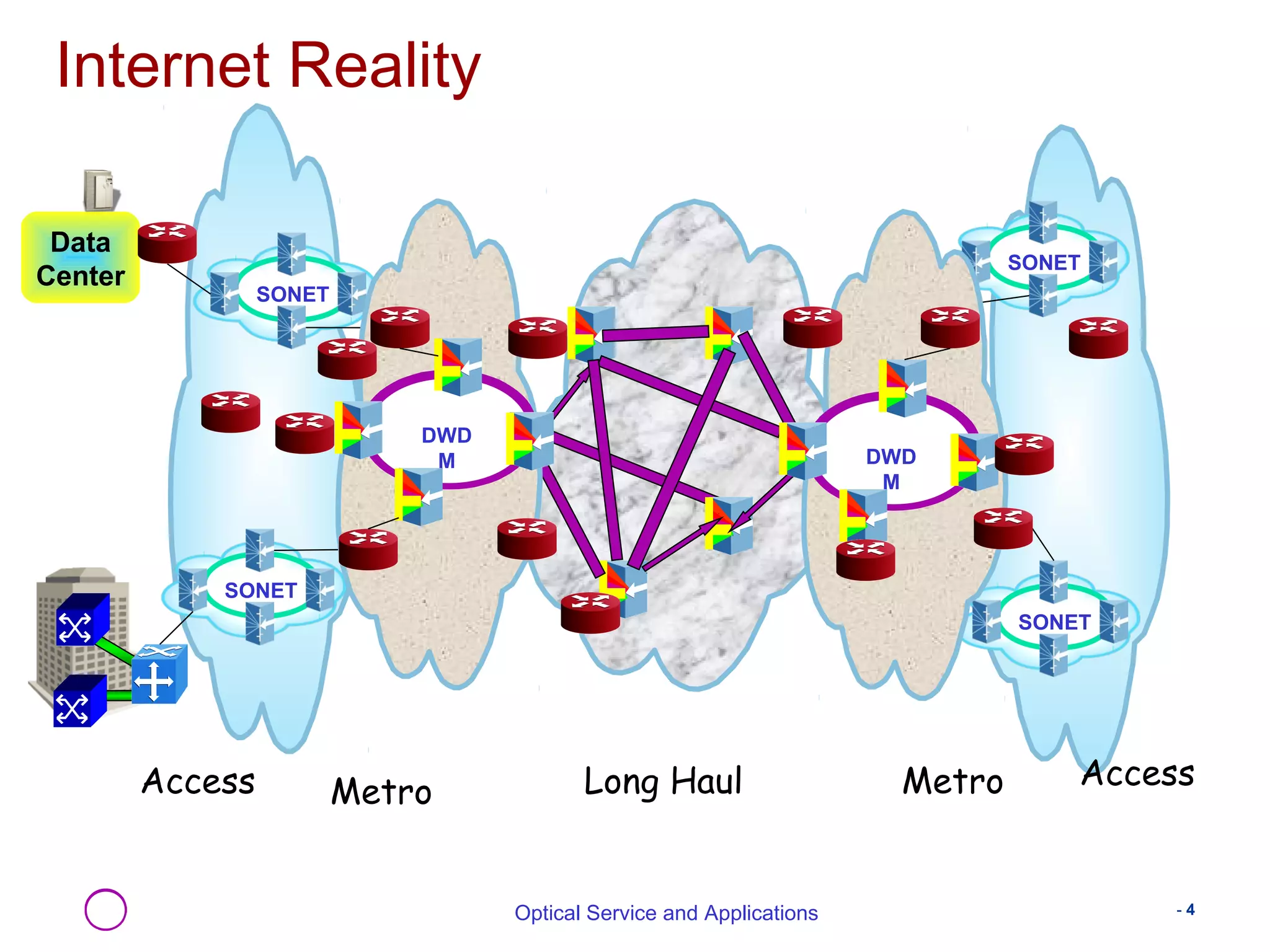
Internet Reality 
Data 
Center SONET 
Optical Service and Applications - 4 
SONET 
SONET 
SONET 
DWD 
M DWD 
M 
Access Metro Long Haul Metro Access
Patch Panel- Manually 
provisioning 
Optical Service and Applications - 5 

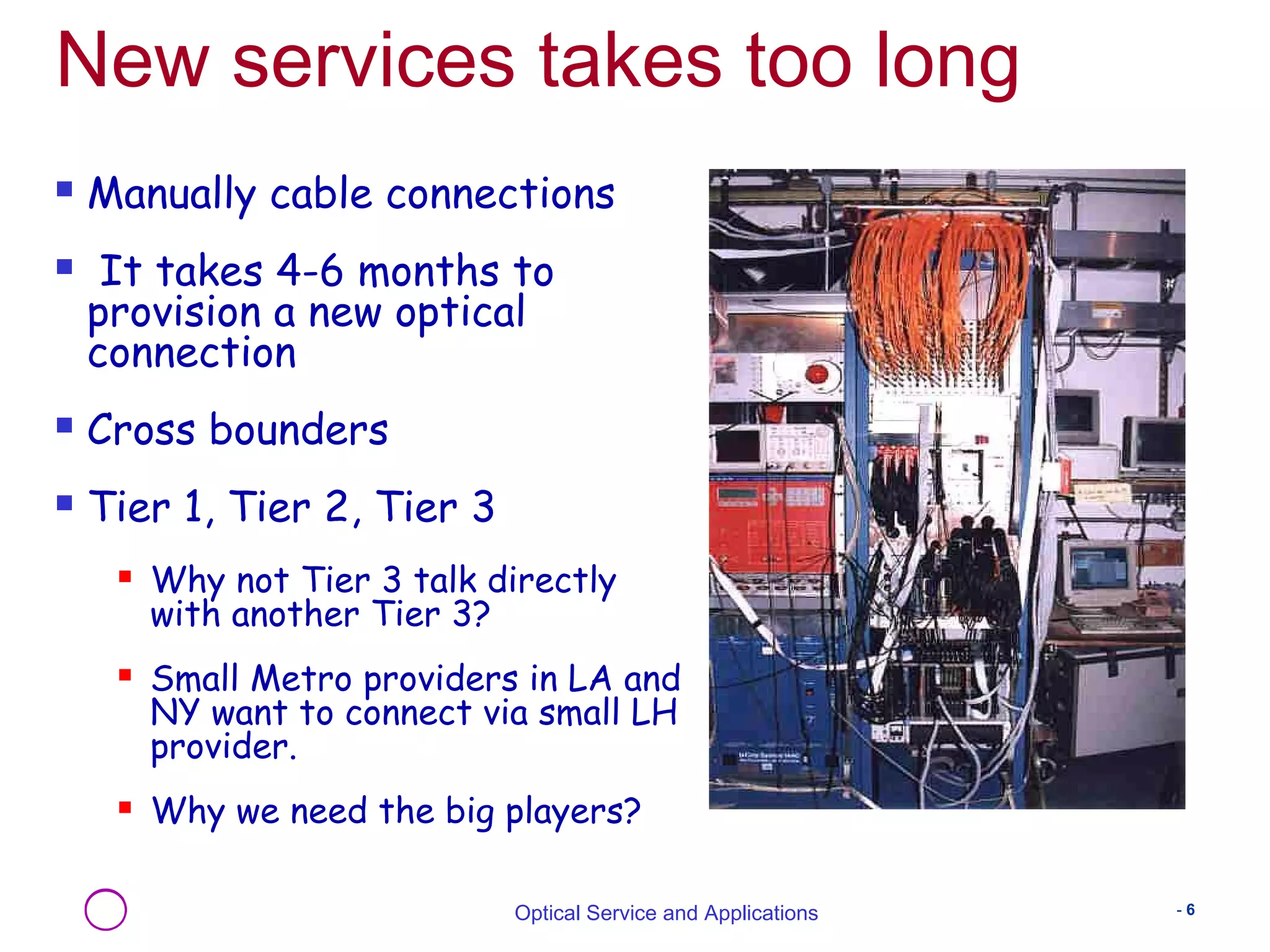
New services takes too long 
 Manually cable connections 
 It takes 4-6 months to 
provision a new optical 
connection 
Optical Service and Applications - 6 
 Cross bounders 
 Tier 1, Tier 2, Tier 3 
 Why not Tier 3 talk directly 
with another Tier 3? 
 Small Metro providers in LA and 
NY want to connect via small LH 
provider. 
 Why we need the big players?
Service Composition 
 Service composition of light path across service provider 
 Many AS each of them does not have access to the rest 
 Build a light path among service providers 
 Many different networks, no one can have full coverage, 
 Network infrastructure is extremely expansive (Billions of 
Dollars), service composition save resources (I’ll use your 
infrastructure, you’ll use mine) 
 Service composition to set light path between technologies 
(Access, Metro and Long Haul) 
Optical Service and Applications - 7 
 Grid computing, SAN
Cooperation and Brokering 
Optical Service and Applications - 8 
 Service composition
Impedance Mismatch 
 Cross boundaries (Control, Management, security) 
 Cross Technologies (Sonet, DWDM, ATM) 
 Dross topologies (P2P, Rings all types, mesh, ) 
Optical Service and Applications - 9 
 Circlet , packets 
 Speeds (1.5, 10, 51, 100, 155, 622, 1G, 2.4G, 10G…) 
 Fiber, copper, wireless 
 Level of media security
Business Case for Direct Peering 
 Typical Internet transit costs - $1000/Mbps per month 
 For 100 Mbps Internet transit then $100,000/mo 
 But coast to coast 100 Mbps channel is $1000/mo (e.g. 
Optical Service and Applications - 10 
www.Cogent.com) 
 New optical technology will reduce that cost further 
 Compelling business case to do as much no-cost direct peering as 
possible 
 See http://www.nanog.org/mtg-0010/tree.doc 
 OBGP is a proposed protocol that will allow massive direct peerings 
 Each optical switch is in effect a mini-IX to allow direct no cost 
peering 
 OBGP will also automate peering relationships 
 Significant business opportunity for carriers who want to partner 
with CANARIE in building next generation optical Internet 
 For example Telia claims that they save 75% in Internet transit fees 
with massive direct peering 
 Speeds up convergence time on BGP routing 
 Source – cook report
ASON – Automatically 
Switched Optical Networks 
 Dynamically switch the light path 
 Enabler for many applications 
 Controlled by UNI and NNI – Allow applications to set the light path 
 Allow to add the intelligence into the optical core 
Optical Service and Applications - 11
What is ASON? 
 The Automatic Switched Optical Network (ASON) 
is both a framework and a technology capability. 
 As a framework that describes a control and 
management architecture for an automatic 
switched optical transport network. 
 As a technology, it refers to routing and signalling 
protocols applied to an optical network which 
enable dynamic path setup. 
 Recently changed names to Automatic Switched 
Transport Network (G.ASTN) 
Optical Service and Applications - 12
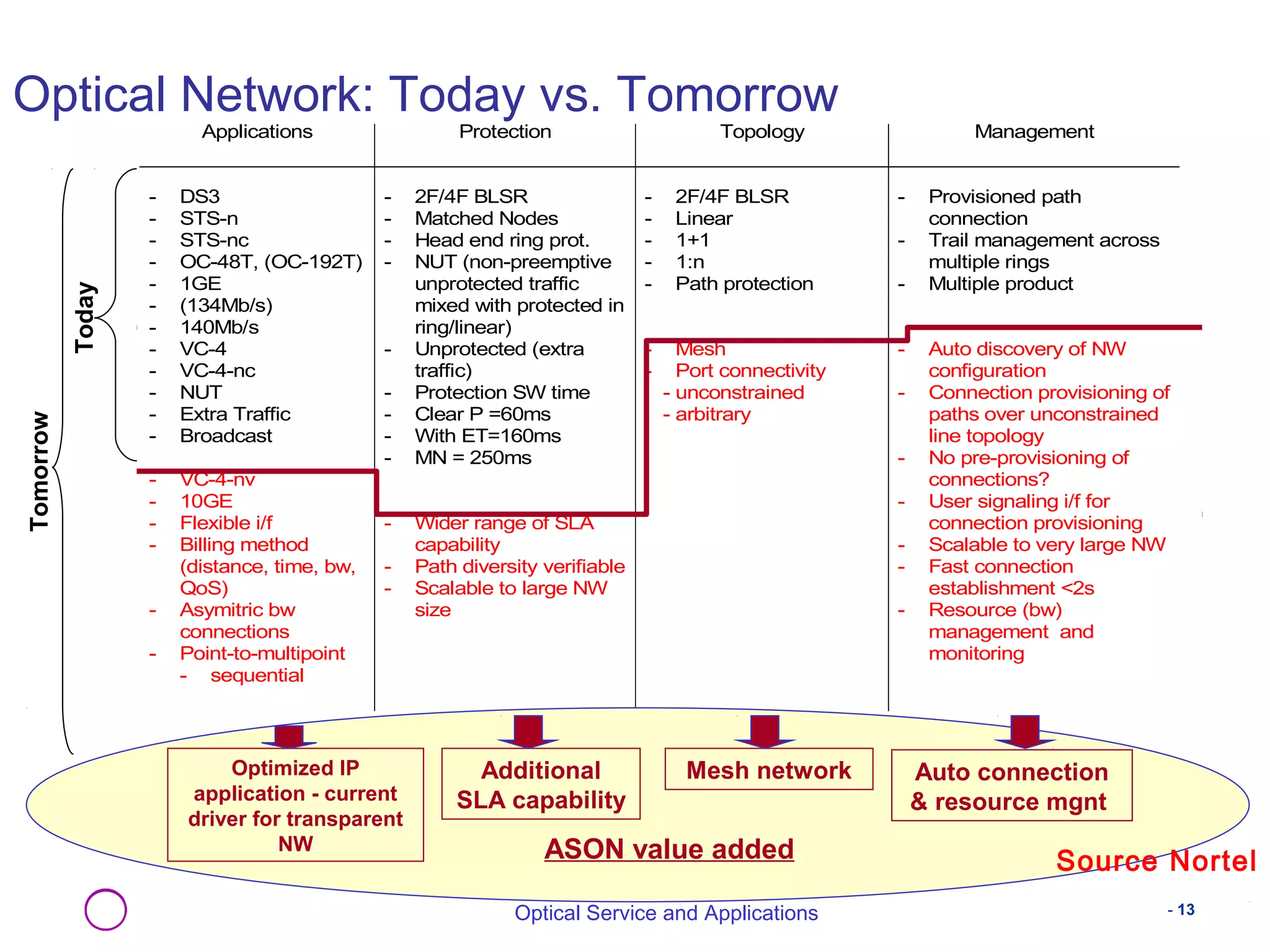
Optical Network: Today vs. Tomorrow 
Applications Protection Topology Management 
NW ASON value added Today 
Optical Service and Applications - 13 
- DS3 
- STS-n 
- STS-nc 
- OC-48T, (OC-192T) 
- 1GE 
- (134Mb/s) 
- 140Mb/s 
- VC-4 
- VC-4-nc 
- NUT 
- Extra Traffic 
- Broadcast 
- VC-4-nv 
- 10GE 
- Flexible i/f 
- Billing method 
(distance, time, bw, 
QoS) 
- Asymitric bw 
connections 
- Point-to-multipoint 
- sequential 
- 2F/4F BLSR 
- Matched Nodes 
- Head end ring prot. 
- NUT (non-preemptive 
unprotected traffic 
mixed with protected in 
ring/linear) 
- Unprotected (extra 
traffic) 
- Protection SW time 
- Clear P =60ms 
- With ET=160ms 
- MN = 250ms 
- Wider range of SLA 
capability 
- Path diversity verifiable 
- Scalable to large NW 
size 
- 2F/4F BLSR 
- Linear 
- 1+1 
- 1:n 
- Path protection 
- Mesh 
- Port connectivity 
- unconstrained 
- arbitrary 
- Provisioned path 
connection 
- Trail management across 
multiple rings 
- Multiple product 
- Auto discovery of NW 
configuration 
- Connection provisioning of 
paths over unconstrained 
line topology 
- No pre-provisioning of 
connections? 
- User signaling i/f for 
connection provisioning 
- Scalable to very large NW 
- Fast connection 
establishment <2s 
- Resource (bw) 
management and 
monitoring 
Additional 
SLA capability 
Mesh network Auto connection 
& resource mgnt 
Optimized IP 
application - current 
driver for transparent 
Tomorrow 
Source Nortel
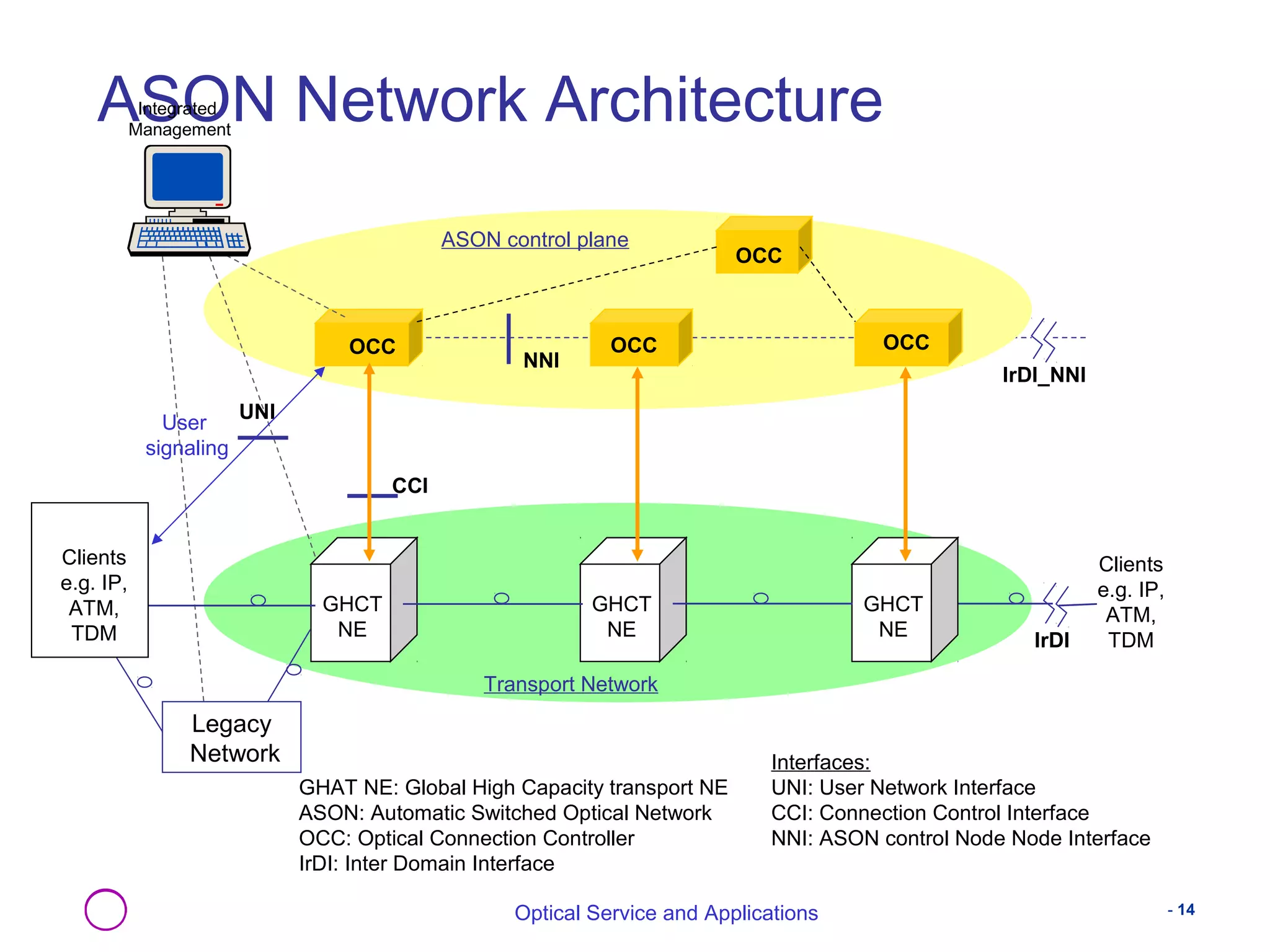
ASON Network Architecture 
OCC 
ASON control plane 
OCC OCC OCC 
NNI 
GHAT NE: Global High Capacity transport NE 
ASON: Automatic Switched Optical Network 
OCC: Optical Connection Controller 
IrDI: Inter Domain Interface 
Clients 
e.g. IP, 
ATM, 
TDM 
IrDI_NNI 
IrDI 
Interfaces: 
UNI: User Network Interface 
CCI: Connection Control Interface 
NNI: ASON control Node Node Interface 
Optical Service and Applications - 14 
Integrated 
Management 
GHCT 
NE 
GHCT 
NE 
GHCT 
NE 
Transport Network 
Legacy 
Network 
Clients 
e.g. IP, 
ATM, 
TDM 
User UNI 
signaling 
CCI
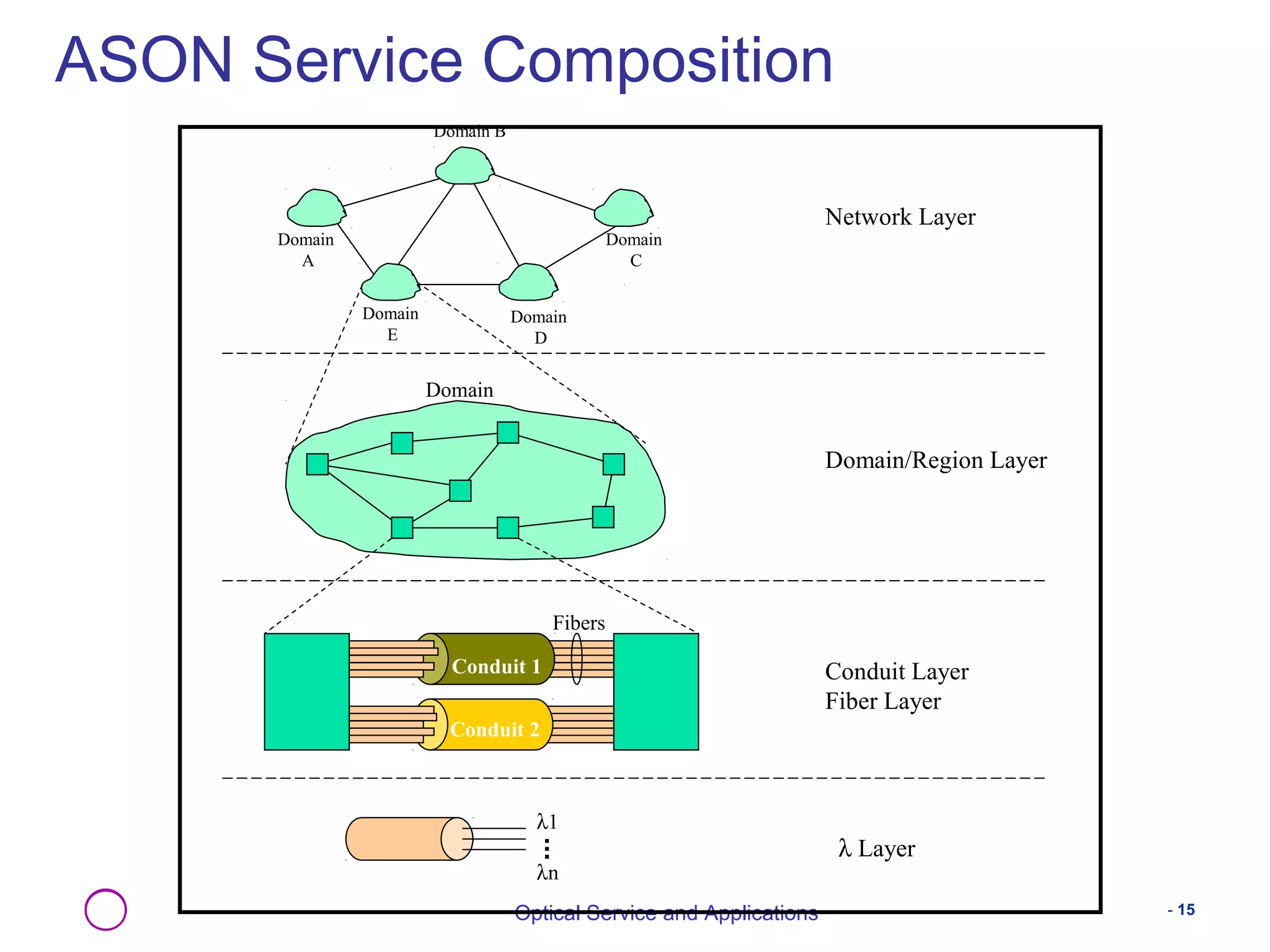
ASON Service Composition 
Network Layer 
Domain/Region Layer 
Conduit Layer 
Fiber Layer 
Domain 
Fibers 
D 
Conduit 1 
Conduit 2 
l Layer 
l1 
ln 
Optical Service and Applications - 15 
Domain B 
Domain 
E 
Domain 
A 
Domain 
C 
Domain
Optical Ethernet – RPR 
 RPR – Resilient Packet Ring – IEEE 802.17 
 Ethernet over MAN (Ethernet is winning all time) 
 Distributed L2 switch over MAN 
 Can have one part of the same subnet at SF, another part in SJ and SC 
 Virtual organization over MAN with NO routing. 
 Started to be deployed in the field 
 Cost – much cheaper than WAN 
Optical Service and Applications - 16
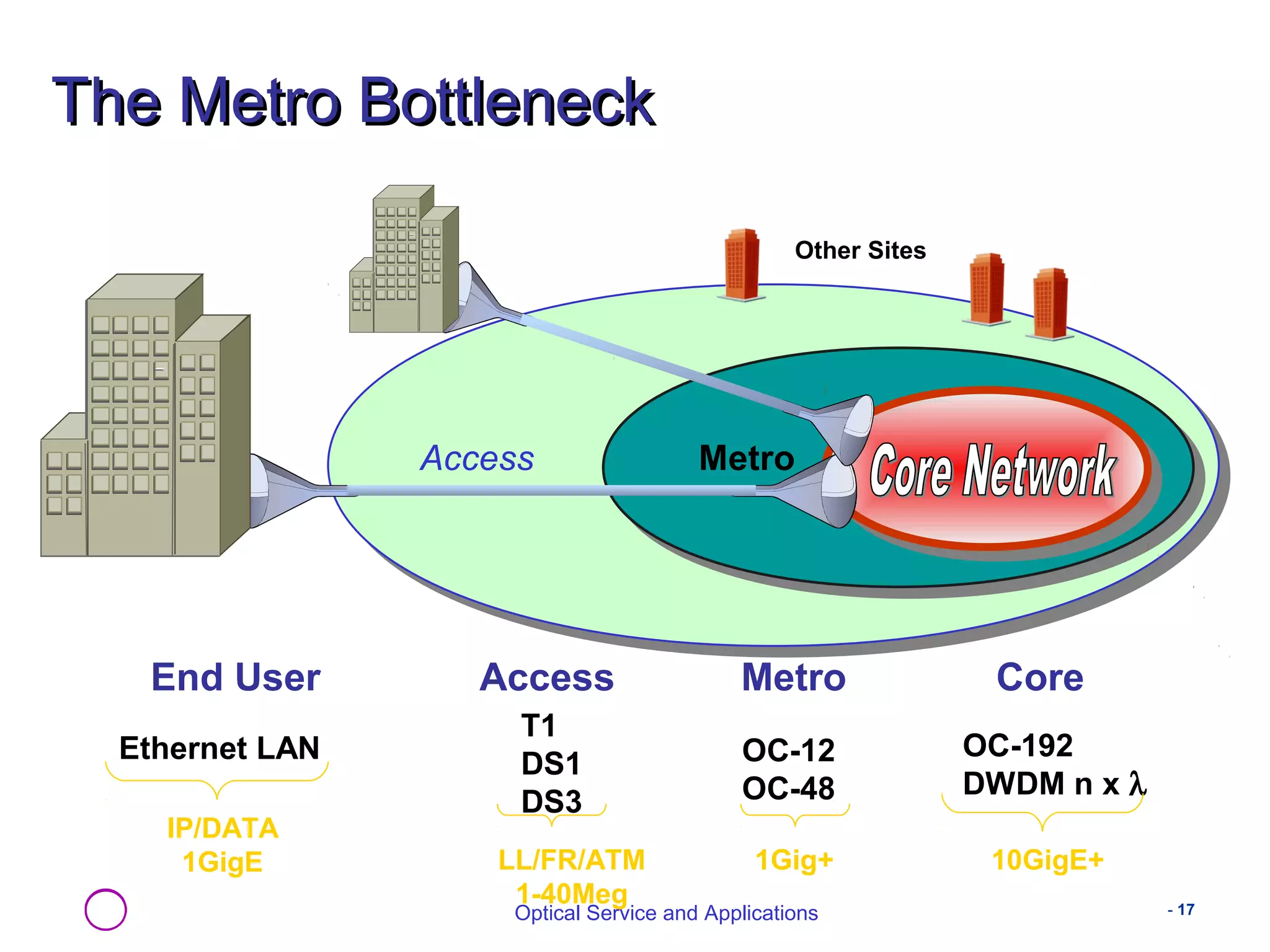
TThhee MMeettrroo BBoottttlleenneecckk 
Other Sites 
Access Metro 
End User Access Metro Core 
Ethernet LAN 
OC-192 
DWDM n x l 
T1 
DS1 
DS3 
IP/DATA 
1GigE 10GigE+ 
LL/FR/ATM 
1-40Meg 
OC-12 
OC-48 
1Gig+ 
Optical Service and Applications - 17
RPR - Expanding the LAN to the MAN/WAN 
LAN in 
the MAN 
Paradigm 
Optical Service and Applications - 18 
LAN 
• Low Cost 
• Simplicity 
• Universality 
MAN/WAN 
DDiissttrriibbuutteedd 
SSwwiittcchh 
+ 
• Scalability 
• Reach 
• Robustness 
• Low Cost 
• Simplicity 
• Universality
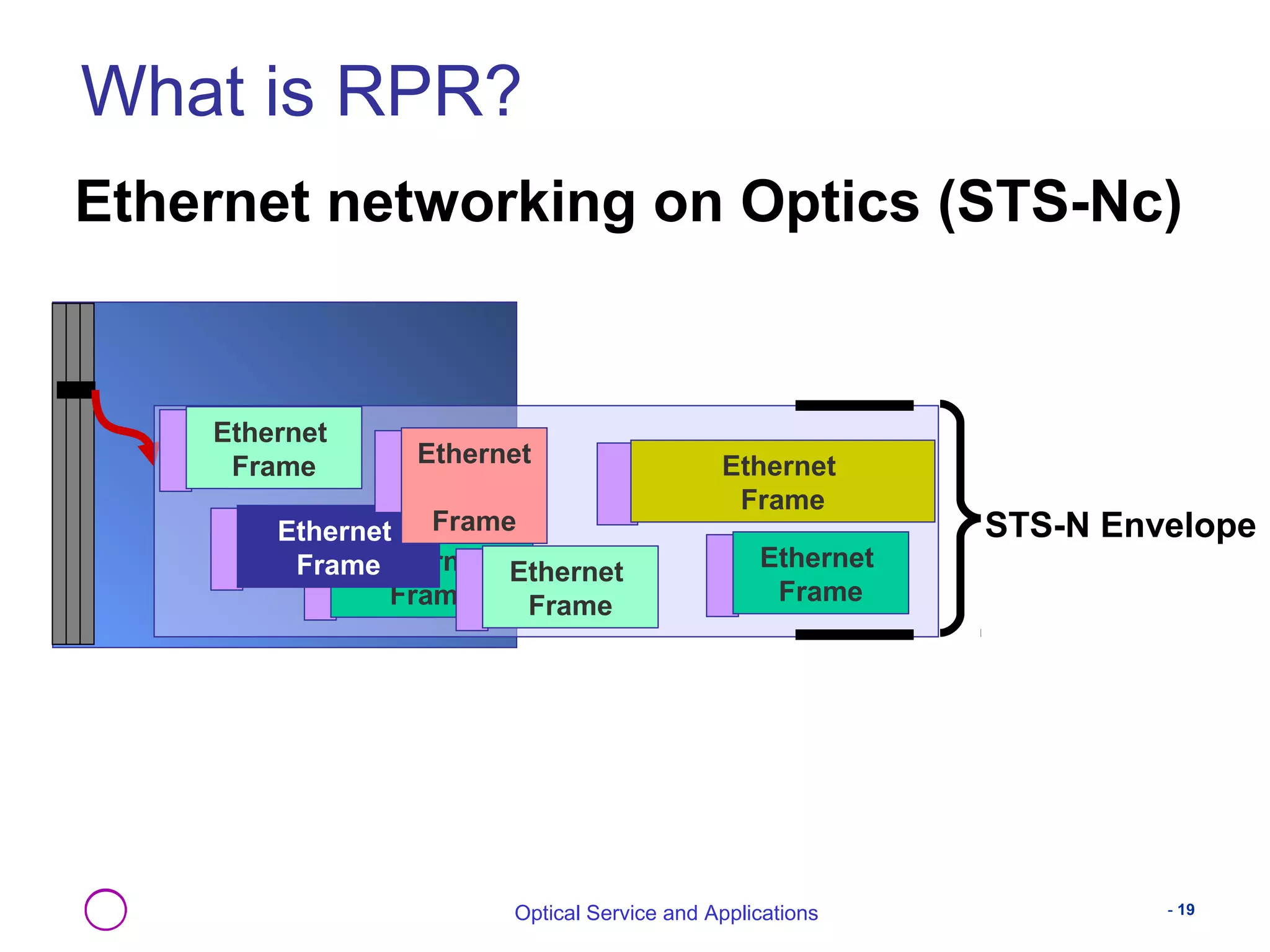
What is RPR? 
Ethernet networking on Optics (STS-Nc) 
STS-N Envelope 
Ethernet 
Frame 
Optical Service and Applications - 19 
Ethernet 
Frame 
Ethernet 
Frame 
Ethernet 
Frame 
Ethernet 
Frame 
Ethernet 
Frame 
Ethernet 
Frame
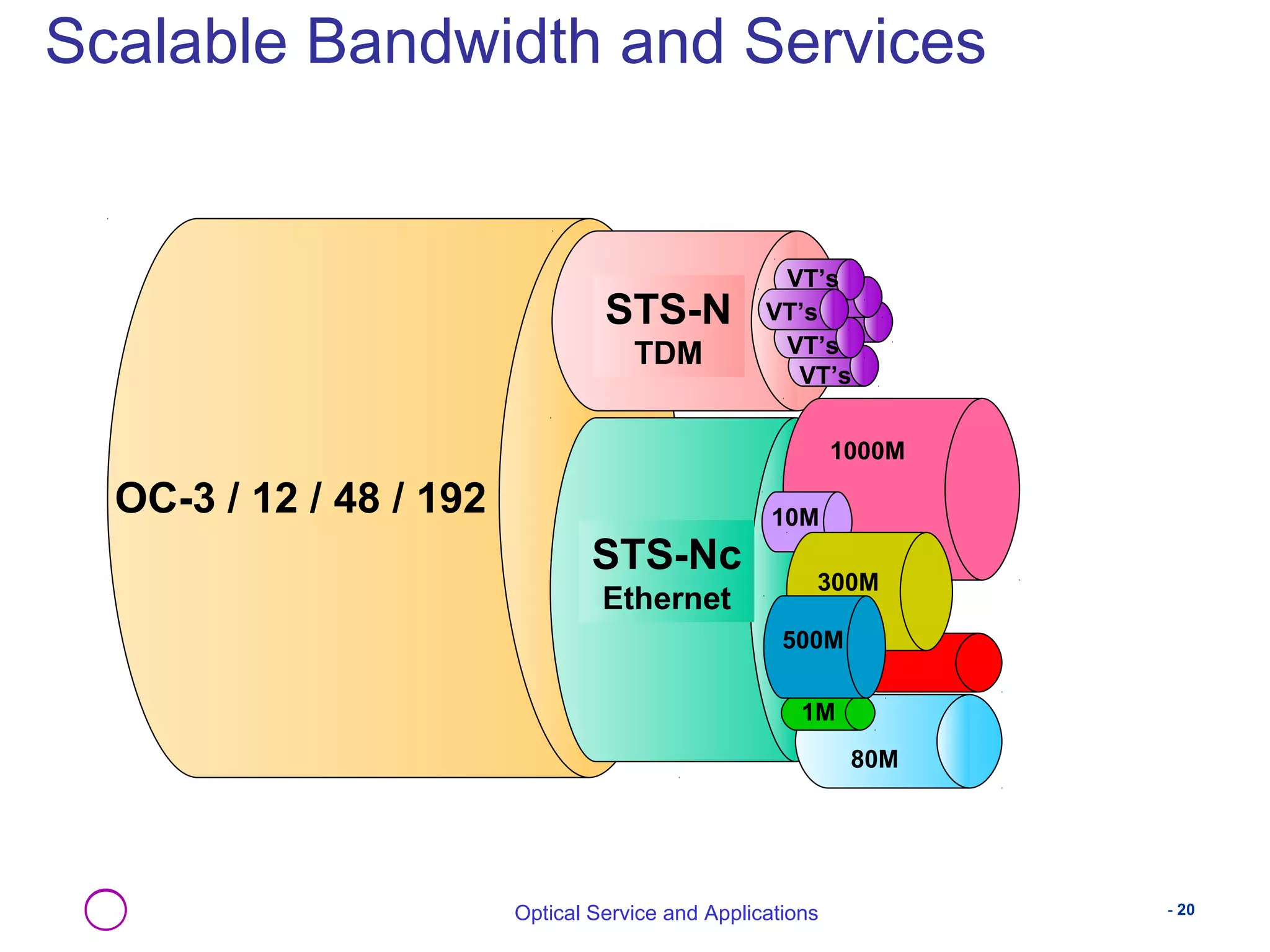
Scalable Bandwidth and Services 
VT’s 
1000M 
10M 
300M 
500M 
Optical Service and Applications - 20 
OC-3 / 12 / 48 / 192 
STS-N 
TDM 
STS-Nc 
Ethernet 
VT’s 
VT’s 
VT’s 
80M 
1M
Network & Customer Management 
•CCuussttoommeerr PPrriivvaaccyy tthhrroouugghh mmaannaaggeedd 
VViirrttuuaall LLAANNss ((880022..11QQ ttaaggss)) 
•CCuussttoommeerr AAggrreeeemmeennttss tthhrroouugghh ffllooww 
aattttrriibbuutteess ((880022..11pp pprriioorriittiizzeedd qquueeuueess aanndd 
ttrraaffffiicc ppoolliicciinngg)) 
Optical Service and Applications - 21 
Customer 
Ethernet 
Ports
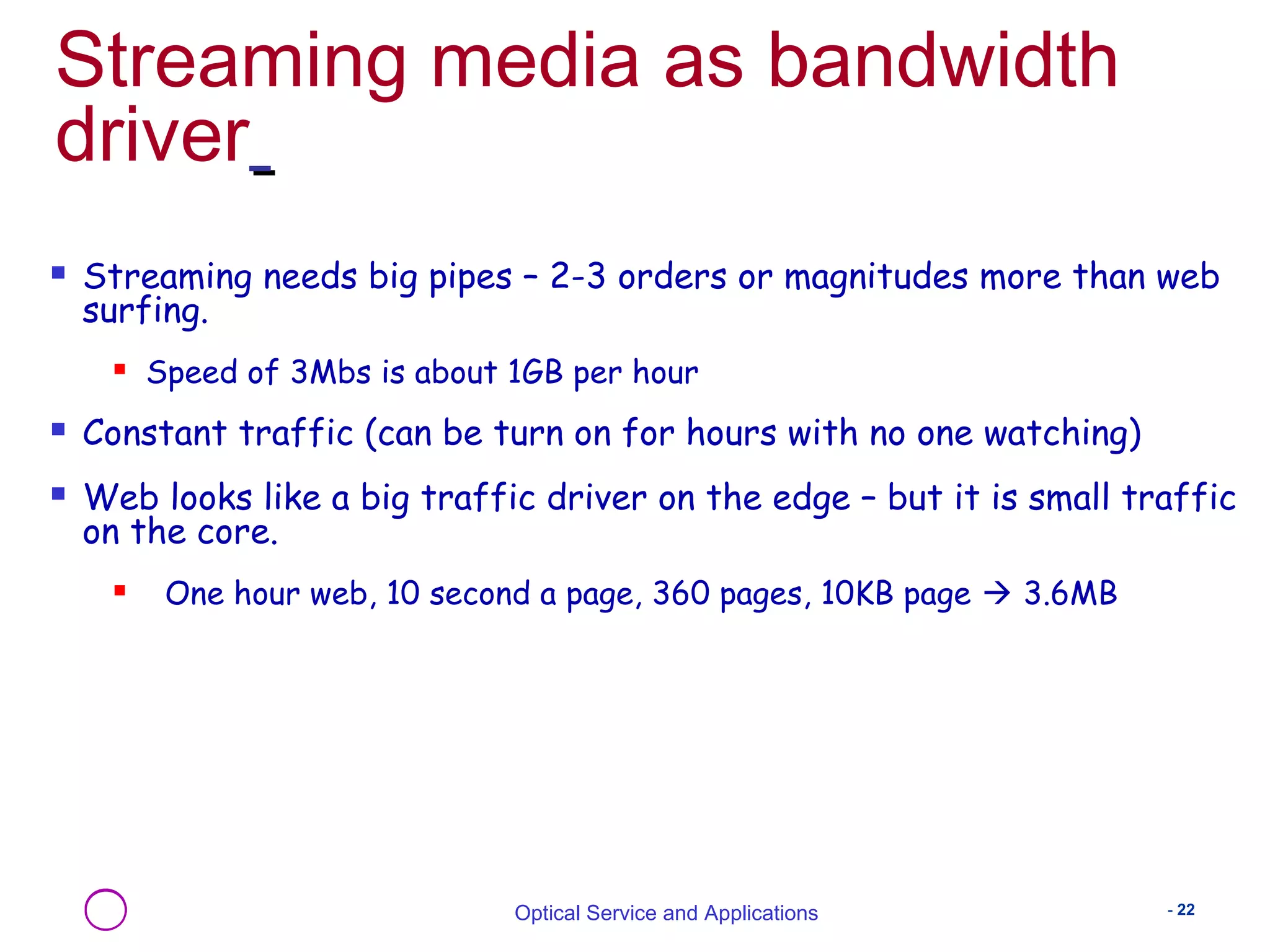
Streaming media as bandwidth 
driver 
 Streaming needs big pipes – 2-3 orders or magnitudes more than web 
surfing. 
 Speed of 3Mbs is about 1GB per hour 
 Constant traffic (can be turn on for hours with no one watching) 
 Web looks like a big traffic driver on the edge – but it is small traffic 
on the core. 
 One hour web, 10 second a page, 360 pages, 10KB page  3.6MB 
Optical Service and Applications - 22
EFM –Ethernet First Mile 
 Ethernet at the first mile start to be attractive. 
 Drive more bandwidth to the end users 
Optical Service and Applications - 23 
 Three proposals : 
 22Mbs on the current phone line 
 PON –Passive Optical Network – split the optical link to 4 and additional 8 
total 32 customers (60Mbs per residence) 
 Point-to-point optical – more expansive 
 SBC and alike are interested. 
 The tight of way is the main issue. Optical fibers work fine in harsh 
environment 
 Sewer net, Power line, Gas line, water line.
Where are the bottlenecks 
 Optical networking is evolving 
Optical Service and Applications - 24 
 Much more bandwidth 
 Agile reconfiguring of light path 
 As soon as one problem is solved, the bottleneck is moving to a new 
place 
 Currently it looks like the bottleneck is at the first mile 
 Streaming media - bottleneck push on routers 
 Much more bandwidth in the MAN move the bottlenecks away from 
the access and the edge 
 Peering points between service provides
OXC – Optical Cross Connect 
 Optical cross connects – less need for core routing 
 Fat pipes replace core routers with NO delay 
 It looks more like circuit switching instead of packet switching (ouhh) 
 MPLS, MPlS, LDP – Label Distribution Protocol – room for binding it 
to services on the edge. 
 UNI - User Network Interface , - allow the end machines and edge to 
send service request to the core 
 NNI – Network Network Interface, - control of the core (if the core 
agree to provide the service, might say no) 
Optical Service and Applications - 25
Backup Slides 
Optical Service and Applications - 26
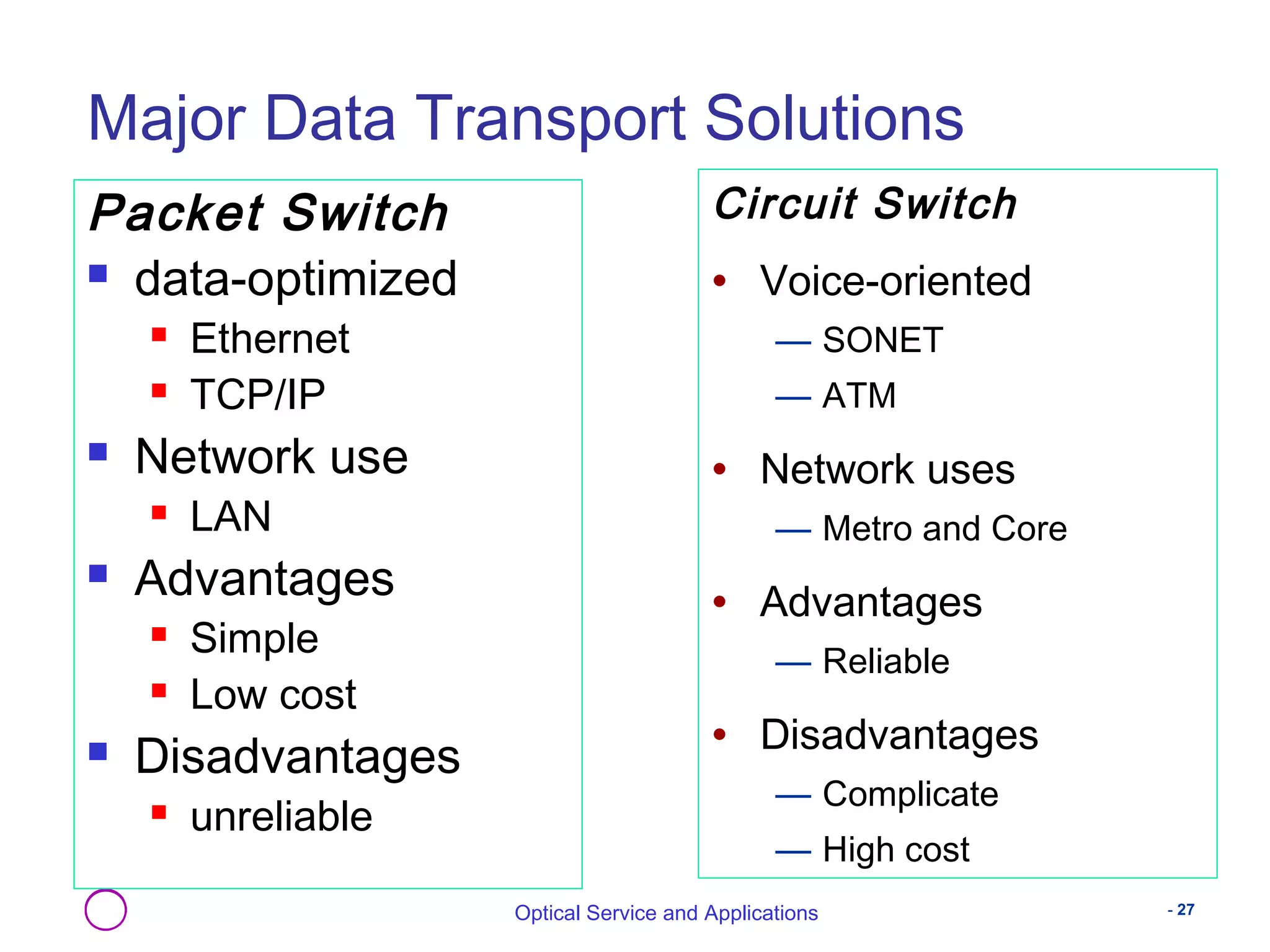
Major Data Transport Solutions 
Packet Switch 
 data-optimized 
Optical Service and Applications - 27 
 Ethernet 
 TCP/IP 
 Network use 
 LAN 
 Advantages 
 Simple 
 Low cost 
 Disadvantages 
 unreliable 
Circuit Switch 
• Voice-oriented 
— SONET 
— ATM 
• Network uses 
— Metro and Core 
• Advantages 
— Reliable 
• Disadvantages 
— Complicate 
— High cost

Optical Networks Infrastructure

  • 1.
  • 2.
    Area of interest  Need for building new services utilizing agile optical  What are the new services? Optical Service and Applications - 2  Impendence mismatch  Static Provisioning  Carrier Hotels  Optical Ethernet - 802.17 RPR – Resilient Packet Ring  ASON – Automatically Switched Optical Networks  EFM - Ethernet First Mile  Where are the bottlenecks - it is changing  OXC – Optical Cross Connects – long hope – move intelligence to the edge
  • 3.
    Need for newservices Optical Service and Applications - 3 
  • 4.
    Internet Reality Data Center SONET Optical Service and Applications - 4 SONET SONET SONET DWD M DWD M Access Metro Long Haul Metro Access
  • 5.
    Patch Panel- Manually provisioning Optical Service and Applications - 5 
  • 6.
    New services takestoo long  Manually cable connections  It takes 4-6 months to provision a new optical connection Optical Service and Applications - 6  Cross bounders  Tier 1, Tier 2, Tier 3  Why not Tier 3 talk directly with another Tier 3?  Small Metro providers in LA and NY want to connect via small LH provider.  Why we need the big players?
  • 7.
    Service Composition Service composition of light path across service provider  Many AS each of them does not have access to the rest  Build a light path among service providers  Many different networks, no one can have full coverage,  Network infrastructure is extremely expansive (Billions of Dollars), service composition save resources (I’ll use your infrastructure, you’ll use mine)  Service composition to set light path between technologies (Access, Metro and Long Haul) Optical Service and Applications - 7  Grid computing, SAN
  • 8.
    Cooperation and Brokering Optical Service and Applications - 8  Service composition
  • 9.
    Impedance Mismatch Cross boundaries (Control, Management, security)  Cross Technologies (Sonet, DWDM, ATM)  Dross topologies (P2P, Rings all types, mesh, ) Optical Service and Applications - 9  Circlet , packets  Speeds (1.5, 10, 51, 100, 155, 622, 1G, 2.4G, 10G…)  Fiber, copper, wireless  Level of media security
  • 10.
    Business Case forDirect Peering  Typical Internet transit costs - $1000/Mbps per month  For 100 Mbps Internet transit then $100,000/mo  But coast to coast 100 Mbps channel is $1000/mo (e.g. Optical Service and Applications - 10 www.Cogent.com)  New optical technology will reduce that cost further  Compelling business case to do as much no-cost direct peering as possible  See http://www.nanog.org/mtg-0010/tree.doc  OBGP is a proposed protocol that will allow massive direct peerings  Each optical switch is in effect a mini-IX to allow direct no cost peering  OBGP will also automate peering relationships  Significant business opportunity for carriers who want to partner with CANARIE in building next generation optical Internet  For example Telia claims that they save 75% in Internet transit fees with massive direct peering  Speeds up convergence time on BGP routing  Source – cook report
  • 11.
    ASON – Automatically Switched Optical Networks  Dynamically switch the light path  Enabler for many applications  Controlled by UNI and NNI – Allow applications to set the light path  Allow to add the intelligence into the optical core Optical Service and Applications - 11
  • 12.
    What is ASON?  The Automatic Switched Optical Network (ASON) is both a framework and a technology capability.  As a framework that describes a control and management architecture for an automatic switched optical transport network.  As a technology, it refers to routing and signalling protocols applied to an optical network which enable dynamic path setup.  Recently changed names to Automatic Switched Transport Network (G.ASTN) Optical Service and Applications - 12
  • 13.
    Optical Network: Todayvs. Tomorrow Applications Protection Topology Management NW ASON value added Today Optical Service and Applications - 13 - DS3 - STS-n - STS-nc - OC-48T, (OC-192T) - 1GE - (134Mb/s) - 140Mb/s - VC-4 - VC-4-nc - NUT - Extra Traffic - Broadcast - VC-4-nv - 10GE - Flexible i/f - Billing method (distance, time, bw, QoS) - Asymitric bw connections - Point-to-multipoint - sequential - 2F/4F BLSR - Matched Nodes - Head end ring prot. - NUT (non-preemptive unprotected traffic mixed with protected in ring/linear) - Unprotected (extra traffic) - Protection SW time - Clear P =60ms - With ET=160ms - MN = 250ms - Wider range of SLA capability - Path diversity verifiable - Scalable to large NW size - 2F/4F BLSR - Linear - 1+1 - 1:n - Path protection - Mesh - Port connectivity - unconstrained - arbitrary - Provisioned path connection - Trail management across multiple rings - Multiple product - Auto discovery of NW configuration - Connection provisioning of paths over unconstrained line topology - No pre-provisioning of connections? - User signaling i/f for connection provisioning - Scalable to very large NW - Fast connection establishment <2s - Resource (bw) management and monitoring Additional SLA capability Mesh network Auto connection & resource mgnt Optimized IP application - current driver for transparent Tomorrow Source Nortel
  • 14.
    ASON Network Architecture OCC ASON control plane OCC OCC OCC NNI GHAT NE: Global High Capacity transport NE ASON: Automatic Switched Optical Network OCC: Optical Connection Controller IrDI: Inter Domain Interface Clients e.g. IP, ATM, TDM IrDI_NNI IrDI Interfaces: UNI: User Network Interface CCI: Connection Control Interface NNI: ASON control Node Node Interface Optical Service and Applications - 14 Integrated Management GHCT NE GHCT NE GHCT NE Transport Network Legacy Network Clients e.g. IP, ATM, TDM User UNI signaling CCI
  • 15.
    ASON Service Composition Network Layer Domain/Region Layer Conduit Layer Fiber Layer Domain Fibers D Conduit 1 Conduit 2 l Layer l1 ln Optical Service and Applications - 15 Domain B Domain E Domain A Domain C Domain
  • 16.
    Optical Ethernet –RPR  RPR – Resilient Packet Ring – IEEE 802.17  Ethernet over MAN (Ethernet is winning all time)  Distributed L2 switch over MAN  Can have one part of the same subnet at SF, another part in SJ and SC  Virtual organization over MAN with NO routing.  Started to be deployed in the field  Cost – much cheaper than WAN Optical Service and Applications - 16
  • 17.
    TThhee MMeettrroo BBoottttlleenneecckk Other Sites Access Metro End User Access Metro Core Ethernet LAN OC-192 DWDM n x l T1 DS1 DS3 IP/DATA 1GigE 10GigE+ LL/FR/ATM 1-40Meg OC-12 OC-48 1Gig+ Optical Service and Applications - 17
  • 18.
    RPR - Expandingthe LAN to the MAN/WAN LAN in the MAN Paradigm Optical Service and Applications - 18 LAN • Low Cost • Simplicity • Universality MAN/WAN DDiissttrriibbuutteedd SSwwiittcchh + • Scalability • Reach • Robustness • Low Cost • Simplicity • Universality
  • 19.
    What is RPR? Ethernet networking on Optics (STS-Nc) STS-N Envelope Ethernet Frame Optical Service and Applications - 19 Ethernet Frame Ethernet Frame Ethernet Frame Ethernet Frame Ethernet Frame Ethernet Frame
  • 20.
    Scalable Bandwidth andServices VT’s 1000M 10M 300M 500M Optical Service and Applications - 20 OC-3 / 12 / 48 / 192 STS-N TDM STS-Nc Ethernet VT’s VT’s VT’s 80M 1M
  • 21.
    Network & CustomerManagement •CCuussttoommeerr PPrriivvaaccyy tthhrroouugghh mmaannaaggeedd VViirrttuuaall LLAANNss ((880022..11QQ ttaaggss)) •CCuussttoommeerr AAggrreeeemmeennttss tthhrroouugghh ffllooww aattttrriibbuutteess ((880022..11pp pprriioorriittiizzeedd qquueeuueess aanndd ttrraaffffiicc ppoolliicciinngg)) Optical Service and Applications - 21 Customer Ethernet Ports
  • 22.
    Streaming media asbandwidth driver  Streaming needs big pipes – 2-3 orders or magnitudes more than web surfing.  Speed of 3Mbs is about 1GB per hour  Constant traffic (can be turn on for hours with no one watching)  Web looks like a big traffic driver on the edge – but it is small traffic on the core.  One hour web, 10 second a page, 360 pages, 10KB page  3.6MB Optical Service and Applications - 22
  • 23.
    EFM –Ethernet FirstMile  Ethernet at the first mile start to be attractive.  Drive more bandwidth to the end users Optical Service and Applications - 23  Three proposals :  22Mbs on the current phone line  PON –Passive Optical Network – split the optical link to 4 and additional 8 total 32 customers (60Mbs per residence)  Point-to-point optical – more expansive  SBC and alike are interested.  The tight of way is the main issue. Optical fibers work fine in harsh environment  Sewer net, Power line, Gas line, water line.
  • 24.
    Where are thebottlenecks  Optical networking is evolving Optical Service and Applications - 24  Much more bandwidth  Agile reconfiguring of light path  As soon as one problem is solved, the bottleneck is moving to a new place  Currently it looks like the bottleneck is at the first mile  Streaming media - bottleneck push on routers  Much more bandwidth in the MAN move the bottlenecks away from the access and the edge  Peering points between service provides
  • 25.
    OXC – OpticalCross Connect  Optical cross connects – less need for core routing  Fat pipes replace core routers with NO delay  It looks more like circuit switching instead of packet switching (ouhh)  MPLS, MPlS, LDP – Label Distribution Protocol – room for binding it to services on the edge.  UNI - User Network Interface , - allow the end machines and edge to send service request to the core  NNI – Network Network Interface, - control of the core (if the core agree to provide the service, might say no) Optical Service and Applications - 25
  • 26.
    Backup Slides OpticalService and Applications - 26
  • 27.
    Major Data TransportSolutions Packet Switch  data-optimized Optical Service and Applications - 27  Ethernet  TCP/IP  Network use  LAN  Advantages  Simple  Low cost  Disadvantages  unreliable Circuit Switch • Voice-oriented — SONET — ATM • Network uses — Metro and Core • Advantages — Reliable • Disadvantages — Complicate — High cost

Editor's Notes

  • #15 ASON connection management system consists of signaling plane, switch controller and SLC machine. Signaling plane is the brain of ASON connection management system. It discovers the transport network topology including the available network resources (such as b/w) automatically or by pre-configuration. Upon a connection request, the signal plane will decide the connection path and inform switch controller to set-up the connection. Switch controller is associated with each network element (OXC, ADM, …) or a group of NEs. It performs actual connection function (set-up, or tear-down connections) under the control of the signal plane. SLA machine is part of the switch controller function. It performs “call” administration control and billing function which off loads function from the signal plane Four connection control interfaces are identified: UNI: The user network interface (UNI) is the interface between ASON control plane and a user such as a router, or an ATM switch, etc. A signal channel is required at this interface as a dialog channel between the user and ASON control plane for connection set up/tear down request. SCI: The signal control interface (SCI) is the interface between the connection control plane and the switch controller in a network element. The ASON signal control plane calculates the connection routes, and set up connection via switch controllers. Switch controller just execute the command from the ASON control plane. IaDI: The intra-domain interface is the interface between network elements in ASON control plane. NNI: The network network interface is the interface between ASON control planes in different administration domains. It allows the network to be partitioned into sub-networks; each sub-network is managed independently while still be able to set up end-to-end connections across multiple administration domains (sub-networks).
  • #18 Enterprise employees have been able to communicate across their Local Area Network (LAN) without much concern over format or rate; Ethernet 10Bt and 100Bt are common in almost all enterprises. The enterprise bottleneck to the Wide Area Network (WAN) has always been constrained to the traditional voice telecommunication rates of DS0 (64Kb/s), DS1 and on rare occasions DS3. Format conversion and adaptation is required for any data communication beyond the LAN. The service provider is seen simply as a “middleman”, providing network connectivity with no value-added content, leaving them susceptible to customer churn as lowered priced offerings become available. Bandwidth capacity has been increasing in the service provider WAN as OC-48 and OC-192 optical backbones have been deployed. Bandwidth has also been increasing in the enterprise LAN as they have deployed Fast Ethernet and 1G Ethernet connections in their corporate networks. A bandwidth bottleneck still exists, however, at the connection between the LAN and the WAN, the Metropolitan Area Network (MAN).
  • #19 The Optical Ethernet takes the application protocol (Native-rate Ethernet) and keeps it intact across the entire network. The limitations of TDM SONET are eliminated by dedicating SONET STS-n bandwidth to Ethernet Data applications. This allows bandwidth sharing as well as highly flexible service offerings.
  • #21 SONET OC-x pipes are composed of multiple STS-n pipes which are in turn composed of virtual tributaries (VTs) which are in turn composed of voice based DS-0s. These STS-n’s, VT’s and DS-0’s are maintained in logical point-to-point connections which allocate the full-bandwidth provisioned even if traffic is not present.