


TOPICS TO BE DISCUSSED
TYPES OF CONNECTION
1.Point to Point Connection
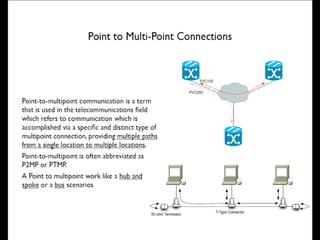
2.Point to Multi-Point Connection
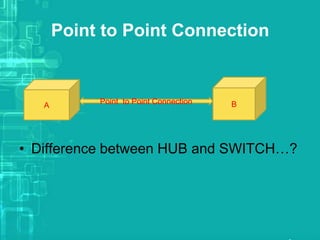
Point to Point Connection

A

Point to Point Connection

B

• Difference between HUB and SWITCH…?
• HUB provides a point-to-multipoint (or
simply multipoint) circuit. which divides the
total bandwidth to all connected client
node.
• SWITCH on the other hand provides a
series of point-to-point circuits, which
allows each client node to have a
dedicated circuit and the added advantage
of having full-duplex connections.
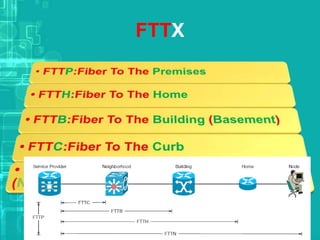
FTTX
Something more about FTTX….!!
• At each customer's premises is a special type of
network interface device (NID). This device is called
either an optical network terminal (ONT) or an optical
network unit (ONU).
• It converts the optical signal into some format
understandable to the customer's devices.
• Optical network units use thin film filter technology to
convert between optical and electrical signals.
• The connection between the optical network terminal at
the customer's premises and the equipment at the
provider's central office is called an optical distribution
network (ODN).
Network interface device (NID)
• This device is also called as either an optical network
terminal (ONT) or an optical network unit (ONU).
• It converts the optical signal into some format
understandable to the customer's devices.
• Optical network units use thin film filter technology to
convert between optical and electrical signals.
• The connection between the optical network terminal at
the customer's premises and the equipment at the
provider's central office is called an optical distribution
network (ODN).
•The simplest optical distribution network is called home run fiber. In this
architecture, each fiber leaving the central office goes to exactly one
customer.
Such networks can provide excellent bandwidth since each customer gets
their own dedicated fiber extending all the way to the central office.
However, this approach is extremely costly due to the amount of fiber
and central office machinery required. It is usually used only in instances
where the service area is very small and close to the central office.
More commonly each fiber leaving the central office is actually shared by
many customers. So we need proper optical distribution network to split
individual customer-specific fibers.
There are two competing optical distribution network architectures
which achieve this split: active optical networks (AONs) and passive
optical networks (PONs).
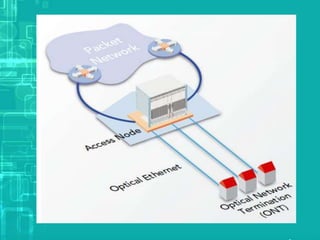
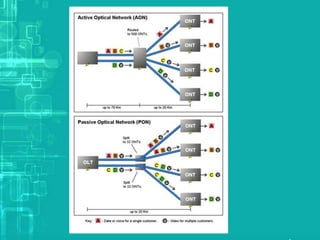
Active Optical Network
• Active optical networks rely on some sort of electrically
powered equipment to distribute the signal, such as a
switch, router, or multiplexer.
• Each signal leaving the central office is directed only to
the customer for which it is intended.(point-to-point
network structure)
• Incoming signals from the customers avoid colliding at
the intersection because the powered equipment there
provides buffering.
• Such networks are identical to Ethernet computer
networks used in businesses and academic institutions,
except that here purpose is to connect homes and
buildings to a central office rather than to connect
computers and printers within a location. Each switching
cabinet can handle up to 1,000 customers
Passive Optical Network
• In comparison with active optical networks, passive optical
networks have significant advantages and disadvantages.
They avoid the complexities involved in keeping electronic
equipment operating outdoors.
• They also allow for analog broadcasts
• However, because each signal must be pushed out to
everyone served by the beam splitter (rather than to just a
single switching device), the central office must be
equipped with a particularly powerful piece of transmitting
equipment called an optical line terminal (OLT).
Optical Line Terminal
• It is a device which serves as the service provider end
point of a passive optical network. It provides two main
functions:
1. to perform conversion between the electrical signals
used by the service provider's equipment and the fiber
optic signals used by the passive optical network.
2. to coordinate the multiplexing between the conversion
devices on the other end of that network (called either
optical network terminals or optical network units).
• An OLT, in a nutsell, is where the PON cards reside. The OLT's also
contain the CPU and the GWR and VGW uplink cards. Each OLT
can have a few or many dozens of PON cards.
PON = Passive Optical Network
GWR = Gateway Router
VGW = Voice Gateway
Each OLT vendor has different models and configurations,
depending on the technology and the end-user.
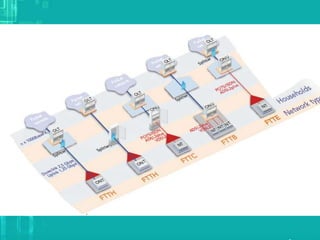
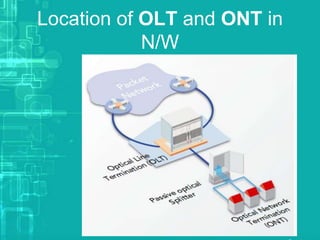
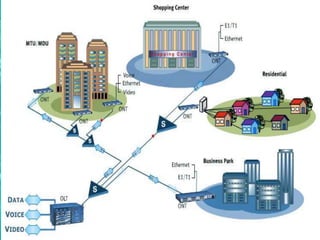
Location of OLT and ONT in
N/W
Advantages of PONs
• Conserves fiber resources
• Low cost of equipment per subscriber
• There is only one optical port at the Central Office
(instead of multiple ports)
• Passive components require little maintenance.
• Additional buildings can be added to the network easily
and inexpensively
• Supports a broad range of applications including triple
play (voice, data, video) over a single fiber and FTTB,
FTTC, FTTH
• Offers a large amount of high speed bandwidth providing
greater flexibility for adding future services
• Flexible and scalable bandwidth assignment
Disadvantages of PONs
•
•
•
•

Fixed location install only
Optical fiber price still higher than copper
Require installed extra splitter when network spread
Splitter and bandwidth ratio cause the network size be
limited
• Bandwidth is limited on OLT capability
• Shared bandwidth network topology
• QoS issues
REFFERENCES
• White paper AON vs PON published by
KEYMILE International GmbH. (2008)
Basic optical network terminology

Basic optical network terminology

  • 2.
    TOPICS TO BEDISCUSSED
  • 3.
    TYPES OF CONNECTION 1.Pointto Point Connection 2.Point to Multi-Point Connection
  • 4.
    Point to PointConnection A Point to Point Connection B • Difference between HUB and SWITCH…?
  • 5.
    • HUB providesa point-to-multipoint (or simply multipoint) circuit. which divides the total bandwidth to all connected client node. • SWITCH on the other hand provides a series of point-to-point circuits, which allows each client node to have a dedicated circuit and the added advantage of having full-duplex connections.
  • 7.
  • 8.
    Something more aboutFTTX….!! • At each customer's premises is a special type of network interface device (NID). This device is called either an optical network terminal (ONT) or an optical network unit (ONU). • It converts the optical signal into some format understandable to the customer's devices. • Optical network units use thin film filter technology to convert between optical and electrical signals. • The connection between the optical network terminal at the customer's premises and the equipment at the provider's central office is called an optical distribution network (ODN).
  • 10.
    Network interface device(NID) • This device is also called as either an optical network terminal (ONT) or an optical network unit (ONU). • It converts the optical signal into some format understandable to the customer's devices. • Optical network units use thin film filter technology to convert between optical and electrical signals. • The connection between the optical network terminal at the customer's premises and the equipment at the provider's central office is called an optical distribution network (ODN).
  • 11.
    •The simplest opticaldistribution network is called home run fiber. In this architecture, each fiber leaving the central office goes to exactly one customer. Such networks can provide excellent bandwidth since each customer gets their own dedicated fiber extending all the way to the central office. However, this approach is extremely costly due to the amount of fiber and central office machinery required. It is usually used only in instances where the service area is very small and close to the central office. More commonly each fiber leaving the central office is actually shared by many customers. So we need proper optical distribution network to split individual customer-specific fibers. There are two competing optical distribution network architectures which achieve this split: active optical networks (AONs) and passive optical networks (PONs).
  • 12.
    Active Optical Network •Active optical networks rely on some sort of electrically powered equipment to distribute the signal, such as a switch, router, or multiplexer. • Each signal leaving the central office is directed only to the customer for which it is intended.(point-to-point network structure) • Incoming signals from the customers avoid colliding at the intersection because the powered equipment there provides buffering. • Such networks are identical to Ethernet computer networks used in businesses and academic institutions, except that here purpose is to connect homes and buildings to a central office rather than to connect computers and printers within a location. Each switching cabinet can handle up to 1,000 customers
  • 14.
    Passive Optical Network •In comparison with active optical networks, passive optical networks have significant advantages and disadvantages. They avoid the complexities involved in keeping electronic equipment operating outdoors. • They also allow for analog broadcasts • However, because each signal must be pushed out to everyone served by the beam splitter (rather than to just a single switching device), the central office must be equipped with a particularly powerful piece of transmitting equipment called an optical line terminal (OLT).
  • 15.
    Optical Line Terminal •It is a device which serves as the service provider end point of a passive optical network. It provides two main functions: 1. to perform conversion between the electrical signals used by the service provider's equipment and the fiber optic signals used by the passive optical network. 2. to coordinate the multiplexing between the conversion devices on the other end of that network (called either optical network terminals or optical network units).
  • 16.
    • An OLT,in a nutsell, is where the PON cards reside. The OLT's also contain the CPU and the GWR and VGW uplink cards. Each OLT can have a few or many dozens of PON cards. PON = Passive Optical Network GWR = Gateway Router VGW = Voice Gateway Each OLT vendor has different models and configurations, depending on the technology and the end-user.
  • 17.
    Location of OLTand ONT in N/W
  • 19.
    Advantages of PONs •Conserves fiber resources • Low cost of equipment per subscriber • There is only one optical port at the Central Office (instead of multiple ports) • Passive components require little maintenance. • Additional buildings can be added to the network easily and inexpensively • Supports a broad range of applications including triple play (voice, data, video) over a single fiber and FTTB, FTTC, FTTH • Offers a large amount of high speed bandwidth providing greater flexibility for adding future services • Flexible and scalable bandwidth assignment
  • 20.
    Disadvantages of PONs • • • • Fixedlocation install only Optical fiber price still higher than copper Require installed extra splitter when network spread Splitter and bandwidth ratio cause the network size be limited • Bandwidth is limited on OLT capability • Shared bandwidth network topology • QoS issues
  • 22.
    REFFERENCES • White paperAON vs PON published by KEYMILE International GmbH. (2008)