
New Drug Application
The New Drug Application (NDA) is the vehicle in the United
States through which drug sponsors formally propose that
the Food and Drug Administration (FDA) approve a new
pharmaceutical for sale and marketing.
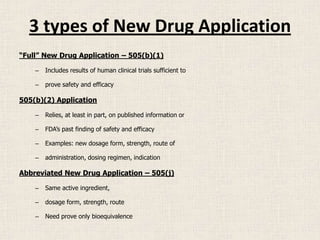
3 types of New Drug Application
“Full” New Drug Application – 505(b)(1)
– Includes results of human clinical trials sufficient to
– prove safety and efficacy
505(b)(2) Application
– Relies, at least in part, on published information or
– FDA’s past finding of safety and efficacy
– Examples: new dosage form, strength, route of
– administration, dosing regimen, indication
Abbreviated New Drug Application – 505(j)
– Same active ingredient,
– dosage form, strength, route
– Need prove only bioequivalence
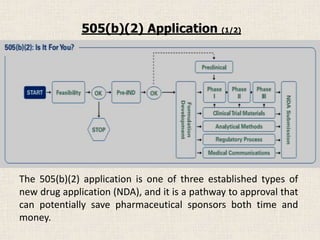
The 505(b)(2) application is one of three established types of
new drug application (NDA), and it is a pathway to approval that
can potentially save pharmaceutical sponsors both time and
money.
505(b)(2) Application (1/2)
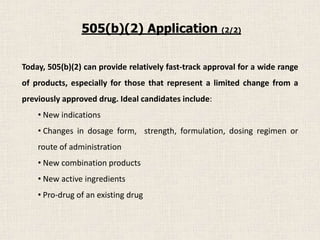
Today, 505(b)(2) can provide relatively fast-track approval for a wide range
of products, especially for those that represent a limited change from a
previously approved drug. Ideal candidates include:
• New indications
• Changes in dosage form, strength, formulation, dosing regimen or
route of administration
• New combination products
• New active ingredients
• Pro-drug of an existing drug
505(b)(2) Application (2/2)
• That are covered under Section 505(j)
• For which the only difference is lower extent of
absorption than reference drug
• For which the only difference is an unintended lower
rate of absorption than reference drug
The 505(b)(2) applications are not
appropriate for products
For further info:
Nazmul Hasan Mahmud
Assistant Manager, International Business
Eskayef Bangladesh Limited
158/E Kemal Ataturk Avenue, Dhaka – 1213
Bangladesh
Email: nhmshuvo@gmail.com
LinkedIn: http://bd.linkedin.com/in/nhmshuvo

New drug application

  • 1.
    New Drug Application TheNew Drug Application (NDA) is the vehicle in the United States through which drug sponsors formally propose that the Food and Drug Administration (FDA) approve a new pharmaceutical for sale and marketing.
  • 2.
    3 types ofNew Drug Application “Full” New Drug Application – 505(b)(1) – Includes results of human clinical trials sufficient to – prove safety and efficacy 505(b)(2) Application – Relies, at least in part, on published information or – FDA’s past finding of safety and efficacy – Examples: new dosage form, strength, route of – administration, dosing regimen, indication Abbreviated New Drug Application – 505(j) – Same active ingredient, – dosage form, strength, route – Need prove only bioequivalence
  • 3.
    The 505(b)(2) applicationis one of three established types of new drug application (NDA), and it is a pathway to approval that can potentially save pharmaceutical sponsors both time and money. 505(b)(2) Application (1/2)
  • 4.
    Today, 505(b)(2) canprovide relatively fast-track approval for a wide range of products, especially for those that represent a limited change from a previously approved drug. Ideal candidates include: • New indications • Changes in dosage form, strength, formulation, dosing regimen or route of administration • New combination products • New active ingredients • Pro-drug of an existing drug 505(b)(2) Application (2/2)
  • 5.
    • That arecovered under Section 505(j) • For which the only difference is lower extent of absorption than reference drug • For which the only difference is an unintended lower rate of absorption than reference drug The 505(b)(2) applications are not appropriate for products
  • 6.
    For further info: NazmulHasan Mahmud Assistant Manager, International Business Eskayef Bangladesh Limited 158/E Kemal Ataturk Avenue, Dhaka – 1213 Bangladesh Email: nhmshuvo@gmail.com LinkedIn: http://bd.linkedin.com/in/nhmshuvo