Generic drug product
development
PRESENTED BY
PREETI KULKARNI
M.PHARM
Generic Drugs
• Defined as "a drug product that is comparable to brand/innovator drug in
dosage form, strength, route of administration, quality and performance
characteristics, and intended use.”
• It should contain the same active ingredients as the original formulation.
• According to the FDA, generic drugs are identical or within an acceptable
bioequivalent range to the brand-name counterpart with respect to
pharmacokinetic and pharmacodynamic properties
Goal
• The main goal in introducing generic medicines into market was to
decrease prices.
• After the expiry of patent patented drug, generic drugs are
marketed.
• Generic drugs are labeled with the name of the manufacturer and the
adopted name (nonproprietary name) of the drug.
• Today about 50% of all prescriptions are filled with generic drugs
Economy
• Globally India ranks 3rd in terms of manufacture pharmaceutical products
by volume.
• Thus every drug cost depends upon the expenditure of the research and
procedures of approval.
• WHO says 3.2% of Indians will fall below the poverty line will because of
high medical bills.
• 39 million Indians are pushed into poverty because of ill health every year.
• Around 30% in rural India, don’t go for any treatment because of
financial constraints.
• The prescriptions from branded drugs to generic drugs will lead to an
annual reduction of overall 11% in drug costs
Patent protection
• In most countries of the world, patents will give 20 years of
protection.
• However, many countries e.g. the European Union and the USA may
grant up to 5 years of additional protection for drugs.
• When the patents on a brand-name drug near expiration, drug
companies that want to manufacture a generic can apply to the FDA
to sell a generic version of the drug
Market
• Indian pharmaceutical market is expected to reach US $ 65 billion by 2024 and to
US $120 billion by 2030.
• Indian pharmaceutical industry is currently valued at US $41 billion.
• Currently India dominates the generic market share with 71 %.
• India exported $ 17.3 billion worth of drugs, which was nearly 20 % of the global
market.
• India ranks 10th in terms of exporting its product to more than 200 countries
around the globe including the USA, South Africa, Russia, the UK, Brazil, Nigeria,
Europe, Japan, and Australia.
Myths & Facts
MYTH 1
• Duplicate drugs
FACT 1
• Due to changes in their brand name or shape of the of dosage, shape of packing, some may think the drugs
are duplicate.
MYTH 2
• Rejected drugs and fake drugs
FACT 2
• Due to the cheap price of generic drugs, generally people thought that generic drugs are rejected form the
company, which is why they are sold for the low price.
MYTH 3
• Ineffective drugs
FACT 3
• People also have a mindset that being costlier will be effective.
• They think that there is something wrong with the medicine, that’s why they are too
cheap
MYTH 4
• Brand-name drugs are made in modern manufacturing facilities, and generics are often
made in sub-standard facilities
FACT 4
• Sub-standard facilities are not permitted by the FDA
Advantages
• Generic medicine provide many economic advantages too;
– Consumer
– Pharmaceutical Business
• It may be supplied by more than one company.
• It reduces time and cost of generic drug production and approvals
• They will have;
– Same quality
– Same safety
– Same strength
Disadvantages
• Drawbacks of generic drugs are much smaller than its advantages:-
• There may be some variations during reformulations.
• Some patients may be allergic to new colour, flavour etc.
• Generic drugs are not possible to manufacture in all the cases.
– Because it takes long time to expire any patent.
• During bioequivalence studies, some error may arise which may lead to
some complications.
• More over bioequivalence studies are less accurate than bioavailability
studies.
Selection of a Generic drug product for
manufacture
• Main driving force is the estimated sales volume for the branded product
• And the potential market share the firm expects for generic drug product.
• In addition to the expiration date of the patent for the active ingredient.
• And the generic firm must consider any other patent claims and
exclusivities that the innovator firm has filed
• The generic drug manufacturer needs to consider:
• The lead time is required to make the product and submission of an
Abbreviated New Drug Application (ANDA) to the U.S.FDA for approval.
• Moreover, there is a financial incentive will be provided for filing the first
generic drug product and approved by FDA.
• 180-days exclusivity, is given under certain conditions, for the generic
manufacturer who is to file first.
• Availability of technology and the cost of acquiring technology to
manufacture will also impact on the choice of generic drug.
• Formulation considerations for generic drugs include:
• Availability of raw materials, chemical purity, polymorphic form.
• Particle size of the API.
• Any patents that the innovator company has filed, including patents
for the synthesis of the API and composition of the dosage form.
Considerations in the Selection of a Generic
Drug Product for Manufacture
• Sales and potential market share
• Patent expiration and exclusivity issues
• Availability of active pharmaceutical ingredient
• Timing
• Technology
• Formulation
• Experience
Generic product development process
• A generic product development process is the sequence of steps or activities that
employs to conceive, design, and commercialize a generic product.
• Different Steps:
• Concept development
• System level design
• Detail design
• Testing and refinement
• Production ramp - up
• 1. CONCEPT DEVELOPMENT:
• The needs of the target market are identified, alternative product
concepts are generated and evaluated, and a single concept is
selected for further development.
• 2. SYSTEM LEVEL DESIGN:
• It includes the definition of the product into subsystem and
components.
• The final assembly scheme for the production system is usually
defined during this phase.
• 3. DETAIL DESIGN
• It includes the complete specifications of the geometry, materials and
tolerances of all the unique parts in the product and the identification
of all the standards parts to be purchased from suppliers.
• A process plan is established and tooling is designed for the each part
to be fabricated within the production system.
• 4. TESTING AND REFINEMENT:
• It Involves the construction and evaluation of multiple preproduction
version of the product.
• Early prototypes are usually built with production intent parts.
• Early prototypes are tested to determine whether the product will
work as designed and whether it satisfies customers needs
• The goal of prototypes are to answer questions about performance
and reliability in order to identify changes for the final product.
• 5. PRODUCTION RAMP UP
• The purpose is to train the work force and to work out any remaining
problems in the production process.
• The objects produced during production ramp up are sometimes
supplied to the preferred customer and are carefully evaluated to
identify any remaining flaws.
Legislative History
• US FDA:
• The U.S. Food and Drug Administration was established in 1906 by the
Federal Food, Drug, and Cosmetic Act (the ‘‘Wiley Act’’) to prevent the
manufacture, sale, or transportation of adulterated or misbranded or
poisonous or deleterious foods, drugs, medicines, and liquors, and for
regulating traffic therein, amongst others.
• In 1938, the Act was amended to require drug manufacturers to file a New
Drug Application (NDA) for each newly introduced drug and to provide data
to establish the safety of the drug product.
• 1962 - Kefauver-Harris Drug Amendments Act:
• These amendments were the first to require drug manufacturers to
prove a product's safety and efficacy to the FDA prior to marketing it.
1984 - Drug Price Competition and Patent
Term Restoration Act (Waxman - Hatch Act)
• This act extended the ANDA process to generic versions of drugs marketed after
1962
• This Act eliminated the requirement to conduct expensive, timeconsuming
clinical and nonclinical studies to demonstrate safety and efficacy of generic drug.
• Approve applications to market generic versions of brand-name drugs (Without
Proving Clinical Trial)
• Compensating the branded drugs manufacturers for the time lost for the
regulatory approval (additional 5 years patent protection provided)
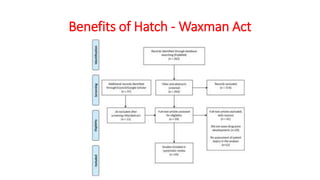
Benefits of Hatch - Waxman Act
THANKYOU
Generic drug product development.pptx

Generic drug product development.pptx

  • 1.
  • 2.
    Generic Drugs • Definedas "a drug product that is comparable to brand/innovator drug in dosage form, strength, route of administration, quality and performance characteristics, and intended use.” • It should contain the same active ingredients as the original formulation. • According to the FDA, generic drugs are identical or within an acceptable bioequivalent range to the brand-name counterpart with respect to pharmacokinetic and pharmacodynamic properties
  • 3.
    Goal • The maingoal in introducing generic medicines into market was to decrease prices. • After the expiry of patent patented drug, generic drugs are marketed. • Generic drugs are labeled with the name of the manufacturer and the adopted name (nonproprietary name) of the drug. • Today about 50% of all prescriptions are filled with generic drugs
  • 4.
    Economy • Globally Indiaranks 3rd in terms of manufacture pharmaceutical products by volume. • Thus every drug cost depends upon the expenditure of the research and procedures of approval. • WHO says 3.2% of Indians will fall below the poverty line will because of high medical bills. • 39 million Indians are pushed into poverty because of ill health every year.
  • 5.
    • Around 30%in rural India, don’t go for any treatment because of financial constraints. • The prescriptions from branded drugs to generic drugs will lead to an annual reduction of overall 11% in drug costs
  • 6.
    Patent protection • Inmost countries of the world, patents will give 20 years of protection. • However, many countries e.g. the European Union and the USA may grant up to 5 years of additional protection for drugs. • When the patents on a brand-name drug near expiration, drug companies that want to manufacture a generic can apply to the FDA to sell a generic version of the drug
  • 7.
    Market • Indian pharmaceuticalmarket is expected to reach US $ 65 billion by 2024 and to US $120 billion by 2030. • Indian pharmaceutical industry is currently valued at US $41 billion. • Currently India dominates the generic market share with 71 %. • India exported $ 17.3 billion worth of drugs, which was nearly 20 % of the global market. • India ranks 10th in terms of exporting its product to more than 200 countries around the globe including the USA, South Africa, Russia, the UK, Brazil, Nigeria, Europe, Japan, and Australia.
  • 8.
    Myths & Facts MYTH1 • Duplicate drugs FACT 1 • Due to changes in their brand name or shape of the of dosage, shape of packing, some may think the drugs are duplicate. MYTH 2 • Rejected drugs and fake drugs FACT 2 • Due to the cheap price of generic drugs, generally people thought that generic drugs are rejected form the company, which is why they are sold for the low price.
  • 9.
    MYTH 3 • Ineffectivedrugs FACT 3 • People also have a mindset that being costlier will be effective. • They think that there is something wrong with the medicine, that’s why they are too cheap MYTH 4 • Brand-name drugs are made in modern manufacturing facilities, and generics are often made in sub-standard facilities FACT 4 • Sub-standard facilities are not permitted by the FDA
  • 10.
    Advantages • Generic medicineprovide many economic advantages too; – Consumer – Pharmaceutical Business • It may be supplied by more than one company. • It reduces time and cost of generic drug production and approvals • They will have; – Same quality – Same safety – Same strength
  • 11.
    Disadvantages • Drawbacks ofgeneric drugs are much smaller than its advantages:- • There may be some variations during reformulations. • Some patients may be allergic to new colour, flavour etc. • Generic drugs are not possible to manufacture in all the cases. – Because it takes long time to expire any patent. • During bioequivalence studies, some error may arise which may lead to some complications. • More over bioequivalence studies are less accurate than bioavailability studies.
  • 12.
    Selection of aGeneric drug product for manufacture • Main driving force is the estimated sales volume for the branded product • And the potential market share the firm expects for generic drug product. • In addition to the expiration date of the patent for the active ingredient. • And the generic firm must consider any other patent claims and exclusivities that the innovator firm has filed
  • 13.
    • The genericdrug manufacturer needs to consider: • The lead time is required to make the product and submission of an Abbreviated New Drug Application (ANDA) to the U.S.FDA for approval. • Moreover, there is a financial incentive will be provided for filing the first generic drug product and approved by FDA. • 180-days exclusivity, is given under certain conditions, for the generic manufacturer who is to file first. • Availability of technology and the cost of acquiring technology to manufacture will also impact on the choice of generic drug.
  • 14.
    • Formulation considerationsfor generic drugs include: • Availability of raw materials, chemical purity, polymorphic form. • Particle size of the API. • Any patents that the innovator company has filed, including patents for the synthesis of the API and composition of the dosage form.
  • 15.
    Considerations in theSelection of a Generic Drug Product for Manufacture • Sales and potential market share • Patent expiration and exclusivity issues • Availability of active pharmaceutical ingredient • Timing • Technology • Formulation • Experience
  • 16.
    Generic product developmentprocess • A generic product development process is the sequence of steps or activities that employs to conceive, design, and commercialize a generic product. • Different Steps: • Concept development • System level design • Detail design • Testing and refinement • Production ramp - up
  • 17.
    • 1. CONCEPTDEVELOPMENT: • The needs of the target market are identified, alternative product concepts are generated and evaluated, and a single concept is selected for further development. • 2. SYSTEM LEVEL DESIGN: • It includes the definition of the product into subsystem and components. • The final assembly scheme for the production system is usually defined during this phase.
  • 18.
    • 3. DETAILDESIGN • It includes the complete specifications of the geometry, materials and tolerances of all the unique parts in the product and the identification of all the standards parts to be purchased from suppliers. • A process plan is established and tooling is designed for the each part to be fabricated within the production system.
  • 19.
    • 4. TESTINGAND REFINEMENT: • It Involves the construction and evaluation of multiple preproduction version of the product. • Early prototypes are usually built with production intent parts. • Early prototypes are tested to determine whether the product will work as designed and whether it satisfies customers needs • The goal of prototypes are to answer questions about performance and reliability in order to identify changes for the final product.
  • 20.
    • 5. PRODUCTIONRAMP UP • The purpose is to train the work force and to work out any remaining problems in the production process. • The objects produced during production ramp up are sometimes supplied to the preferred customer and are carefully evaluated to identify any remaining flaws.
  • 21.
    Legislative History • USFDA: • The U.S. Food and Drug Administration was established in 1906 by the Federal Food, Drug, and Cosmetic Act (the ‘‘Wiley Act’’) to prevent the manufacture, sale, or transportation of adulterated or misbranded or poisonous or deleterious foods, drugs, medicines, and liquors, and for regulating traffic therein, amongst others. • In 1938, the Act was amended to require drug manufacturers to file a New Drug Application (NDA) for each newly introduced drug and to provide data to establish the safety of the drug product.
  • 22.
    • 1962 -Kefauver-Harris Drug Amendments Act: • These amendments were the first to require drug manufacturers to prove a product's safety and efficacy to the FDA prior to marketing it.
  • 23.
    1984 - DrugPrice Competition and Patent Term Restoration Act (Waxman - Hatch Act) • This act extended the ANDA process to generic versions of drugs marketed after 1962 • This Act eliminated the requirement to conduct expensive, timeconsuming clinical and nonclinical studies to demonstrate safety and efficacy of generic drug. • Approve applications to market generic versions of brand-name drugs (Without Proving Clinical Trial) • Compensating the branded drugs manufacturers for the time lost for the regulatory approval (additional 5 years patent protection provided)
  • 24.
    Benefits of Hatch- Waxman Act
  • 25.