Presented By:-
Mr. Sachin R. Naksakhare
M.Pharm Sem-II
Guided By:-
Dr. R. P. Bhole
Dr. D .Y Patil Institute Of Pharmaceutical Science and
Research, Pimpri, Pune
1
• INTRODUCTION
• HISTORY
• GOAL OF NDA
• FORMAT OF APPLICATION
• APPLICATION FORM
• FORM’S USED IN NDA
• NDA CONTENTS
• FDA- APPROVAL PROCESS
• REVIEW PROCESS
• COMMON TECHNICAL DOCUMENTS
• REFERENCE
Contents
Introduction
The NDA application is the vehicle through which drug
sponsors, such as biotech and pharmaceutical companies,
formally propose that the FDA approve a new
pharmaceutical for sale and marketing.
For decades, the regulation and control of new drugs in the
United States has been based on the New Drug Application
(NDA).
3
HISTORY
 When the Federal Food, drug and cosmetic act of 1938 was
passed, a new area of drug product development began.
The act required the assurance of safety and stated minimum
requirements for manufacturing and quality control.
It provided only 60 days for review by FDA before the distribution
of any new drug product.
The 1962 kefauver-Harris Amendments to the act required
greatly increased information concerning the safety ,
effectiveness, quality, sale , use , manufacturing and controls of
the drug products.
4
Definitions
Drug
Drug are the substance intended to be used for or in the diagnosis,
treatment, mitigation, or prevention of any disease or disorder in
human being or animal.
New Drug
A new substance of chemical, biological, or biotechnological origin in
bulk or prepared dosage form used for Diagnosis, Treatment,
Mitigation or Prevention of any disease or disorder in Human or
Animal which except during local clinical trial has not been used in
the country to any significant extent and during local clinical trials has
not been recognized in the country as effective and safe for the
proposed claims.
5
 An application submitted by the manufacturer of a drug to the
FDA - after clinical trials have been completed - for a license to
market the drug for a specified.
 New Drug Application (NDA) is the vehicle in the United States
through which drug sponsors formally propose that the FDA
approve a new.
New Drug Application (NDA)
6
GOAL OF NDA
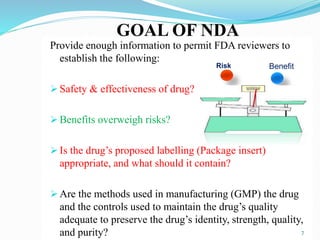
Provide enough information to permit FDA reviewers to
establish the following:
 Safety & effectiveness of drug?
 Benefits overweigh risks?
 Is the drug’s proposed labelling (Package insert)
appropriate, and what should it contain?
 Are the methods used in manufacturing (GMP) the drug
and the controls used to maintain the drug’s quality
adequate to preserve the drug’s identity, strength, quality,
and purity? 7
Risk Benefit
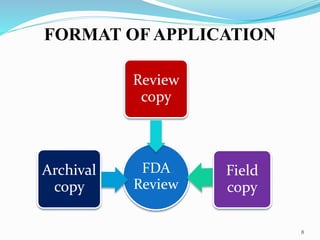
FORMAT OF APPLICATION
8
FDA
Review
Archival
copy
Review
copy
Field
copy
9
3 copies of the application are required:
 Archival copy
 Review copy
 Field copy
1. Archival copy:
This is a complete copy of an application submission and is
intended to serve as a reference source for FDA reviewers.
This contains information which not contained in the review copy .
2. Review copy
It contains the NDA’s technical section along with cover
letter, form FDA-356h ,NDA index as well as individual
content , labeling section and application summary.
3. Field copy
This is required by the FDA inspectors during pre-
approval facilities inspections.
It is implemented in 1993.
10
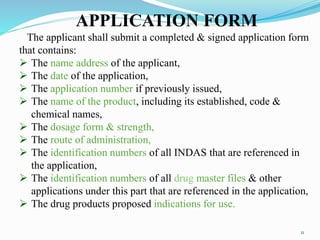
APPLICATION FORM
The applicant shall submit a completed & signed application form
that contains:
 The name address of the applicant,
 The date of the application,
 The application number if previously issued,
 The name of the product, including its established, code &
chemical names,
 The dosage form & strength,
 The route of administration,
 The identification numbers of all INDAS that are referenced in
the application,
 The identification numbers of all drug master files & other
applications under this part that are referenced in the application,
 The drug products proposed indications for use.
11
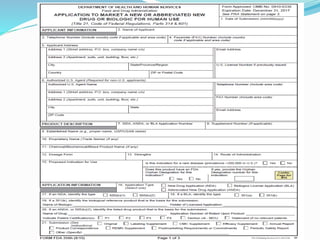
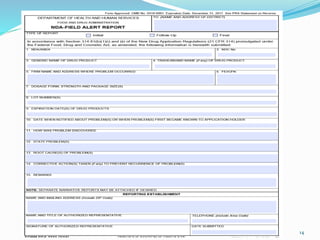
FORM’S USED IN NDA
 Form FDA-356h. Application to market a new drug, biological or an
antibiotic drug for human use.
 Form FDA 3397. User fee cover sheet.
 Form FDA 3331. New drug application field report.
12
13
14
NDA Contents
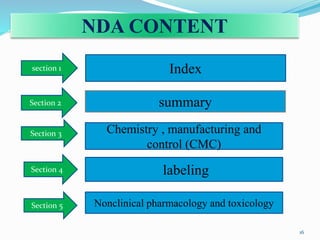
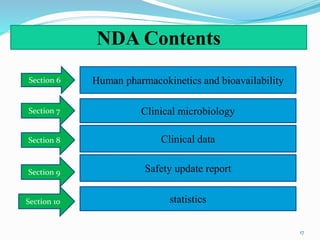
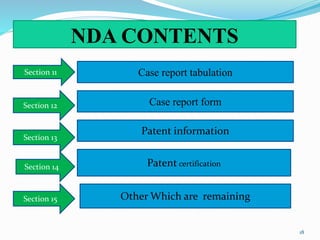
The NDA have as many as 15 different section in addition to the
Form FDA 356h itself.
The specific content of NDA will depend on the nature of the
drug product and the information available at the time of
submission the application.
15
NDA CONTENT
16
section 1
Section 2
Section 3
Section 4
Chemistry , manufacturing and
control (CMC)
Section 5 Nonclinical pharmacology and toxicology
Index
summary
labeling
NDA Contents
17
Section 6
Section 7
Section 8
Section 9
Section 10
Human pharmacokinetics and bioavailability
Clinical microbiology
Clinical data
Safety update report
statistics
NDA CONTENTS
18
Section 11
Section 13
Section 12
Section 14
Case report tabulation
Case report form
Patent information
Patent certification
Section 15 Other Which are remaining
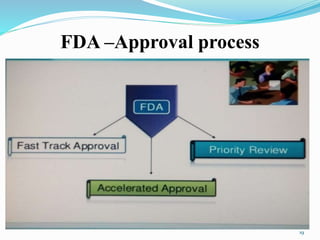
FDA –Approval process
19
1. Fast track approval
Drug for
Serious disease.
Must be requested by the drug company .
FDA 60 days review decision.
20
2. Accelerated approval
In 1992 FDA instituted the accelerated approval regulation.
Based on surrogate endpoint, not on clinical outcome.
A surrogate endpoint is a marker- a laboratory measurement, or
physical sign that is used in clinical trial as an indirect or
substitute measurement that represent a clinically meaningful
outcome, such as survival or symptom improvement.
21
3. Priority review
 A priority review designation is given to drug that offer major
advances in treatment.
 The goal for completing a priority review is 6 month.
 It can given for drug used in serious/non serious disease.
22
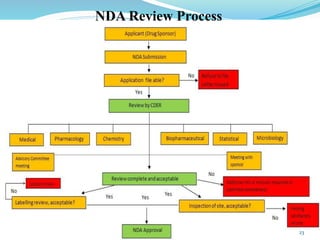
NDA Review Process
23
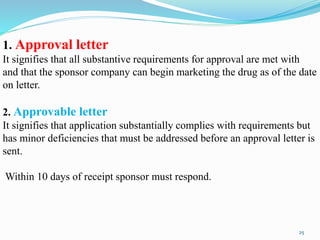
At the end of that, the FDA is required to respond with an action letter.
24
 An Approval letter
 An Approvable letter
 An Non Approvable letter
Three action letters
1. Approval letter
It signifies that all substantive requirements for approval are met with
and that the sponsor company can begin marketing the drug as of the date
on letter.
2. Approvable letter
It signifies that application substantially complies with requirements but
has minor deficiencies that must be addressed before an approval letter is
sent.
Within 10 days of receipt sponsor must respond.
25
3. Non approvable letter
 It signifies that FDA has a major concern with the
application and will not approve the proposed drug
product for marketing as submitted.
26
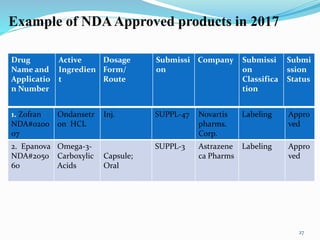
Example of NDAApproved products in 2017
Drug
Name and
Applicatio
n Number
Active
Ingredien
t
Dosage
Form/
Route
Submissi
on
Company Submissi
on
Classifica
tion
Submi
ssion
Status
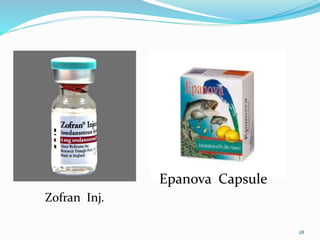
1. Zofran
NDA#0200
07
Ondansetr
on HCL
Inj. SUPPL-47 Novartis
pharms.
Corp.
Labeling Appro
ved
2. Epanova
NDA#2050
60
Omega-3-
Carboxylic
Acids
Capsule;
Oral
SUPPL-3 Astrazene
ca Pharms
Labeling Appro
ved
27
28
Zofran Inj.
Epanova Capsule
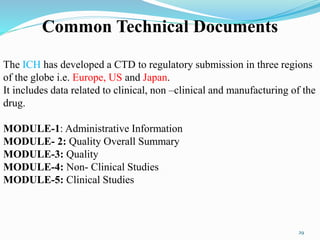
Common Technical Documents
The ICH has developed a CTD to regulatory submission in three regions
of the globe i.e. Europe, US and Japan.
It includes data related to clinical, non –clinical and manufacturing of the
drug.
MODULE-1: Administrative Information
MODULE- 2: Quality Overall Summary
MODULE-3: Quality
MODULE-4: Non- Clinical Studies
MODULE-5: Clinical Studies
29
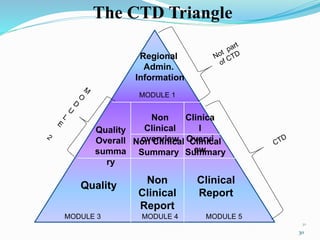
MODULE 1
MODULE 3 MODULE 4 MODULE 5
Regional
Admin.
Information
Quality
Overall
summa
ry
Non
Clinical
overviewNon Clinical
Summary
Clinica
l
Overvi
ew
Clinical
Summary
Quality
Non
Clinical
Report
Clinical
Report
The CTD Triangle
30
30
REFERENCE
 Vyawahare N. S. , Itkar S. C. “Drug Regulatory Affairs” Nirali
prakashan page no:-5.1-5.10
https://en.wikipedia.org/wiki/New drug application
https://www.fda.gov/drugs/developmentapprovalprocess
CFR Title 21 Part 312. Investigational New Drug Application.
31
http://www.fda.gov/Drugs/Guidance Regulatory
Info:Accessed March 16, 2017.
http://www.fda.gov/downloads/AboutFDA/CentersOffices/Or
ganizationCharts/UCM144011.pdf. Accessed March 16, 2017.
http://CFR Title 21 Part 312. New Drug Application,
Accessed March 16, 2017.
REFERENCE
 Center for Biologics Evaluation and Research Organization.
March 16,2017. Available at:
http://www.fda.gov/AboutFDA/CentersOffices/
OrganizationCharts/ucm135943.htm. Accessed March 16, 2017
 Department of Health and Human Services Food and Drug
Administration Center for Drug Evaluation and Research.
Available at:
http://www.fda.gov/downloads/AboutFDA/CentersOffices/
OrganizationCharts/UCM144011.pdf. Accessed March 16, 2017
 Information for Sponsor-Investigators Submitting
Investigational New
Drug Applications (NDAs). March 16, 2017 Available at:
 http:// www.fda.gov/Drugs/DevelopmentApprovalProcess/
SmallBusinessAssistance/ucm071098.htm. Accessed March 16,
2017
32
33

Sem 2 nda

  • 1.
    Presented By:- Mr. SachinR. Naksakhare M.Pharm Sem-II Guided By:- Dr. R. P. Bhole Dr. D .Y Patil Institute Of Pharmaceutical Science and Research, Pimpri, Pune 1
  • 2.
    • INTRODUCTION • HISTORY •GOAL OF NDA • FORMAT OF APPLICATION • APPLICATION FORM • FORM’S USED IN NDA • NDA CONTENTS • FDA- APPROVAL PROCESS • REVIEW PROCESS • COMMON TECHNICAL DOCUMENTS • REFERENCE Contents
  • 3.
    Introduction The NDA applicationis the vehicle through which drug sponsors, such as biotech and pharmaceutical companies, formally propose that the FDA approve a new pharmaceutical for sale and marketing. For decades, the regulation and control of new drugs in the United States has been based on the New Drug Application (NDA). 3
  • 4.
    HISTORY  When theFederal Food, drug and cosmetic act of 1938 was passed, a new area of drug product development began. The act required the assurance of safety and stated minimum requirements for manufacturing and quality control. It provided only 60 days for review by FDA before the distribution of any new drug product. The 1962 kefauver-Harris Amendments to the act required greatly increased information concerning the safety , effectiveness, quality, sale , use , manufacturing and controls of the drug products. 4
  • 5.
    Definitions Drug Drug are thesubstance intended to be used for or in the diagnosis, treatment, mitigation, or prevention of any disease or disorder in human being or animal. New Drug A new substance of chemical, biological, or biotechnological origin in bulk or prepared dosage form used for Diagnosis, Treatment, Mitigation or Prevention of any disease or disorder in Human or Animal which except during local clinical trial has not been used in the country to any significant extent and during local clinical trials has not been recognized in the country as effective and safe for the proposed claims. 5
  • 6.
     An applicationsubmitted by the manufacturer of a drug to the FDA - after clinical trials have been completed - for a license to market the drug for a specified.  New Drug Application (NDA) is the vehicle in the United States through which drug sponsors formally propose that the FDA approve a new. New Drug Application (NDA) 6
  • 7.
    GOAL OF NDA Provideenough information to permit FDA reviewers to establish the following:  Safety & effectiveness of drug?  Benefits overweigh risks?  Is the drug’s proposed labelling (Package insert) appropriate, and what should it contain?  Are the methods used in manufacturing (GMP) the drug and the controls used to maintain the drug’s quality adequate to preserve the drug’s identity, strength, quality, and purity? 7 Risk Benefit
  • 8.
  • 9.
    9 3 copies ofthe application are required:  Archival copy  Review copy  Field copy 1. Archival copy: This is a complete copy of an application submission and is intended to serve as a reference source for FDA reviewers. This contains information which not contained in the review copy .
  • 10.
    2. Review copy Itcontains the NDA’s technical section along with cover letter, form FDA-356h ,NDA index as well as individual content , labeling section and application summary. 3. Field copy This is required by the FDA inspectors during pre- approval facilities inspections. It is implemented in 1993. 10
  • 11.
    APPLICATION FORM The applicantshall submit a completed & signed application form that contains:  The name address of the applicant,  The date of the application,  The application number if previously issued,  The name of the product, including its established, code & chemical names,  The dosage form & strength,  The route of administration,  The identification numbers of all INDAS that are referenced in the application,  The identification numbers of all drug master files & other applications under this part that are referenced in the application,  The drug products proposed indications for use. 11
  • 12.
    FORM’S USED INNDA  Form FDA-356h. Application to market a new drug, biological or an antibiotic drug for human use.  Form FDA 3397. User fee cover sheet.  Form FDA 3331. New drug application field report. 12
  • 13.
  • 14.
  • 15.
    NDA Contents The NDAhave as many as 15 different section in addition to the Form FDA 356h itself. The specific content of NDA will depend on the nature of the drug product and the information available at the time of submission the application. 15
  • 16.
    NDA CONTENT 16 section 1 Section2 Section 3 Section 4 Chemistry , manufacturing and control (CMC) Section 5 Nonclinical pharmacology and toxicology Index summary labeling
  • 17.
    NDA Contents 17 Section 6 Section7 Section 8 Section 9 Section 10 Human pharmacokinetics and bioavailability Clinical microbiology Clinical data Safety update report statistics
  • 18.
    NDA CONTENTS 18 Section 11 Section13 Section 12 Section 14 Case report tabulation Case report form Patent information Patent certification Section 15 Other Which are remaining
  • 19.
  • 20.
    1. Fast trackapproval Drug for Serious disease. Must be requested by the drug company . FDA 60 days review decision. 20
  • 21.
    2. Accelerated approval In1992 FDA instituted the accelerated approval regulation. Based on surrogate endpoint, not on clinical outcome. A surrogate endpoint is a marker- a laboratory measurement, or physical sign that is used in clinical trial as an indirect or substitute measurement that represent a clinically meaningful outcome, such as survival or symptom improvement. 21
  • 22.
    3. Priority review A priority review designation is given to drug that offer major advances in treatment.  The goal for completing a priority review is 6 month.  It can given for drug used in serious/non serious disease. 22
  • 23.
  • 24.
    At the endof that, the FDA is required to respond with an action letter. 24  An Approval letter  An Approvable letter  An Non Approvable letter Three action letters
  • 25.
    1. Approval letter Itsignifies that all substantive requirements for approval are met with and that the sponsor company can begin marketing the drug as of the date on letter. 2. Approvable letter It signifies that application substantially complies with requirements but has minor deficiencies that must be addressed before an approval letter is sent. Within 10 days of receipt sponsor must respond. 25
  • 26.
    3. Non approvableletter  It signifies that FDA has a major concern with the application and will not approve the proposed drug product for marketing as submitted. 26
  • 27.
    Example of NDAApprovedproducts in 2017 Drug Name and Applicatio n Number Active Ingredien t Dosage Form/ Route Submissi on Company Submissi on Classifica tion Submi ssion Status 1. Zofran NDA#0200 07 Ondansetr on HCL Inj. SUPPL-47 Novartis pharms. Corp. Labeling Appro ved 2. Epanova NDA#2050 60 Omega-3- Carboxylic Acids Capsule; Oral SUPPL-3 Astrazene ca Pharms Labeling Appro ved 27
  • 28.
  • 29.
    Common Technical Documents TheICH has developed a CTD to regulatory submission in three regions of the globe i.e. Europe, US and Japan. It includes data related to clinical, non –clinical and manufacturing of the drug. MODULE-1: Administrative Information MODULE- 2: Quality Overall Summary MODULE-3: Quality MODULE-4: Non- Clinical Studies MODULE-5: Clinical Studies 29
  • 30.
    MODULE 1 MODULE 3MODULE 4 MODULE 5 Regional Admin. Information Quality Overall summa ry Non Clinical overviewNon Clinical Summary Clinica l Overvi ew Clinical Summary Quality Non Clinical Report Clinical Report The CTD Triangle 30 30
  • 31.
    REFERENCE  Vyawahare N.S. , Itkar S. C. “Drug Regulatory Affairs” Nirali prakashan page no:-5.1-5.10 https://en.wikipedia.org/wiki/New drug application https://www.fda.gov/drugs/developmentapprovalprocess CFR Title 21 Part 312. Investigational New Drug Application. 31 http://www.fda.gov/Drugs/Guidance Regulatory Info:Accessed March 16, 2017. http://www.fda.gov/downloads/AboutFDA/CentersOffices/Or ganizationCharts/UCM144011.pdf. Accessed March 16, 2017. http://CFR Title 21 Part 312. New Drug Application, Accessed March 16, 2017.
  • 32.
    REFERENCE  Center forBiologics Evaluation and Research Organization. March 16,2017. Available at: http://www.fda.gov/AboutFDA/CentersOffices/ OrganizationCharts/ucm135943.htm. Accessed March 16, 2017  Department of Health and Human Services Food and Drug Administration Center for Drug Evaluation and Research. Available at: http://www.fda.gov/downloads/AboutFDA/CentersOffices/ OrganizationCharts/UCM144011.pdf. Accessed March 16, 2017  Information for Sponsor-Investigators Submitting Investigational New Drug Applications (NDAs). March 16, 2017 Available at:  http:// www.fda.gov/Drugs/DevelopmentApprovalProcess/ SmallBusinessAssistance/ucm071098.htm. Accessed March 16, 2017 32
  • 33.