1. Acid base Indicator
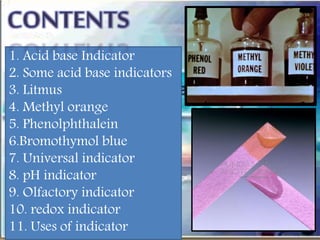
2. Some acid base indicators
3. Litmus
4. Methyl orange
5. Phenolphthalein
6.Bromothymol blue
7. Universal indicator
8. pH indicator
9. Olfactory indicator
10. redox indicator
11. Uses of indicator
Indicators are chemical substances that are used to find out whether a
given solution is acidic or alkaline by showing a color change.Acid-base
indicators are used to determine when one has added enough acid to a
base to neutralized the base. So, in a titration the color of the indicator
must shift at the pH of the end point. The pH of the endpoint is that
calculated from the salt solution. The indicator, added to the solution,
must have a different color when the solution has excess base verses
the color when there is an excess of acid.
Acid base indicator
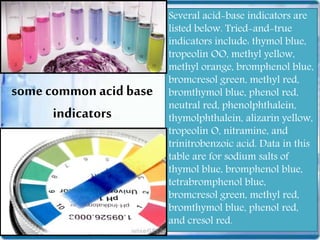
Several acid-base indicators are
listed below. Tried-and-true
indicators include: thymol blue,
tropeolin OO, methyl yellow,
methyl orange, bromphenol blue,
bromcresol green, methyl red,
bromthymol blue, phenol red,
neutral red, phenolphthalein,
thymolphthalein, alizarin yellow,
tropeolin O, nitramine, and
trinitrobenzoic acid. Data in this
table are for sodium salts of
thymol blue, bromphenol blue,
tetrabromphenol blue,
bromcresol green, methyl red,
bromthymol blue, phenol red,
and cresol red.
somecommonacid base
indicators
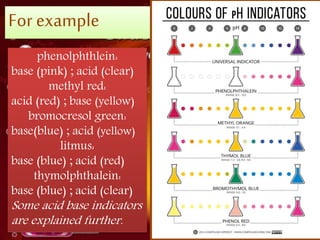
phenolphthlein:
base (pink) ; acid (clear)
methyl red:
acid (red) ; base (yellow)
bromocresol green:
base(blue) ; acid (yellow)
litmus:
base (blue) ; acid (red)
thymolphthalein:
base (blue) ; acid (clear)
Some acid base indicators
are explained further.
For example
litmus
Litmus is a water soluble mixture of
different dyes extracted from lichens. It is often absorbed
onto filter paper to produce one of the oldest forms of pH
indicator, used to test materials for acidity. Blue litmus paper
turns red under acidic conditions and red litmus paper
turns blue under basic. Neutral litmus paper is purple . Litmus can
also be prepared as an aqueous solution that functions similarly.
Under acidic conditions, the solution is red, and under basic
conditions, the solution is blue.
Methyl orange
Methyl orange is a pH
indicator frequently used
in titrations because of its clear and
distinct colour change. Because it
changes colour at the pH of a mid
strength acid, it is usually used in
titrations for acids. Unlike a universal
indicator, methyl orange does not have
a full spectrum of colour change, but
has a sharper end point. In a solution
becoming less acidic, methyl orange
moves from red to orange and finally to
yellow with the reverse occurring for a
solution increasing in acidity.
phenolphthalein
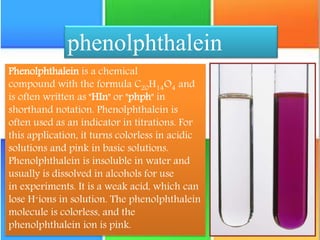
Phenolphthalein is a chemical
compound with the formula C20H14O4 and
is often written as "HIn" or "phph" in
shorthand notation. Phenolphthalein is
often used as an indicator in titrations. For
this application, it turns colorless in acidic
solutions and pink in basic solutions.
Phenolphthalein is insoluble in water and
usually is dissolved in alcohols for use
in experiments. It is a weak acid, which can
lose H+ions in solution. The phenolphthalein
molecule is colorless, and the
phenolphthalein ion is pink.
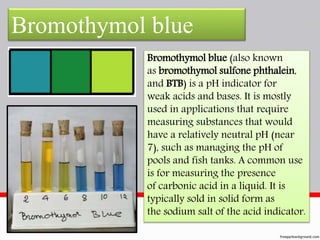
Bromothymol blue
Bromothymol blue (also known
as bromothymol sulfone phthalein,
and BTB) is a pH indicator for
weak acids and bases. It is mostly
used in applications that require
measuring substances that would
have a relatively neutral pH (near
7), such as managing the pH of
pools and fish tanks. A common use
is for measuring the presence
of carbonic acid in a liquid. It is
typically sold in solid form as
the sodium salt of the acid indicator.
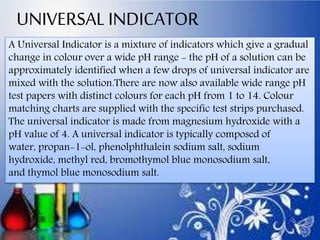
UNIVERSALINDICATOR
A Universal Indicator is a mixture of indicators which give a gradual
change in colour over a wide pH range - the pH of a solution can be
approximately identified when a few drops of universal indicator are
mixed with the solution.There are now also available wide range pH
test papers with distinct colours for each pH from 1 to 14. Colour
matching charts are supplied with the specific test strips purchased.
The universal indicator is made from magnesium hydroxide with a
pH value of 4. A universal indicator is typically composed of
water, propan-1-ol, phenolphthalein sodium salt, sodium
hydroxide, methyl red, bromothymol blue monosodium salt,
and thymol blue monosodium salt.
PH scale
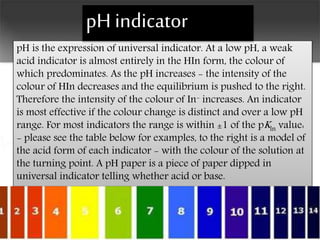
pH is the expression of universal indicator. At a low pH, a weak
acid indicator is almost entirely in the HIn form, the colour of
which predominates. As the pH increases - the intensity of the
colour of HIn decreases and the equilibrium is pushed to the right.
Therefore the intensity of the colour of In- increases. An indicator
is most effective if the colour change is distinct and over a low pH
range. For most indicators the range is within ±1 of the pKln value:
- please see the table below for examples, to the right is a model of
the acid form of each indicator - with the colour of the solution at
the turning point. A pH paper is a piece of paper dipped in
universal indicator telling whether acid or base.
pH indicator
A pH scale reading of less than 7 indicates an acidic medium.
A pH scale reading of more than 7 indicates a basic medium.
A pH scale reading equal to 7 indicates a neutral medium or solution
(pure distilled water).
A pH scale reading of 2 indicates a strong acid.
A pH scale reading of 13 indicates a strong base.
A pH scale reading of 6 indicates a weak acid.
A pH scale reading of 8 indicates a weak base.
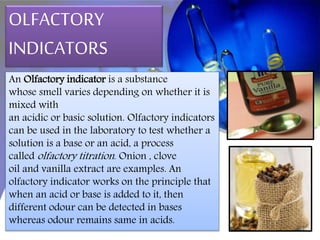
OLFACTORY
INDICATORS
An Olfactory indicator is a substance
whose smell varies depending on whether it is
mixed with
an acidic or basic solution. Olfactory indicators
can be used in the laboratory to test whether a
solution is a base or an acid, a process
called olfactory titration. Onion , clove
oil and vanilla extract are examples. An
olfactory indicator works on the principle that
when an acid or base is added to it, then
different odour can be detected in bases
whereas odour remains same in acids.
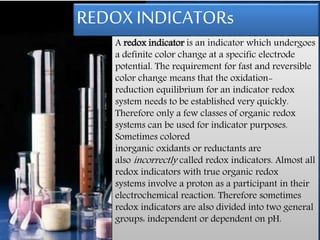
REDOX INDICATORs
A redox indicator is an indicator which undergoes
a definite color change at a specific electrode
potential. The requirement for fast and reversible
color change means that the oxidation-
reduction equilibrium for an indicator redox
system needs to be established very quickly.
Therefore only a few classes of organic redox
systems can be used for indicator purposes.
Sometimes colored
inorganic oxidants or reductants are
also incorrectly called redox indicators. Almost all
redox indicators with true organic redox
systems involve a proton as a participant in their
electrochemical reaction. Therefore sometimes
redox indicators are also divided into two general
groups: independent or dependent on pH.
1.Testing the acidity or basicity of soils, as
some plants grow best in slightly acidic soils
(such as azaleas and pineapples) while others
grow best in slightly basic soils (such as
violets)
2.Pineapples and violets have very different
soil requirements Because soil is dark in
colour, a white inert solid such as barium
sulfate is mixed with the soil before the
indicator is added.
3.The colour of the indicator can be seen on
the white solid.
Everyday uses of indicators include:
4.If a soil is found to be too acidic, it
can be partially neutralised by adding
a weak base such as powdered
limestone (calcium carbonate).
5.If a soil is found to be too basic, it
can be partially neutralised by adding
a weak acid such as ammonium
sulfate.
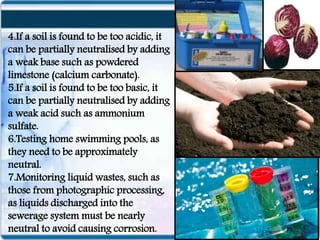
6.Testing home swimming pools, as
they need to be approximately
neutral.
7.Monitoring liquid wastes, such as
those from photographic processing,
as liquids discharged into the
sewerage system must be nearly
neutral to avoid causing corrosion.
chemical Indicators

chemical Indicators

  • 3.
    1. Acid baseIndicator 2. Some acid base indicators 3. Litmus 4. Methyl orange 5. Phenolphthalein 6.Bromothymol blue 7. Universal indicator 8. pH indicator 9. Olfactory indicator 10. redox indicator 11. Uses of indicator
  • 4.
    Indicators are chemicalsubstances that are used to find out whether a given solution is acidic or alkaline by showing a color change.Acid-base indicators are used to determine when one has added enough acid to a base to neutralized the base. So, in a titration the color of the indicator must shift at the pH of the end point. The pH of the endpoint is that calculated from the salt solution. The indicator, added to the solution, must have a different color when the solution has excess base verses the color when there is an excess of acid. Acid base indicator
  • 5.
    Several acid-base indicatorsare listed below. Tried-and-true indicators include: thymol blue, tropeolin OO, methyl yellow, methyl orange, bromphenol blue, bromcresol green, methyl red, bromthymol blue, phenol red, neutral red, phenolphthalein, thymolphthalein, alizarin yellow, tropeolin O, nitramine, and trinitrobenzoic acid. Data in this table are for sodium salts of thymol blue, bromphenol blue, tetrabromphenol blue, bromcresol green, methyl red, bromthymol blue, phenol red, and cresol red. somecommonacid base indicators
  • 6.
    phenolphthlein: base (pink) ;acid (clear) methyl red: acid (red) ; base (yellow) bromocresol green: base(blue) ; acid (yellow) litmus: base (blue) ; acid (red) thymolphthalein: base (blue) ; acid (clear) Some acid base indicators are explained further. For example
  • 7.
    litmus Litmus is awater soluble mixture of different dyes extracted from lichens. It is often absorbed onto filter paper to produce one of the oldest forms of pH indicator, used to test materials for acidity. Blue litmus paper turns red under acidic conditions and red litmus paper turns blue under basic. Neutral litmus paper is purple . Litmus can also be prepared as an aqueous solution that functions similarly. Under acidic conditions, the solution is red, and under basic conditions, the solution is blue.
  • 8.
    Methyl orange Methyl orangeis a pH indicator frequently used in titrations because of its clear and distinct colour change. Because it changes colour at the pH of a mid strength acid, it is usually used in titrations for acids. Unlike a universal indicator, methyl orange does not have a full spectrum of colour change, but has a sharper end point. In a solution becoming less acidic, methyl orange moves from red to orange and finally to yellow with the reverse occurring for a solution increasing in acidity.
  • 9.
    phenolphthalein Phenolphthalein is achemical compound with the formula C20H14O4 and is often written as "HIn" or "phph" in shorthand notation. Phenolphthalein is often used as an indicator in titrations. For this application, it turns colorless in acidic solutions and pink in basic solutions. Phenolphthalein is insoluble in water and usually is dissolved in alcohols for use in experiments. It is a weak acid, which can lose H+ions in solution. The phenolphthalein molecule is colorless, and the phenolphthalein ion is pink.
  • 10.
    Bromothymol blue Bromothymol blue(also known as bromothymol sulfone phthalein, and BTB) is a pH indicator for weak acids and bases. It is mostly used in applications that require measuring substances that would have a relatively neutral pH (near 7), such as managing the pH of pools and fish tanks. A common use is for measuring the presence of carbonic acid in a liquid. It is typically sold in solid form as the sodium salt of the acid indicator.
  • 11.
    UNIVERSALINDICATOR A Universal Indicatoris a mixture of indicators which give a gradual change in colour over a wide pH range - the pH of a solution can be approximately identified when a few drops of universal indicator are mixed with the solution.There are now also available wide range pH test papers with distinct colours for each pH from 1 to 14. Colour matching charts are supplied with the specific test strips purchased. The universal indicator is made from magnesium hydroxide with a pH value of 4. A universal indicator is typically composed of water, propan-1-ol, phenolphthalein sodium salt, sodium hydroxide, methyl red, bromothymol blue monosodium salt, and thymol blue monosodium salt.
  • 12.
    PH scale pH isthe expression of universal indicator. At a low pH, a weak acid indicator is almost entirely in the HIn form, the colour of which predominates. As the pH increases - the intensity of the colour of HIn decreases and the equilibrium is pushed to the right. Therefore the intensity of the colour of In- increases. An indicator is most effective if the colour change is distinct and over a low pH range. For most indicators the range is within ±1 of the pKln value: - please see the table below for examples, to the right is a model of the acid form of each indicator - with the colour of the solution at the turning point. A pH paper is a piece of paper dipped in universal indicator telling whether acid or base. pH indicator
  • 13.
    A pH scalereading of less than 7 indicates an acidic medium. A pH scale reading of more than 7 indicates a basic medium. A pH scale reading equal to 7 indicates a neutral medium or solution (pure distilled water). A pH scale reading of 2 indicates a strong acid. A pH scale reading of 13 indicates a strong base. A pH scale reading of 6 indicates a weak acid. A pH scale reading of 8 indicates a weak base.
  • 15.
    OLFACTORY INDICATORS An Olfactory indicatoris a substance whose smell varies depending on whether it is mixed with an acidic or basic solution. Olfactory indicators can be used in the laboratory to test whether a solution is a base or an acid, a process called olfactory titration. Onion , clove oil and vanilla extract are examples. An olfactory indicator works on the principle that when an acid or base is added to it, then different odour can be detected in bases whereas odour remains same in acids.
  • 16.
    REDOX INDICATORs A redoxindicator is an indicator which undergoes a definite color change at a specific electrode potential. The requirement for fast and reversible color change means that the oxidation- reduction equilibrium for an indicator redox system needs to be established very quickly. Therefore only a few classes of organic redox systems can be used for indicator purposes. Sometimes colored inorganic oxidants or reductants are also incorrectly called redox indicators. Almost all redox indicators with true organic redox systems involve a proton as a participant in their electrochemical reaction. Therefore sometimes redox indicators are also divided into two general groups: independent or dependent on pH.
  • 17.
    1.Testing the acidityor basicity of soils, as some plants grow best in slightly acidic soils (such as azaleas and pineapples) while others grow best in slightly basic soils (such as violets) 2.Pineapples and violets have very different soil requirements Because soil is dark in colour, a white inert solid such as barium sulfate is mixed with the soil before the indicator is added. 3.The colour of the indicator can be seen on the white solid. Everyday uses of indicators include:
  • 18.
    4.If a soilis found to be too acidic, it can be partially neutralised by adding a weak base such as powdered limestone (calcium carbonate). 5.If a soil is found to be too basic, it can be partially neutralised by adding a weak acid such as ammonium sulfate. 6.Testing home swimming pools, as they need to be approximately neutral. 7.Monitoring liquid wastes, such as those from photographic processing, as liquids discharged into the sewerage system must be nearly neutral to avoid causing corrosion.