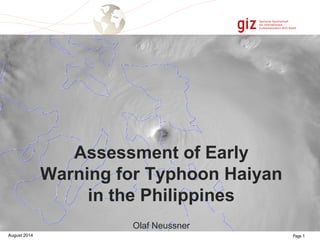
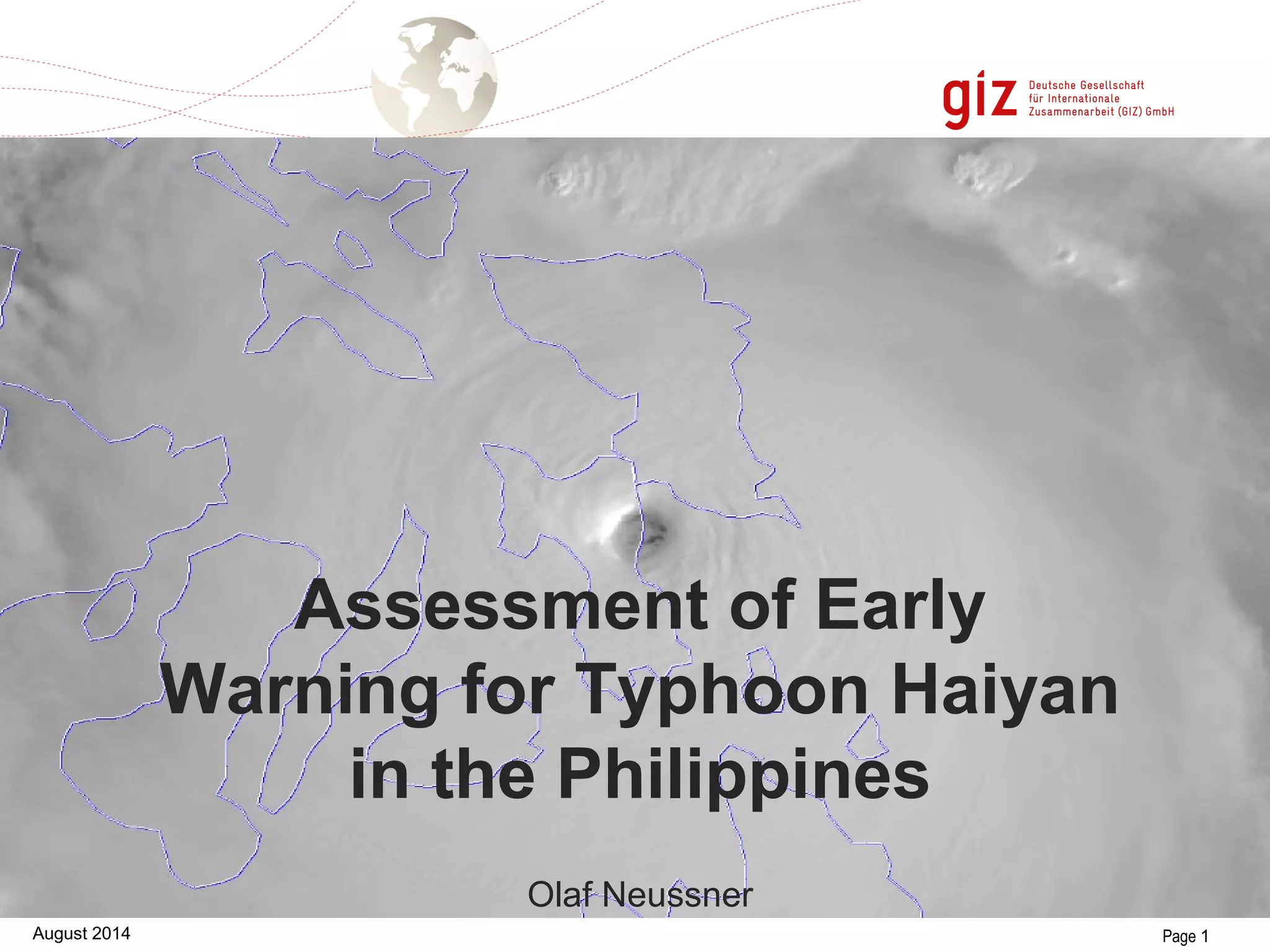
Assessment of Early 
Warning for Typhoon Haiyan 
in the Philippines 
Olaf Neussner 
August 2014 Page 1
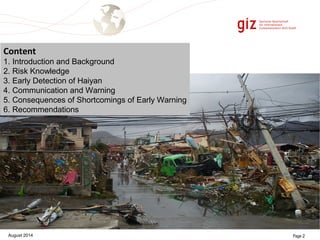
Content 
1. Introduction and Background 
2. Risk Knowledge 
3. Early Detection of Haiyan 
4. Communication and Warning 
5. Consequences of Shortcomings of Early Warning 
6. Recommendations 
August 2014 Page 2
1. Introduction and Background 
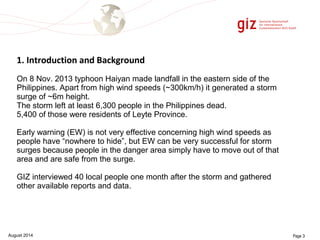
On 8 Nov. 2013 typhoon Haiyan made landfall in the eastern side of the 
Philippines. Apart from high wind speeds (~300km/h) it generated a storm 
surge of ~6m height. 
The storm left at least 6,300 people in the Philippines dead. 
5,400 of those were residents of Leyte Province. 
Early warning (EW) is not very effective concerning high wind speeds as 
people have “nowhere to hide”, but EW can be very successful for storm 
surges because people in the danger area simply have to move out of that 
area and are safe from the surge. 
GIZ interviewed 40 local people one month after the storm and gathered 
other available reports and data. 
August 2014 Page 3
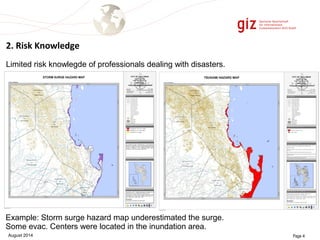
2. Risk Knowledge 
Limited risk knowlegde of professionals dealing with disasters. 
Example: Storm surge hazard map underestimated the surge. 
Some evac. Centers were located in the inundation area. 
August 2014 Page 4
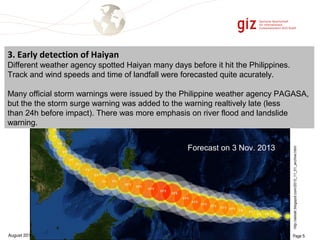
3. Early detection of Haiyan 
Different weather agency spotted Haiyan many days before it hit the Philippines. 
Track and wind speeds and time of landfall were forecasted quite acurately. 
Many official storm warnings were issued by the Philippine weather agency PAGASA, 
but the the storm surge warning was added to the warning realtively late (less 
than 24h before impact). There was more emphasis on river flood and landslide 
warning. 
http://alstatr.blogspot.com/2013_11_01_archive.html 
Forecast on 3 Nov. 2013 
August 2014 Page 5
4. Communication and Warning 
GIZ interviewed 40+ residents and DRM professionals in December 2013 
Result: 
• Everybody was aware of a “super typhoon” coming. 
• Still many people did not realize the strength of the storm. 
• Many people did not understand the term “storm surge”. 
• Many people did not know how far the water could go. 
• Some people moved to evacuation centres which turned out to be 
in the inundation are – and some people died there. 
• Disaster officials consulting the storm surge hazard map 
(READY/PAGASA) noticed that the inundation area was only up 
to 4m. 
• Very few forced evacuations. Many people remained home. 
August 2014 Page 6
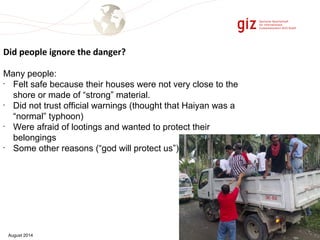
Did people ignore the danger? 
Many people: 
• Felt safe because their houses were not very close to the 
shore or made of “strong” material. 
• Did not trust official warnings (thought that Haiyan was a 
“normal” typhoon) 
• Were afraid of lootings and wanted to protect their 
belongings 
• Some other reasons (“god will protect us”) 
August 2014 Page 7
5. Consequences of Shortcomings of Early Warning 
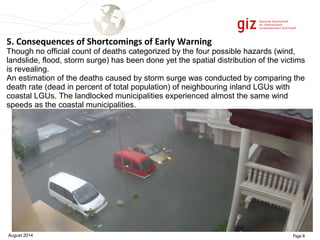
Though no official count of deaths categorized by the four possible hazards (wind, 
landslide, flood, storm surge) has been done yet the spatial distribution of the victims 
is revealing. 
An estimation of the deaths caused by storm surge was conducted by comparing the 
death rate (dead in percent of total population) of neighbouring inland LGUs with 
coastal LGUs. The landlocked municipalities experienced almost the same wind 
speeds as the coastal municipalities. 
August 2014 Page 8
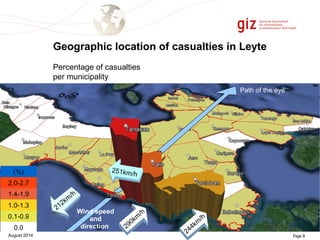
Geographic location of casualties in Leyte 
Percentage of casualties 
per municipality 
Death rate of inland LGUs: 
0.09 
Death rate of coastal LGUs: 
1.79 
This means the death rate at 
the coast was 20 times higher 
(%) than inland. 
2.0-2.7 
1.4-1.9 
1.0-1.3 
0.1-0.9 
0.0 
Path of the eye 
251km/h 
290km/h 
212km/h 
Wind speed 
and 
direction 
290km/h 
244km/August 2014 Page 9
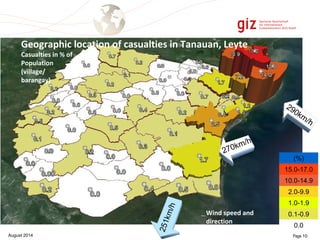
Geographic location of casualties in Tanauan, Leyte 
Casualties in % of 
Population 
(village/ 
barangay) 
290km/h 
270km/h 
251km/h 
(%) 
15.0-17.0 
10.0-14.9 
2.0-9.9 
1.0-1.9 
0.1-0.9 
0.0 
Wind speed and 
direction 
August 2014 Page 10
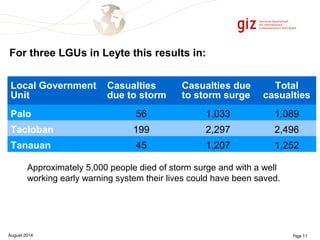
For three LGUs in Leyte this results in: 
Local Government 
Unit 
Casualties 
due to storm 
Casualties due 
to storm surge 
Total 
casualties 
Palo 56 1,033 1,089 
Tacloban 199 2,297 2,496 
Tanauan 45 1,207 1,252 
Approximately 5,000 people died of storm surge and with a well 
working early warning system their lives could have been saved. 
August 2014 Page 11
6. Recommendations 
Recommendations for Philippine warning agencies 
Warnings should use layman's language and emphasise 
seriousness of a particular hazard. 
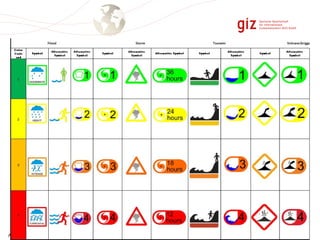
A colour coded harmonized multi-hazard early warning 
system should be introduced. 
Storm surge should be included in the official warning 
system (similar to tsunami). 
August 2014 Page 12
August 2014 Page 13
Recommendations 
For Disaster Risk Reduction Offices/Committees 
• Delineate danger zones (tsunami, storm surge) clearly with signs. 
• Mark evacuation routes and evacuation centers with signs. 
• 
Survey existing evacuation centers and identify those within danger zones. 
• 
Assign evacuation centres depending on hazard. 
• 
Re-enforce evacuation centres depending on hazard. 
• 
Consider strict enforcement of forced evacuation. 
August 2014 Page 14
Recommendations 
For land use planners 
• Assign new evacuation centres outside danger zones. 
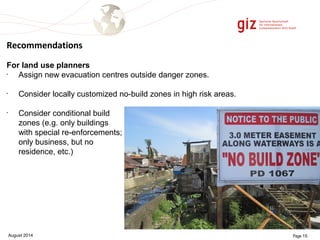
• Consider locally customized no-build zones in high risk areas. 
• Consider conditional build 
zones (e.g. only buildings 
with special re-enforcements; 
only business, but no 
residence, etc.) 
August 2014 Page 15
Olaf Neussner (olafneus@gmx.net) 
A 64 page report is available at: 
http://www.preventionweb.net/files/36860_36860gizassessmentofearlywarningyol.pdf 
This activity was funded by: 
August 2014 Page 16

Neussner assessment

  • 1.
    Assessment of Early Warning for Typhoon Haiyan in the Philippines Olaf Neussner August 2014 Page 1
  • 2.
    Content 1. Introductionand Background 2. Risk Knowledge 3. Early Detection of Haiyan 4. Communication and Warning 5. Consequences of Shortcomings of Early Warning 6. Recommendations August 2014 Page 2
  • 3.
    1. Introduction andBackground On 8 Nov. 2013 typhoon Haiyan made landfall in the eastern side of the Philippines. Apart from high wind speeds (~300km/h) it generated a storm surge of ~6m height. The storm left at least 6,300 people in the Philippines dead. 5,400 of those were residents of Leyte Province. Early warning (EW) is not very effective concerning high wind speeds as people have “nowhere to hide”, but EW can be very successful for storm surges because people in the danger area simply have to move out of that area and are safe from the surge. GIZ interviewed 40 local people one month after the storm and gathered other available reports and data. August 2014 Page 3
  • 4.
    2. Risk Knowledge Limited risk knowlegde of professionals dealing with disasters. Example: Storm surge hazard map underestimated the surge. Some evac. Centers were located in the inundation area. August 2014 Page 4
  • 5.
    3. Early detectionof Haiyan Different weather agency spotted Haiyan many days before it hit the Philippines. Track and wind speeds and time of landfall were forecasted quite acurately. Many official storm warnings were issued by the Philippine weather agency PAGASA, but the the storm surge warning was added to the warning realtively late (less than 24h before impact). There was more emphasis on river flood and landslide warning. http://alstatr.blogspot.com/2013_11_01_archive.html Forecast on 3 Nov. 2013 August 2014 Page 5
  • 6.
    4. Communication andWarning GIZ interviewed 40+ residents and DRM professionals in December 2013 Result: • Everybody was aware of a “super typhoon” coming. • Still many people did not realize the strength of the storm. • Many people did not understand the term “storm surge”. • Many people did not know how far the water could go. • Some people moved to evacuation centres which turned out to be in the inundation are – and some people died there. • Disaster officials consulting the storm surge hazard map (READY/PAGASA) noticed that the inundation area was only up to 4m. • Very few forced evacuations. Many people remained home. August 2014 Page 6
  • 7.
    Did people ignorethe danger? Many people: • Felt safe because their houses were not very close to the shore or made of “strong” material. • Did not trust official warnings (thought that Haiyan was a “normal” typhoon) • Were afraid of lootings and wanted to protect their belongings • Some other reasons (“god will protect us”) August 2014 Page 7
  • 8.
    5. Consequences ofShortcomings of Early Warning Though no official count of deaths categorized by the four possible hazards (wind, landslide, flood, storm surge) has been done yet the spatial distribution of the victims is revealing. An estimation of the deaths caused by storm surge was conducted by comparing the death rate (dead in percent of total population) of neighbouring inland LGUs with coastal LGUs. The landlocked municipalities experienced almost the same wind speeds as the coastal municipalities. August 2014 Page 8
  • 9.
    Geographic location ofcasualties in Leyte Percentage of casualties per municipality Death rate of inland LGUs: 0.09 Death rate of coastal LGUs: 1.79 This means the death rate at the coast was 20 times higher (%) than inland. 2.0-2.7 1.4-1.9 1.0-1.3 0.1-0.9 0.0 Path of the eye 251km/h 290km/h 212km/h Wind speed and direction 290km/h 244km/August 2014 Page 9
  • 10.
    Geographic location ofcasualties in Tanauan, Leyte Casualties in % of Population (village/ barangay) 290km/h 270km/h 251km/h (%) 15.0-17.0 10.0-14.9 2.0-9.9 1.0-1.9 0.1-0.9 0.0 Wind speed and direction August 2014 Page 10
  • 11.
    For three LGUsin Leyte this results in: Local Government Unit Casualties due to storm Casualties due to storm surge Total casualties Palo 56 1,033 1,089 Tacloban 199 2,297 2,496 Tanauan 45 1,207 1,252 Approximately 5,000 people died of storm surge and with a well working early warning system their lives could have been saved. August 2014 Page 11
  • 12.
    6. Recommendations Recommendationsfor Philippine warning agencies Warnings should use layman's language and emphasise seriousness of a particular hazard. A colour coded harmonized multi-hazard early warning system should be introduced. Storm surge should be included in the official warning system (similar to tsunami). August 2014 Page 12
  • 13.
  • 14.
    Recommendations For DisasterRisk Reduction Offices/Committees • Delineate danger zones (tsunami, storm surge) clearly with signs. • Mark evacuation routes and evacuation centers with signs. • Survey existing evacuation centers and identify those within danger zones. • Assign evacuation centres depending on hazard. • Re-enforce evacuation centres depending on hazard. • Consider strict enforcement of forced evacuation. August 2014 Page 14
  • 15.
    Recommendations For landuse planners • Assign new evacuation centres outside danger zones. • Consider locally customized no-build zones in high risk areas. • Consider conditional build zones (e.g. only buildings with special re-enforcements; only business, but no residence, etc.) August 2014 Page 15
  • 16.
    Olaf Neussner (olafneus@gmx.net) A 64 page report is available at: http://www.preventionweb.net/files/36860_36860gizassessmentofearlywarningyol.pdf This activity was funded by: August 2014 Page 16