Implementing ecosystem-
based DRR :
introducing EPIC
Camille Buyck, IUCN
www.epicproject.net
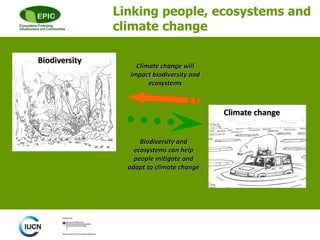
Linking people, ecosystems and
climate change
Biodiversity
Climate change
Climate change will
impact biodiversity and
ecosystems
Biodiversity and
ecosystems can help
people mitigate and
adapt to climate change
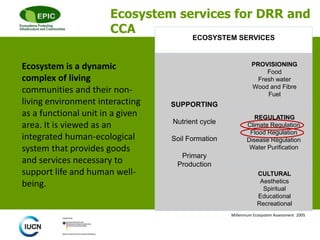
Ecosystem services for DRR and
CCA
Ecosystem is a dynamic
complex of living
communities and their non-
living environment interacting
as a functional unit in a given
area. It is viewed as an
integrated human-ecological
system that provides goods
and services necessary to
support life and human well-
being.
Millennium Ecosystem Assessment 2005
ECOSYSTEM SERVICES
SUPPORTING
Nutrient cycle
Soil Formation
Primary
Production
PROVISIONING
Food
Fresh water
Wood and Fibre
Fuel
REGULATING
Climate Regulation
Flood Regulation
Disease Regulation
Water Purification
CULTURAL
Aesthetics
Spiritual
Educational
Recreational
Ecosystems as a cost-efficient
DRR and CCA strategy
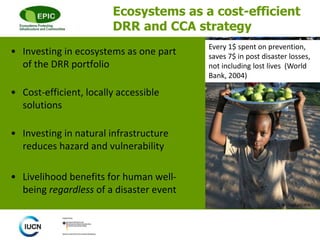
• Investing in ecosystems as one part
of the DRR portfolio
• Cost-efficient, locally accessible
solutions
• Investing in natural infrastructure
reduces hazard and vulnerability
• Livelihood benefits for human well-
being regardless of a disaster event
© M. Deghati/IRIN
Every 1$ spent on prevention,
saves 7$ in post disaster losses,
not including lost lives (World
Bank, 2004)
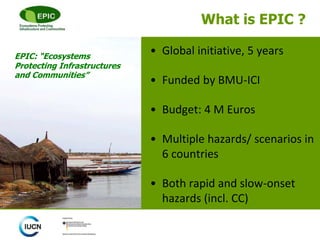
What is EPIC ?
• Global initiative, 5 years
• Funded by BMU-ICI
• Budget: 4 M Euros
• Multiple hazards/ scenarios in
6 countries
• Both rapid and slow-onset
hazards (incl. CC)
EPIC: “Ecosystems
Protecting Infrastructures
and Communities”
Ecosystem services are recognised, promoted
and conserved as an integral part of disaster
risk reduction policy, planning and
programming in the 6 target countries and in
key global processes such as implementation
of The Hyogo Framework of Action of UN-
ISDR, and climate change adaption
framework of the UNFCCC.
Global Outcome
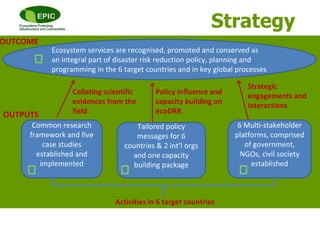
Strategy
Common research
framework and five
case studies
established and
implemented
Tailored policy
messages for 6
countries & 2 int’l orgs
and one capacity
building package
6 Multi-stakeholder
platforms, comprised
of government,
NGOs, civil society
established
Activities in 6 target countries
OUTCOME
OUTPUTS
Ecosystem services are recognised, promoted and conserved as
an integral part of disaster risk reduction policy, planning and
programming in the 6 target countries and in key global processes
Collating scientific
evidences from the
field
Policy influence and
capacity building on
ecoDRR
Strategic
engagements and
interactions
- Climate initiative
- Working on DRR as an entry point
- Ecosystem services for DRR and CCA
- Working with communities (who feel that
CC is happening through the disasters they
have to cope with)
- Involving communities from the start
through consultations
Unique Approach
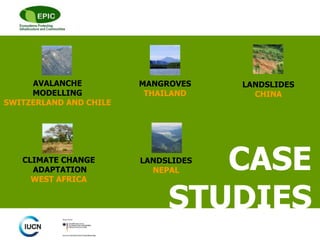
CASE
STUDIES
AVALANCHE
MODELLING
SWITZERLAND AND CHILE
MANGROVES
THAILAND
LANDSLIDES
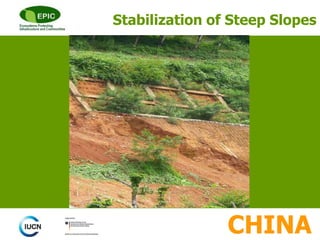
CHINA
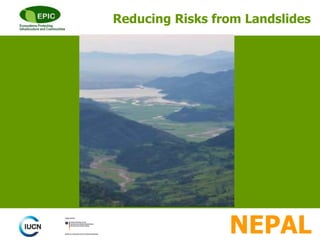
LANDSLIDES
NEPAL
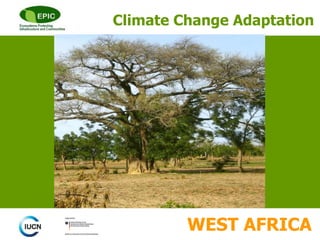
CLIMATE CHANGE
ADAPTATION
WEST AFRICA
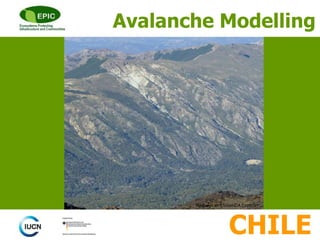
Nevados de Chillàn©A.Casteller
CHILE
Avalanche Modelling
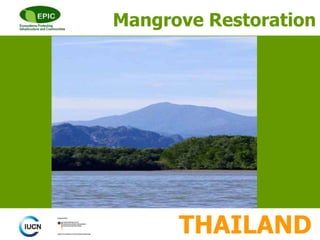
THAILAND
Mangrove Restoration
CHINA
Stabilization of Steep Slopes
NEPAL
Reducing Risks from Landslides
WEST AFRICA
Climate Change Adaptation
Key Questions
1. Why is your approach relevant for addressing communities' needs?
2. What are the key aspects/mechanisms ensuring the success of your
approach? (in terms of scientific knowledge, policy engagement,
practices in the field, etc.)
3. How do you involve key stakeholders at local/national/regional
level?
4. What are the main challenges that you are facing while
implementing eco-DRR in your country?

Introducing EPIC_CamilleBuyck_Final

  • 1.
    Implementing ecosystem- based DRR: introducing EPIC Camille Buyck, IUCN www.epicproject.net
  • 2.
    Linking people, ecosystemsand climate change Biodiversity Climate change Climate change will impact biodiversity and ecosystems Biodiversity and ecosystems can help people mitigate and adapt to climate change
  • 3.
    Ecosystem services forDRR and CCA Ecosystem is a dynamic complex of living communities and their non- living environment interacting as a functional unit in a given area. It is viewed as an integrated human-ecological system that provides goods and services necessary to support life and human well- being. Millennium Ecosystem Assessment 2005 ECOSYSTEM SERVICES SUPPORTING Nutrient cycle Soil Formation Primary Production PROVISIONING Food Fresh water Wood and Fibre Fuel REGULATING Climate Regulation Flood Regulation Disease Regulation Water Purification CULTURAL Aesthetics Spiritual Educational Recreational
  • 4.
    Ecosystems as acost-efficient DRR and CCA strategy • Investing in ecosystems as one part of the DRR portfolio • Cost-efficient, locally accessible solutions • Investing in natural infrastructure reduces hazard and vulnerability • Livelihood benefits for human well- being regardless of a disaster event © M. Deghati/IRIN Every 1$ spent on prevention, saves 7$ in post disaster losses, not including lost lives (World Bank, 2004)
  • 5.
    What is EPIC? • Global initiative, 5 years • Funded by BMU-ICI • Budget: 4 M Euros • Multiple hazards/ scenarios in 6 countries • Both rapid and slow-onset hazards (incl. CC) EPIC: “Ecosystems Protecting Infrastructures and Communities”
  • 6.
    Ecosystem services arerecognised, promoted and conserved as an integral part of disaster risk reduction policy, planning and programming in the 6 target countries and in key global processes such as implementation of The Hyogo Framework of Action of UN- ISDR, and climate change adaption framework of the UNFCCC. Global Outcome
  • 7.
    Strategy Common research framework andfive case studies established and implemented Tailored policy messages for 6 countries & 2 int’l orgs and one capacity building package 6 Multi-stakeholder platforms, comprised of government, NGOs, civil society established Activities in 6 target countries OUTCOME OUTPUTS Ecosystem services are recognised, promoted and conserved as an integral part of disaster risk reduction policy, planning and programming in the 6 target countries and in key global processes Collating scientific evidences from the field Policy influence and capacity building on ecoDRR Strategic engagements and interactions
  • 8.
    - Climate initiative -Working on DRR as an entry point - Ecosystem services for DRR and CCA - Working with communities (who feel that CC is happening through the disasters they have to cope with) - Involving communities from the start through consultations Unique Approach
  • 9.
  • 10.
  • 11.
  • 12.
  • 13.
  • 14.
  • 15.
    Key Questions 1. Whyis your approach relevant for addressing communities' needs? 2. What are the key aspects/mechanisms ensuring the success of your approach? (in terms of scientific knowledge, policy engagement, practices in the field, etc.) 3. How do you involve key stakeholders at local/national/regional level? 4. What are the main challenges that you are facing while implementing eco-DRR in your country?

Editor's Notes

  • #3 Basic principles of Ecosystem-based Adaptation: climate change will have impacts on biodiversity as well as ecosystem services and, by extension, vulnerable people who so heavily rely on these services. However, if biodiversity is preserved and ecosystems are managed sustainably, they can help adapt to climate change impacts.
  • #4 Disasters are often a result of poor environmental management. Poor management leads to degradation of ecosystem services that are vital for human security – provisioning, regulating, and cultural values For instance: Ecosystems as Natural Buffers (for floods etc): Investing in natural infrastructure reduces hazard and vulnerability. Ecosystems contribute to greenhouse gas mitigation (CC regulation) -> Ecosystems support Livelihood and human well-being regardless of a disaster event.
  • #5 Therefore Ecosystems management can be used as a strategy to support Livelihood and human well-being regardless of a disaster event. It is cost-efficient and locally accessible It provides solutions for mitigating CC and buffering natural hazards impacts It provides multiple benefits for livelihood, ex food, water and wood.
  • #7 Outcome = The actual goal of the project, i.e. changes that can be directly causally attributed to the project. It also comprises the process of change that intermediaries and target groups go through when they make use of the outputs (products, goods, services and sets of regulations/standards) generated by the project. + 3 outputs = Learning framework (collating science based knowledge) + policy influencing and capacity building (PEDRR material) + MSD
  • #8 3 outputs = Learning framework (collating science based knowledge) + policy influencing and capacity building (PEDRR material) + MSD -> How they link to each other -> How they contribute to EPIC outcome
  • #9 Outcome = The actual goal of the project, i.e. changes that can be directly causally attributed to the project. It also comprises the process of change that intermediaries and target groups go through when they make use of the outputs (products, goods, services and sets of regulations/standards) generated by the project. + 3 outputs = Learning framework (collating science based knowledge) + policy influencing and capacity building (PEDRR material) + MSD
  • #11 Quantifying and Improving the Protective Capacity of Forests against Snow Avalanches
  • #12 Demonstrative Community-based Ecological Mangrove Restoration
  • #13 Eco-Engineering for stabilization of steep slopes in Southern China
  • #14 Increasing Resilience of Mountain Communities in Eastern Nepal “Middle Hills”
  • #15 Strengthening Local Climates Change Adaptation Strategies in West Africa
  • #16 Strengthening Local Climates Change Adaptation Strategies in West Africa