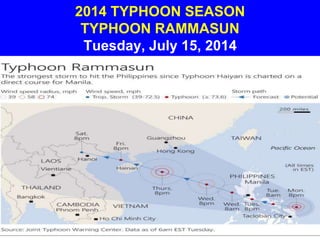
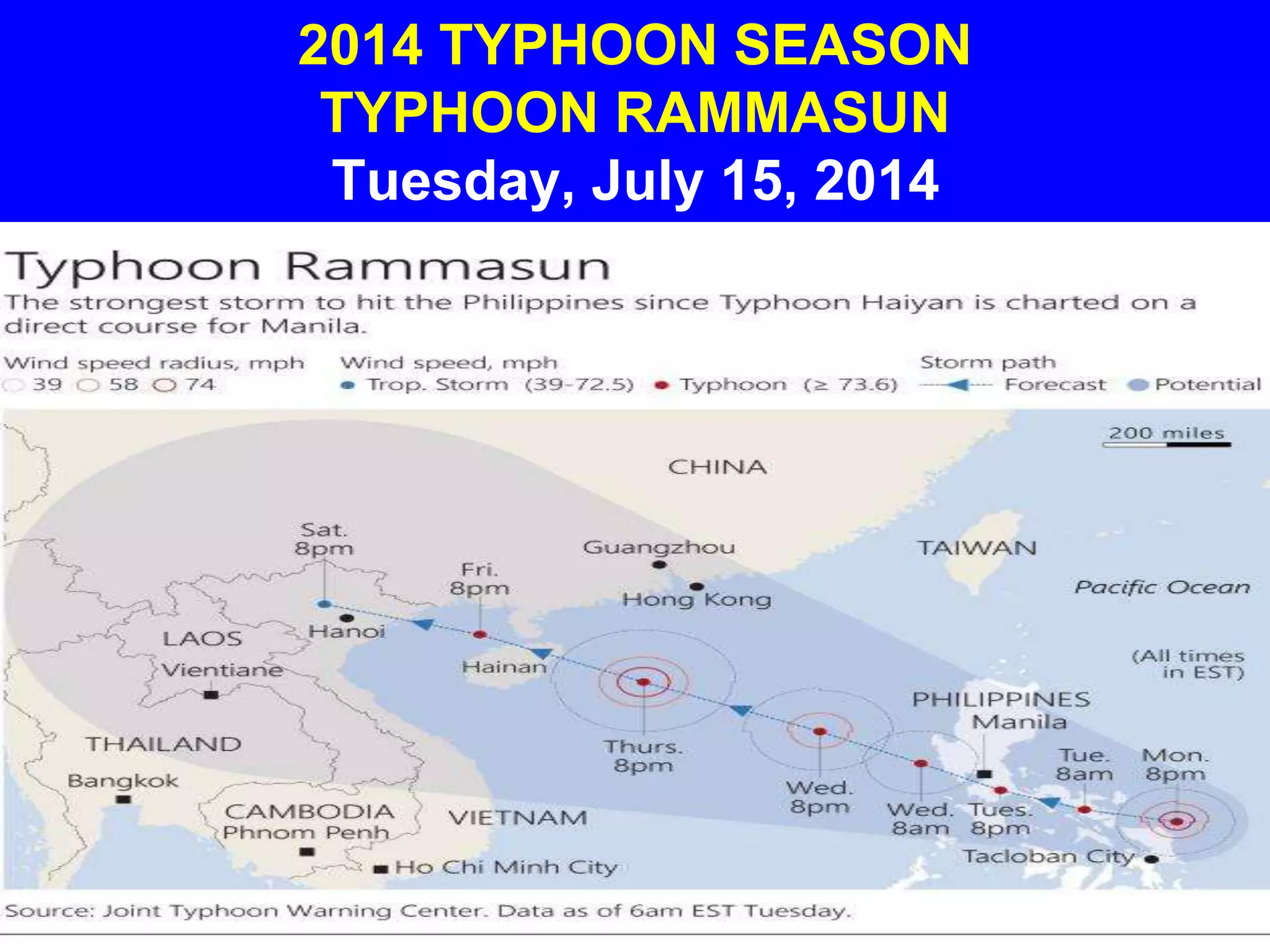
2014 TYPHOON SEASON
TYPHOON RAMMASUN
Tuesday, July 15, 2014
Rammasun is the strongest
storm to threaten the country
since Haiyan, a Cat-5 "super
typhoon," wiped out nearly
everything in its path when it
crossed over the central
Philippines in November, 2013.
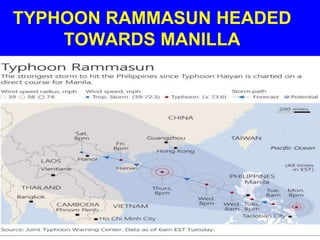
RAMMASUN (CAT 3) WAS
HEADED FOR MANILLA—THE
FIRST DIRECT HIT ON THE
CAPITOL IN FOUR YEARS—
ON JULY 14, 2014
TYPHOON RAMMASUN HEADED
TOWARDS MANILLA
PHYSICAL DETAILS
• Typhoon Rammasun, with
gusts of up to 160 kph (99 mph)
and sustained winds of 130 kph
(81 mph) near its centre, hit
land over Rapu-Rapu island in
the eastern province of Albay,
TIMELY ANTICIPATORY
ACTIONS
• At least 300,000 people have
already fled from their homes
in Albay province alone.
• However, many people were
unwilling to evacuate.
TIMELY ANTICIPATORY
ACTIONS
• Schools were closed.
• International flights were
cancelled.
• The army was placed on high
alert.
WHAT CAN HAPPEN?
POTENTIAL DISASTER
AGENTS AND RISK FROM
TYPHOON HAIYAN
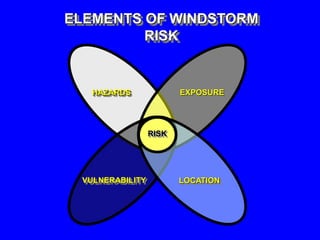
HAZARDS
ELEMENTS OF WINDSTORM
RISK
EXPOSURE
VULNERABILITY LOCATION
RISK
POTENTIAL DISASTER AGENTS (AKA
HAZARDS) OF A TYPHOON
• WIND FIELD [CAT 1 (55 mph) TO CAT 5+
(155 mph or greater)]
• DEBRIS
• STORM SURGE/FLOODS
• HEAVY PRECIPITATION/FLOODS
• LANDSLIDES (MUDFLOWS)
• COSTAL EROSION
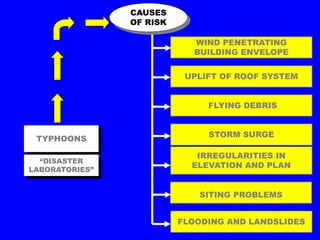
WIND PENETRATING
BUILDING ENVELOPE
TYPHOONS
UPLIFT OF ROOF SYSTEM
FLYING DEBRIS
STORM SURGE
IRREGULARITIES IN
ELEVATION AND PLAN
SITING PROBLEMS
FLOODING AND LANDSLIDES
CAUSES
OF RISK
“DISASTER
LABORATORIES”
Rammasun is expected to
bring storm surges of up to
three meters (10 feet) in
coastal villages
REMEMBERING TYPHOON
HAIYAN
SUPER TYPHOON HAIYAN
DEVASTATED THE PHILIPPINES;
NOVEMBER 8-10, 2013
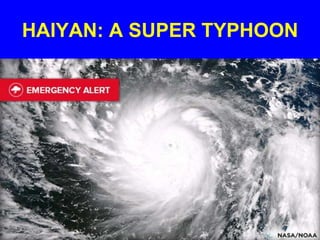
HAIYAN: A SUPER TYPHOON
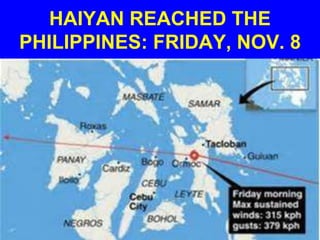
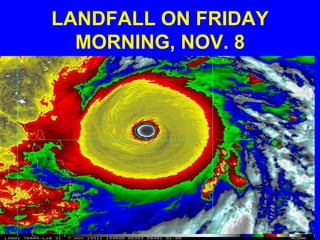
HAIYAN REACHED THE
PHILIPPINES: FRIDAY, NOV. 8
LANDFALL ON FRIDAY
MORNING, NOV. 8
RATED AS PROBABLY THE
STRONGEST TYPHOON
EVER TO STRIKE THE
PHILIPPINES
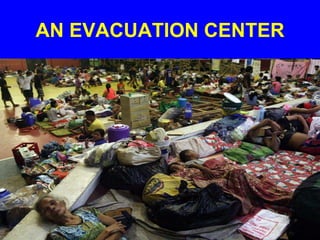
ADVANCE EVACUATIONS
• 800,000 people were evacuated
to emergency shelters.
AN EVACUATION CENTER
INITIAL IMPACTS IN THE
PHILIPPINES
• Wide spread flooding,
mudslides, and power outages
• Winds of 380 kph (290 mph)
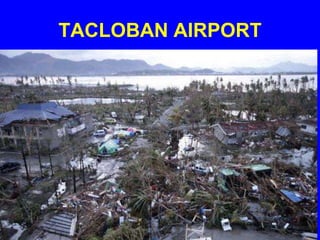
• TACLOBAN hit very hard by the
storm surge with many deaths
• Tacloban’s airport destroyed
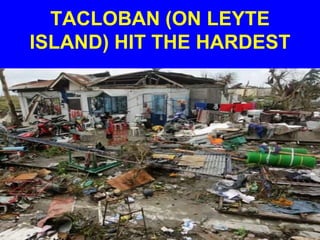
TACLOBAN (ON LEYTE
ISLAND) HIT THE HARDEST
FOUR HOURS OF FEAR AND
DESTRUCTION
• Winds flattened hundreds of homes.
• Heavy rainfall triggered mudslides and
flash flooding.
• A storm surge with waves of up to 10 m
(30 feet) destroyed everything,
sweeping people away and drowning
thousands.
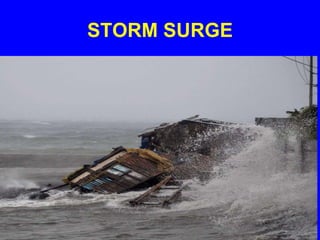
STORM SURGE
AN AERIAL VIEW
• It was like a tsunami," Interior
Secretary Manuel Roxas told
Reuters.
• "From a helicopter, you could see
the extent of devastation. From the
shore and moving a km inland, no
structures were left standing.
INITIAL IMPACTS IN THE
PHILIPPINES
• Loss of communication
• An estimated 10,000 people
dead
• Economic losses in the billions
SURVIVOR STORIES
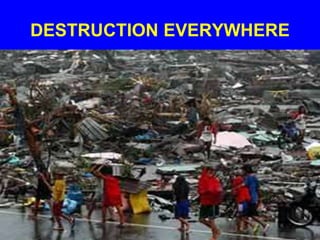
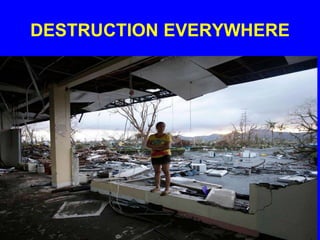
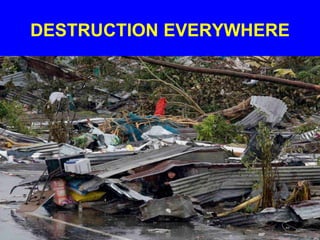
• Survivors of the storm
described towering waves that
swept away all but the most
robust engineered structures.
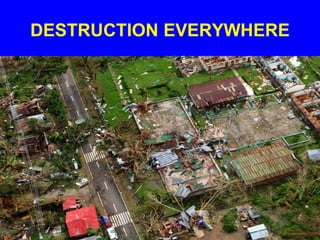
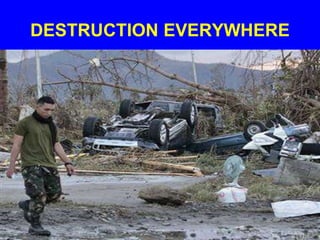
DESTRUCTION EVERYWHERE
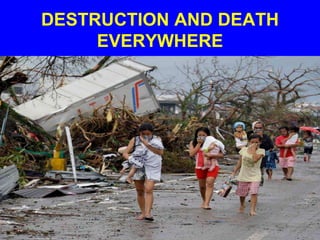
DESTRUCTION AND DEATH
EVERYWHERE
DESTRUCTION EVERYWHERE
TACLOBAN AIRPORT
SURVIVOR NEEDS
• Survivors were in desperate need
of clean drinking water and food
• Survivors were temporarily cut off
from aid, and from their families in
the Philippines as well as in other
countries (e.g., 3 million in the
USA)
USA MILITARY FORCES
WERE DISPATCHED TO
ASSIST LOCAL OFFICIALS
IN WHAT BECAME A
HISTORIC RELIEF EFFORT
Search and Rescue and Relief
Efforts Were Hampered by
Landslides and Damaged Road
Systems
LOOKING TO THE FUTURE
ONCE AGAIN, TYPHOON HAIYAN
DEMONSTRATED THAT IT
USUALLY TAKES MULTIPLE
DISASTERS BEFORE THE
STRICKEN NATION WILL ADOPT
POLICIES TO BECOME DISASTER
RESILIENT
ONCE AGAIN, UNAFFECTED
NATIONS USUALLY DON’T
LEARN ANYTHING NEW AND
DON’T CHANGE EXISTING
POLICIES ON THE BASIS OF
ANOTHER NATION’S
EXPERIENCES
TYPHOON DISASTER RESILIENCE
POLICIES AND MEASURES ARE
NEEDED BY MANY NATIONS
Preparedness
Adoption and Implementation of a Modern Wind
Engineering Building Code
Time,y Early Warning and Evacuation
Timely Emergency Response (including
Emergency Medical Services)
Cost-Effective Recovery
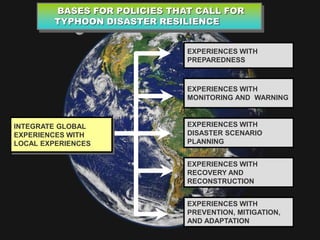
BASES FOR POLICIES THAT CALL FOR
TYPHOON DISASTER RESILIENCE
EXPERIENCES WITH
PREPAREDNESS
EXPERIENCES WITH
MONITORING AND WARNING
EXPERIENCES WITH
DISASTER SCENARIO
PLANNING
EXPERIENCES WITH
RECOVERY AND
RECONSTRUCTION
EXPERIENCES WITH
PREVENTION, MITIGATION,
AND ADAPTATION
INTEGRATE GLOBAL
EXPERIENCES WITH
LOCAL EXPERIENCES
THE CHALLENGE:
POLICY CHANGES: CREATE, ADJUST, AND
REALIGN PROGRAMS, PARTNERS AND
PEOPLE UNTIL YOU HAVE CREATED THE
KINDS OF TURNING POINTS NEEDED FOR
MOVING TOWARDS TYPHOON RESILIENCE
LESSON: ANTICIPATORY ACTIONS
ARE THE KEY TO PREPAREDNESS
• The people who know: 1) what to
expect (e.g., high-velocity winds,
rain, flash floods, landslides, and
storm surge), 2) where and when it
will happen, and 3) what they
should (and should not) do to
prepare will survive.
LESSON: EMERGENCY
RESPONSE IS COMPLEX
• All kinds of things can go
wrong during the emergency
response period when the
uncontrollable and unthinkable
events happen along with the
expected events
LESSON: TIMING OF EMERGENCY
RESPONSE IS VITAL
• The “Uncontrollable and
Unthinkable” events can
significantly hinder the timing of
urgent emergency response
operations.
LESSON: TIMELY EARLY WARNING
AND EVACUATION SAVES LIVES
• The people who have timely early
warning in conjunction with a
community evacuation plan that
facilitates getting out of harm’s way
from the risks associated with
storm surge, high winds, flooding,
and landslides will survive.
LESSON: WIND ENGINEERED
BUILDINGS SAVE LIVES
• Buildings protected by wind
engineering to withstand a
typhoon’s high velocity winds will
maintain their function, protect
occupants and users, and minimize
death and injury.
LESSON: EMERGENCY MEDICAL
PREPAREDNESS SAVES LIVES
• Damaged hospitals and medical
facilities combined with lack of
clean drinking water, food, and
medicine, and high levels of
morbidity and mortality will quickly
overrun the local community’s
capacity for emergency health care.
LESSON: THE INTERNATIONAL
COMMUNITY PROVIDES AID
• The International Community
provides millions to billions of
dollars in relief to help “pick up the
pieces, ” but this strategy by itself is
not enough to ensure typhoon
disaster resilience.
CREATING TURNING POINTS FOR
TYPHOON DISASTER
RESILIENCE
 USING EDUCATIONAL SURGES CONTAINING
THE PAST AND PRESENT LESSONS TO FOSTER
AND ACCELERATE THE CREATION OF TURNING
POINTS
THE PEOPLE OF THE PHILIPPINES
HAVE HAD MANY
OPPORTUNITIES TO LEARN
VITAL LESSONS
FROM PAST TYPHOONS OF ALL
SIZES MAKING LANDFALL THERE
The Philippines has more than enough
experience with typhoons for action.

Typhoon Rammasun (Cat 3) Headed Towards Manila

  • 1.
    2014 TYPHOON SEASON TYPHOONRAMMASUN Tuesday, July 15, 2014
  • 2.
    Rammasun is thestrongest storm to threaten the country since Haiyan, a Cat-5 "super typhoon," wiped out nearly everything in its path when it crossed over the central Philippines in November, 2013.
  • 3.
    RAMMASUN (CAT 3)WAS HEADED FOR MANILLA—THE FIRST DIRECT HIT ON THE CAPITOL IN FOUR YEARS— ON JULY 14, 2014
  • 4.
  • 5.
    PHYSICAL DETAILS • TyphoonRammasun, with gusts of up to 160 kph (99 mph) and sustained winds of 130 kph (81 mph) near its centre, hit land over Rapu-Rapu island in the eastern province of Albay,
  • 6.
    TIMELY ANTICIPATORY ACTIONS • Atleast 300,000 people have already fled from their homes in Albay province alone. • However, many people were unwilling to evacuate.
  • 7.
    TIMELY ANTICIPATORY ACTIONS • Schoolswere closed. • International flights were cancelled. • The army was placed on high alert.
  • 8.
  • 9.
    POTENTIAL DISASTER AGENTS ANDRISK FROM TYPHOON HAIYAN
  • 10.
  • 11.
    POTENTIAL DISASTER AGENTS(AKA HAZARDS) OF A TYPHOON • WIND FIELD [CAT 1 (55 mph) TO CAT 5+ (155 mph or greater)] • DEBRIS • STORM SURGE/FLOODS • HEAVY PRECIPITATION/FLOODS • LANDSLIDES (MUDFLOWS) • COSTAL EROSION
  • 12.
    WIND PENETRATING BUILDING ENVELOPE TYPHOONS UPLIFTOF ROOF SYSTEM FLYING DEBRIS STORM SURGE IRREGULARITIES IN ELEVATION AND PLAN SITING PROBLEMS FLOODING AND LANDSLIDES CAUSES OF RISK “DISASTER LABORATORIES”
  • 13.
    Rammasun is expectedto bring storm surges of up to three meters (10 feet) in coastal villages
  • 14.
  • 15.
    SUPER TYPHOON HAIYAN DEVASTATEDTHE PHILIPPINES; NOVEMBER 8-10, 2013
  • 16.
  • 17.
  • 18.
  • 19.
    RATED AS PROBABLYTHE STRONGEST TYPHOON EVER TO STRIKE THE PHILIPPINES
  • 20.
    ADVANCE EVACUATIONS • 800,000people were evacuated to emergency shelters.
  • 21.
  • 22.
    INITIAL IMPACTS INTHE PHILIPPINES • Wide spread flooding, mudslides, and power outages • Winds of 380 kph (290 mph) • TACLOBAN hit very hard by the storm surge with many deaths • Tacloban’s airport destroyed
  • 23.
  • 24.
    FOUR HOURS OFFEAR AND DESTRUCTION • Winds flattened hundreds of homes. • Heavy rainfall triggered mudslides and flash flooding. • A storm surge with waves of up to 10 m (30 feet) destroyed everything, sweeping people away and drowning thousands.
  • 25.
  • 26.
    AN AERIAL VIEW •It was like a tsunami," Interior Secretary Manuel Roxas told Reuters. • "From a helicopter, you could see the extent of devastation. From the shore and moving a km inland, no structures were left standing.
  • 27.
    INITIAL IMPACTS INTHE PHILIPPINES • Loss of communication • An estimated 10,000 people dead • Economic losses in the billions
  • 28.
    SURVIVOR STORIES • Survivorsof the storm described towering waves that swept away all but the most robust engineered structures.
  • 29.
  • 30.
  • 31.
  • 32.
  • 33.
  • 34.
  • 35.
  • 36.
    SURVIVOR NEEDS • Survivorswere in desperate need of clean drinking water and food • Survivors were temporarily cut off from aid, and from their families in the Philippines as well as in other countries (e.g., 3 million in the USA)
  • 37.
    USA MILITARY FORCES WEREDISPATCHED TO ASSIST LOCAL OFFICIALS IN WHAT BECAME A HISTORIC RELIEF EFFORT
  • 38.
    Search and Rescueand Relief Efforts Were Hampered by Landslides and Damaged Road Systems
  • 39.
  • 40.
    ONCE AGAIN, TYPHOONHAIYAN DEMONSTRATED THAT IT USUALLY TAKES MULTIPLE DISASTERS BEFORE THE STRICKEN NATION WILL ADOPT POLICIES TO BECOME DISASTER RESILIENT
  • 41.
    ONCE AGAIN, UNAFFECTED NATIONSUSUALLY DON’T LEARN ANYTHING NEW AND DON’T CHANGE EXISTING POLICIES ON THE BASIS OF ANOTHER NATION’S EXPERIENCES
  • 42.
    TYPHOON DISASTER RESILIENCE POLICIESAND MEASURES ARE NEEDED BY MANY NATIONS Preparedness Adoption and Implementation of a Modern Wind Engineering Building Code Time,y Early Warning and Evacuation Timely Emergency Response (including Emergency Medical Services) Cost-Effective Recovery
  • 43.
    BASES FOR POLICIESTHAT CALL FOR TYPHOON DISASTER RESILIENCE EXPERIENCES WITH PREPAREDNESS EXPERIENCES WITH MONITORING AND WARNING EXPERIENCES WITH DISASTER SCENARIO PLANNING EXPERIENCES WITH RECOVERY AND RECONSTRUCTION EXPERIENCES WITH PREVENTION, MITIGATION, AND ADAPTATION INTEGRATE GLOBAL EXPERIENCES WITH LOCAL EXPERIENCES
  • 44.
    THE CHALLENGE: POLICY CHANGES:CREATE, ADJUST, AND REALIGN PROGRAMS, PARTNERS AND PEOPLE UNTIL YOU HAVE CREATED THE KINDS OF TURNING POINTS NEEDED FOR MOVING TOWARDS TYPHOON RESILIENCE
  • 45.
    LESSON: ANTICIPATORY ACTIONS ARETHE KEY TO PREPAREDNESS • The people who know: 1) what to expect (e.g., high-velocity winds, rain, flash floods, landslides, and storm surge), 2) where and when it will happen, and 3) what they should (and should not) do to prepare will survive.
  • 46.
    LESSON: EMERGENCY RESPONSE ISCOMPLEX • All kinds of things can go wrong during the emergency response period when the uncontrollable and unthinkable events happen along with the expected events
  • 47.
    LESSON: TIMING OFEMERGENCY RESPONSE IS VITAL • The “Uncontrollable and Unthinkable” events can significantly hinder the timing of urgent emergency response operations.
  • 48.
    LESSON: TIMELY EARLYWARNING AND EVACUATION SAVES LIVES • The people who have timely early warning in conjunction with a community evacuation plan that facilitates getting out of harm’s way from the risks associated with storm surge, high winds, flooding, and landslides will survive.
  • 49.
    LESSON: WIND ENGINEERED BUILDINGSSAVE LIVES • Buildings protected by wind engineering to withstand a typhoon’s high velocity winds will maintain their function, protect occupants and users, and minimize death and injury.
  • 50.
    LESSON: EMERGENCY MEDICAL PREPAREDNESSSAVES LIVES • Damaged hospitals and medical facilities combined with lack of clean drinking water, food, and medicine, and high levels of morbidity and mortality will quickly overrun the local community’s capacity for emergency health care.
  • 51.
    LESSON: THE INTERNATIONAL COMMUNITYPROVIDES AID • The International Community provides millions to billions of dollars in relief to help “pick up the pieces, ” but this strategy by itself is not enough to ensure typhoon disaster resilience.
  • 52.
    CREATING TURNING POINTSFOR TYPHOON DISASTER RESILIENCE  USING EDUCATIONAL SURGES CONTAINING THE PAST AND PRESENT LESSONS TO FOSTER AND ACCELERATE THE CREATION OF TURNING POINTS
  • 53.
    THE PEOPLE OFTHE PHILIPPINES HAVE HAD MANY OPPORTUNITIES TO LEARN VITAL LESSONS FROM PAST TYPHOONS OF ALL SIZES MAKING LANDFALL THERE The Philippines has more than enough experience with typhoons for action.