1
Emerging proliferation risks
imposed by a nuclear growth
scenario
K. Gufler1, N. Arnold1
1 Institute of Security/Safety- and Risk Sciences, University of Natural
Resources and Life Sciences, Vienna, risk@boku.ac.at, www.risk.boku.ac.at
2
Overview
 Background
 Objective and Approach
 Database
 Nuclear power scenarios
 Nuclear Fuel Cycle
 Proliferation Issues
 Results
 Conclusions
3
Background
 Discussion on the role of nuclear in tackling climate change
 Expected growth of installed nuclear capacity
 Induced need of more nuclear fuel cycle facilities to cope the fuel
demand
4
Objective and Approach
 Identification of existing and future capacities
 Identification of crucial technologies in the NFC
 Socio political analysis
Combined to a
 Comprehensive approach
Results will be used for
 Discussion of the results with stakeholders
 Elaborating different potential pathways
5
Database
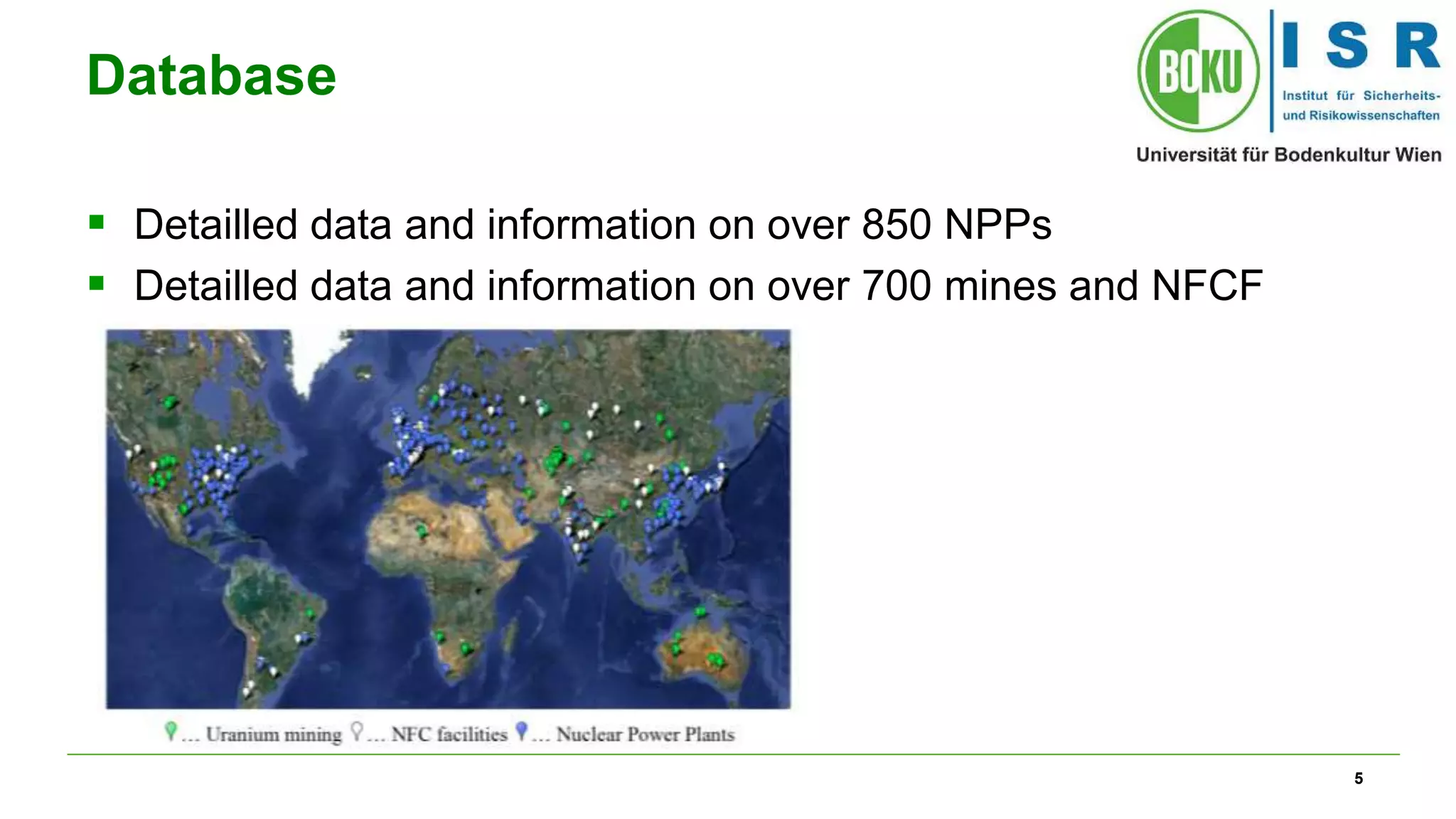
 Detailled data and information on over 850 NPPs
 Detailled data and information on over 700 mines and NFCF
6
Status of nuclear power in 2014
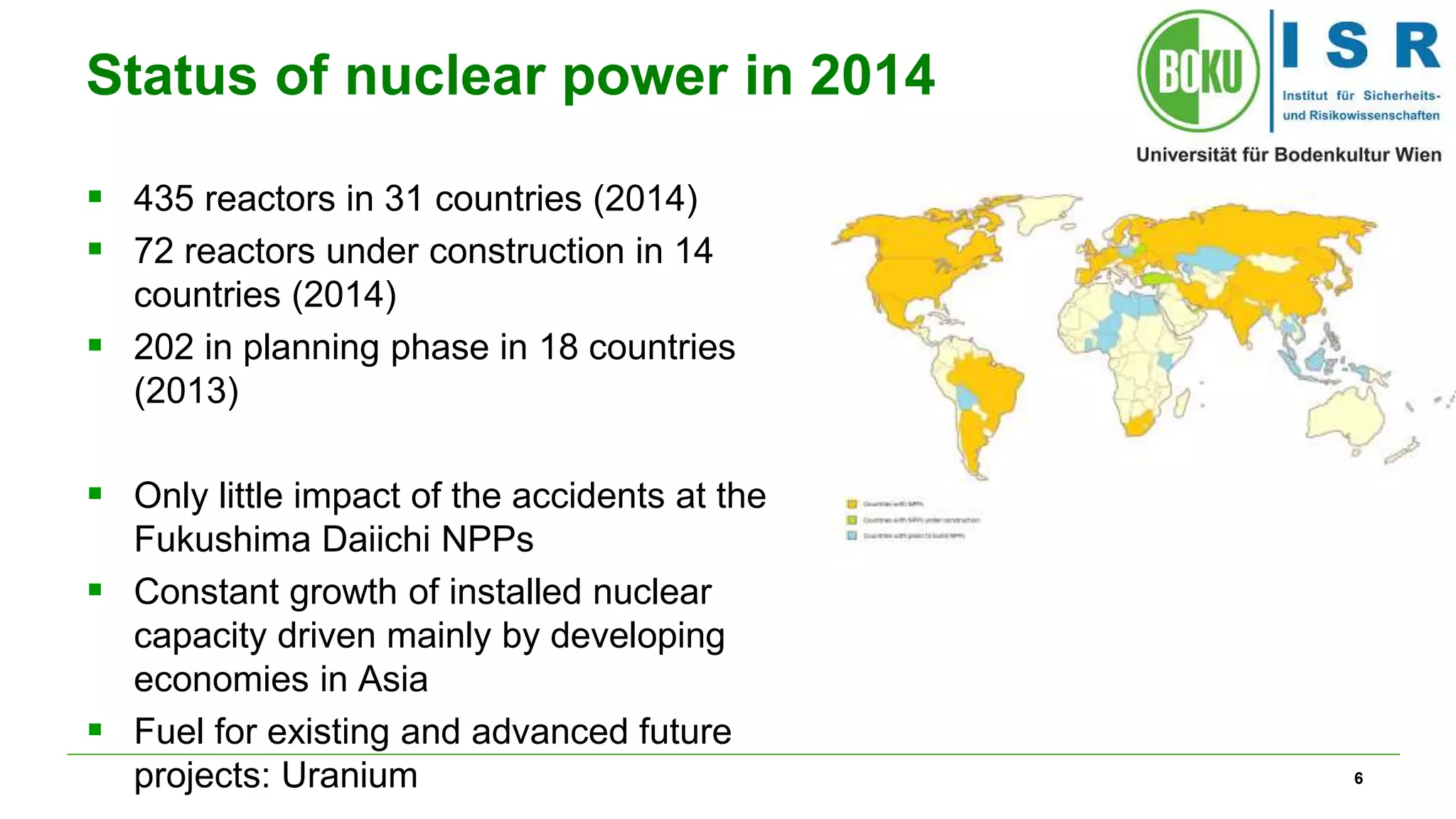
 435 reactors in 31 countries (2014)
 72 reactors under construction in 14
countries (2014)
 202 in planning phase in 18 countries
(2013)
 Only little impact of the accidents at the
Fukushima Daiichi NPPs
 Constant growth of installed nuclear
capacity driven mainly by developing
economies in Asia
 Fuel for existing and advanced future
projects: Uranium
7
Status of the nuclear fuel cycle in
2014
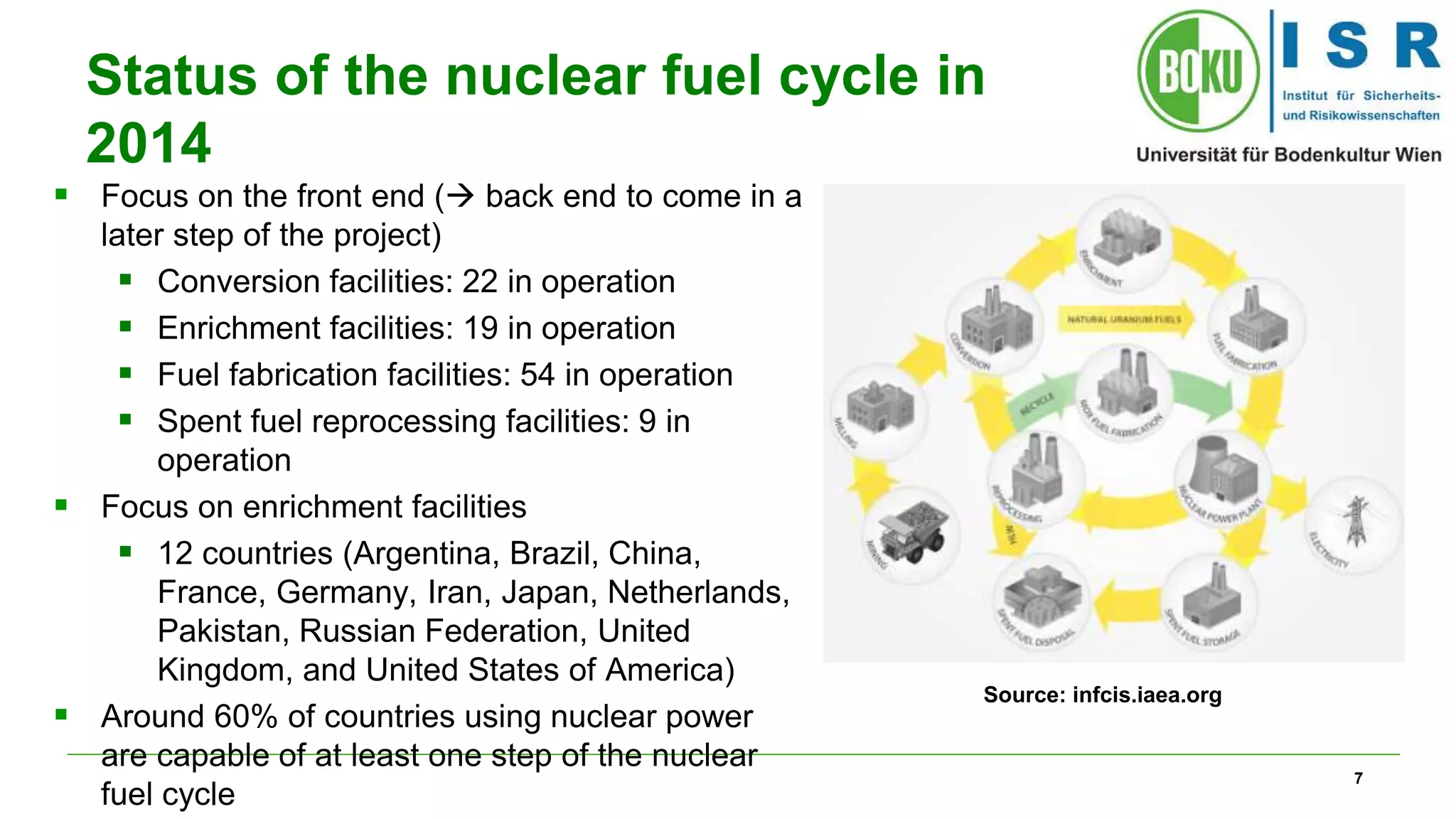
 Focus on the front end ( back end to come in a
later step of the project)
 Conversion facilities: 22 in operation
 Enrichment facilities: 19 in operation
 Fuel fabrication facilities: 54 in operation
 Spent fuel reprocessing facilities: 9 in
operation
 Focus on enrichment facilities
 12 countries (Argentina, Brazil, China,
France, Germany, Iran, Japan, Netherlands,
Pakistan, Russian Federation, United
Kingdom, and United States of America)
 Around 60% of countries using nuclear power
are capable of at least one step of the nuclear
fuel cycle
Source: infcis.iaea.org
8
Nuclear power projections and
scenarios
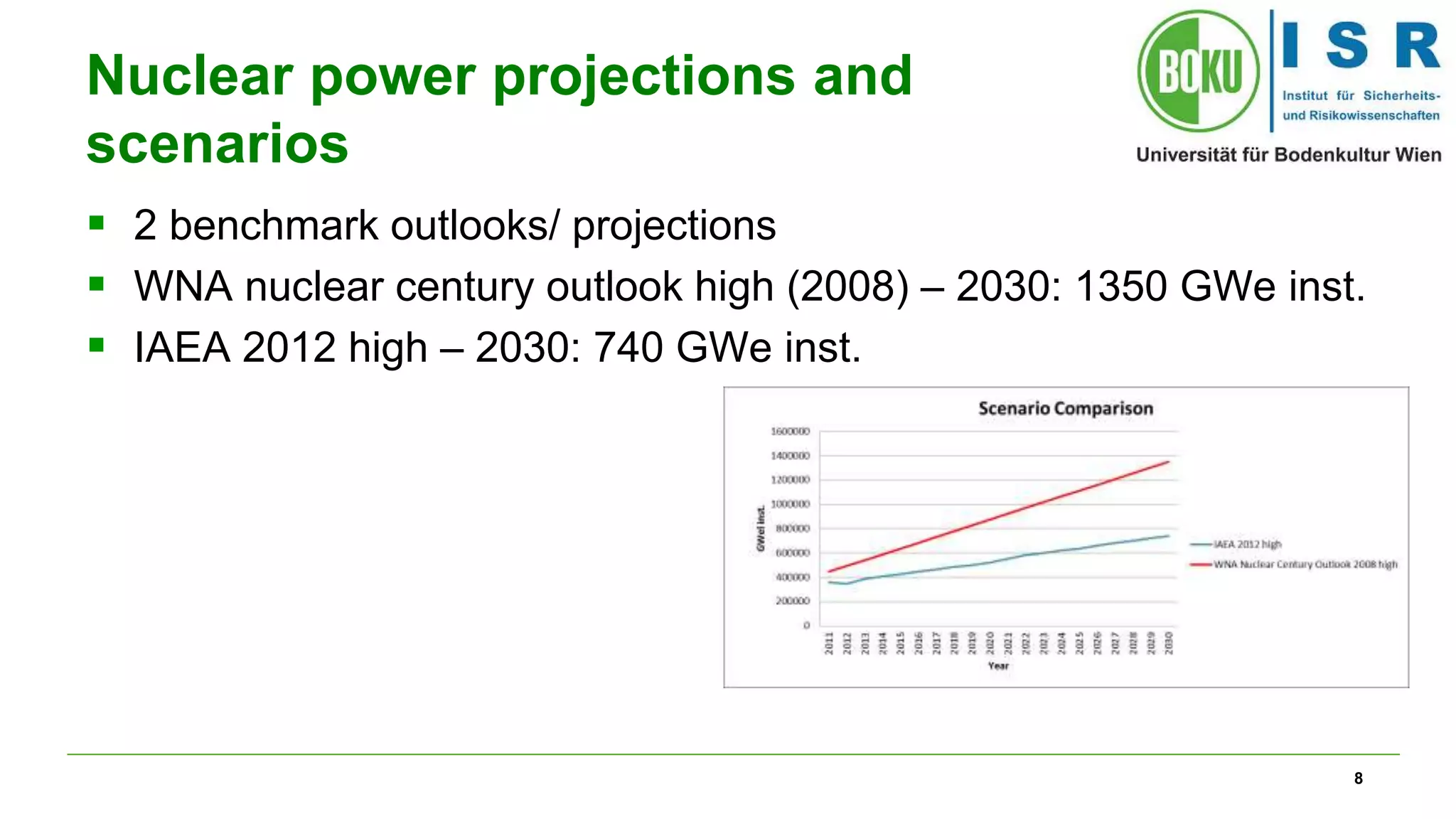
 2 benchmark outlooks/ projections
 WNA nuclear century outlook high (2008) – 2030: 1350 GWe inst.
 IAEA 2012 high – 2030: 740 GWe inst.
9
Nuclear Proliferation
 Spread of nuclear weapons, fissonable material, weapon
applicable technology
 Fissonable material: Uranium, Plutonium
 Weapon applicable technology (also dual use technology):
Enrichment, Separation
 Proliferation resistance
 Intrinsic proliferation resistance features: physical and
engineering aspects
 Extrinsic proliferation resistance features: institutional aspects
as external barriers and safeguards
10
Results (1)
 Shift of the global nuclear industry towards developing countries and
emerging markets
 There are newcomer states that want to add nuclear into their energy
portfolio
 Existing nuclear power using countries will enlarge their nuclear
generation capacity – special focus on China, the Russian Federation
and India
 Many “old” nuclear power generating countries are planning to reduce
their installed capacity, as they will not replace old reactors, or as they
choose to phase out
 The current situation of the global nuclear fuel cycle clearly
demonstrates that the main capacities (conversion, enrichment and
11
Results (2)
 To meet the fuel requirements of the IAEA 2012 high scenario the
enrichment capacity needs to be enlarged from about 68 kt SWU
in the year 2011 to 127 kt SWU in the year 2030 (almost double)
 WNA 2008 outlook would lead to the need of 231 kt SWU (more
than triple)
 The average design capacity of commercial enrichment facilities
in operation on a global level is about 4 kt SWU per year
  IAEA 2012: around 15 new enrichment facilities required*
  WNA 2008: around 40 new enrichment facilities required*
*assuming that all actual enrichment facilities will get life time extensions
12
Conclusions
 Investments in NFCF is required to allow the growth of the
nuclear power reactor fleet
 Dual use problem
13
Conclusions
 Possible pathways for future development (A1)
 Every country is allowed to possess and develop a domestic nuclear fuel cycle
including the enrichment technology
 The nuclear material is safeguarded by the IAEA
 Implications
 The safeguard mission by the IAEA would be huge, due to the high number of
potential new facilities
 Does not seem to be feasible, due to the enormous workload and would lead to an
enhanced proliferation risk, because nuclear material would be heavily spread –as
well as the technology
 Consequence
 In order to reduce the intrinsic proliferation risk, a step backwards towards the
diffusion technology would help to monitor the enrichment facilities, as they can be
hidden much more difficultly due to the high energy consumption
14
Conclusions
 Possible pathways for future development (A2)
 Black box option - centralized enrichment and nuclear fuel bank organized by the IAEA and
hosted by one or more member countries
 Implications
 If only certain countries would obtain their fuel from such a facility this would enhance the
imbalance between the IAEA member states
 The spread of dual use technology would be reduced and the mass flow of fissile and fertile
material could be more easily followed
 Consequence
 The proliferation risk would be lower compared to the first option, but other negative impacts
are not negligible
 For certain countries the security of supply – one of the very strong arguments to introduce
nuclear energy – could not be enhanced, but rather the dependency on certain supplier
countries would be increased
 If there is a threat for one or more countries, that due to certain boundary conditions nuclear
fuel will not be delivered, they will not agree on this option
15
Conclusions
 Many more possible pathways (ongoing discussion and research)
 Correlation between nuclear growth and an emerging nuclear
proliferation risk
 The emerging nuclear proliferation risk is driven by the need of
more enrichment facilities, the spread of knowledge, and the
spread of nuclear material
 In order to tackle the emerging nuclear proliferation risk intrinsic
and extrinsic features are needed, such as more proliferation
resistant technologies in the nuclear fuel cycle and enhanced
IAEA safeguards.
 The safeguards need to get more funding’s and more
16
References
 Ahearne, J.F., 2011. Prospects for nuclear energy. Energy Econ. 33, 572–580. doi:10.1016/j.eneco.2010.11.014
 Arnold, N., Gufler, K., 2012. Fuel cycle risks imposed by a nuclear growth scenario. 4th Int. Disaster Risk Conf. IDRC Davos 2012.
 Arnold, N., Gufler, K., 2014. Nuclear Database. Vienna, Austria.
 Arnold, N., Kromp, W., Zittel, W., 2011. Perspektiven nuklearer Energieerzeugung bezüglich ihrer Uran Brennstoffversorgung.
 Bari, R., Peterson, P., Therios, I., Whitlock, J., 2009. Proliferation Resistance and Physical Protection - Evaluation Methodology Development and Applications. Brookhaven
National Laboratory, Upton, NY.
 Gabriel, S., Baschwitz, A., Mathonnière, G., Fizaine, F., Eleouet, T., 2013. Building future nuclear power fleets: The available uranium resources constraint. Resour. Policy
38, 458–469. doi:10.1016/j.resourpol.2013.06.008
 Gufler, K., 2013. Short and mid-term trends of the development of nuclear energy. ISR, Wien.
 IAEA, 2008. Guidance for the Application of an Assessment Methodology for Innovative Nuclear Energy Systems, INPRO Manual — Proliferation Resistance, IAEA-
TECDOC-1575 Rev. 1. Vienna, Austria.
 IAEA, 2012. Energy, Electricity and Nuclear Power, Estimates for the Period up to 2050; Reference Data Series No.1, 2012 Edition, IAEA Vienna. Vienna, Austria.
 IAEA, 2013. IAEA ministerial conference on nuclear power in the 21th century.
 IAEA, 2014a. IAEA PRIS [WWW Document]. URL http://www.iaea.org/pris/home.aspx
 IAEA, 2014b. Integrated Nuclear Fuel Cycle Information System [WWW Document].
 IAEA, 2014c. IAEA Technical Meeting on topical issues in the development of nuclear power infrastructure.
 IEA, 2013. World Energy Outlook 2012. Paris, France.
 Kessides, I.N., Wade, D.C., 2011. Towards a sustainable global energy supply infrastructure: Net energy balance and density considerations. Energy Policy 39, 5322–
5334. doi:10.1016/j.enpol.2011.05.032
 Knapp, V., Pevec, D., Matijević, M., 2010. The potential of fission nuclear power in resolving global climate change under the constraints of nuclear fuel resources and
once-through fuel cycles. Energy Policy, Energy Efficiency Policies and Strategies with regular papers. 38, 6793–6803. doi:10.1016/j.enpol.2010.06.052
 WNA, 2008. WNA Nuclear Century Outlook.
 Zittel, W., Arnold, N., Liebert, W., 2013. Nuclear Fuel and Availability. Vienna, Ottobrunn, Darmstadt.
17
Thanks for your kind attention!
For further and more detailled information feel free to
contact me
klaus.gufler@boku.ac.at

IDRC_2014_emerging proliferation update

  • 1.
    1 Emerging proliferation risks imposedby a nuclear growth scenario K. Gufler1, N. Arnold1 1 Institute of Security/Safety- and Risk Sciences, University of Natural Resources and Life Sciences, Vienna, risk@boku.ac.at, www.risk.boku.ac.at
  • 2.
    2 Overview  Background  Objectiveand Approach  Database  Nuclear power scenarios  Nuclear Fuel Cycle  Proliferation Issues  Results  Conclusions
  • 3.
    3 Background  Discussion onthe role of nuclear in tackling climate change  Expected growth of installed nuclear capacity  Induced need of more nuclear fuel cycle facilities to cope the fuel demand
  • 4.
    4 Objective and Approach Identification of existing and future capacities  Identification of crucial technologies in the NFC  Socio political analysis Combined to a  Comprehensive approach Results will be used for  Discussion of the results with stakeholders  Elaborating different potential pathways
  • 5.
    5 Database  Detailled dataand information on over 850 NPPs  Detailled data and information on over 700 mines and NFCF
  • 6.
    6 Status of nuclearpower in 2014  435 reactors in 31 countries (2014)  72 reactors under construction in 14 countries (2014)  202 in planning phase in 18 countries (2013)  Only little impact of the accidents at the Fukushima Daiichi NPPs  Constant growth of installed nuclear capacity driven mainly by developing economies in Asia  Fuel for existing and advanced future projects: Uranium
  • 7.
    7 Status of thenuclear fuel cycle in 2014  Focus on the front end ( back end to come in a later step of the project)  Conversion facilities: 22 in operation  Enrichment facilities: 19 in operation  Fuel fabrication facilities: 54 in operation  Spent fuel reprocessing facilities: 9 in operation  Focus on enrichment facilities  12 countries (Argentina, Brazil, China, France, Germany, Iran, Japan, Netherlands, Pakistan, Russian Federation, United Kingdom, and United States of America)  Around 60% of countries using nuclear power are capable of at least one step of the nuclear fuel cycle Source: infcis.iaea.org
  • 8.
    8 Nuclear power projectionsand scenarios  2 benchmark outlooks/ projections  WNA nuclear century outlook high (2008) – 2030: 1350 GWe inst.  IAEA 2012 high – 2030: 740 GWe inst.
  • 9.
    9 Nuclear Proliferation  Spreadof nuclear weapons, fissonable material, weapon applicable technology  Fissonable material: Uranium, Plutonium  Weapon applicable technology (also dual use technology): Enrichment, Separation  Proliferation resistance  Intrinsic proliferation resistance features: physical and engineering aspects  Extrinsic proliferation resistance features: institutional aspects as external barriers and safeguards
  • 10.
    10 Results (1)  Shiftof the global nuclear industry towards developing countries and emerging markets  There are newcomer states that want to add nuclear into their energy portfolio  Existing nuclear power using countries will enlarge their nuclear generation capacity – special focus on China, the Russian Federation and India  Many “old” nuclear power generating countries are planning to reduce their installed capacity, as they will not replace old reactors, or as they choose to phase out  The current situation of the global nuclear fuel cycle clearly demonstrates that the main capacities (conversion, enrichment and
  • 11.
    11 Results (2)  Tomeet the fuel requirements of the IAEA 2012 high scenario the enrichment capacity needs to be enlarged from about 68 kt SWU in the year 2011 to 127 kt SWU in the year 2030 (almost double)  WNA 2008 outlook would lead to the need of 231 kt SWU (more than triple)  The average design capacity of commercial enrichment facilities in operation on a global level is about 4 kt SWU per year   IAEA 2012: around 15 new enrichment facilities required*   WNA 2008: around 40 new enrichment facilities required* *assuming that all actual enrichment facilities will get life time extensions
  • 12.
    12 Conclusions  Investments inNFCF is required to allow the growth of the nuclear power reactor fleet  Dual use problem
  • 13.
    13 Conclusions  Possible pathwaysfor future development (A1)  Every country is allowed to possess and develop a domestic nuclear fuel cycle including the enrichment technology  The nuclear material is safeguarded by the IAEA  Implications  The safeguard mission by the IAEA would be huge, due to the high number of potential new facilities  Does not seem to be feasible, due to the enormous workload and would lead to an enhanced proliferation risk, because nuclear material would be heavily spread –as well as the technology  Consequence  In order to reduce the intrinsic proliferation risk, a step backwards towards the diffusion technology would help to monitor the enrichment facilities, as they can be hidden much more difficultly due to the high energy consumption
  • 14.
    14 Conclusions  Possible pathwaysfor future development (A2)  Black box option - centralized enrichment and nuclear fuel bank organized by the IAEA and hosted by one or more member countries  Implications  If only certain countries would obtain their fuel from such a facility this would enhance the imbalance between the IAEA member states  The spread of dual use technology would be reduced and the mass flow of fissile and fertile material could be more easily followed  Consequence  The proliferation risk would be lower compared to the first option, but other negative impacts are not negligible  For certain countries the security of supply – one of the very strong arguments to introduce nuclear energy – could not be enhanced, but rather the dependency on certain supplier countries would be increased  If there is a threat for one or more countries, that due to certain boundary conditions nuclear fuel will not be delivered, they will not agree on this option
  • 15.
    15 Conclusions  Many morepossible pathways (ongoing discussion and research)  Correlation between nuclear growth and an emerging nuclear proliferation risk  The emerging nuclear proliferation risk is driven by the need of more enrichment facilities, the spread of knowledge, and the spread of nuclear material  In order to tackle the emerging nuclear proliferation risk intrinsic and extrinsic features are needed, such as more proliferation resistant technologies in the nuclear fuel cycle and enhanced IAEA safeguards.  The safeguards need to get more funding’s and more
  • 16.
    16 References  Ahearne, J.F.,2011. Prospects for nuclear energy. Energy Econ. 33, 572–580. doi:10.1016/j.eneco.2010.11.014  Arnold, N., Gufler, K., 2012. Fuel cycle risks imposed by a nuclear growth scenario. 4th Int. Disaster Risk Conf. IDRC Davos 2012.  Arnold, N., Gufler, K., 2014. Nuclear Database. Vienna, Austria.  Arnold, N., Kromp, W., Zittel, W., 2011. Perspektiven nuklearer Energieerzeugung bezüglich ihrer Uran Brennstoffversorgung.  Bari, R., Peterson, P., Therios, I., Whitlock, J., 2009. Proliferation Resistance and Physical Protection - Evaluation Methodology Development and Applications. Brookhaven National Laboratory, Upton, NY.  Gabriel, S., Baschwitz, A., Mathonnière, G., Fizaine, F., Eleouet, T., 2013. Building future nuclear power fleets: The available uranium resources constraint. Resour. Policy 38, 458–469. doi:10.1016/j.resourpol.2013.06.008  Gufler, K., 2013. Short and mid-term trends of the development of nuclear energy. ISR, Wien.  IAEA, 2008. Guidance for the Application of an Assessment Methodology for Innovative Nuclear Energy Systems, INPRO Manual — Proliferation Resistance, IAEA- TECDOC-1575 Rev. 1. Vienna, Austria.  IAEA, 2012. Energy, Electricity and Nuclear Power, Estimates for the Period up to 2050; Reference Data Series No.1, 2012 Edition, IAEA Vienna. Vienna, Austria.  IAEA, 2013. IAEA ministerial conference on nuclear power in the 21th century.  IAEA, 2014a. IAEA PRIS [WWW Document]. URL http://www.iaea.org/pris/home.aspx  IAEA, 2014b. Integrated Nuclear Fuel Cycle Information System [WWW Document].  IAEA, 2014c. IAEA Technical Meeting on topical issues in the development of nuclear power infrastructure.  IEA, 2013. World Energy Outlook 2012. Paris, France.  Kessides, I.N., Wade, D.C., 2011. Towards a sustainable global energy supply infrastructure: Net energy balance and density considerations. Energy Policy 39, 5322– 5334. doi:10.1016/j.enpol.2011.05.032  Knapp, V., Pevec, D., Matijević, M., 2010. The potential of fission nuclear power in resolving global climate change under the constraints of nuclear fuel resources and once-through fuel cycles. Energy Policy, Energy Efficiency Policies and Strategies with regular papers. 38, 6793–6803. doi:10.1016/j.enpol.2010.06.052  WNA, 2008. WNA Nuclear Century Outlook.  Zittel, W., Arnold, N., Liebert, W., 2013. Nuclear Fuel and Availability. Vienna, Ottobrunn, Darmstadt.
  • 17.
    17 Thanks for yourkind attention! For further and more detailled information feel free to contact me klaus.gufler@boku.ac.at