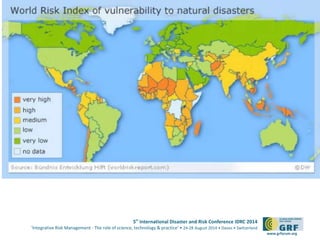
Developing a Continental Potential 
Conflict Landscape for Establishing 
5th International Disaster and Risk Conference IDRC 2014 
‘Integrative Risk Management - The role of science, technology & practice‘ • 24-28 August 2014 • Davos • Switzerland 
www.grforum.org 
Response Context: 
Case Study Africa 
Timothy L. Haithcoat 
Geographic Resources Center, University of Missouri, USA 
Erik Mueller 
Department of Geography, University of Missouri, USA
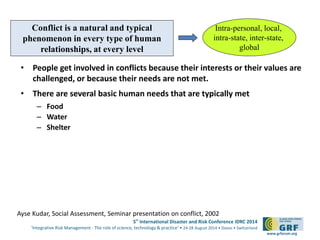
Conflict is a natural and typical 
phenomenon in every type of human 
relationships, at every level 
• People get involved in conflicts because their interests or their values are 
5th International Disaster and Risk Conference IDRC 2014 
‘Integrative Risk Management - The role of science, technology & practice‘ • 24-28 August 2014 • Davos • Switzerland 
www.grforum.org 
challenged, or because their needs are not met. 
• There are several basic human needs that are typically met 
– Food 
– Water 
– Shelter 
Intra-personal, local, 
intra-state, inter-state, 
global 
Ayse Kudar, Social Assessment, Seminar presentation on conflict, 2002
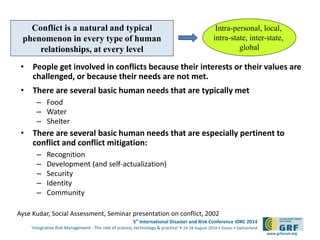
Conflict is a natural and typical 
phenomenon in every type of human 
relationships, at every level 
• People get involved in conflicts because their interests or their values are 
5th International Disaster and Risk Conference IDRC 2014 
‘Integrative Risk Management - The role of science, technology & practice‘ • 24-28 August 2014 • Davos • Switzerland 
www.grforum.org 
challenged, or because their needs are not met. 
• There are several basic human needs that are typically met 
– Food 
– Water 
– Shelter 
• There are several basic human needs that are especially pertinent to 
conflict and conflict mitigation: 
– Recognition 
– Development (and self-actualization) 
– Security 
– Identity 
– Community 
Intra-personal, local, 
intra-state, inter-state, 
global 
Ayse Kudar, Social Assessment, Seminar presentation on conflict, 2002
5th International Disaster and Risk Conference IDRC 2014 
‘Integrative Risk Management - The role of science, technology & practice‘ • 24-28 August 2014 • Davos • Switzerland 
www.grforum.org 
Major Proposition of Conflict Theories 
• Society is not a system in equilibrium but a nebulous structure of 
imperfectly coordinated elements 
• Change and conflict are continuous and normal; inherent 
predispositions to change vary in scope, nature, intensity and 
degree 
• Every society, at every moment, experiences social conflict 
• Every element within a society contributes to its change 
• Every society rests on constrain of some of its members by others 
• Social universe is the setting within which the conflict of life are 
acted out 
Ayse Kudar, Social Assessment, Seminar presentation on conflict, 2002
5th International Disaster and Risk Conference IDRC 2014 
‘Integrative Risk Management - The role of science, technology & practice‘ • 24-28 August 2014 • Davos • Switzerland 
www.grforum.org 
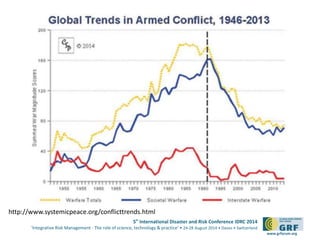
http://www.systemicpeace.org/conflicttrends.html
5th International Disaster and Risk Conference IDRC 2014 
‘Integrative Risk Management - The role of science, technology & practice‘ • 24-28 August 2014 • Davos • Switzerland 
www.grforum.org
5th International Disaster and Risk Conference IDRC 2014 
‘Integrative Risk Management - The role of science, technology & practice‘ • 24-28 August 2014 • Davos • Switzerland 
www.grforum.org 
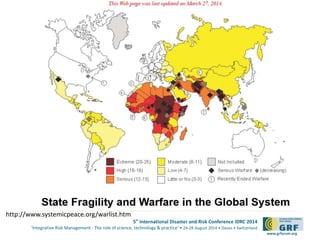
http://www.systemicpeace.org/warlist.htm
5th International Disaster and Risk Conference IDRC 2014 
‘Integrative Risk Management - The role of science, technology & practice‘ • 24-28 August 2014 • Davos • Switzerland 
www.grforum.org
5th International Disaster and Risk Conference IDRC 2014 
‘Integrative Risk Management - The role of science, technology & practice‘ • 24-28 August 2014 • Davos • Switzerland 
www.grforum.org 
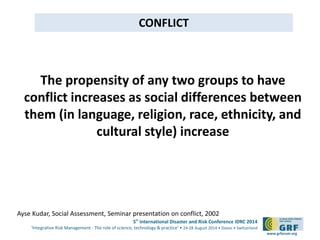
CONFLICT 
The propensity of any two groups to have 
conflict increases as social differences between 
them (in language, religion, race, ethnicity, and 
cultural style) increase 
Ayse Kudar, Social Assessment, Seminar presentation on conflict, 2002
5th International Disaster and Risk Conference IDRC 2014 
‘Integrative Risk Management - The role of science, technology & practice‘ • 24-28 August 2014 • Davos • Switzerland 
www.grforum.org 
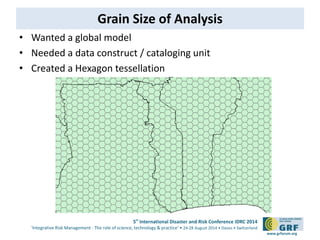
Grain Size of Analysis 
• Wanted a global model 
• Needed a data construct / cataloging unit 
• Created a Hexagon tessellation
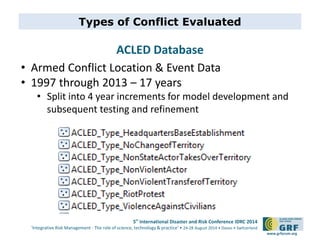
Types of Conflict Evaluated 
5th International Disaster and Risk Conference IDRC 2014 
‘Integrative Risk Management - The role of science, technology & practice‘ • 24-28 August 2014 • Davos • Switzerland 
www.grforum.org 
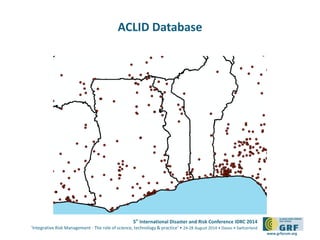
ACLED Database 
• Armed Conflict Location & Event Data 
• 1997 through 2013 – 17 years 
• Split into 4 year increments for model development and 
subsequent testing and refinement
5th International Disaster and Risk Conference IDRC 2014 
‘Integrative Risk Management - The role of science, technology & practice‘ • 24-28 August 2014 • Davos • Switzerland 
www.grforum.org 
VIOLENCE 
• Direct violence --killing and beating--happens in 
interpersonal and inter-group situation 
• Structural violence--poverty, hunger, repression and social 
alienation--is associated with uneven life chances and is 
built into most society 
– Oppression and discrimination are symptoms of structural 
violence 
– Absence of direct violence is no guarantee for the lack of 
structural violence; not all forms of structural violence lead to 
direct violence 
Ayse Kudar, Social Assessment, Seminar presentation on conflict, 2002
5th International Disaster and Risk Conference IDRC 2014 
‘Integrative Risk Management - The role of science, technology & practice‘ • 24-28 August 2014 • Davos • Switzerland 
www.grforum.org 
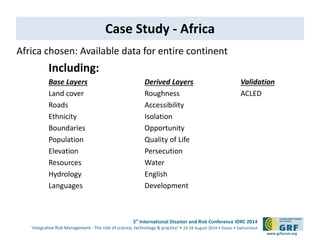
Case Study - Africa 
Africa chosen: Available data for entire continent 
Including: 
Base Layers Derived Layers Validation 
Land cover Roughness ACLED 
Roads Accessibility 
Ethnicity Isolation 
Boundaries Opportunity 
Population Quality of Life 
Elevation Persecution 
Resources Water 
Hydrology English 
Languages Development
5th International Disaster and Risk Conference IDRC 2014 
‘Integrative Risk Management - The role of science, technology & practice‘ • 24-28 August 2014 • Davos • Switzerland 
www.grforum.org 
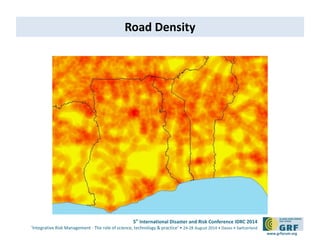
Road Density
5th International Disaster and Risk Conference IDRC 2014 
‘Integrative Risk Management - The role of science, technology & practice‘ • 24-28 August 2014 • Davos • Switzerland 
www.grforum.org 
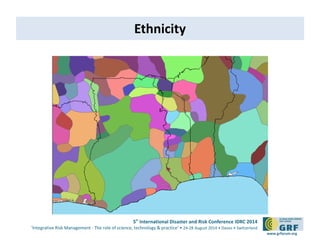
Ethnicity
5th International Disaster and Risk Conference IDRC 2014 
‘Integrative Risk Management - The role of science, technology & practice‘ • 24-28 August 2014 • Davos • Switzerland 
www.grforum.org 
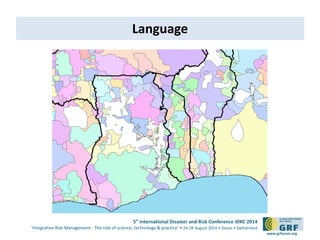
Language
5th International Disaster and Risk Conference IDRC 2014 
‘Integrative Risk Management - The role of science, technology & practice‘ • 24-28 August 2014 • Davos • Switzerland 
www.grforum.org 
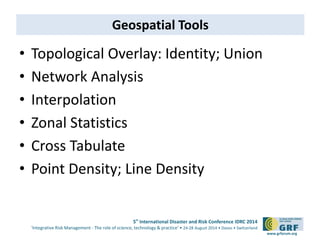
Geospatial Tools 
• Topological Overlay: Identity; Union 
• Network Analysis 
• Interpolation 
• Zonal Statistics 
• Cross Tabulate 
• Point Density; Line Density
5th International Disaster and Risk Conference IDRC 2014 
…… 
‘Integrative Risk Management - The role of science, technology & practice‘ • 24-28 August 2014 • Davos • Switzerland 
www.grforum.org 
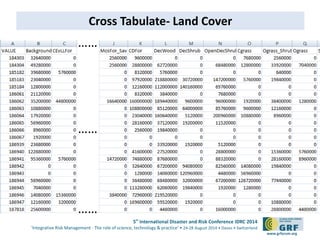
Cross Tabulate- Land Cover 
…… 
……
5th International Disaster and Risk Conference IDRC 2014 
‘Integrative Risk Management - The role of science, technology & practice‘ • 24-28 August 2014 • Davos • Switzerland 
www.grforum.org 
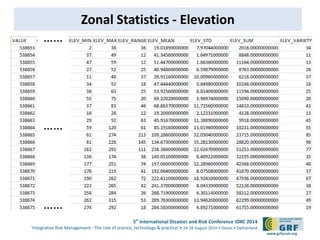
Zonal Statistics - Elevation 
…… 
…… 
……
5th International Disaster and Risk Conference IDRC 2014 
‘Integrative Risk Management - The role of science, technology & practice‘ • 24-28 August 2014 • Davos • Switzerland 
www.grforum.org 
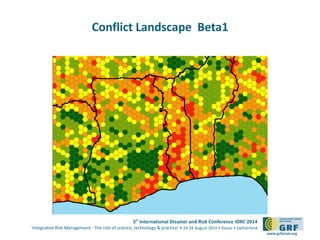
Conflict Landscape Beta1
5th International Disaster and Risk Conference IDRC 2014 
‘Integrative Risk Management - The role of science, technology & practice‘ • 24-28 August 2014 • Davos • Switzerland 
www.grforum.org 
ACLID Database
5th International Disaster and Risk Conference IDRC 2014 
‘Integrative Risk Management - The role of science, technology & practice‘ • 24-28 August 2014 • Davos • Switzerland 
www.grforum.org 
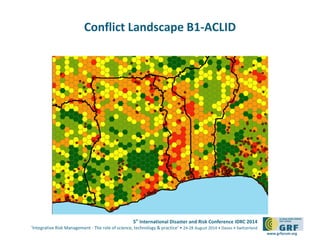
Conflict Landscape B1-ACLID
Added value for the Post 2015 Framework for 
5th International Disaster and Risk Conference IDRC 2014 
‘Integrative Risk Management - The role of science, technology & practice‘ • 24-28 August 2014 • Davos • Switzerland 
www.grforum.org 
Disaster Risk Reduction 
Research Gaps: 
1) The need to initiate ongoing monitoring of the socio-cultural 
parameters / dynamics to track areas of conflict concern. 
2) The development of an understanding of the socio-cultural 
context of the risk both in terms of the geophysical but also 
the geopolitical 
3) The development, integration, and use of geospatial models 
and geostatistics to support decision making. 
– In developing this understanding it is critical to gain perspective and 
insight on model interactions through sensitivity analysis and the 
understanding of error and its possible cascading effects.
Added value for the Post 2015 Framework for 
5th International Disaster and Risk Conference IDRC 2014 
‘Integrative Risk Management - The role of science, technology & practice‘ • 24-28 August 2014 • Davos • Switzerland 
www.grforum.org 
Disaster Risk Reduction 
Education & Training: 
It is critically important to systematically integrate: 
1. Geospatial modelling and visualization within the education, 
training and exercising environments to strengthen their 
analytical capacity 
2. Conflict and socio-cultural analysis into disaster management 
and risk assessment 
This will develop the skills and understanding of both geospatial and 
socio-cultural data and its proper use to support decisions. This includes 
the visualization of confidence in the resulting decision based on the 
inputs used.
Added value for the Post 2015 Framework for 
5th International Disaster and Risk Conference IDRC 2014 
‘Integrative Risk Management - The role of science, technology & practice‘ • 24-28 August 2014 • Davos • Switzerland 
www.grforum.org 
Disaster Risk Reduction 
Implementation & Training: 
• Consideration of conflict reduction strategies for 
countries with a high propensity for conflict 
• Give water conflicts renewed operational focus 
• Complement analyses of “vulnerable groups” with 
“conflict groups”; introduce less static concepts to social 
group analyses to include social, cultural, ethnic and 
other cohesive groups 
• Re-evaluate social dynamics of “border” issues and 
ethnicity 
• Re-assess role of cultural factors, especially religion, in 
plans and implementations
Added value for the Post 2015 Framework for 
5th International Disaster and Risk Conference IDRC 2014 
‘Integrative Risk Management - The role of science, technology & practice‘ • 24-28 August 2014 • Davos • Switzerland 
www.grforum.org 
Disaster Risk Reduction 
Policy: 
In developing a more complete understanding of both the 
physical and socio-cultural context a policy dialogue can 
occur. 
A statement can be developed to ensure that the socio-cultural 
context (and its associated cascading ramifications) 
are incorporated into the initial disaster response, 
mitigation, and rebuilding plans so that stability (resiliency) 
can be truly achieved and maintained.
5th International Disaster and Risk Conference IDRC 2014 
‘Integrative Risk Management - The role of science, technology & practice‘ • 24-28 August 2014 • Davos • Switzerland 
www.grforum.org 
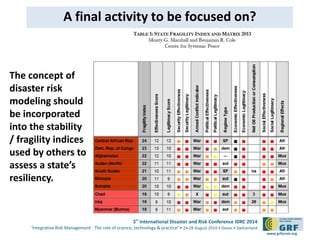
A final activity to be focused on? 
The concept of 
disaster risk 
modeling should 
be incorporated 
into the stability 
/ fragility indices 
used by others to 
assess a state’s 
resiliency.

HAITHCOAT-Developing a continental potential conflict landscape-ID1553-IDRC2014_b

  • 1.
    Developing a ContinentalPotential Conflict Landscape for Establishing 5th International Disaster and Risk Conference IDRC 2014 ‘Integrative Risk Management - The role of science, technology & practice‘ • 24-28 August 2014 • Davos • Switzerland www.grforum.org Response Context: Case Study Africa Timothy L. Haithcoat Geographic Resources Center, University of Missouri, USA Erik Mueller Department of Geography, University of Missouri, USA
  • 2.
    Conflict is anatural and typical phenomenon in every type of human relationships, at every level • People get involved in conflicts because their interests or their values are 5th International Disaster and Risk Conference IDRC 2014 ‘Integrative Risk Management - The role of science, technology & practice‘ • 24-28 August 2014 • Davos • Switzerland www.grforum.org challenged, or because their needs are not met. • There are several basic human needs that are typically met – Food – Water – Shelter Intra-personal, local, intra-state, inter-state, global Ayse Kudar, Social Assessment, Seminar presentation on conflict, 2002
  • 3.
    Conflict is anatural and typical phenomenon in every type of human relationships, at every level • People get involved in conflicts because their interests or their values are 5th International Disaster and Risk Conference IDRC 2014 ‘Integrative Risk Management - The role of science, technology & practice‘ • 24-28 August 2014 • Davos • Switzerland www.grforum.org challenged, or because their needs are not met. • There are several basic human needs that are typically met – Food – Water – Shelter • There are several basic human needs that are especially pertinent to conflict and conflict mitigation: – Recognition – Development (and self-actualization) – Security – Identity – Community Intra-personal, local, intra-state, inter-state, global Ayse Kudar, Social Assessment, Seminar presentation on conflict, 2002
  • 4.
    5th International Disasterand Risk Conference IDRC 2014 ‘Integrative Risk Management - The role of science, technology & practice‘ • 24-28 August 2014 • Davos • Switzerland www.grforum.org Major Proposition of Conflict Theories • Society is not a system in equilibrium but a nebulous structure of imperfectly coordinated elements • Change and conflict are continuous and normal; inherent predispositions to change vary in scope, nature, intensity and degree • Every society, at every moment, experiences social conflict • Every element within a society contributes to its change • Every society rests on constrain of some of its members by others • Social universe is the setting within which the conflict of life are acted out Ayse Kudar, Social Assessment, Seminar presentation on conflict, 2002
  • 5.
    5th International Disasterand Risk Conference IDRC 2014 ‘Integrative Risk Management - The role of science, technology & practice‘ • 24-28 August 2014 • Davos • Switzerland www.grforum.org http://www.systemicpeace.org/conflicttrends.html
  • 6.
    5th International Disasterand Risk Conference IDRC 2014 ‘Integrative Risk Management - The role of science, technology & practice‘ • 24-28 August 2014 • Davos • Switzerland www.grforum.org
  • 7.
    5th International Disasterand Risk Conference IDRC 2014 ‘Integrative Risk Management - The role of science, technology & practice‘ • 24-28 August 2014 • Davos • Switzerland www.grforum.org http://www.systemicpeace.org/warlist.htm
  • 8.
    5th International Disasterand Risk Conference IDRC 2014 ‘Integrative Risk Management - The role of science, technology & practice‘ • 24-28 August 2014 • Davos • Switzerland www.grforum.org
  • 9.
    5th International Disasterand Risk Conference IDRC 2014 ‘Integrative Risk Management - The role of science, technology & practice‘ • 24-28 August 2014 • Davos • Switzerland www.grforum.org CONFLICT The propensity of any two groups to have conflict increases as social differences between them (in language, religion, race, ethnicity, and cultural style) increase Ayse Kudar, Social Assessment, Seminar presentation on conflict, 2002
  • 10.
    5th International Disasterand Risk Conference IDRC 2014 ‘Integrative Risk Management - The role of science, technology & practice‘ • 24-28 August 2014 • Davos • Switzerland www.grforum.org Grain Size of Analysis • Wanted a global model • Needed a data construct / cataloging unit • Created a Hexagon tessellation
  • 11.
    Types of ConflictEvaluated 5th International Disaster and Risk Conference IDRC 2014 ‘Integrative Risk Management - The role of science, technology & practice‘ • 24-28 August 2014 • Davos • Switzerland www.grforum.org ACLED Database • Armed Conflict Location & Event Data • 1997 through 2013 – 17 years • Split into 4 year increments for model development and subsequent testing and refinement
  • 12.
    5th International Disasterand Risk Conference IDRC 2014 ‘Integrative Risk Management - The role of science, technology & practice‘ • 24-28 August 2014 • Davos • Switzerland www.grforum.org VIOLENCE • Direct violence --killing and beating--happens in interpersonal and inter-group situation • Structural violence--poverty, hunger, repression and social alienation--is associated with uneven life chances and is built into most society – Oppression and discrimination are symptoms of structural violence – Absence of direct violence is no guarantee for the lack of structural violence; not all forms of structural violence lead to direct violence Ayse Kudar, Social Assessment, Seminar presentation on conflict, 2002
  • 13.
    5th International Disasterand Risk Conference IDRC 2014 ‘Integrative Risk Management - The role of science, technology & practice‘ • 24-28 August 2014 • Davos • Switzerland www.grforum.org Case Study - Africa Africa chosen: Available data for entire continent Including: Base Layers Derived Layers Validation Land cover Roughness ACLED Roads Accessibility Ethnicity Isolation Boundaries Opportunity Population Quality of Life Elevation Persecution Resources Water Hydrology English Languages Development
  • 14.
    5th International Disasterand Risk Conference IDRC 2014 ‘Integrative Risk Management - The role of science, technology & practice‘ • 24-28 August 2014 • Davos • Switzerland www.grforum.org Road Density
  • 15.
    5th International Disasterand Risk Conference IDRC 2014 ‘Integrative Risk Management - The role of science, technology & practice‘ • 24-28 August 2014 • Davos • Switzerland www.grforum.org Ethnicity
  • 16.
    5th International Disasterand Risk Conference IDRC 2014 ‘Integrative Risk Management - The role of science, technology & practice‘ • 24-28 August 2014 • Davos • Switzerland www.grforum.org Language
  • 17.
    5th International Disasterand Risk Conference IDRC 2014 ‘Integrative Risk Management - The role of science, technology & practice‘ • 24-28 August 2014 • Davos • Switzerland www.grforum.org Geospatial Tools • Topological Overlay: Identity; Union • Network Analysis • Interpolation • Zonal Statistics • Cross Tabulate • Point Density; Line Density
  • 18.
    5th International Disasterand Risk Conference IDRC 2014 …… ‘Integrative Risk Management - The role of science, technology & practice‘ • 24-28 August 2014 • Davos • Switzerland www.grforum.org Cross Tabulate- Land Cover …… ……
  • 19.
    5th International Disasterand Risk Conference IDRC 2014 ‘Integrative Risk Management - The role of science, technology & practice‘ • 24-28 August 2014 • Davos • Switzerland www.grforum.org Zonal Statistics - Elevation …… …… ……
  • 20.
    5th International Disasterand Risk Conference IDRC 2014 ‘Integrative Risk Management - The role of science, technology & practice‘ • 24-28 August 2014 • Davos • Switzerland www.grforum.org Conflict Landscape Beta1
  • 21.
    5th International Disasterand Risk Conference IDRC 2014 ‘Integrative Risk Management - The role of science, technology & practice‘ • 24-28 August 2014 • Davos • Switzerland www.grforum.org ACLID Database
  • 22.
    5th International Disasterand Risk Conference IDRC 2014 ‘Integrative Risk Management - The role of science, technology & practice‘ • 24-28 August 2014 • Davos • Switzerland www.grforum.org Conflict Landscape B1-ACLID
  • 23.
    Added value forthe Post 2015 Framework for 5th International Disaster and Risk Conference IDRC 2014 ‘Integrative Risk Management - The role of science, technology & practice‘ • 24-28 August 2014 • Davos • Switzerland www.grforum.org Disaster Risk Reduction Research Gaps: 1) The need to initiate ongoing monitoring of the socio-cultural parameters / dynamics to track areas of conflict concern. 2) The development of an understanding of the socio-cultural context of the risk both in terms of the geophysical but also the geopolitical 3) The development, integration, and use of geospatial models and geostatistics to support decision making. – In developing this understanding it is critical to gain perspective and insight on model interactions through sensitivity analysis and the understanding of error and its possible cascading effects.
  • 24.
    Added value forthe Post 2015 Framework for 5th International Disaster and Risk Conference IDRC 2014 ‘Integrative Risk Management - The role of science, technology & practice‘ • 24-28 August 2014 • Davos • Switzerland www.grforum.org Disaster Risk Reduction Education & Training: It is critically important to systematically integrate: 1. Geospatial modelling and visualization within the education, training and exercising environments to strengthen their analytical capacity 2. Conflict and socio-cultural analysis into disaster management and risk assessment This will develop the skills and understanding of both geospatial and socio-cultural data and its proper use to support decisions. This includes the visualization of confidence in the resulting decision based on the inputs used.
  • 25.
    Added value forthe Post 2015 Framework for 5th International Disaster and Risk Conference IDRC 2014 ‘Integrative Risk Management - The role of science, technology & practice‘ • 24-28 August 2014 • Davos • Switzerland www.grforum.org Disaster Risk Reduction Implementation & Training: • Consideration of conflict reduction strategies for countries with a high propensity for conflict • Give water conflicts renewed operational focus • Complement analyses of “vulnerable groups” with “conflict groups”; introduce less static concepts to social group analyses to include social, cultural, ethnic and other cohesive groups • Re-evaluate social dynamics of “border” issues and ethnicity • Re-assess role of cultural factors, especially religion, in plans and implementations
  • 26.
    Added value forthe Post 2015 Framework for 5th International Disaster and Risk Conference IDRC 2014 ‘Integrative Risk Management - The role of science, technology & practice‘ • 24-28 August 2014 • Davos • Switzerland www.grforum.org Disaster Risk Reduction Policy: In developing a more complete understanding of both the physical and socio-cultural context a policy dialogue can occur. A statement can be developed to ensure that the socio-cultural context (and its associated cascading ramifications) are incorporated into the initial disaster response, mitigation, and rebuilding plans so that stability (resiliency) can be truly achieved and maintained.
  • 27.
    5th International Disasterand Risk Conference IDRC 2014 ‘Integrative Risk Management - The role of science, technology & practice‘ • 24-28 August 2014 • Davos • Switzerland www.grforum.org A final activity to be focused on? The concept of disaster risk modeling should be incorporated into the stability / fragility indices used by others to assess a state’s resiliency.