NEUROTRANSMITTERS
&
NEUROMODULATORS
By
Dr. Faraza Javaid
Neurotransmitter is a chemical
substance that acts as a mediator for the
transmission of nerve impulse from one
neuron to another neuron through a
synapse.
Neurotransmitter
CRITERIA FOR
NEUROTRANSMITTER
1.It must be found in a neuron
2.It must be produced by a neuron
3.It must be released by a neuron
4.After release, it must act on a target
area and produce some biological
effect
5.After the action, it must be
inactivated
CLASSIFICATION OF
NEUROTRANSMITTERS
 DEPENDING UPON CHEMICAL
NATURE
 DEPENDING UPON FUNCTION
DEPENDING UPON
CHEMICAL NATURE
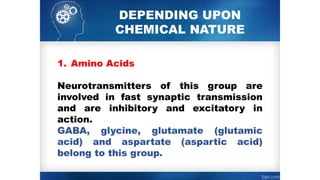
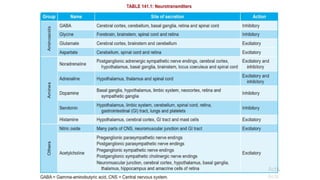
1. Amino Acids
Neurotransmitters of this group are
involved in fast synaptic transmission
and are inhibitory and excitatory in
action.
GABA, glycine, glutamate (glutamic
acid) and aspartate (aspartic acid)
belong to this group.
DEPENDING UPON
CHEMICAL NATURE
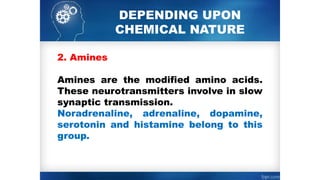
2. Amines
Amines are the modified amino acids.
These neurotransmitters involve in slow
synaptic transmission.
Noradrenaline, adrenaline, dopamine,
serotonin and histamine belong to this
group.
DEPENDING UPON
CHEMICAL NATURE
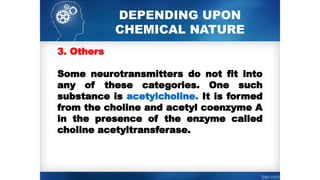
3. Others
Some neurotransmitters do not fit into
any of these categories. One such
substance is acetylcholine. It is formed
from the choline and acetyl coenzyme A
in the presence of the enzyme called
choline acetyltransferase.
DEPENDING UPON
FUNCTION
1. Excitatory neurotransmitters
2. Inhibitory neurotransmitters
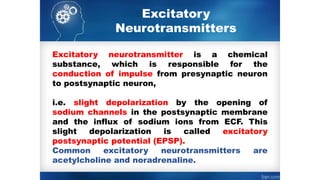
Excitatory neurotransmitter is a chemical
substance, which is responsible for the
conduction of impulse from presynaptic neuron
to postsynaptic neuron,
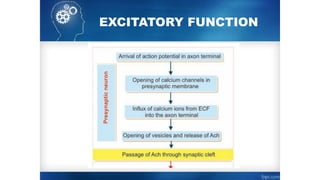
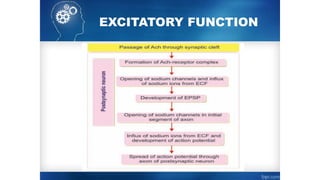
i.e. slight depolarization by the opening of
sodium channels in the postsynaptic membrane
and the influx of sodium ions from ECF. This
slight depolarization is called excitatory
postsynaptic potential (EPSP).
Common excitatory neurotransmitters are
acetylcholine and noradrenaline.
Excitatory
Neurotransmitters
EXCITATORY FUNCTION
EXCITATORY FUNCTION
Inhibitory
Neurotransmitters
Inhibitory neurotransmitter is a chemical
substance, which inhibits the conduction of
impulse from the presynaptic neuron to the
postsynaptic neuron.
it causes opening of potassium channels in
the postsynaptic membrane and efflux of
potassium ions. This leads to
hyperpolarization, which is called the
inhibitory postsynaptic potential (IPSP).
Common inhibitory neurotransmitters are
gamma-aminobutyric acid (GABA) and
dopamine.
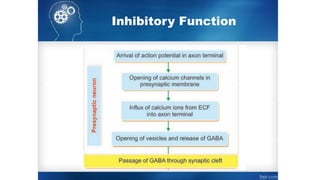
Inhibitory Function
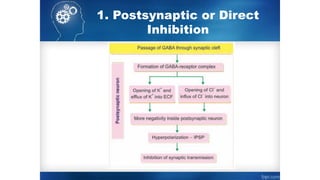
1. Postsynaptic or Direct
Inhibition
ACETYLCHOLINE
 Acetylcholine is a cholinergic
neurotransmitter.
 It possesses excitatory function.
 It produces the excitatory function by
opening the ligand-gated sodium
channels.
ACETYLCHOLINE
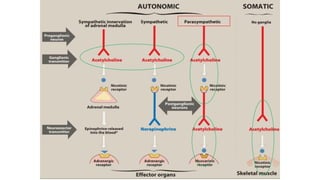
Source
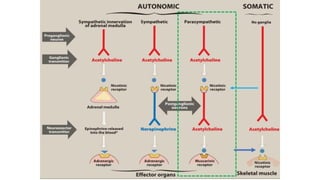
It is released by the following nerve endings:
1. Preganglionic parasympathetic nerve
2. Postganglionic parasympathetic nerve
3. Preganglionic sympathetic nerve
4. Postganglionic sympathetic cholinergic
nerves
5. Neuromuscular junction
6. Many regions of brain
ACETYLCHOLINE
Synthesis
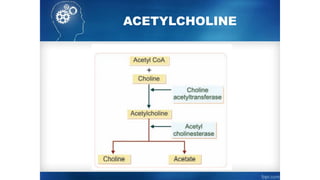
 Ach is synthesized in the cholinergic nerve
endings. Synthesis takes place in axoplasm
and Ach is stored in the vesicles. It is
synthesized from acetyl coenzyme A (acetyl
CoA). It combines with choline in the
presence of the enzyme choline
acetyltransferase to form Ach.
 Within one millisecond after the release
from the vesicles, it is hydrolyzed into
acetate and choline by the enzyme
acetylcholinesterase.
ACETYLCHOLINE
ACETYLCHOLINE
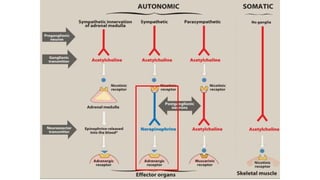
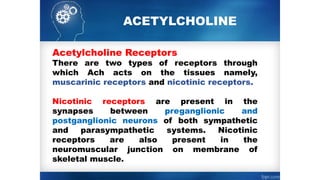
Acetylcholine Receptors
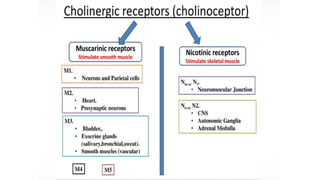
There are two types of receptors through
which Ach acts on the tissues namely,
muscarinic receptors and nicotinic receptors.
Nicotinic receptors are present in the
synapses between preganglionic and
postganglionic neurons of both sympathetic
and parasympathetic systems. Nicotinic
receptors are also present in the
neuromuscular junction on membrane of
skeletal muscle.
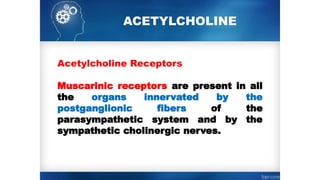
ACETYLCHOLINE
Acetylcholine Receptors
Muscarinic receptors are present in all
the organs innervated by the
postganglionic fibers of the
parasympathetic system and by the
sympathetic cholinergic nerves.
NORADRENALINE
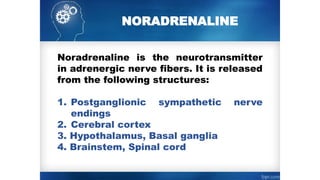
Noradrenaline is the neurotransmitter
in adrenergic nerve fibers. It is released
from the following structures:
1. Postganglionic sympathetic nerve
endings
2. Cerebral cortex
3. Hypothalamus, Basal ganglia
4. Brainstem, Spinal cord
DOPAMINE
Dopamine is secreted by nerve endings
in the following areas:
1. Basal ganglia
2. Hypothalamus
3. Limbic system
Dopamine possesses inhibitory action.
SEROTONIN
 Serotonin is otherwise known as 5­
hydroxytryptamine (5-HT).
 It is synthesized from tryptophan by
hydroxylation and decarboxylation.
 Large amount of serotonin (90%) is
found in enterochromatin cells of GI
tract.
 Small amount is found in platelets and
nervous system.
GAMMA­
AMINOBUTYRIC
ACID
Gamma-aminobutyric acid (GABA) is an
inhibitory neuro transmitter in synapses
particularly in CNS. It is responsible for
presynaptic inhibition. It is secreted by nerve
endings in the following structures:
1. Cerebral cortex
2. Cerebellum
3. Basal ganglia
4. Spinal cord
GABA causes synaptic inhibition by opening
potassium channels and chloride channels.
SUBSTANCE P
 Substance P is secreted by the nerve endings
of pain pathway in spinal cord.
 It is also found in many peripheral nerves,
different parts of brain particularly
hypothalamus, retina and intestine.
 It mediates pain sensation. It is a potent
vasodilator in CNS.
 It is responsible for regulation of anxiety,
stress, mood disorders, neurotoxicity, nausea
and vomiting.
NITRIC OXIDE
 Nitric oxide (NO) is a neurotransmitter in
the CNS.
 It is also the important neurotransmitter
in the neuromuscular junctions between
the inhibitory motor fibers of intrinsic
nerve plexus and the smooth muscle
fibers of GI tract.
NITRIC OXIDE
 Nitric oxide acts as a mediator for the dilator
effect of Ach on small arteries. In the smooth
muscle fibers of arterioles, NO activates the
enzyme guanylyl cyclase, which in turn
causes formation of cyclic guanosine
monophosphate (cGMP) from GMP.
 The cGMP is a smooth muscle relaxant and it
causes dilatation of arterioles. Thus, NO
indirectly causes dilatation of arterioles.
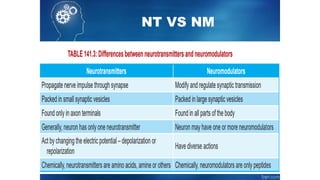
NEUROMODULATORS
 Neuromodulator is the chemical
messenger, which modifies and regulates
activities that take place during the
synaptic transmission.
 These peptides do not propagate nerve
impulses like neurotransmitters.
NT VS NM
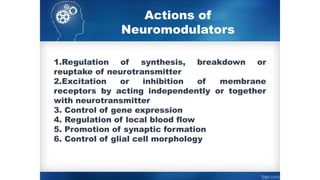
Actions of
Neuromodulators
1.Regulation of synthesis, breakdown or
reuptake of neurotransmitter
2.Excitation or inhibition of membrane
receptors by acting independently or together
with neurotransmitter
3. Control of gene expression
4. Regulation of local blood flow
5. Promotion of synaptic formation
6. Control of glial cell morphology
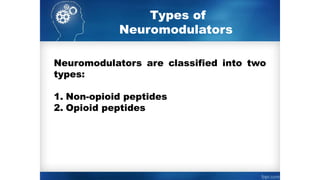
Types of
Neuromodulators
Neuromodulators are classified into two
types:
1. Non-opioid peptides
2. Opioid peptides
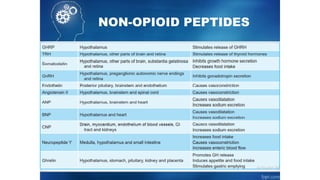
NON-­
OPIOID PEPTIDES
Non-opioid neuropeptides act by binding
with G protein coupled receptors.
These neuropeptides are also called non­
-
opioid neuromodulators.
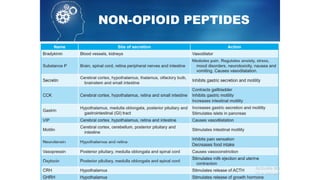
NON-­
OPIOID PEPTIDES
NON-­
OPIOID PEPTIDES
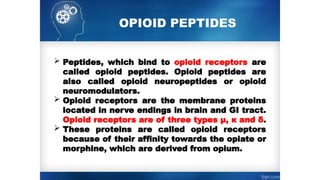
 Peptides, which bind to opioid receptors are
called opioid peptides. Opioid peptides are
also called opioid neuropeptides or opioid
neuromodulators.
 Opioid receptors are the membrane proteins
located in nerve endings in brain and GI tract.
Opioid receptors are of three types µ, к and δ.
 These proteins are called opioid receptors
because of their affinity towards the opiate or
morphine, which are derived from opium.
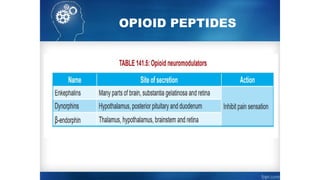
OPIOID PEPTIDES
OPIOID PEPTIDES
Thank You

NEUROTRANSMITTERS & NEUROMODULATORS.pptx

  • 1.
  • 2.
    Neurotransmitter is achemical substance that acts as a mediator for the transmission of nerve impulse from one neuron to another neuron through a synapse. Neurotransmitter
  • 3.
    CRITERIA FOR NEUROTRANSMITTER 1.It mustbe found in a neuron 2.It must be produced by a neuron 3.It must be released by a neuron 4.After release, it must act on a target area and produce some biological effect 5.After the action, it must be inactivated
  • 4.
    CLASSIFICATION OF NEUROTRANSMITTERS  DEPENDINGUPON CHEMICAL NATURE  DEPENDING UPON FUNCTION
  • 5.
    DEPENDING UPON CHEMICAL NATURE 1.Amino Acids Neurotransmitters of this group are involved in fast synaptic transmission and are inhibitory and excitatory in action. GABA, glycine, glutamate (glutamic acid) and aspartate (aspartic acid) belong to this group.
  • 6.
    DEPENDING UPON CHEMICAL NATURE 2.Amines Amines are the modified amino acids. These neurotransmitters involve in slow synaptic transmission. Noradrenaline, adrenaline, dopamine, serotonin and histamine belong to this group.
  • 7.
    DEPENDING UPON CHEMICAL NATURE 3.Others Some neurotransmitters do not fit into any of these categories. One such substance is acetylcholine. It is formed from the choline and acetyl coenzyme A in the presence of the enzyme called choline acetyltransferase.
  • 8.
    DEPENDING UPON FUNCTION 1. Excitatoryneurotransmitters 2. Inhibitory neurotransmitters
  • 9.
    Excitatory neurotransmitter isa chemical substance, which is responsible for the conduction of impulse from presynaptic neuron to postsynaptic neuron, i.e. slight depolarization by the opening of sodium channels in the postsynaptic membrane and the influx of sodium ions from ECF. This slight depolarization is called excitatory postsynaptic potential (EPSP). Common excitatory neurotransmitters are acetylcholine and noradrenaline. Excitatory Neurotransmitters
  • 10.
  • 11.
  • 12.
    Inhibitory Neurotransmitters Inhibitory neurotransmitter isa chemical substance, which inhibits the conduction of impulse from the presynaptic neuron to the postsynaptic neuron. it causes opening of potassium channels in the postsynaptic membrane and efflux of potassium ions. This leads to hyperpolarization, which is called the inhibitory postsynaptic potential (IPSP). Common inhibitory neurotransmitters are gamma-aminobutyric acid (GABA) and dopamine.
  • 13.
  • 14.
    1. Postsynaptic orDirect Inhibition
  • 16.
    ACETYLCHOLINE  Acetylcholine isa cholinergic neurotransmitter.  It possesses excitatory function.  It produces the excitatory function by opening the ligand-gated sodium channels.
  • 17.
    ACETYLCHOLINE Source It is releasedby the following nerve endings: 1. Preganglionic parasympathetic nerve 2. Postganglionic parasympathetic nerve 3. Preganglionic sympathetic nerve 4. Postganglionic sympathetic cholinergic nerves 5. Neuromuscular junction 6. Many regions of brain
  • 19.
    ACETYLCHOLINE Synthesis  Ach issynthesized in the cholinergic nerve endings. Synthesis takes place in axoplasm and Ach is stored in the vesicles. It is synthesized from acetyl coenzyme A (acetyl CoA). It combines with choline in the presence of the enzyme choline acetyltransferase to form Ach.  Within one millisecond after the release from the vesicles, it is hydrolyzed into acetate and choline by the enzyme acetylcholinesterase.
  • 20.
  • 21.
    ACETYLCHOLINE Acetylcholine Receptors There aretwo types of receptors through which Ach acts on the tissues namely, muscarinic receptors and nicotinic receptors. Nicotinic receptors are present in the synapses between preganglionic and postganglionic neurons of both sympathetic and parasympathetic systems. Nicotinic receptors are also present in the neuromuscular junction on membrane of skeletal muscle.
  • 22.
    ACETYLCHOLINE Acetylcholine Receptors Muscarinic receptorsare present in all the organs innervated by the postganglionic fibers of the parasympathetic system and by the sympathetic cholinergic nerves.
  • 25.
    NORADRENALINE Noradrenaline is theneurotransmitter in adrenergic nerve fibers. It is released from the following structures: 1. Postganglionic sympathetic nerve endings 2. Cerebral cortex 3. Hypothalamus, Basal ganglia 4. Brainstem, Spinal cord
  • 27.
    DOPAMINE Dopamine is secretedby nerve endings in the following areas: 1. Basal ganglia 2. Hypothalamus 3. Limbic system Dopamine possesses inhibitory action.
  • 28.
    SEROTONIN  Serotonin isotherwise known as 5­ hydroxytryptamine (5-HT).  It is synthesized from tryptophan by hydroxylation and decarboxylation.  Large amount of serotonin (90%) is found in enterochromatin cells of GI tract.  Small amount is found in platelets and nervous system.
  • 29.
    GAMMA­ AMINOBUTYRIC ACID Gamma-aminobutyric acid (GABA)is an inhibitory neuro transmitter in synapses particularly in CNS. It is responsible for presynaptic inhibition. It is secreted by nerve endings in the following structures: 1. Cerebral cortex 2. Cerebellum 3. Basal ganglia 4. Spinal cord GABA causes synaptic inhibition by opening potassium channels and chloride channels.
  • 30.
    SUBSTANCE P  SubstanceP is secreted by the nerve endings of pain pathway in spinal cord.  It is also found in many peripheral nerves, different parts of brain particularly hypothalamus, retina and intestine.  It mediates pain sensation. It is a potent vasodilator in CNS.  It is responsible for regulation of anxiety, stress, mood disorders, neurotoxicity, nausea and vomiting.
  • 31.
    NITRIC OXIDE  Nitricoxide (NO) is a neurotransmitter in the CNS.  It is also the important neurotransmitter in the neuromuscular junctions between the inhibitory motor fibers of intrinsic nerve plexus and the smooth muscle fibers of GI tract.
  • 32.
    NITRIC OXIDE  Nitricoxide acts as a mediator for the dilator effect of Ach on small arteries. In the smooth muscle fibers of arterioles, NO activates the enzyme guanylyl cyclase, which in turn causes formation of cyclic guanosine monophosphate (cGMP) from GMP.  The cGMP is a smooth muscle relaxant and it causes dilatation of arterioles. Thus, NO indirectly causes dilatation of arterioles.
  • 33.
    NEUROMODULATORS  Neuromodulator isthe chemical messenger, which modifies and regulates activities that take place during the synaptic transmission.  These peptides do not propagate nerve impulses like neurotransmitters.
  • 34.
  • 35.
    Actions of Neuromodulators 1.Regulation ofsynthesis, breakdown or reuptake of neurotransmitter 2.Excitation or inhibition of membrane receptors by acting independently or together with neurotransmitter 3. Control of gene expression 4. Regulation of local blood flow 5. Promotion of synaptic formation 6. Control of glial cell morphology
  • 36.
    Types of Neuromodulators Neuromodulators areclassified into two types: 1. Non-opioid peptides 2. Opioid peptides
  • 37.
    NON-­ OPIOID PEPTIDES Non-opioid neuropeptidesact by binding with G protein coupled receptors. These neuropeptides are also called non­ - opioid neuromodulators.
  • 38.
  • 39.
  • 40.
     Peptides, whichbind to opioid receptors are called opioid peptides. Opioid peptides are also called opioid neuropeptides or opioid neuromodulators.  Opioid receptors are the membrane proteins located in nerve endings in brain and GI tract. Opioid receptors are of three types µ, к and δ.  These proteins are called opioid receptors because of their affinity towards the opiate or morphine, which are derived from opium. OPIOID PEPTIDES
  • 41.
  • 42.