Chemical and
Electrical Synapse
GUIDED BY- DR. JITENDRA SIR
CREATED BY- HEMANT SONI (127)
Outline
 Synapse
 Physiological classification of synapse
 Comparison between chemical and
electrical synapse
 Summary
Synapse
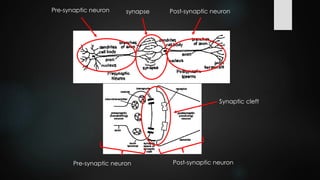
 A synapse is a junction between two
neurons where the axon (or some
other part) of one neuron (called as
pre-synaptic neuron) terminates on
the dendrite (or another part) of the
second neuron (called as post-
synaptic neuron).
Pre-synaptic neuron
Pre-synaptic neuron
Post-synaptic neuronsynapse
Post-synaptic neuron
Synaptic cleft
Physiological classification
1)Chemical Synapse
2)Electrical Synapse
3)Conjoint Synapse
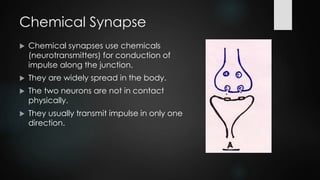
Chemical Synapse
 Chemical synapses use chemicals
(neurotransmitters) for conduction of
impulse along the junction.
 They are widely spread in the body.
 The two neurons are not in contact
physically.
 They usually transmit impulse in only one
direction.
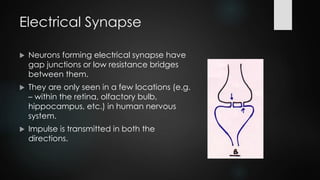
Electrical Synapse
 Neurons forming electrical synapse have
gap junctions or low resistance bridges
between them.
 They are only seen in a few locations (e.g.
– within the retina, olfactory bulb,
hippocampus, etc.) in human nervous
system.
 Impulse is transmitted in both the
directions.
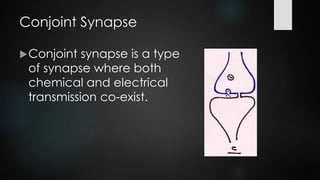
Conjoint Synapse
Conjoint synapse is a type
of synapse where both
chemical and electrical
transmission co-exist.
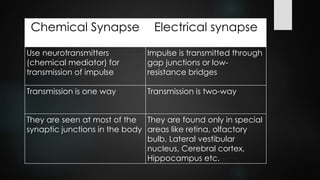
Chemical Synapse Electrical synapse
Use neurotransmitters
(chemical mediator) for
transmission of impulse
Impulse is transmitted through
gap junctions or low-
resistance bridges
Transmission is one way Transmission is two-way
They are seen at most of the
synaptic junctions in the body
They are found only in special
areas like retina, olfactory
bulb, Lateral vestibular
nucleus, Cerebral cortex,
Hippocampus etc.
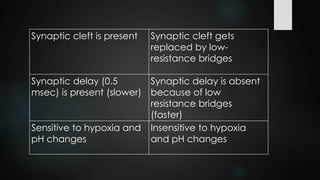
Synaptic cleft is present Synaptic cleft gets
replaced by low-
resistance bridges
Synaptic delay (0.5
msec) is present (slower)
Synaptic delay is absent
because of low
resistance bridges
(faster)
Sensitive to hypoxia and
pH changes
Insensitive to hypoxia
and pH changes
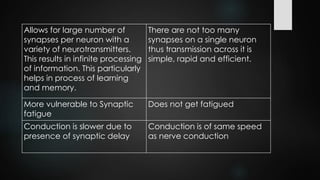
Allows for large number of
synapses per neuron with a
variety of neurotransmitters.
This results in infinite processing
of information. This particularly
helps in process of learning
and memory.
There are not too many
synapses on a single neuron
thus transmission across it is
simple, rapid and efficient.
More vulnerable to Synaptic
fatigue
Does not get fatigued
Conduction is slower due to
presence of synaptic delay
Conduction is of same speed
as nerve conduction
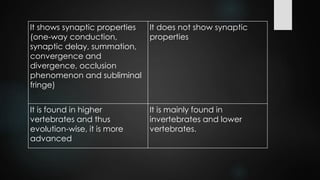
It shows synaptic properties
(one-way conduction,
synaptic delay, summation,
convergence and
divergence, occlusion
phenomenon and subliminal
fringe)
It does not show synaptic
properties
It is found in higher
vertebrates and thus
evolution-wise, it is more
advanced
It is mainly found in
invertebrates and lower
vertebrates.
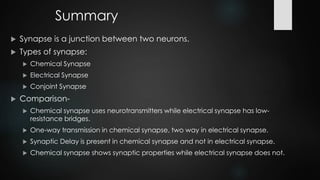
Summary
 Synapse is a junction between two neurons.
 Types of synapse:
 Chemical Synapse
 Electrical Synapse
 Conjoint Synapse
 Comparison-
 Chemical synapse uses neurotransmitters while electrical synapse has low-
resistance bridges.
 One-way transmission in chemical synapse, two way in electrical synapse.
 Synaptic Delay is present in chemical synapse and not in electrical synapse.
 Chemical synapse shows synaptic properties while electrical synapse does not.
Bibliography
 A. K. Jain
 Indu Khurana
Killing time is not a
murder, it is SUICIDE.
-Anonymous.

Chemical and electrical synapse

  • 1.
    Chemical and Electrical Synapse GUIDEDBY- DR. JITENDRA SIR CREATED BY- HEMANT SONI (127)
  • 2.
    Outline  Synapse  Physiologicalclassification of synapse  Comparison between chemical and electrical synapse  Summary
  • 3.
    Synapse  A synapseis a junction between two neurons where the axon (or some other part) of one neuron (called as pre-synaptic neuron) terminates on the dendrite (or another part) of the second neuron (called as post- synaptic neuron).
  • 4.
    Pre-synaptic neuron Pre-synaptic neuron Post-synapticneuronsynapse Post-synaptic neuron Synaptic cleft
  • 5.
  • 6.
    Chemical Synapse  Chemicalsynapses use chemicals (neurotransmitters) for conduction of impulse along the junction.  They are widely spread in the body.  The two neurons are not in contact physically.  They usually transmit impulse in only one direction.
  • 7.
    Electrical Synapse  Neuronsforming electrical synapse have gap junctions or low resistance bridges between them.  They are only seen in a few locations (e.g. – within the retina, olfactory bulb, hippocampus, etc.) in human nervous system.  Impulse is transmitted in both the directions.
  • 8.
    Conjoint Synapse Conjoint synapseis a type of synapse where both chemical and electrical transmission co-exist.
  • 9.
    Chemical Synapse Electricalsynapse Use neurotransmitters (chemical mediator) for transmission of impulse Impulse is transmitted through gap junctions or low- resistance bridges Transmission is one way Transmission is two-way They are seen at most of the synaptic junctions in the body They are found only in special areas like retina, olfactory bulb, Lateral vestibular nucleus, Cerebral cortex, Hippocampus etc.
  • 10.
    Synaptic cleft ispresent Synaptic cleft gets replaced by low- resistance bridges Synaptic delay (0.5 msec) is present (slower) Synaptic delay is absent because of low resistance bridges (faster) Sensitive to hypoxia and pH changes Insensitive to hypoxia and pH changes
  • 11.
    Allows for largenumber of synapses per neuron with a variety of neurotransmitters. This results in infinite processing of information. This particularly helps in process of learning and memory. There are not too many synapses on a single neuron thus transmission across it is simple, rapid and efficient. More vulnerable to Synaptic fatigue Does not get fatigued Conduction is slower due to presence of synaptic delay Conduction is of same speed as nerve conduction
  • 12.
    It shows synapticproperties (one-way conduction, synaptic delay, summation, convergence and divergence, occlusion phenomenon and subliminal fringe) It does not show synaptic properties It is found in higher vertebrates and thus evolution-wise, it is more advanced It is mainly found in invertebrates and lower vertebrates.
  • 13.
    Summary  Synapse isa junction between two neurons.  Types of synapse:  Chemical Synapse  Electrical Synapse  Conjoint Synapse  Comparison-  Chemical synapse uses neurotransmitters while electrical synapse has low- resistance bridges.  One-way transmission in chemical synapse, two way in electrical synapse.  Synaptic Delay is present in chemical synapse and not in electrical synapse.  Chemical synapse shows synaptic properties while electrical synapse does not.
  • 14.
    Bibliography  A. K.Jain  Indu Khurana
  • 17.
    Killing time isnot a murder, it is SUICIDE. -Anonymous.