ASSESSMENT: Neurologic ExaminationMa. Tosca Cybil A. Torres, RN, MAN
AN IMPORTANT ASPECT OF THE NEUROLOGIC ASSESSMENT IS THE HISTORY OF THE PRESENT ILLNESS
HEALTH HISTORYShould include: OnsetCharacterSeverityLocation Duration Frequency of s/sxAssociated complaintsPrecipitating and aggravating factorsProgression, remission, and exacerbationPresence and absence of similar symptoms among family membersReview of medical history History of falls or traumaUse of alcohol, medications and illicit drugs
Common Clinical ManifestationsPain (chronic or acute) SeizuresDizziness and vertigo Visual disturbances WeaknessAbnormal sensation
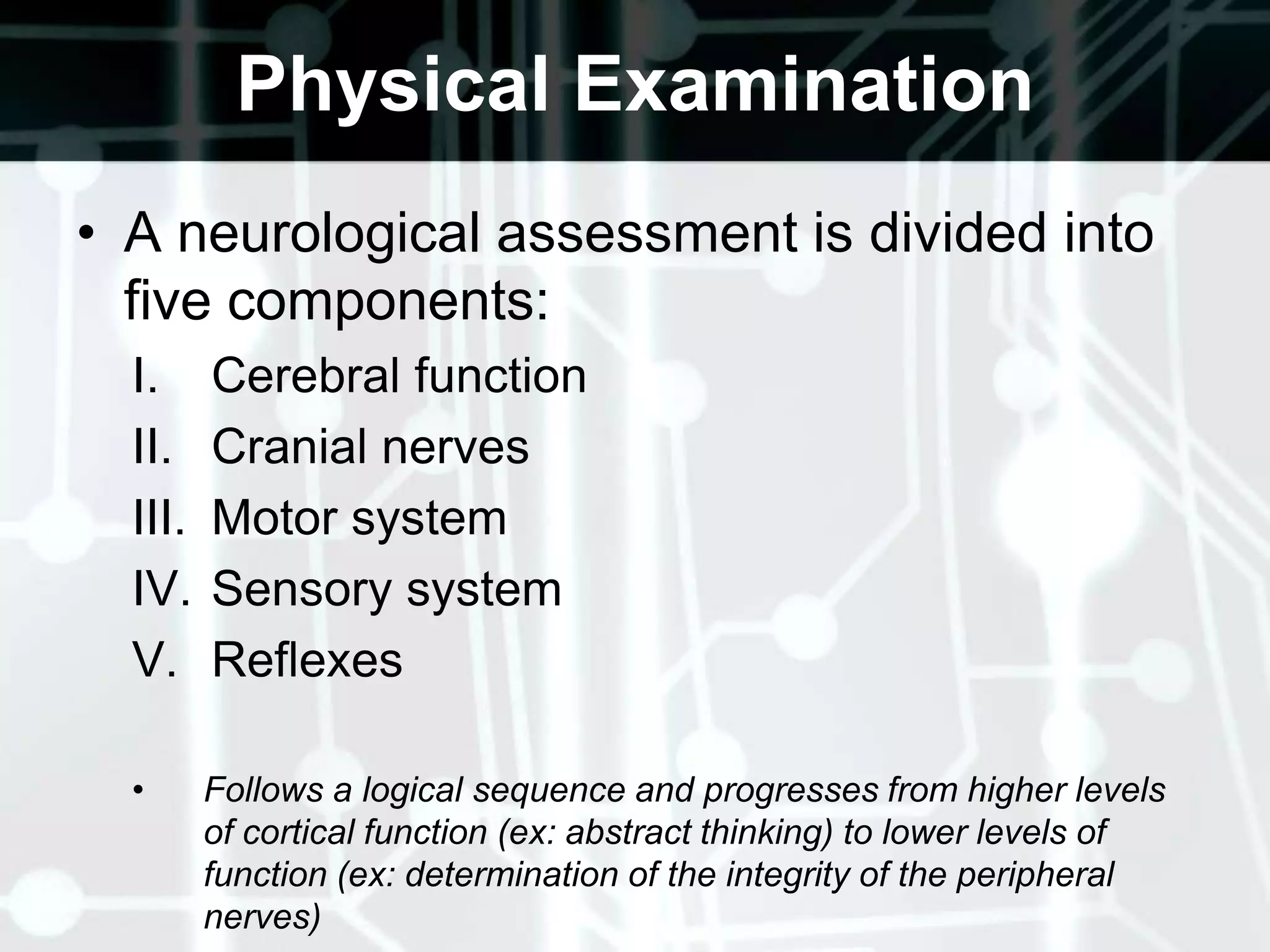
Physical Examination A neurological assessment is divided into five components: Cerebral function Cranial nervesMotor system Sensory system Reflexes Follows a logical sequence and progresses from higher levels of cortical function (ex: abstract thinking) to lower levels of function (ex: determination of the integrity of the peripheral nerves)
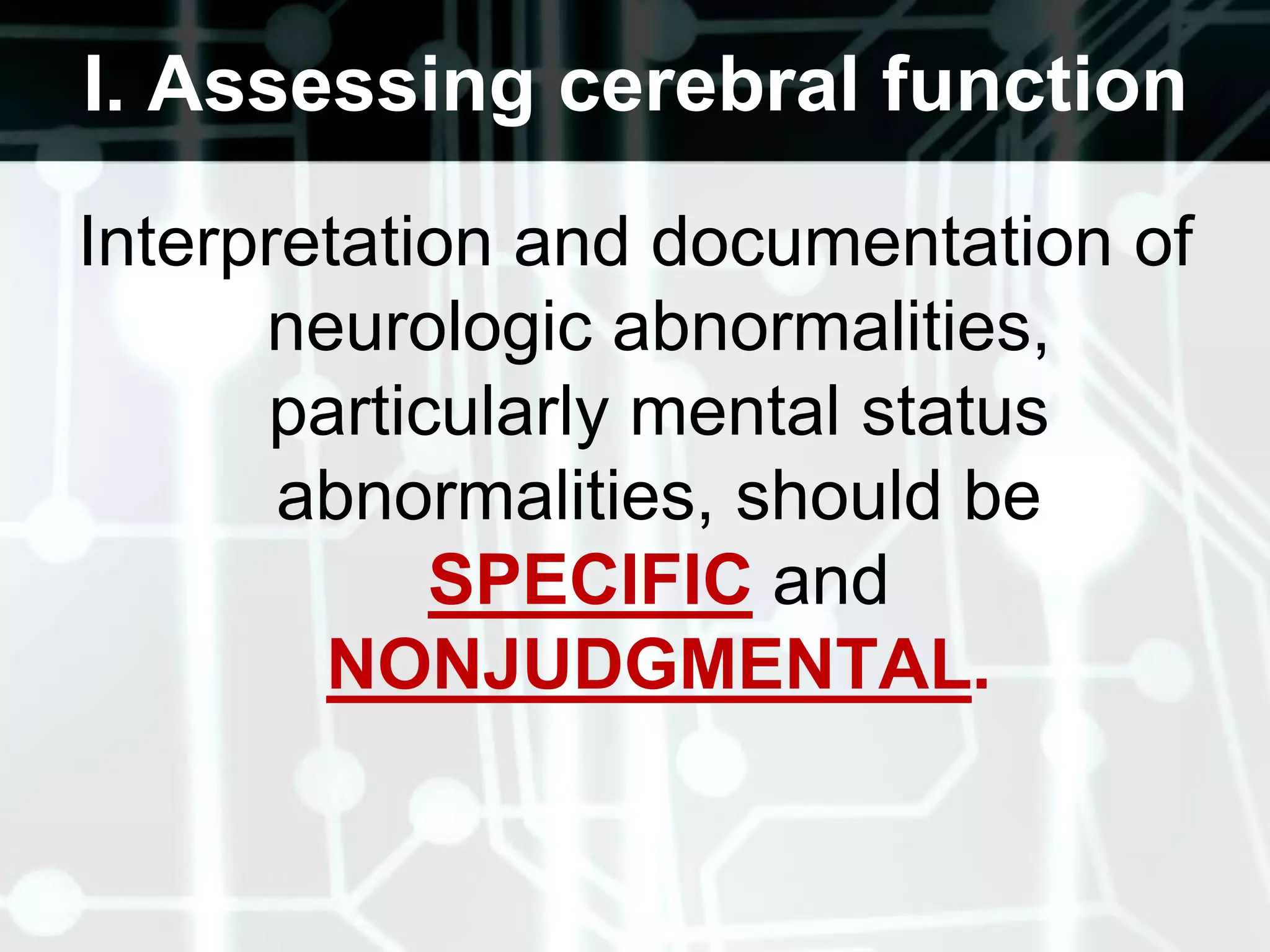
I. Assessing cerebral function Interpretation and documentation of neurologic abnormalities, particularly mental status abnormalities, should be SPECIFICandNONJUDGMENTAL.
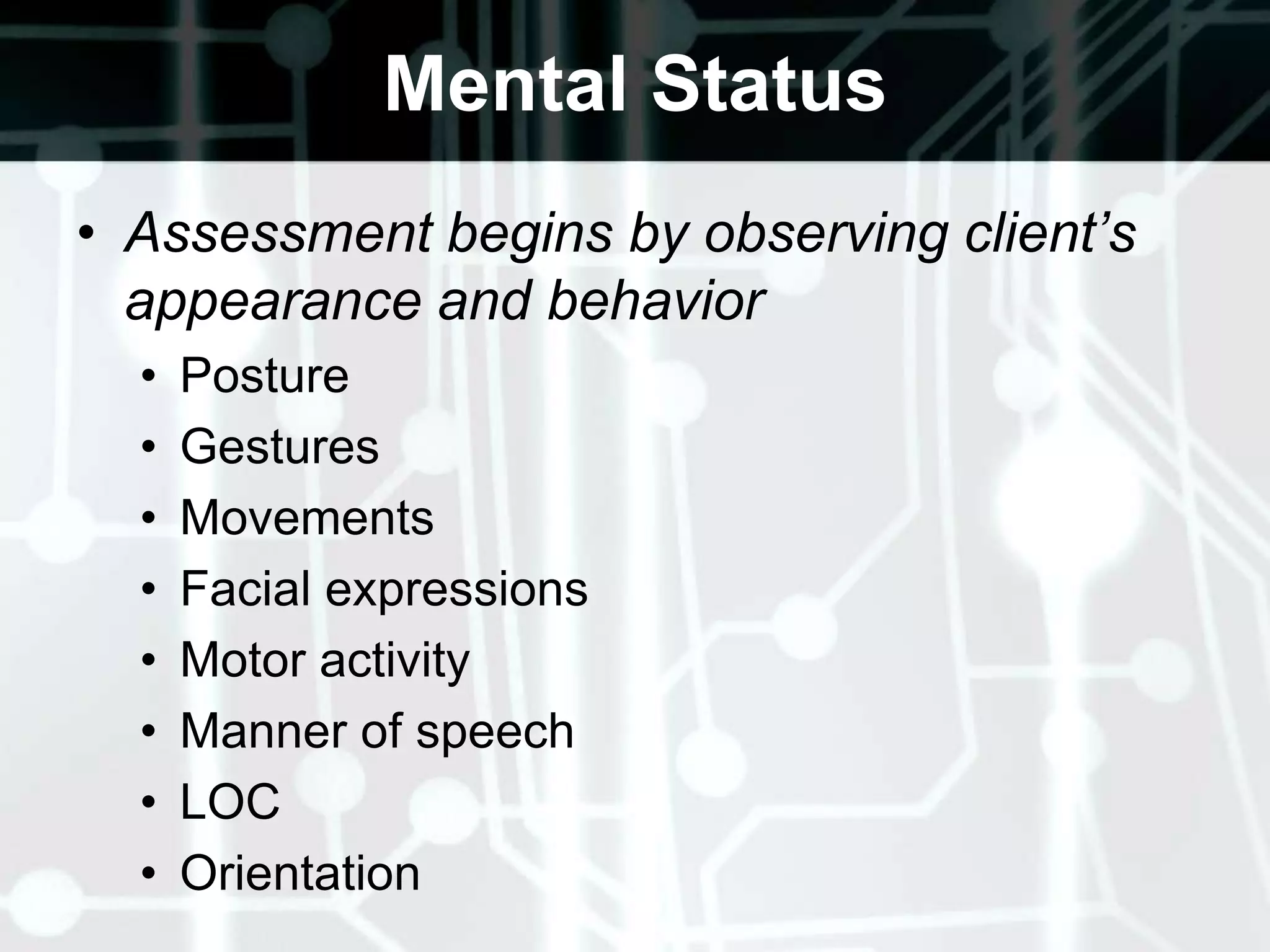
Mental StatusAssessment begins by observing client’s appearance and behaviorPostureGesturesMovementsFacial expressionsMotor activity Manner of speech LOCOrientation
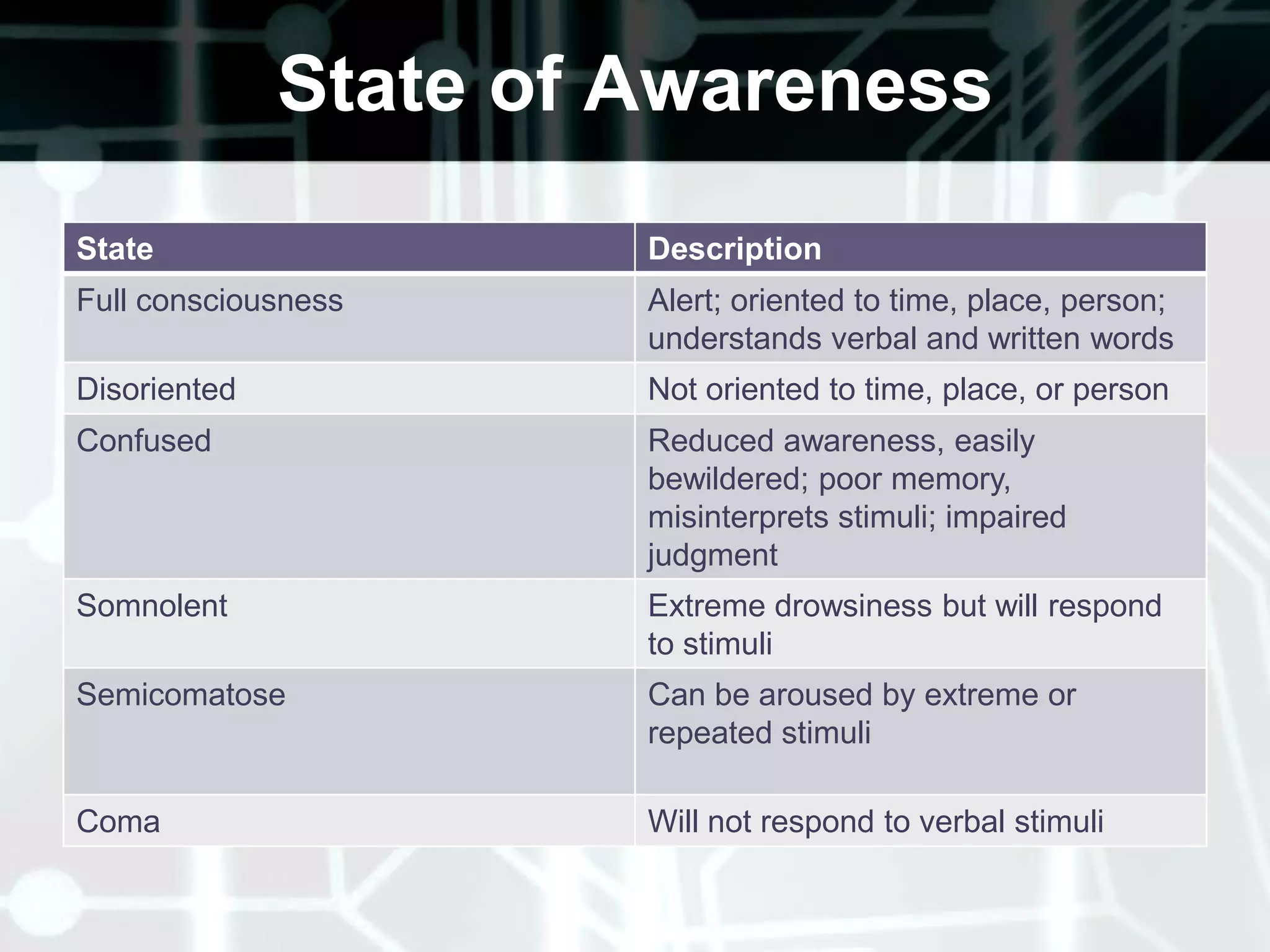
State of Awareness
Intellectual function Serial 7sInterpretation of well-known proverbs/idiomsCapacity to recognize similaritiesJudgement
Though Content Is the patient’s thoughts:
Spontaneous
Natural
Clear
Relevant
Coherent
Check: IllusionsHallucinationspreoccupations
Emotional Status Assess:Affect
Mood
Consistency of verbal communication to non verbal cues Perception Agnosia- inability to interpret or recognize objects seen through the special senses. Visual
Auditory
Tactile
Body parts and relationships Motor Ability Ask client to perform a skilled actSuccessful performance requires the ability to understand the activity desired and normal motor strength
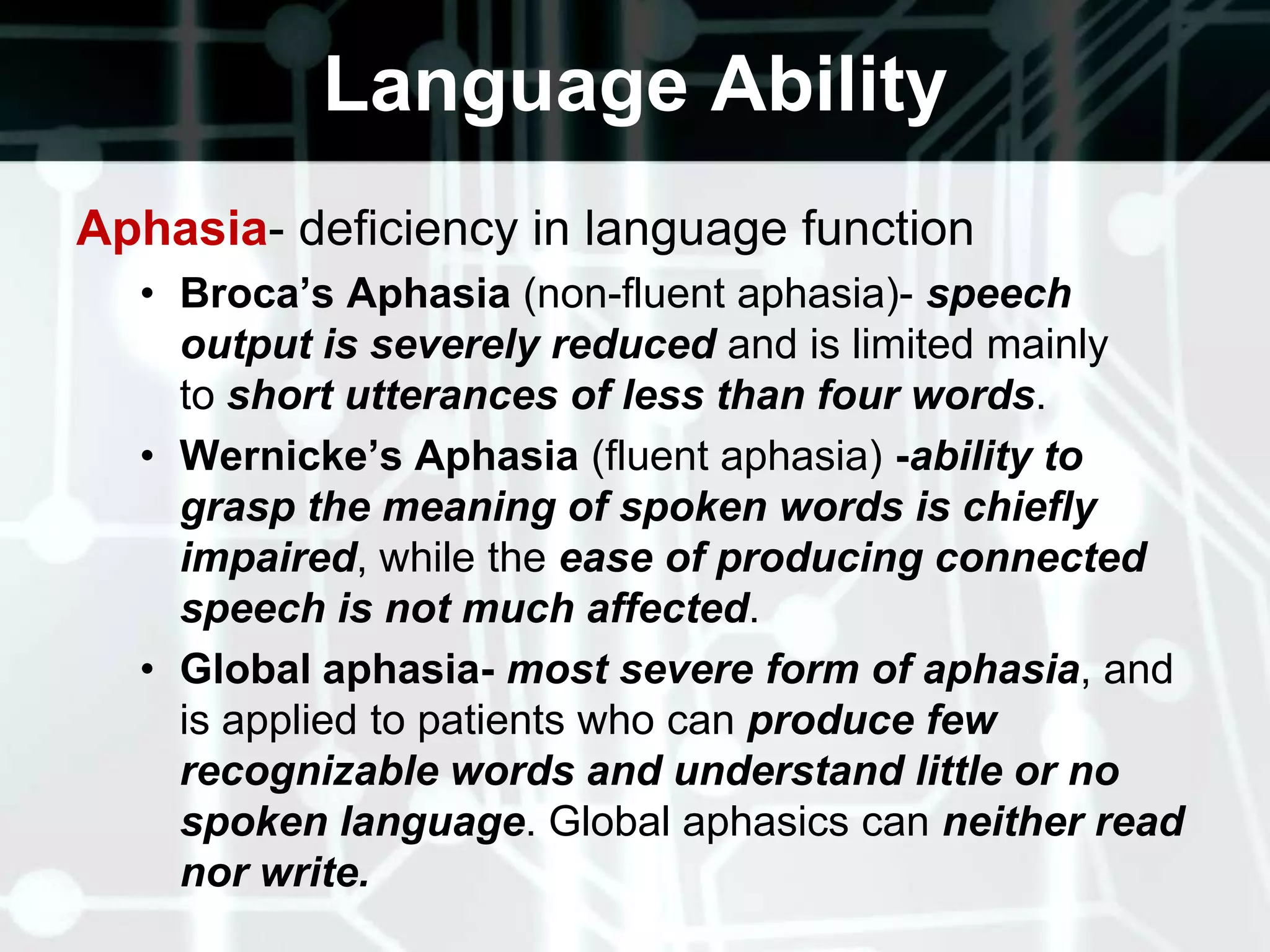
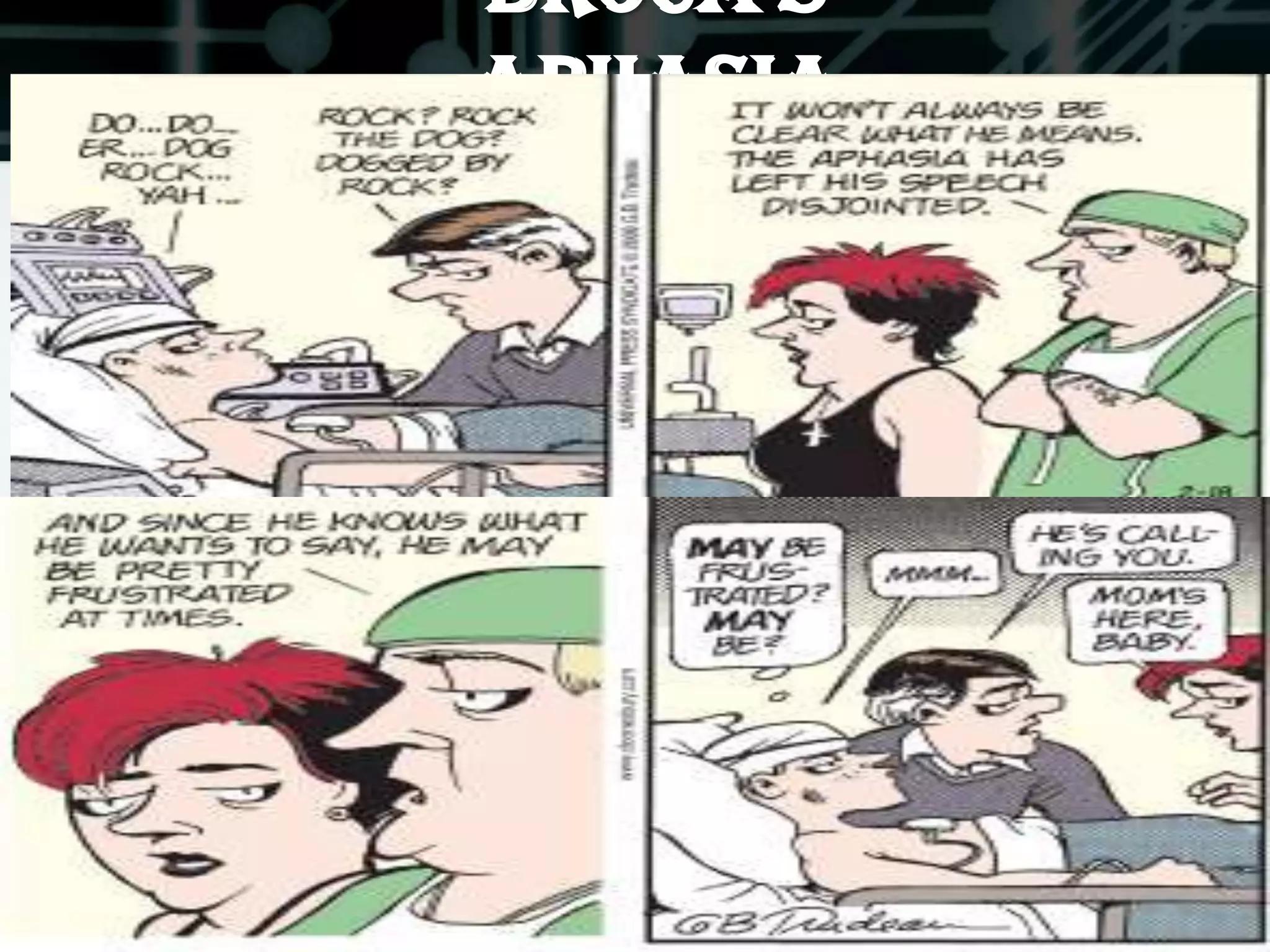
Language Ability Aphasia- deficiency in language functionBroca’s Aphasia (non-fluent aphasia)- speech output is severely reduced and is limited mainly to short utterances of less than four words.Wernicke’s Aphasia (fluent aphasia) -ability to grasp the meaning of spoken words is chiefly impaired, while the ease of producing connected speech is not much affected.Global aphasia- most severe form of aphasia, and is applied to patients who can produce few recognizable words and understand little or no spoken language. Global aphasics can neither read nor write.
Broca’s Aphasia
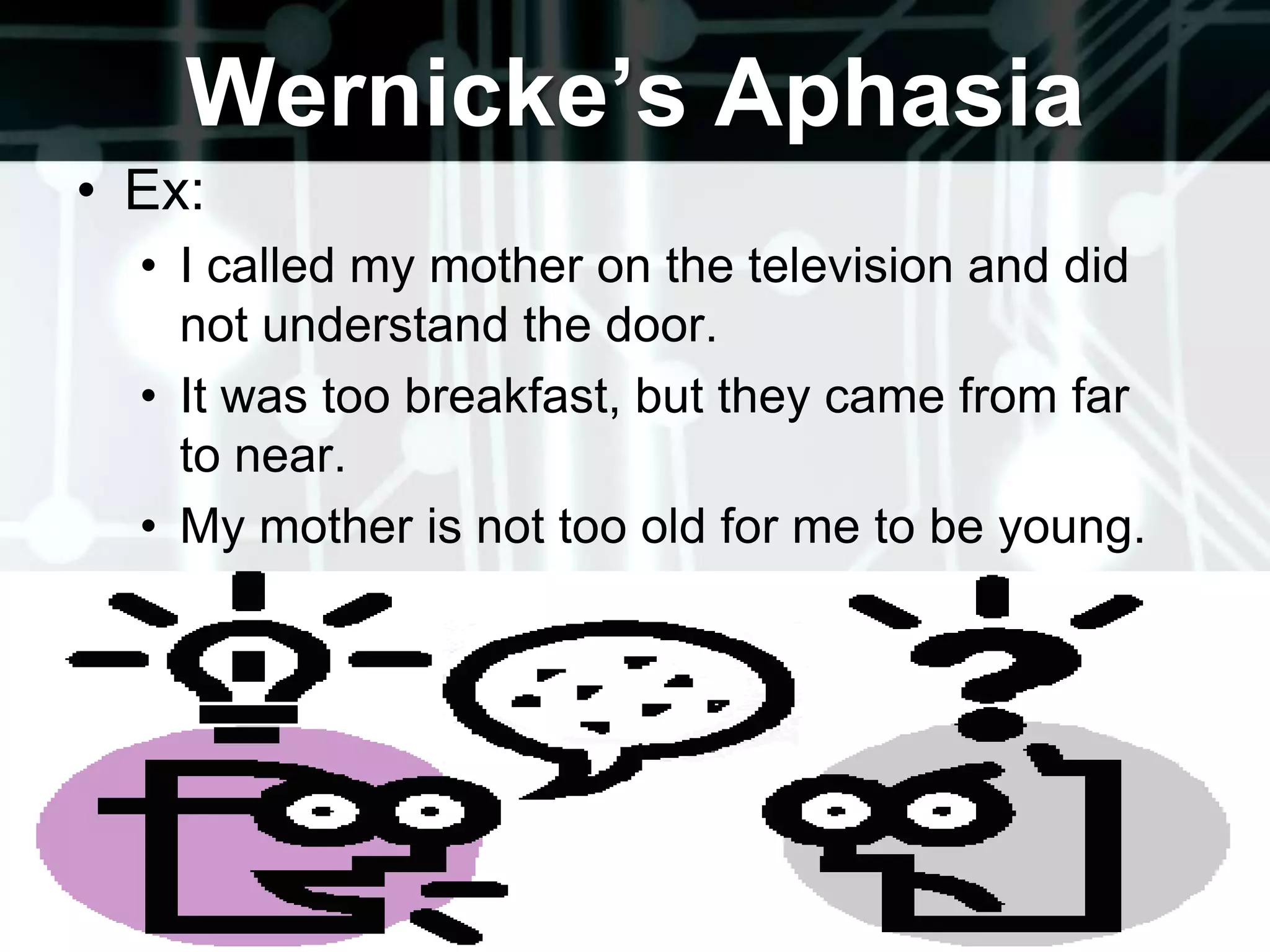
Wernicke’s AphasiaEx: I called my mother on the television and did not understand the door. It was too breakfast, but they came from far to near. My mother is not too old for me to be young.
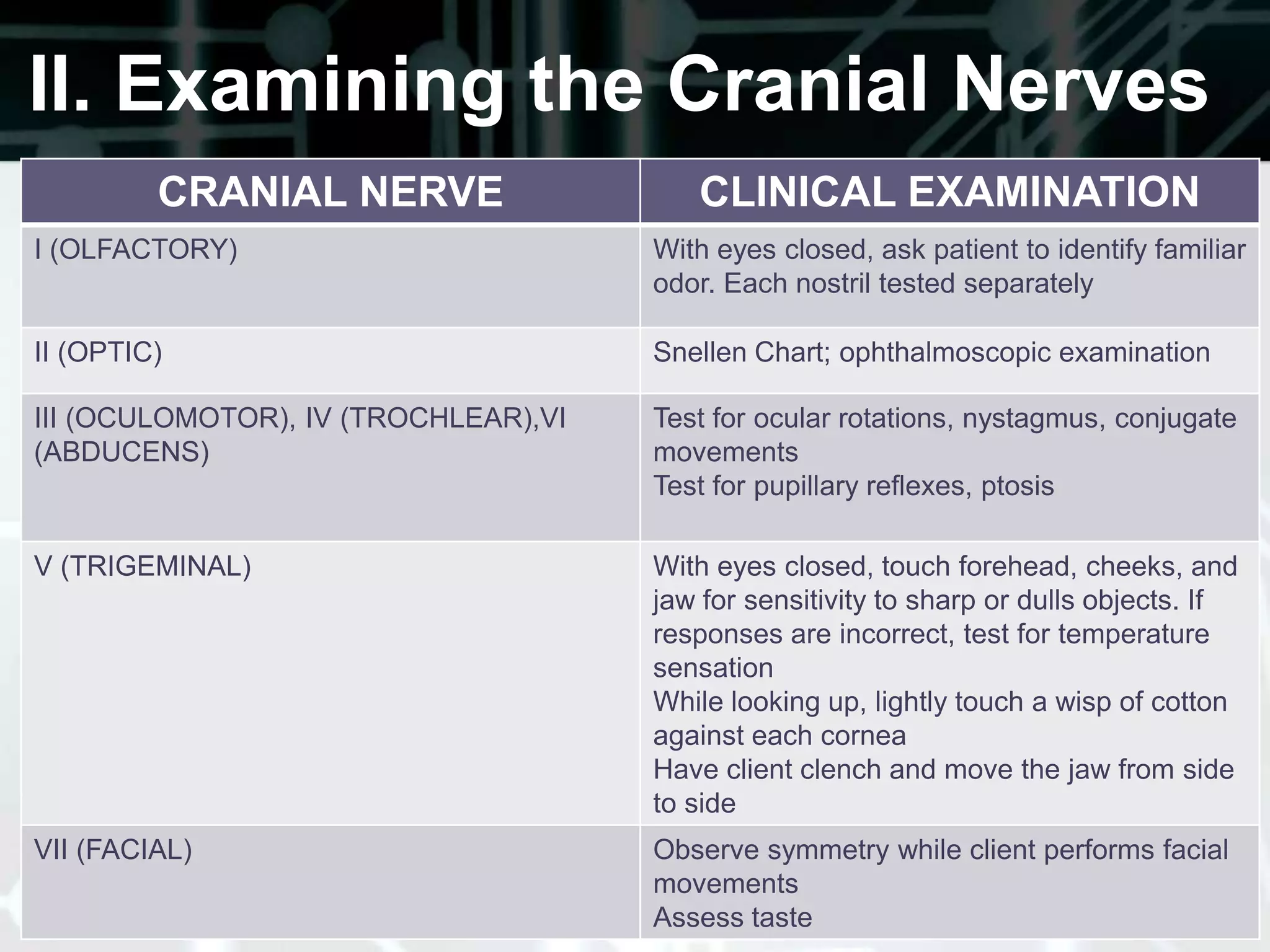
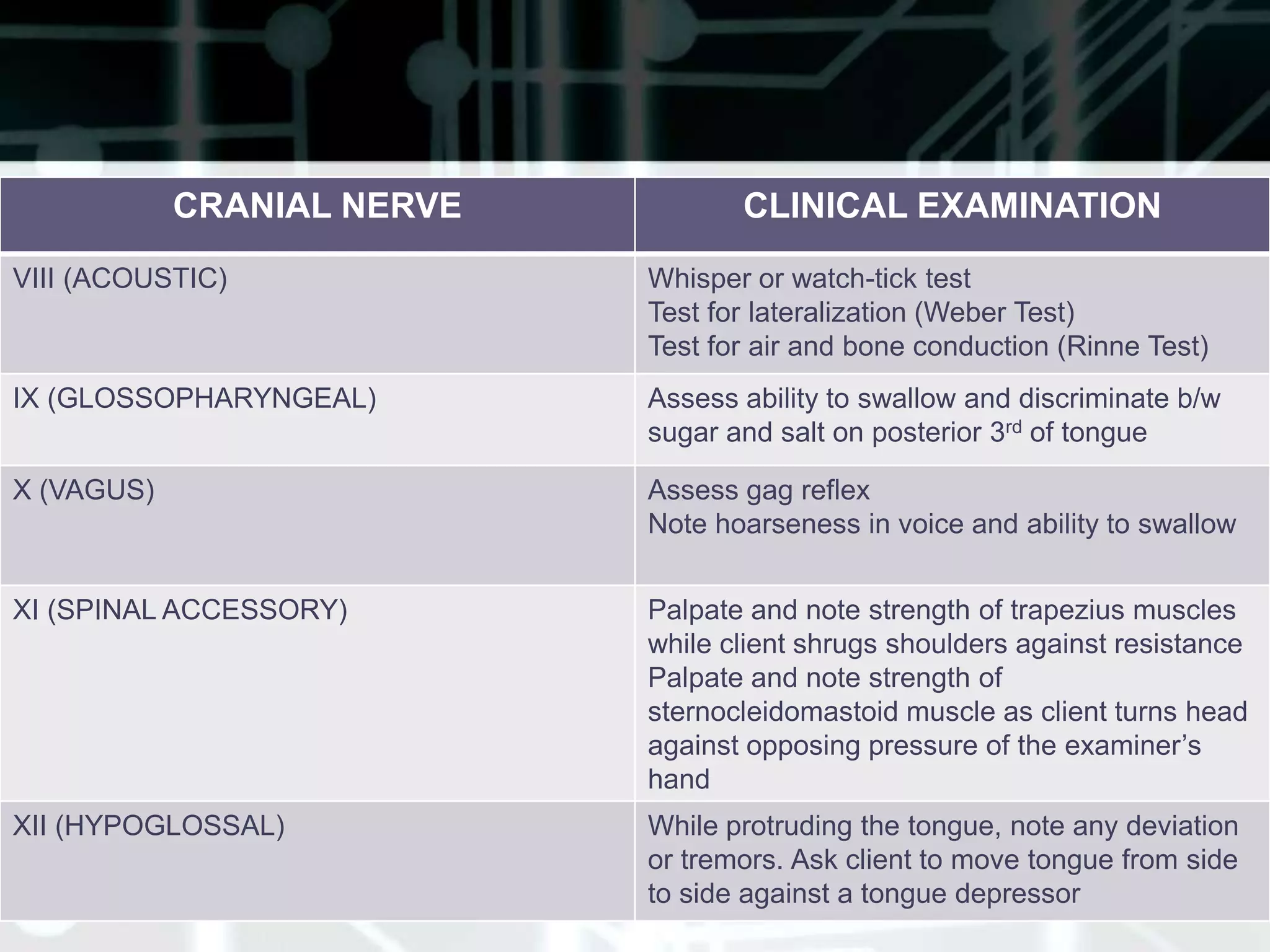
II. Examining the Cranial Nerves
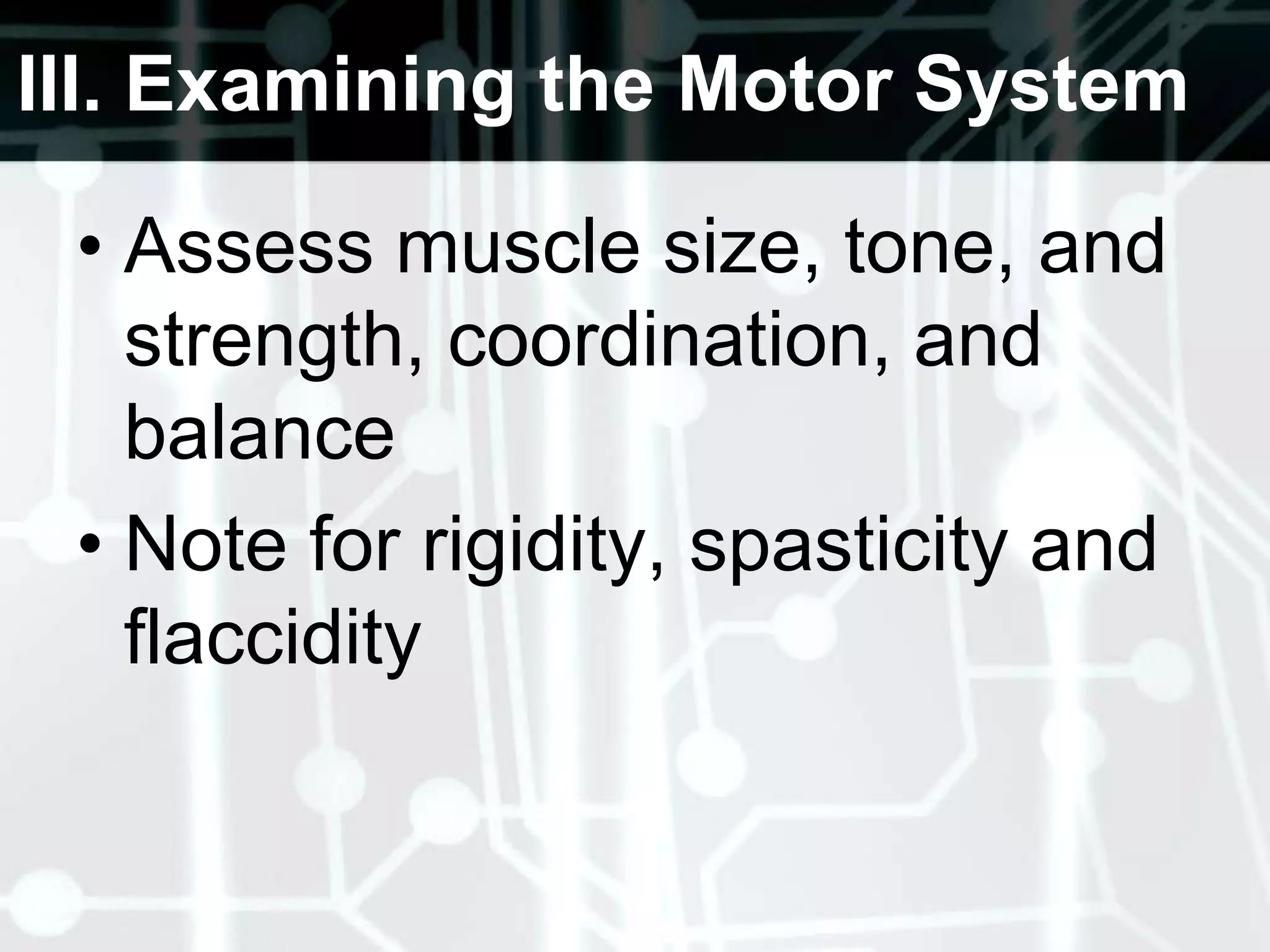
III. Examining the Motor SystemAssess muscle size, tone, and strength, coordination, and balanceNote for rigidity, spasticity and flaccidity
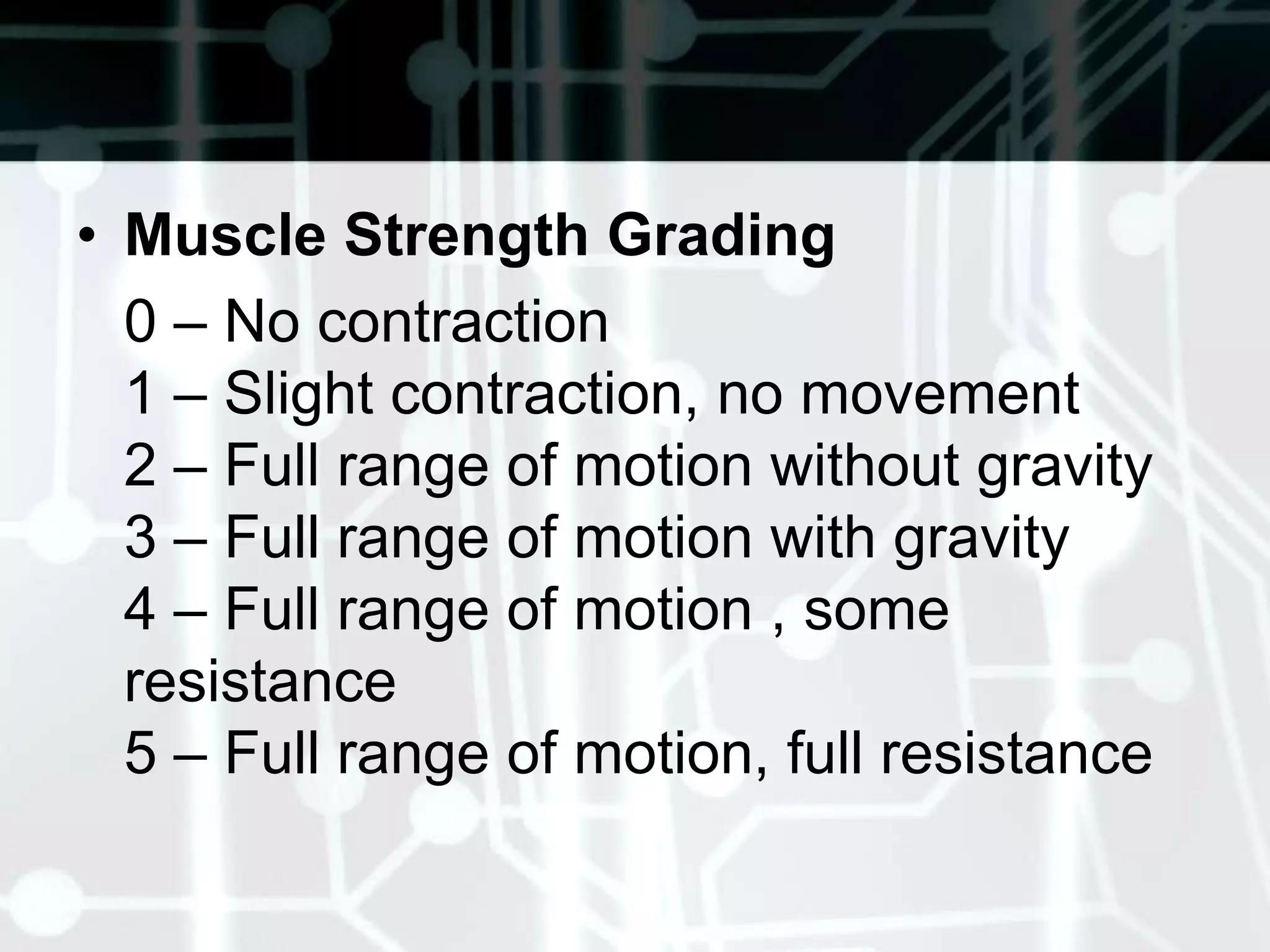
Muscle Strength Grading	0 – No contraction1 – Slight contraction, no movement2 – Full range of motion without gravity3 – Full range of motion with gravity4 – Full range of motion , some resistance5 – Full range of motion, full resistance
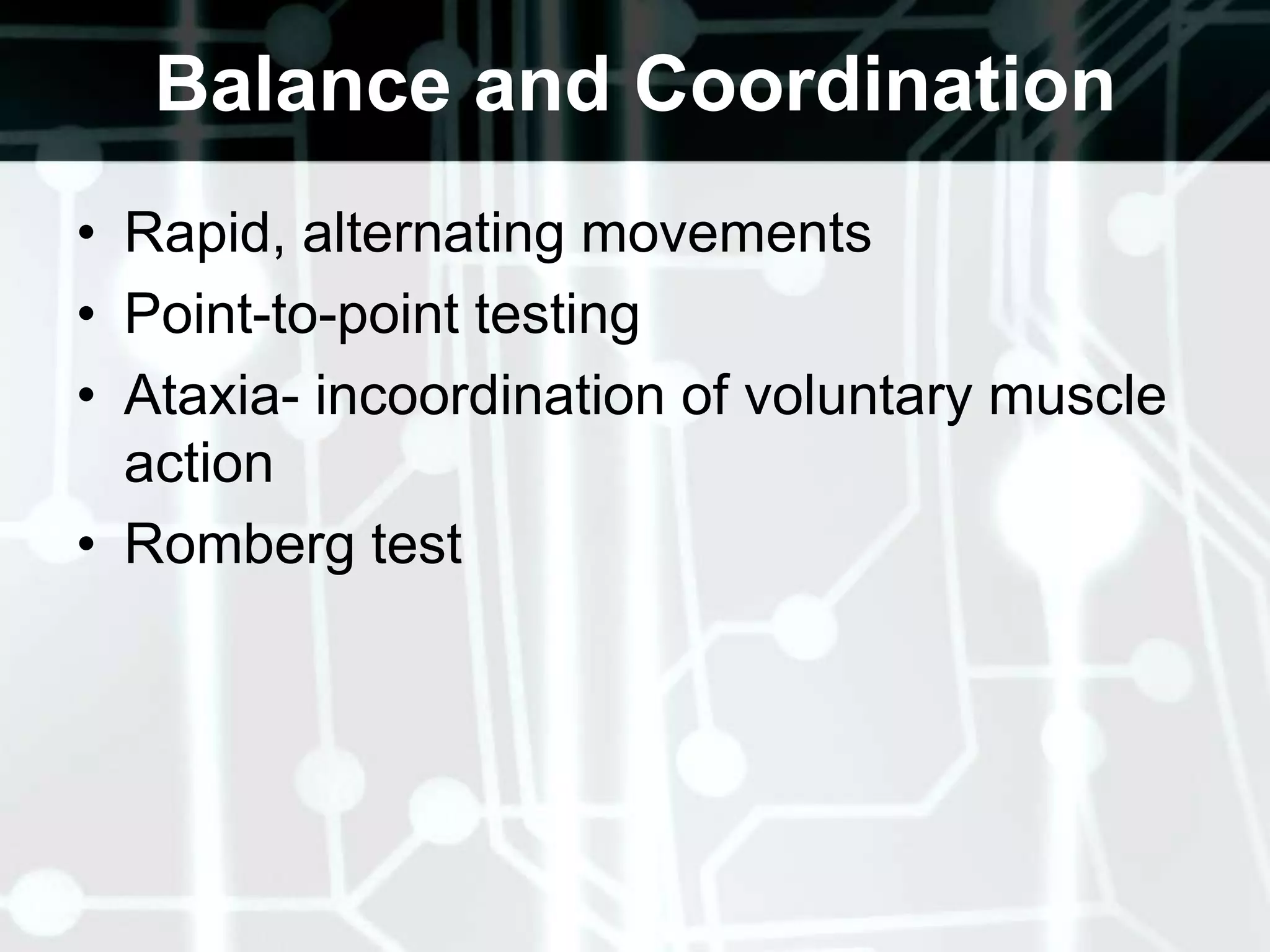
Balance and CoordinationRapid, alternating movementsPoint-to-point testing Ataxia- incoordination of voluntary muscle action Romberg test
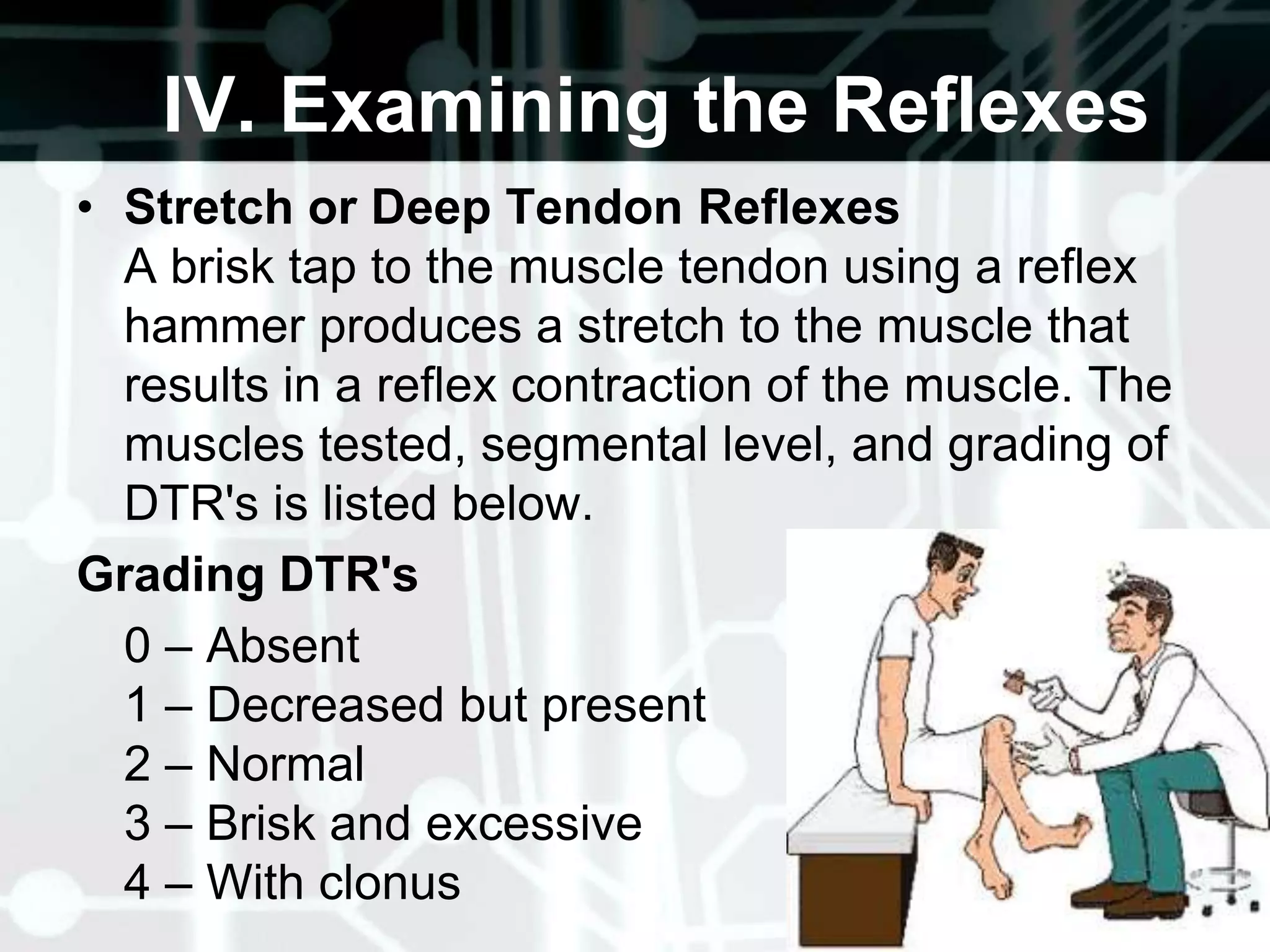
IV. Examining the ReflexesStretch or Deep Tendon Reflexes A brisk tap to the muscle tendon using a reflex hammer produces a stretch to the muscle that results in a reflex contraction of the muscle. The muscles tested, segmental level, and grading of DTR's is listed below.Grading DTR's	0 – Absent1 – Decreased but present2 – Normal3 – Brisk and excessive4 – With clonus
Reflexes Biceps reflexTriceps reflexBrachioradialis reflexPatellar reflexAnkle reflexSuperficial reflexesCorneal Abdominal reflexesGagCremastericPlantarperianal
V. Sensory ExaminationThe sensory examination is largely subjective and requires the cooperation of the patient.
Assessment of the sensory system involves: Tactile sensation Superficial pain Vibration Integration of sensation ProprioceptionStereognosis
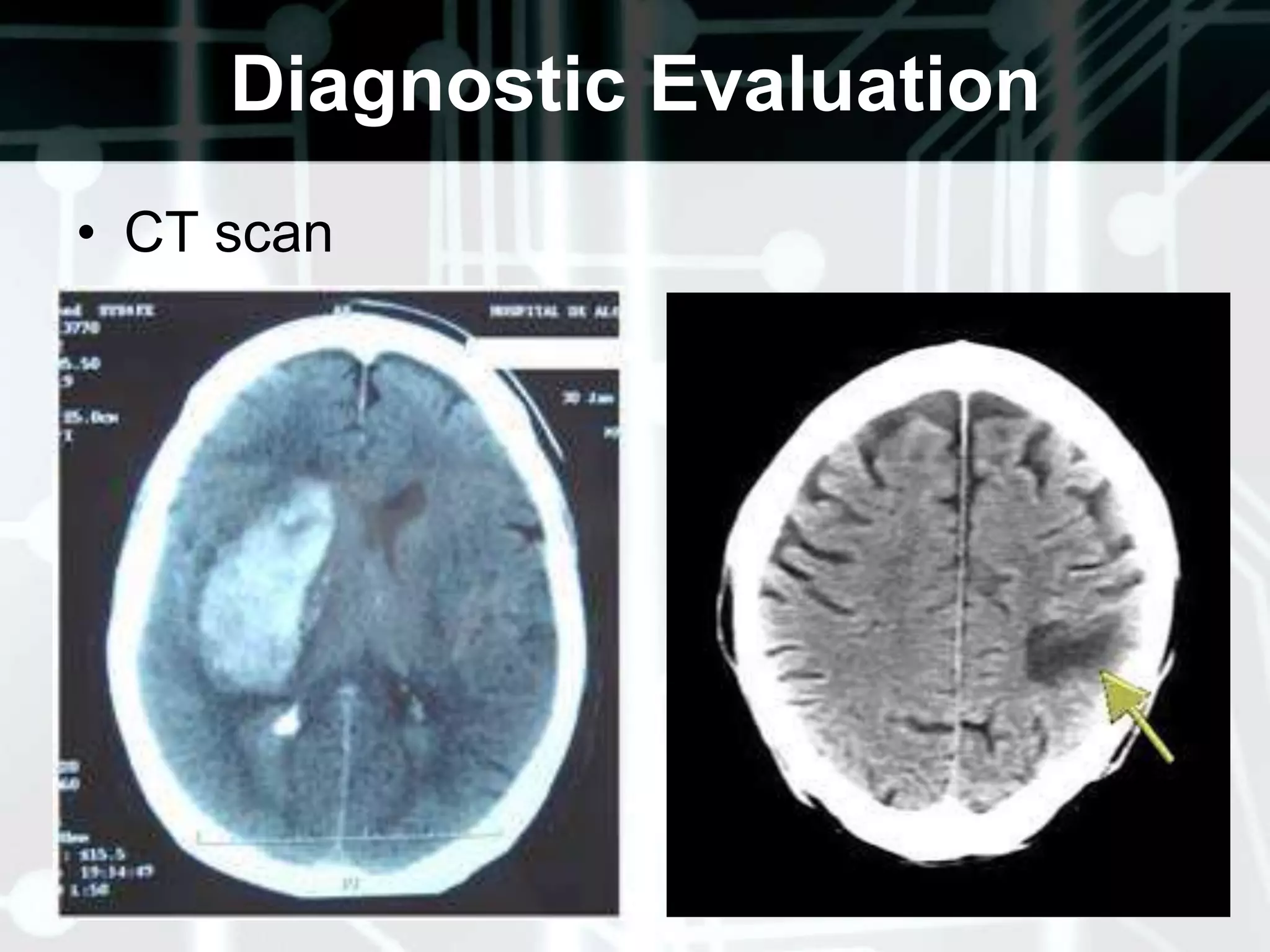
Diagnostic EvaluationCT scan
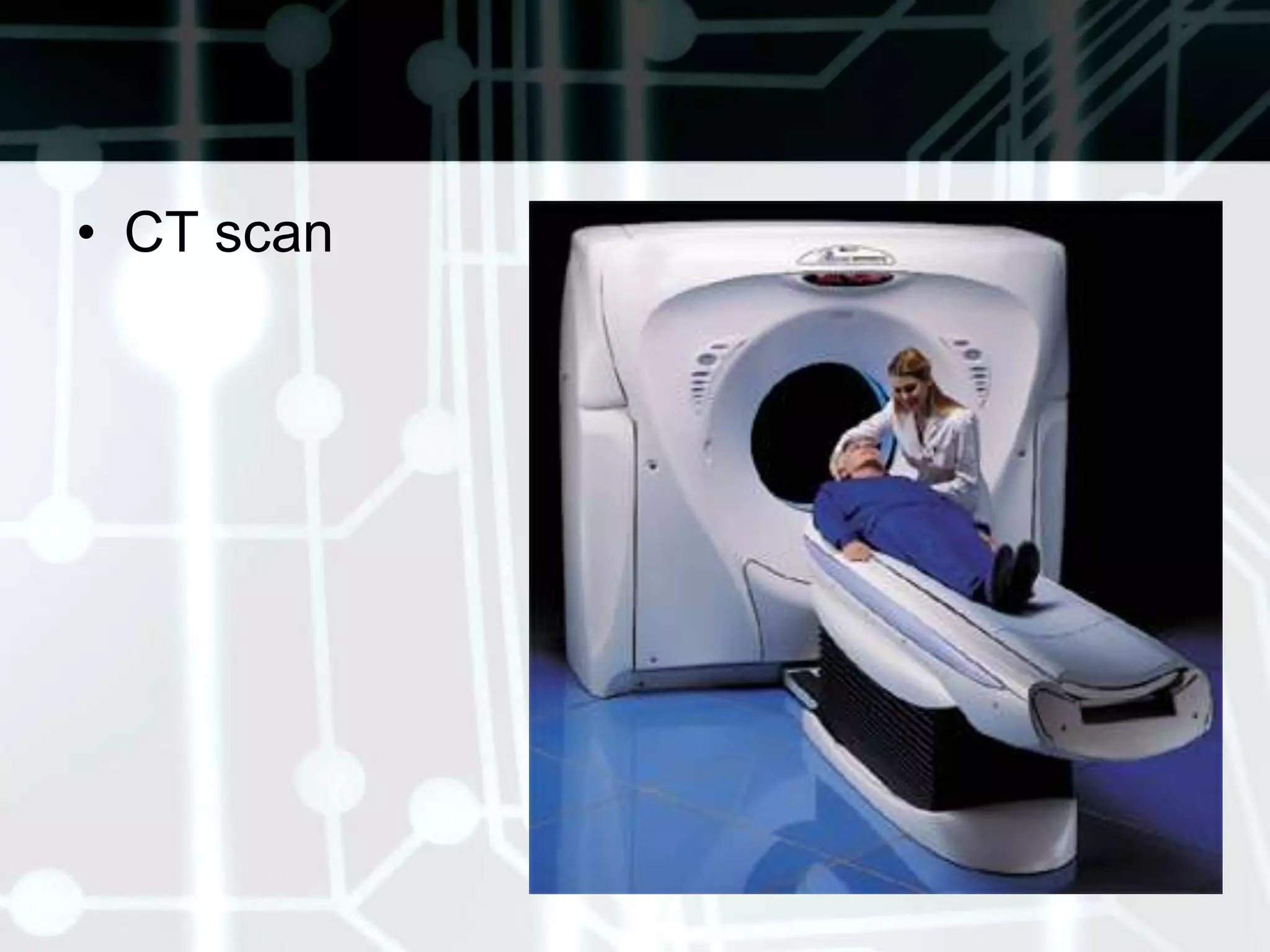
CT scan

Neurologic Exam

  • 1.
    ASSESSMENT: Neurologic ExaminationMa.Tosca Cybil A. Torres, RN, MAN
  • 2.
    AN IMPORTANT ASPECTOF THE NEUROLOGIC ASSESSMENT IS THE HISTORY OF THE PRESENT ILLNESS
  • 3.
    HEALTH HISTORYShould include:OnsetCharacterSeverityLocation Duration Frequency of s/sxAssociated complaintsPrecipitating and aggravating factorsProgression, remission, and exacerbationPresence and absence of similar symptoms among family membersReview of medical history History of falls or traumaUse of alcohol, medications and illicit drugs
  • 4.
    Common Clinical ManifestationsPain(chronic or acute) SeizuresDizziness and vertigo Visual disturbances WeaknessAbnormal sensation
  • 5.
    Physical Examination Aneurological assessment is divided into five components: Cerebral function Cranial nervesMotor system Sensory system Reflexes Follows a logical sequence and progresses from higher levels of cortical function (ex: abstract thinking) to lower levels of function (ex: determination of the integrity of the peripheral nerves)
  • 6.
    I. Assessing cerebralfunction Interpretation and documentation of neurologic abnormalities, particularly mental status abnormalities, should be SPECIFICandNONJUDGMENTAL.
  • 7.
    Mental StatusAssessment beginsby observing client’s appearance and behaviorPostureGesturesMovementsFacial expressionsMotor activity Manner of speech LOCOrientation
  • 8.
  • 9.
    Intellectual function Serial7sInterpretation of well-known proverbs/idiomsCapacity to recognize similaritiesJudgement
  • 10.
    Though Content Isthe patient’s thoughts:
  • 11.
  • 12.
  • 13.
  • 14.
  • 15.
  • 16.
  • 17.
  • 18.
  • 19.
    Consistency of verbalcommunication to non verbal cues Perception Agnosia- inability to interpret or recognize objects seen through the special senses. Visual
  • 20.
  • 21.
  • 22.
    Body parts andrelationships Motor Ability Ask client to perform a skilled actSuccessful performance requires the ability to understand the activity desired and normal motor strength
  • 23.
    Language Ability Aphasia-deficiency in language functionBroca’s Aphasia (non-fluent aphasia)- speech output is severely reduced and is limited mainly to short utterances of less than four words.Wernicke’s Aphasia (fluent aphasia) -ability to grasp the meaning of spoken words is chiefly impaired, while the ease of producing connected speech is not much affected.Global aphasia- most severe form of aphasia, and is applied to patients who can produce few recognizable words and understand little or no spoken language. Global aphasics can neither read nor write.
  • 24.
  • 25.
    Wernicke’s AphasiaEx: Icalled my mother on the television and did not understand the door. It was too breakfast, but they came from far to near. My mother is not too old for me to be young.
  • 26.
    II. Examining theCranial Nerves
  • 28.
    III. Examining theMotor SystemAssess muscle size, tone, and strength, coordination, and balanceNote for rigidity, spasticity and flaccidity
  • 29.
    Muscle Strength Grading 0– No contraction1 – Slight contraction, no movement2 – Full range of motion without gravity3 – Full range of motion with gravity4 – Full range of motion , some resistance5 – Full range of motion, full resistance
  • 30.
    Balance and CoordinationRapid,alternating movementsPoint-to-point testing Ataxia- incoordination of voluntary muscle action Romberg test
  • 31.
    IV. Examining theReflexesStretch or Deep Tendon Reflexes A brisk tap to the muscle tendon using a reflex hammer produces a stretch to the muscle that results in a reflex contraction of the muscle. The muscles tested, segmental level, and grading of DTR's is listed below.Grading DTR's 0 – Absent1 – Decreased but present2 – Normal3 – Brisk and excessive4 – With clonus
  • 32.
    Reflexes Biceps reflexTricepsreflexBrachioradialis reflexPatellar reflexAnkle reflexSuperficial reflexesCorneal Abdominal reflexesGagCremastericPlantarperianal
  • 33.
    V. Sensory ExaminationThesensory examination is largely subjective and requires the cooperation of the patient.
  • 34.
    Assessment of thesensory system involves: Tactile sensation Superficial pain Vibration Integration of sensation ProprioceptionStereognosis
  • 35.
  • 36.
  • 37.
  • 38.
  • 39.
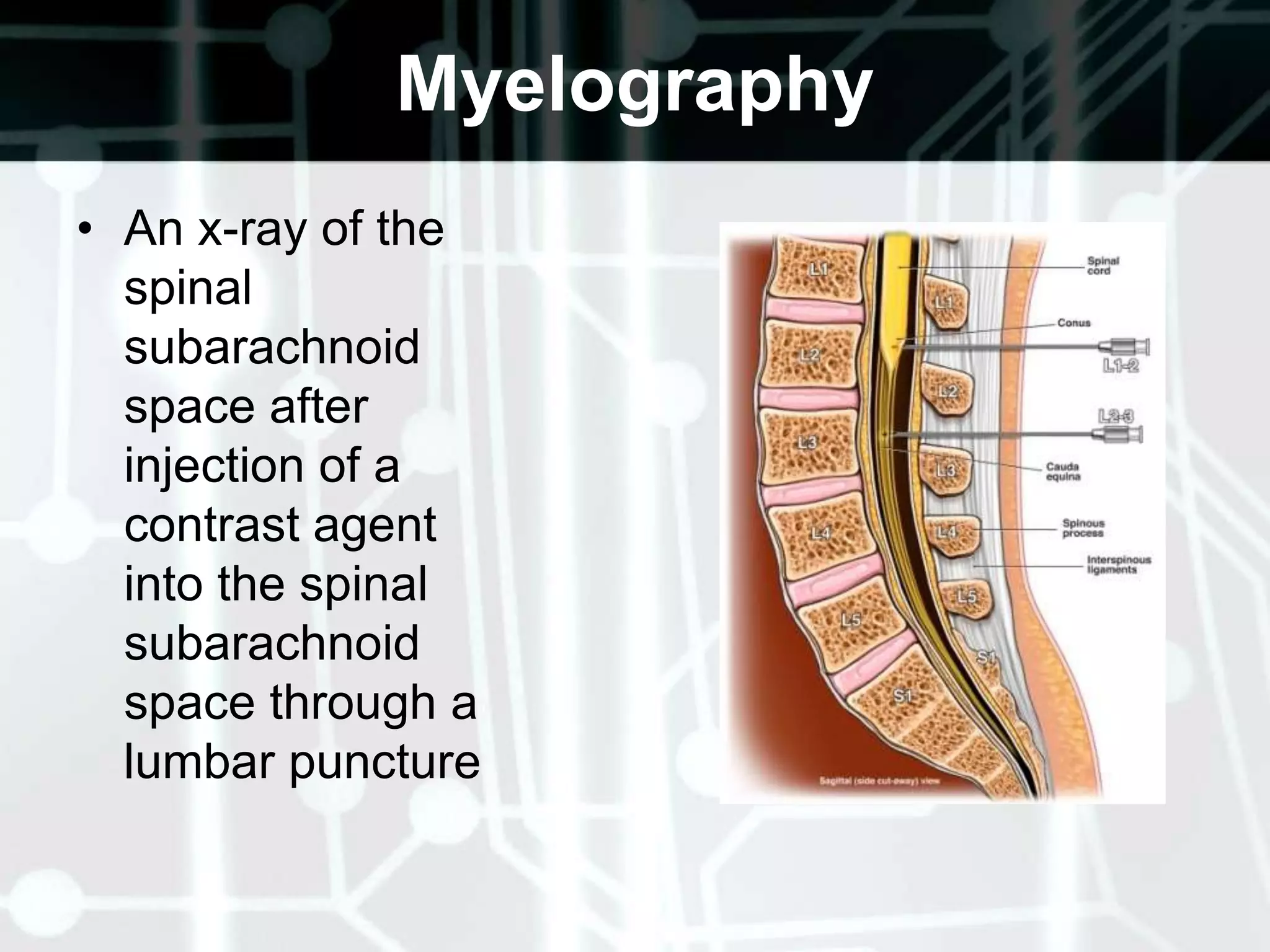
    MyelographyAn x-ray ofthe spinal subarachnoid space after injection of a contrast agent into the spinal subarachnoid space through a lumbar puncture
  • 40.
    Post myelography careHeadelevated to 30-45 degrees for 3H or as prescribed by the APEncouraged to increase OFI Assess VS and ability to void Untoward signs------headache, fever, stiff neck, photophobia, and seizures
  • 41.
  • 42.
  • 43.
  • 44.
  • 45.