Global developmental delay &
Intellectual disability
Dr. Dilip Choudhary
Department of Pediatrics
TN Medical College &
BYL Nair Hospital,
Mumbai
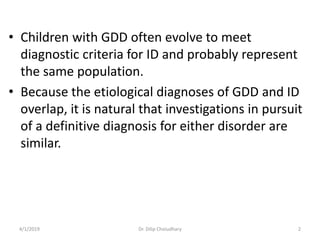
• Children with GDD often evolve to meet
diagnostic criteria for ID and probably represent
the same population.
• Because the etiological diagnoses of GDD and ID
overlap, it is natural that investigations in pursuit
of a definitive diagnosis for either disorder are
similar.
4/1/2019 Dr. Dilip Choiudhary 2
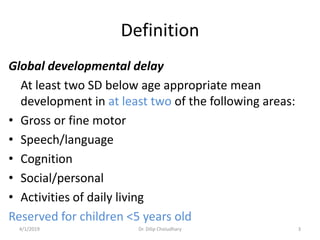
Definition
Global developmental delay
At least two SD below age appropriate mean
development in at least two of the following areas:
• Gross or fine motor
• Speech/language
• Cognition
• Social/personal
• Activities of daily living
Reserved for children <5 years old
4/1/2019 Dr. Dilip Choiudhary 3
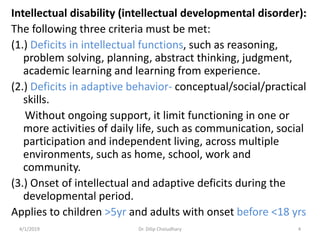
Intellectual disability (intellectual developmental disorder):
The following three criteria must be met:
(1.) Deficits in intellectual functions, such as reasoning,
problem solving, planning, abstract thinking, judgment,
academic learning and learning from experience.
(2.) Deficits in adaptive behavior- conceptual/social/practical
skills.
Without ongoing support, it limit functioning in one or
more activities of daily life, such as communication, social
participation and independent living, across multiple
environments, such as home, school, work and
community.
(3.) Onset of intellectual and adaptive deficits during the
developmental period.
Applies to children >5yr and adults with onset before <18 yrs
4/1/2019 Dr. Dilip Choiudhary 4
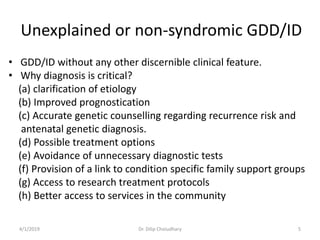
Unexplained or non-syndromic GDD/ID
• GDD/ID without any other discernible clinical feature.
• Why diagnosis is critical?
(a) clarification of etiology
(b) Improved prognostication
(c) Accurate genetic counselling regarding recurrence risk and
antenatal genetic diagnosis.
(d) Possible treatment options
(e) Avoidance of unnecessary diagnostic tests
(f) Provision of a link to condition specific family support groups
(g) Access to research treatment protocols
(h) Better access to services in the community
4/1/2019 Dr. Dilip Choiudhary 5
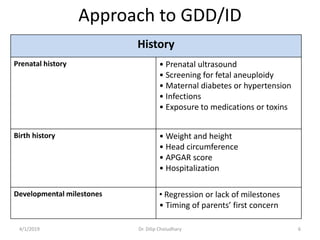
Approach to GDD/ID
History
Prenatal history • Prenatal ultrasound
• Screening for fetal aneuploidy
• Maternal diabetes or hypertension
• Infections
• Exposure to medications or toxins
Birth history • Weight and height
• Head circumference
• APGAR score
• Hospitalization
Developmental milestones • Regression or lack of milestones
• Timing of parents’ first concern
4/1/2019 Dr. Dilip Choiudhary 6
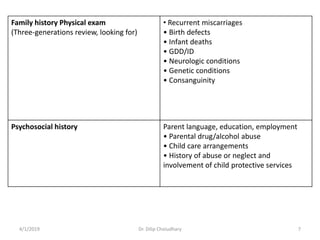
Family history Physical exam
(Three-generations review, looking for)
• Recurrent miscarriages
• Birth defects
• Infant deaths
• GDD/ID
• Neurologic conditions
• Genetic conditions
• Consanguinity
Psychosocial history Parent language, education, employment
• Parental drug/alcohol abuse
• Child care arrangements
• History of abuse or neglect and
involvement of child protective services
4/1/2019 Dr. Dilip Choiudhary 7
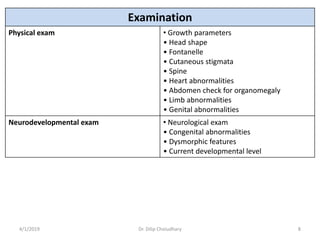
Examination
Physical exam • Growth parameters
• Head shape
• Fontanelle
• Cutaneous stigmata
• Spine
• Heart abnormalities
• Abdomen check for organomegaly
• Limb abnormalities
• Genital abnormalities
Neurodevelopmental exam • Neurological exam
• Congenital abnormalities
• Dysmorphic features
• Current developmental level
4/1/2019 Dr. Dilip Choiudhary 8
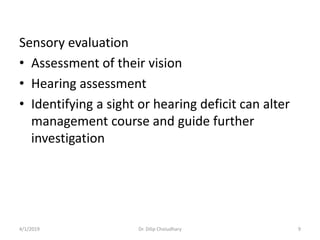
Sensory evaluation
• Assessment of their vision
• Hearing assessment
• Identifying a sight or hearing deficit can alter
management course and guide further
investigation
4/1/2019 Dr. Dilip Choiudhary 9
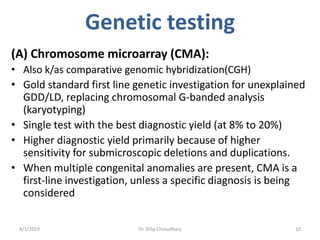
Genetic testing
(A) Chromosome microarray (CMA):
• Also k/as comparative genomic hybridization(CGH)
• Gold standard first line genetic investigation for unexplained
GDD/LD, replacing chromosomal G-banded analysis
(karyotyping)
• Single test with the best diagnostic yield (at 8% to 20%)
• Higher diagnostic yield primarily because of higher
sensitivity for submicroscopic deletions and duplications.
• When multiple congenital anomalies are present, CMA is a
first-line investigation, unless a specific diagnosis is being
considered
4/1/2019 Dr. Dilip Choiudhary 10
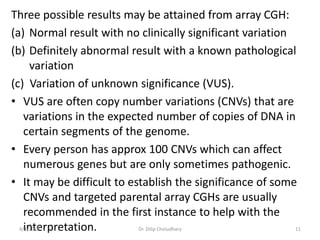
Three possible results may be attained from array CGH:
(a) Normal result with no clinically significant variation
(b) Definitely abnormal result with a known pathological
variation
(c) Variation of unknown significance (VUS).
• VUS are often copy number variations (CNVs) that are
variations in the expected number of copies of DNA in
certain segments of the genome.
• Every person has approx 100 CNVs which can affect
numerous genes but are only sometimes pathogenic.
• It may be difficult to establish the significance of some
CNVs and targeted parental array CGHs are usually
recommended in the first instance to help with the
interpretation.4/1/2019 Dr. Dilip Choiudhary 11
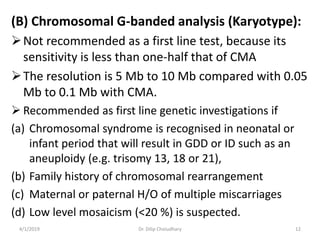
(B) Chromosomal G-banded analysis (Karyotype):
Not recommended as a first line test, because its
sensitivity is less than one-half that of CMA
The resolution is 5 Mb to 10 Mb compared with 0.05
Mb to 0.1 Mb with CMA.
 Recommended as first line genetic investigations if
(a) Chromosomal syndrome is recognised in neonatal or
infant period that will result in GDD or ID such as an
aneuploidy (e.g. trisomy 13, 18 or 21),
(b) Family history of chromosomal rearrangement
(c) Maternal or paternal H/O of multiple miscarriages
(d) Low level mosaicism (<20 %) is suspected.
4/1/2019 Dr. Dilip Choiudhary 12
(C) Whole-exome or -genome sequencing
Permits analysis of coding regions for known
genes and the identification of causal mutations
in up to 40% of patients with severe ID
4/1/2019 Dr. Dilip Choiudhary 13
(D) Fragile X DNA testing
• For children with ID, Fragile X is the most common
genetic cause, representing 2% to 6% of affected boys
and 1% to 4% of affected girls.
• To be added to the first line genetic investigation list:
(a) males with moderatesevere GDD/ID
(b) females with mild/moderate/severe GDD/ID
without profound physical handicap
• Because the clinical phenotype is often nonspecific in
infants and young children with Fragile X, Fragile X
DNA (FMR1) testing be considered as part of first-line
investigation
4/1/2019 Dr. Dilip Choiudhary 14
(E) Rett syndrome testing:
Rett syndrome is found in 1.5% of girls with
moderate-to-severe ID
MECP2 molecular analysis should be ordered
when characteristic symptomatology is present-
• Initially normal development f/b loss of speech
and purposeful hand use
• Stereotypical hand movement
• Gait abnormalities
4/1/2019 Dr. Dilip Choiudhary 15
(F) Additional genetic analysis:
for genomic imprinting disorders eg.
Prader–Willi syndrome,
Angelman syndrome,
Beckwith–Wiedemann syndrome
Silver–Russell syndrome.
4/1/2019 Dr. Dilip Choiudhary 16
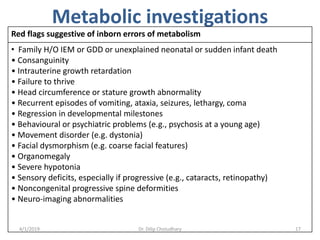
Metabolic investigations
Red flags suggestive of inborn errors of metabolism
• Family H/O IEM or GDD or unexplained neonatal or sudden infant death
• Consanguinity
• Intrauterine growth retardation
• Failure to thrive
• Head circumference or stature growth abnormality
• Recurrent episodes of vomiting, ataxia, seizures, lethargy, coma
• Regression in developmental milestones
• Behavioural or psychiatric problems (e.g., psychosis at a young age)
• Movement disorder (e.g. dystonia)
• Facial dysmorphism (e.g. coarse facial features)
• Organomegaly
• Severe hypotonia
• Sensory deficits, especially if progressive (e.g., cataracts, retinopathy)
• Noncongenital progressive spine deformities
• Neuro-imaging abnormalities
4/1/2019 Dr. Dilip Choiudhary 17
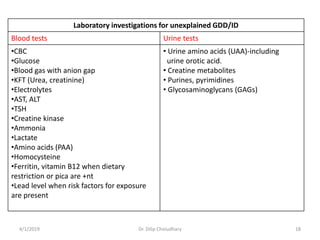
Laboratory investigations for unexplained GDD/ID
Blood tests Urine tests
•CBC
•Glucose
•Blood gas with anion gap
•KFT (Urea, creatinine)
•Electrolytes
•AST, ALT
•TSH
•Creatine kinase
•Ammonia
•Lactate
•Amino acids (PAA)
•Homocysteine
•Ferritin, vitamin B12 when dietary
restriction or pica are +nt
•Lead level when risk factors for exposure
are present
• Urine amino acids (UAA)-including
urine orotic acid.
• Creatine metabolites
• Purines, pyrimidines
• Glycosaminoglycans (GAGs)
4/1/2019 Dr. Dilip Choiudhary 18
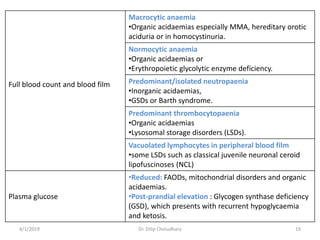
Full blood count and blood film
Macrocytic anaemia
•Organic acidaemias especially MMA, hereditary orotic
aciduria or in homocystinuria.
Normocytic anaemia
•Organic acidaemias or
•Erythropoietic glycolytic enzyme deficiency.
Predominant/isolated neutropaenia
•Inorganic acidaemias,
•GSDs or Barth syndrome.
Predominant thrombocytopaenia
•Organic acidaemias
•Lysosomal storage disorders (LSDs).
Vacuolated lymphocytes in peripheral blood film
•some LSDs such as classical juvenile neuronal ceroid
lipofuscinoses (NCL)
Plasma glucose
•Reduced: FAODs, mitochondrial disorders and organic
acidaemias.
•Post-prandial elevation : Glycogen synthase deficiency
(GSD), which presents with recurrent hypoglycaemia
and ketosis.
4/1/2019 Dr. Dilip Choiudhary 19
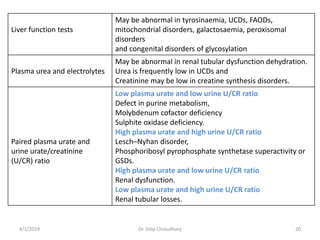
Liver function tests
May be abnormal in tyrosinaemia, UCDs, FAODs,
mitochondrial disorders, galactosaemia, peroxisomal
disorders
and congenital disorders of glycosylation
Plasma urea and electrolytes
May be abnormal in renal tubular dysfunction dehydration.
Urea is frequently low in UCDs and
Creatinine may be low in creatine synthesis disorders.
Paired plasma urate and
urine urate/creatinine
(U/CR) ratio
Low plasma urate and low urine U/CR ratio
Defect in purine metabolism,
Molybdenum cofactor deficiency
Sulphite oxidase deficiency.
High plasma urate and high urine U/CR ratio
Lesch–Nyhan disorder,
Phosphoribosyl pyrophosphate synthetase superactivity or
GSDs.
High plasma urate and low urine U/CR ratio
Renal dysfunction.
Low plasma urate and high urine U/CR ratio
Renal tubular losses.
4/1/2019 Dr. Dilip Choiudhary 20
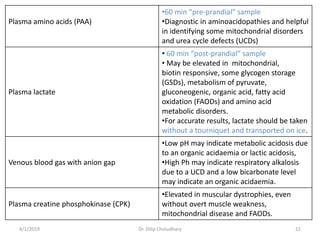
Plasma amino acids (PAA)
•60 min “pre-prandial” sample
•Diagnostic in aminoacidopathies and helpful
in identifying some mitochondrial disorders
and urea cycle defects (UCDs)
Plasma lactate
• 60 min “post-prandial” sample
• May be elevated in mitochondrial,
biotin responsive, some glycogen storage
(GSDs), metabolism of pyruvate,
gluconeogenic, organic acid, fatty acid
oxidation (FAODs) and amino acid
metabolic disorders.
•For accurate results, lactate should be taken
without a tourniquet and transported on ice.
Venous blood gas with anion gap
•Low pH may indicate metabolic acidosis due
to an organic acidaemia or lactic acidosis,
•High Ph may indicate respiratory alkalosis
due to a UCD and a low bicarbonate level
may indicate an organic acidaemia.
Plasma creatine phosphokinase (CPK)
•Elevated in muscular dystrophies, even
without overt muscle weakness,
mitochondrial disease and FAODs.
4/1/2019 Dr. Dilip Choiudhary 21
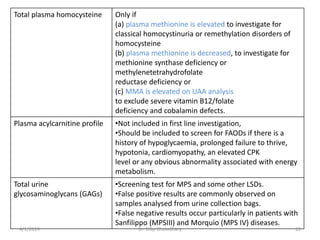
Total plasma homocysteine Only if
(a) plasma methionine is elevated to investigate for
classical homocystinuria or remethylation disorders of
homocysteine
(b) plasma methionine is decreased, to investigate for
methionine synthase deficiency or
methylenetetrahydrofolate
reductase deficiency or
(c) MMA is elevated on UAA analysis
to exclude severe vitamin B12/folate
deficiency and cobalamin defects.
Plasma acylcarnitine profile •Not included in first line investigation,
•Should be included to screen for FAODs if there is a
history of hypoglycaemia, prolonged failure to thrive,
hypotonia, cardiomyopathy, an elevated CPK
level or any obvious abnormality associated with energy
metabolism.
Total urine
glycosaminoglycans (GAGs)
•Screening test for MPS and some other LSDs.
•False positive results are commonly observed on
samples analysed from urine collection bags.
•False negative results occur particularly in patients with
Sanfilippo (MPSIII) and Morquio (MPS IV) diseases.
4/1/2019 Dr. Dilip Choiudhary 22
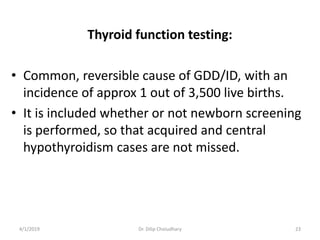
Thyroid function testing:
• Common, reversible cause of GDD/ID, with an
incidence of approx 1 out of 3,500 live births.
• It is included whether or not newborn screening
is performed, so that acquired and central
hypothyroidism cases are not missed.
4/1/2019 Dr. Dilip Choiudhary 23
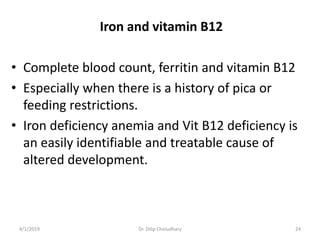
Iron and vitamin B12
• Complete blood count, ferritin and vitamin B12
• Especially when there is a history of pica or
feeding restrictions.
• Iron deficiency anemia and Vit B12 deficiency is
an easily identifiable and treatable cause of
altered development.
4/1/2019 Dr. Dilip Choiudhary 24
Lead
• Lead poisoning can affect mental and physical
development severely, especially in children
younger than 5 years of age.
• Lading to conditions such as autism spectrum
disorder, loss of milestones (particularly related
to language) and encephalopathy
4/1/2019 Dr. Dilip Choiudhary 25
Testing for congenital infections
• TORCH titre when neurological anomalies,
microcephaly, hearing and/or vision loss are
present.
4/1/2019 Dr. Dilip Choiudhary 26
Neuroimaging (CT/MRI)
• Reveal nonspecific abnormalities in approx 30% of
children with GDD/ID.
• But contributes to understanding the etiology
underlying GDD/ID in only 0.2% to 2.2% of cases.
• The diagnostic yield improves when an abnormal
neurological examination, seizures or macro or
microcephaly are present.
• MRI is preferred because it is more sensitive for
identifying clinically significant structural
abnormalities and anomalies related to
myelination and neuronal migration.
4/1/2019 Dr. Dilip Choiudhary 27
• AAP does not recommend neuroimaging as a
routine investigation for children with GDD/ID.
• While the AAN recommends performing an MRI
on all patients when chromosomal microarray,
Fragile X testing and MECP2 (if indicated) have
been inconclusive.
• Brain MRI with spectroscopy is indicated in all
cases of intractable epilepsy or developmental
regression.
4/1/2019 Dr. Dilip Choiudhary 28
Electroencephalogram
• Uncontrolled epilepsy or epileptic syndromes,
such as Landau-Kleffner syndrome, can be
associated with developmental delays or
regression.
• Seizures are a common symptom of IEMs.
• An EEG is justified when there is clinical suspicion
of seizures, speech regression/ neurodegenerative
disorder
4/1/2019 Dr. Dilip Choiudhary 29
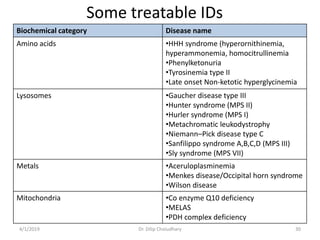
Some treatable IDs
Biochemical category Disease name
Amino acids •HHH syndrome (hyperornithinemia,
hyperammonemia, homocitrullinemia
•Phenylketonuria
•Tyrosinemia type II
•Late onset Non-ketotic hyperglycinemia
Lysosomes •Gaucher disease type III
•Hunter syndrome (MPS II)
•Hurler syndrome (MPS I)
•Metachromatic leukodystrophy
•Niemann–Pick disease type C
•Sanfilippo syndrome A,B,C,D (MPS III)
•Sly syndrome (MPS VII)
Metals •Aceruloplasminemia
•Menkes disease/Occipital horn syndrome
•Wilson disease
Mitochondria •Co enzyme Q10 deficiency
•MELAS
•PDH complex deficiency
4/1/2019 Dr. Dilip Choiudhary 30
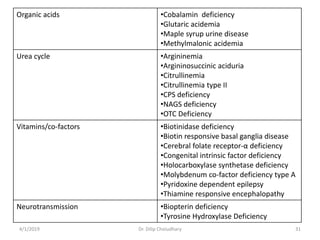
Organic acids •Cobalamin deficiency
•Glutaric acidemia
•Maple syrup urine disease
•Methylmalonic acidemia
Urea cycle •Argininemia
•Argininosuccinic aciduria
•Citrullinemia
•Citrullinemia type II
•CPS deficiency
•NAGS deficiency
•OTC Deficiency
Vitamins/co-factors •Biotinidase deficiency
•Biotin responsive basal ganglia disease
•Cerebral folate receptor-α deficiency
•Congenital intrinsic factor deficiency
•Holocarboxylase synthetase deficiency
•Molybdenum co-factor deficiency type A
•Pyridoxine dependent epilepsy
•Thiamine responsive encephalopathy
Neurotransmission •Biopterin deficiency
•Tyrosine Hydroxylase Deficiency
4/1/2019 Dr. Dilip Choiudhary 31
4/1/2019 Dr. Dilip Choiudhary 32
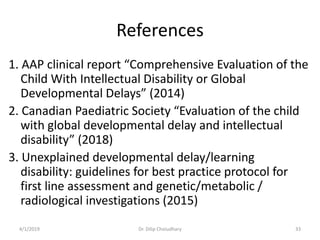
References
1. AAP clinical report “Comprehensive Evaluation of the
Child With Intellectual Disability or Global
Developmental Delays” (2014)
2. Canadian Paediatric Society “Evaluation of the child
with global developmental delay and intellectual
disability” (2018)
3. Unexplained developmental delay/learning
disability: guidelines for best practice protocol for
first line assessment and genetic/metabolic /
radiological investigations (2015)
4/1/2019 Dr. Dilip Choiudhary 33

Global developmental delay & Intellectual disability

  • 1.
    Global developmental delay& Intellectual disability Dr. Dilip Choudhary Department of Pediatrics TN Medical College & BYL Nair Hospital, Mumbai
  • 2.
    • Children withGDD often evolve to meet diagnostic criteria for ID and probably represent the same population. • Because the etiological diagnoses of GDD and ID overlap, it is natural that investigations in pursuit of a definitive diagnosis for either disorder are similar. 4/1/2019 Dr. Dilip Choiudhary 2
  • 3.
    Definition Global developmental delay Atleast two SD below age appropriate mean development in at least two of the following areas: • Gross or fine motor • Speech/language • Cognition • Social/personal • Activities of daily living Reserved for children <5 years old 4/1/2019 Dr. Dilip Choiudhary 3
  • 4.
    Intellectual disability (intellectualdevelopmental disorder): The following three criteria must be met: (1.) Deficits in intellectual functions, such as reasoning, problem solving, planning, abstract thinking, judgment, academic learning and learning from experience. (2.) Deficits in adaptive behavior- conceptual/social/practical skills. Without ongoing support, it limit functioning in one or more activities of daily life, such as communication, social participation and independent living, across multiple environments, such as home, school, work and community. (3.) Onset of intellectual and adaptive deficits during the developmental period. Applies to children >5yr and adults with onset before <18 yrs 4/1/2019 Dr. Dilip Choiudhary 4
  • 5.
    Unexplained or non-syndromicGDD/ID • GDD/ID without any other discernible clinical feature. • Why diagnosis is critical? (a) clarification of etiology (b) Improved prognostication (c) Accurate genetic counselling regarding recurrence risk and antenatal genetic diagnosis. (d) Possible treatment options (e) Avoidance of unnecessary diagnostic tests (f) Provision of a link to condition specific family support groups (g) Access to research treatment protocols (h) Better access to services in the community 4/1/2019 Dr. Dilip Choiudhary 5
  • 6.
    Approach to GDD/ID History Prenatalhistory • Prenatal ultrasound • Screening for fetal aneuploidy • Maternal diabetes or hypertension • Infections • Exposure to medications or toxins Birth history • Weight and height • Head circumference • APGAR score • Hospitalization Developmental milestones • Regression or lack of milestones • Timing of parents’ first concern 4/1/2019 Dr. Dilip Choiudhary 6
  • 7.
    Family history Physicalexam (Three-generations review, looking for) • Recurrent miscarriages • Birth defects • Infant deaths • GDD/ID • Neurologic conditions • Genetic conditions • Consanguinity Psychosocial history Parent language, education, employment • Parental drug/alcohol abuse • Child care arrangements • History of abuse or neglect and involvement of child protective services 4/1/2019 Dr. Dilip Choiudhary 7
  • 8.
    Examination Physical exam •Growth parameters • Head shape • Fontanelle • Cutaneous stigmata • Spine • Heart abnormalities • Abdomen check for organomegaly • Limb abnormalities • Genital abnormalities Neurodevelopmental exam • Neurological exam • Congenital abnormalities • Dysmorphic features • Current developmental level 4/1/2019 Dr. Dilip Choiudhary 8
  • 9.
    Sensory evaluation • Assessmentof their vision • Hearing assessment • Identifying a sight or hearing deficit can alter management course and guide further investigation 4/1/2019 Dr. Dilip Choiudhary 9
  • 10.
    Genetic testing (A) Chromosomemicroarray (CMA): • Also k/as comparative genomic hybridization(CGH) • Gold standard first line genetic investigation for unexplained GDD/LD, replacing chromosomal G-banded analysis (karyotyping) • Single test with the best diagnostic yield (at 8% to 20%) • Higher diagnostic yield primarily because of higher sensitivity for submicroscopic deletions and duplications. • When multiple congenital anomalies are present, CMA is a first-line investigation, unless a specific diagnosis is being considered 4/1/2019 Dr. Dilip Choiudhary 10
  • 11.
    Three possible resultsmay be attained from array CGH: (a) Normal result with no clinically significant variation (b) Definitely abnormal result with a known pathological variation (c) Variation of unknown significance (VUS). • VUS are often copy number variations (CNVs) that are variations in the expected number of copies of DNA in certain segments of the genome. • Every person has approx 100 CNVs which can affect numerous genes but are only sometimes pathogenic. • It may be difficult to establish the significance of some CNVs and targeted parental array CGHs are usually recommended in the first instance to help with the interpretation.4/1/2019 Dr. Dilip Choiudhary 11
  • 12.
    (B) Chromosomal G-bandedanalysis (Karyotype): Not recommended as a first line test, because its sensitivity is less than one-half that of CMA The resolution is 5 Mb to 10 Mb compared with 0.05 Mb to 0.1 Mb with CMA.  Recommended as first line genetic investigations if (a) Chromosomal syndrome is recognised in neonatal or infant period that will result in GDD or ID such as an aneuploidy (e.g. trisomy 13, 18 or 21), (b) Family history of chromosomal rearrangement (c) Maternal or paternal H/O of multiple miscarriages (d) Low level mosaicism (<20 %) is suspected. 4/1/2019 Dr. Dilip Choiudhary 12
  • 13.
    (C) Whole-exome or-genome sequencing Permits analysis of coding regions for known genes and the identification of causal mutations in up to 40% of patients with severe ID 4/1/2019 Dr. Dilip Choiudhary 13
  • 14.
    (D) Fragile XDNA testing • For children with ID, Fragile X is the most common genetic cause, representing 2% to 6% of affected boys and 1% to 4% of affected girls. • To be added to the first line genetic investigation list: (a) males with moderatesevere GDD/ID (b) females with mild/moderate/severe GDD/ID without profound physical handicap • Because the clinical phenotype is often nonspecific in infants and young children with Fragile X, Fragile X DNA (FMR1) testing be considered as part of first-line investigation 4/1/2019 Dr. Dilip Choiudhary 14
  • 15.
    (E) Rett syndrometesting: Rett syndrome is found in 1.5% of girls with moderate-to-severe ID MECP2 molecular analysis should be ordered when characteristic symptomatology is present- • Initially normal development f/b loss of speech and purposeful hand use • Stereotypical hand movement • Gait abnormalities 4/1/2019 Dr. Dilip Choiudhary 15
  • 16.
    (F) Additional geneticanalysis: for genomic imprinting disorders eg. Prader–Willi syndrome, Angelman syndrome, Beckwith–Wiedemann syndrome Silver–Russell syndrome. 4/1/2019 Dr. Dilip Choiudhary 16
  • 17.
    Metabolic investigations Red flagssuggestive of inborn errors of metabolism • Family H/O IEM or GDD or unexplained neonatal or sudden infant death • Consanguinity • Intrauterine growth retardation • Failure to thrive • Head circumference or stature growth abnormality • Recurrent episodes of vomiting, ataxia, seizures, lethargy, coma • Regression in developmental milestones • Behavioural or psychiatric problems (e.g., psychosis at a young age) • Movement disorder (e.g. dystonia) • Facial dysmorphism (e.g. coarse facial features) • Organomegaly • Severe hypotonia • Sensory deficits, especially if progressive (e.g., cataracts, retinopathy) • Noncongenital progressive spine deformities • Neuro-imaging abnormalities 4/1/2019 Dr. Dilip Choiudhary 17
  • 18.
    Laboratory investigations forunexplained GDD/ID Blood tests Urine tests •CBC •Glucose •Blood gas with anion gap •KFT (Urea, creatinine) •Electrolytes •AST, ALT •TSH •Creatine kinase •Ammonia •Lactate •Amino acids (PAA) •Homocysteine •Ferritin, vitamin B12 when dietary restriction or pica are +nt •Lead level when risk factors for exposure are present • Urine amino acids (UAA)-including urine orotic acid. • Creatine metabolites • Purines, pyrimidines • Glycosaminoglycans (GAGs) 4/1/2019 Dr. Dilip Choiudhary 18
  • 19.
    Full blood countand blood film Macrocytic anaemia •Organic acidaemias especially MMA, hereditary orotic aciduria or in homocystinuria. Normocytic anaemia •Organic acidaemias or •Erythropoietic glycolytic enzyme deficiency. Predominant/isolated neutropaenia •Inorganic acidaemias, •GSDs or Barth syndrome. Predominant thrombocytopaenia •Organic acidaemias •Lysosomal storage disorders (LSDs). Vacuolated lymphocytes in peripheral blood film •some LSDs such as classical juvenile neuronal ceroid lipofuscinoses (NCL) Plasma glucose •Reduced: FAODs, mitochondrial disorders and organic acidaemias. •Post-prandial elevation : Glycogen synthase deficiency (GSD), which presents with recurrent hypoglycaemia and ketosis. 4/1/2019 Dr. Dilip Choiudhary 19
  • 20.
    Liver function tests Maybe abnormal in tyrosinaemia, UCDs, FAODs, mitochondrial disorders, galactosaemia, peroxisomal disorders and congenital disorders of glycosylation Plasma urea and electrolytes May be abnormal in renal tubular dysfunction dehydration. Urea is frequently low in UCDs and Creatinine may be low in creatine synthesis disorders. Paired plasma urate and urine urate/creatinine (U/CR) ratio Low plasma urate and low urine U/CR ratio Defect in purine metabolism, Molybdenum cofactor deficiency Sulphite oxidase deficiency. High plasma urate and high urine U/CR ratio Lesch–Nyhan disorder, Phosphoribosyl pyrophosphate synthetase superactivity or GSDs. High plasma urate and low urine U/CR ratio Renal dysfunction. Low plasma urate and high urine U/CR ratio Renal tubular losses. 4/1/2019 Dr. Dilip Choiudhary 20
  • 21.
    Plasma amino acids(PAA) •60 min “pre-prandial” sample •Diagnostic in aminoacidopathies and helpful in identifying some mitochondrial disorders and urea cycle defects (UCDs) Plasma lactate • 60 min “post-prandial” sample • May be elevated in mitochondrial, biotin responsive, some glycogen storage (GSDs), metabolism of pyruvate, gluconeogenic, organic acid, fatty acid oxidation (FAODs) and amino acid metabolic disorders. •For accurate results, lactate should be taken without a tourniquet and transported on ice. Venous blood gas with anion gap •Low pH may indicate metabolic acidosis due to an organic acidaemia or lactic acidosis, •High Ph may indicate respiratory alkalosis due to a UCD and a low bicarbonate level may indicate an organic acidaemia. Plasma creatine phosphokinase (CPK) •Elevated in muscular dystrophies, even without overt muscle weakness, mitochondrial disease and FAODs. 4/1/2019 Dr. Dilip Choiudhary 21
  • 22.
    Total plasma homocysteineOnly if (a) plasma methionine is elevated to investigate for classical homocystinuria or remethylation disorders of homocysteine (b) plasma methionine is decreased, to investigate for methionine synthase deficiency or methylenetetrahydrofolate reductase deficiency or (c) MMA is elevated on UAA analysis to exclude severe vitamin B12/folate deficiency and cobalamin defects. Plasma acylcarnitine profile •Not included in first line investigation, •Should be included to screen for FAODs if there is a history of hypoglycaemia, prolonged failure to thrive, hypotonia, cardiomyopathy, an elevated CPK level or any obvious abnormality associated with energy metabolism. Total urine glycosaminoglycans (GAGs) •Screening test for MPS and some other LSDs. •False positive results are commonly observed on samples analysed from urine collection bags. •False negative results occur particularly in patients with Sanfilippo (MPSIII) and Morquio (MPS IV) diseases. 4/1/2019 Dr. Dilip Choiudhary 22
  • 23.
    Thyroid function testing: •Common, reversible cause of GDD/ID, with an incidence of approx 1 out of 3,500 live births. • It is included whether or not newborn screening is performed, so that acquired and central hypothyroidism cases are not missed. 4/1/2019 Dr. Dilip Choiudhary 23
  • 24.
    Iron and vitaminB12 • Complete blood count, ferritin and vitamin B12 • Especially when there is a history of pica or feeding restrictions. • Iron deficiency anemia and Vit B12 deficiency is an easily identifiable and treatable cause of altered development. 4/1/2019 Dr. Dilip Choiudhary 24
  • 25.
    Lead • Lead poisoningcan affect mental and physical development severely, especially in children younger than 5 years of age. • Lading to conditions such as autism spectrum disorder, loss of milestones (particularly related to language) and encephalopathy 4/1/2019 Dr. Dilip Choiudhary 25
  • 26.
    Testing for congenitalinfections • TORCH titre when neurological anomalies, microcephaly, hearing and/or vision loss are present. 4/1/2019 Dr. Dilip Choiudhary 26
  • 27.
    Neuroimaging (CT/MRI) • Revealnonspecific abnormalities in approx 30% of children with GDD/ID. • But contributes to understanding the etiology underlying GDD/ID in only 0.2% to 2.2% of cases. • The diagnostic yield improves when an abnormal neurological examination, seizures or macro or microcephaly are present. • MRI is preferred because it is more sensitive for identifying clinically significant structural abnormalities and anomalies related to myelination and neuronal migration. 4/1/2019 Dr. Dilip Choiudhary 27
  • 28.
    • AAP doesnot recommend neuroimaging as a routine investigation for children with GDD/ID. • While the AAN recommends performing an MRI on all patients when chromosomal microarray, Fragile X testing and MECP2 (if indicated) have been inconclusive. • Brain MRI with spectroscopy is indicated in all cases of intractable epilepsy or developmental regression. 4/1/2019 Dr. Dilip Choiudhary 28
  • 29.
    Electroencephalogram • Uncontrolled epilepsyor epileptic syndromes, such as Landau-Kleffner syndrome, can be associated with developmental delays or regression. • Seizures are a common symptom of IEMs. • An EEG is justified when there is clinical suspicion of seizures, speech regression/ neurodegenerative disorder 4/1/2019 Dr. Dilip Choiudhary 29
  • 30.
    Some treatable IDs Biochemicalcategory Disease name Amino acids •HHH syndrome (hyperornithinemia, hyperammonemia, homocitrullinemia •Phenylketonuria •Tyrosinemia type II •Late onset Non-ketotic hyperglycinemia Lysosomes •Gaucher disease type III •Hunter syndrome (MPS II) •Hurler syndrome (MPS I) •Metachromatic leukodystrophy •Niemann–Pick disease type C •Sanfilippo syndrome A,B,C,D (MPS III) •Sly syndrome (MPS VII) Metals •Aceruloplasminemia •Menkes disease/Occipital horn syndrome •Wilson disease Mitochondria •Co enzyme Q10 deficiency •MELAS •PDH complex deficiency 4/1/2019 Dr. Dilip Choiudhary 30
  • 31.
    Organic acids •Cobalamindeficiency •Glutaric acidemia •Maple syrup urine disease •Methylmalonic acidemia Urea cycle •Argininemia •Argininosuccinic aciduria •Citrullinemia •Citrullinemia type II •CPS deficiency •NAGS deficiency •OTC Deficiency Vitamins/co-factors •Biotinidase deficiency •Biotin responsive basal ganglia disease •Cerebral folate receptor-α deficiency •Congenital intrinsic factor deficiency •Holocarboxylase synthetase deficiency •Molybdenum co-factor deficiency type A •Pyridoxine dependent epilepsy •Thiamine responsive encephalopathy Neurotransmission •Biopterin deficiency •Tyrosine Hydroxylase Deficiency 4/1/2019 Dr. Dilip Choiudhary 31
  • 32.
    4/1/2019 Dr. DilipChoiudhary 32
  • 33.
    References 1. AAP clinicalreport “Comprehensive Evaluation of the Child With Intellectual Disability or Global Developmental Delays” (2014) 2. Canadian Paediatric Society “Evaluation of the child with global developmental delay and intellectual disability” (2018) 3. Unexplained developmental delay/learning disability: guidelines for best practice protocol for first line assessment and genetic/metabolic / radiological investigations (2015) 4/1/2019 Dr. Dilip Choiudhary 33