ELIMINATION FECALMa. Tosca Cybil A. Torres, RN, MAN
DEFECATIONDefecation is the expulsion of feces from the anus and rectum.
Also known as bowel movementDefecation reflexIntrinsic defecation reflex
Feces enter rectum distension of rectal walls initiates signal through mesenteric plexus initiate peristaltic waves (descending, sigmoid colon, rectum)anus internal sphincter inhibited from closing relaxed external sphincter defecation
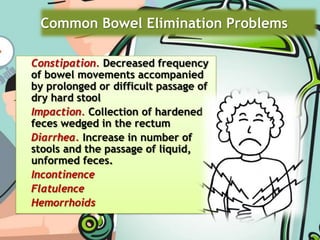
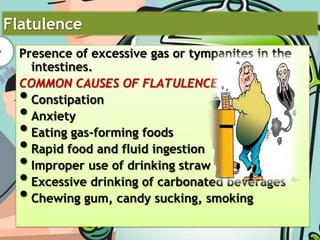
Parasympathetic defecation reflexCommon Bowel Elimination ProblemsConstipation. Decreased frequency of bowel movements accompanied by prolonged or difficult passage of dry hard stoolImpaction. Collection of hardened feces wedged in the rectumDiarrhea. Increase in number of stools and the passage of liquid, unformed feces.Incontinence	Flatulence	Hemorrhoids
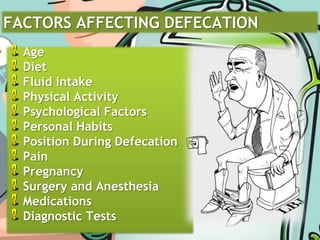
FACTORS AFFECTING DEFECATIONAgeDietFluid intakePhysical ActivityPsychological FactorsPersonal HabitsPosition During DefecationPain PregnancySurgery and AnesthesiaMedicationsDiagnostic Tests
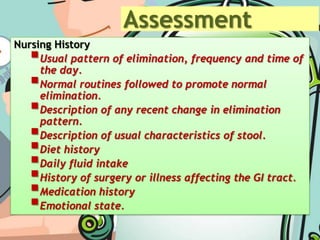
AssessmentNursing HistoryUsual pattern of elimination, frequency and time of the day.
Normal routines followed to promote normal elimination.
Description of any recent change in elimination pattern.
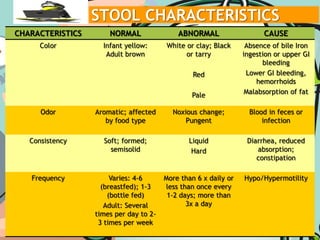
Description of usual characteristics of stool.
Diet history
Daily fluid intake
History of surgery or illness affecting the GI tract.
Medication history
Emotional state.Assessment of the GITMTCAT '09Nursing History : Subjective Data1. General Datapresence of dental prosthesis, comfort of usagedifficulty eating or digesting foodnausea or vomitingweight losspain – may be caused by distention or sudden contraction of  any part of the GIT	 - specify the area, describe the pain2. Specific data if symptoms are presentsituations or events that effect symptomsonset, possible cause, location, duration, character of symptomsrelationship of specific foods, smoking or alcohol to severity of symptomshow the symptoms was managed before seeking medical help
Assessment of the GITMTCAT '093.  Normal pattern of bowel eliminationfrequency and character of stooluse of laxatives, enemas4.  Recent changes in normal patternschanges in character of stool (constipation, diarrhea, or alternating constipation and diarrhea)changes in color of stool melena - black tarry stool (upper GI bleeding)hematochezia – fresh blood  in the stool  (lower GI bleeding)c.  drugs /medications being takend.  measures taken to relieve symptoms
Assessment of the GITMTCAT '09B.  Physical Examination : Objective Dataa.)  Mouth and Pharynxlips – color, moisture, swelling, cracks or lesionsteeth – completeness (20 in children, 32 in adults), caries, loose teeth, absence of teeth  impair adequate chewinggums – color, redness, swelling, bleeding, pain (gingivitis)mucosa – color (light pink)examine for moisture, white spots or patches, areas of bleeding, or ulcers
white patches – due to candidiasis (oral thrush)
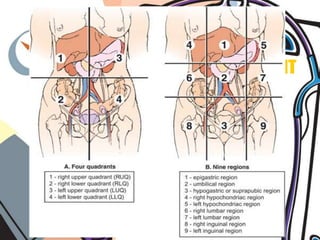
white plaques w/in  red patches may be malignant lesionstongue – color, mobility, symmetry, ulcerations / lesions or nodulespharynx – observe the uvula, soft palate, tonsils, posterior pharynx    signs of inflammation (redness, edema, ulceration, thick yellowish secretions), assess also for symmetry of uvula and palateAssessment of the GITMTCAT '09b.)  Abdomen         -  assess for the presence or absence of tenderness, organ enlargement, masses, spasm or rigidity of the abdominal muscles, fluid or air in the abdominal cavityAnatomic Location of OrgansRUQ – liver, gallbladder, duodenum, right kidney, hepatic flexure of colonRLQ  - cecum, appendix, right ovary and fallopian tubeLUQ – stomach, spleen, left kidney, pancreas, splenic flexure of colonLLQ – sigmoid colon, left ovary and tube
Assessment of the GITMTCAT '09
Assessment of the GITMTCAT '091. Inspectionassess the skin for color, texture, scars, striae, engorged veins, visible peristalsis (intestinal obstruction), visible pulsations (abdominal aorta), visible masses (hernia)
assess contour (flat, protuberant, globular)
abdominal distension, measure abdominal girth or circumference at the level of umbilicus or 2-5 cm. belowAssessment of the GITMTCAT '092.  Auscultationpresence or absence of peristalsis or bowel sounds
Normoactive – every 5-20 secs.
Hypoactive – 1 or 2 sounds in 2 mins.
Absent – no sounds in 3-5 mins.		    peritonitis, paralytic ileus, Hyperactive – 5-6 sounds in less than 30 sec. diarrhea, gastroenteritis, early intestinal              obstruction
Assessment of the GITMTCAT '093.  Percussiondone to confirm the size of various organs
to determine presence of excessive amounts of air or fluid
Normal – tympany
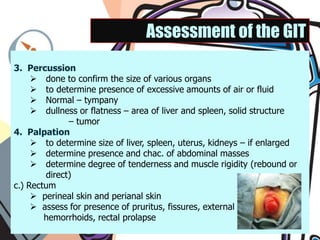
dullness or flatness – area of liver and spleen, solid structure                 – tumor4.  Palpationto determine size of liver, spleen, uterus, kidneys – if enlarged
determine presence and chac. of abdominal masses
determine degree of tenderness and muscle rigidity (rebound or direct)c.) Rectumperineal skin and perianal skin
  assess for presence of pruritus, fissures, external     hemorrhoids, rectal prolapse
FECAL STUDIESFor blood, fat, infectious organismsA freshly passed, warm stool is the best specimen.
From fat or infections organisms, collect three separate specimens and label day # 1, day #2, day # 3.Stool examination (fecalysis)Stool for occult blood(Guaiac Test)
GI bleeding
No red meat, turnips, horseradish, steroids, NSAIDS, iron
Stool for Ova and parasites
proper collection of specimen  should not be mixed with water or urine, should be sent immediately to the laboratoryUPPER GI SERIES (BARIUM SWALLOW)Fluoroscopic examination of upper GI tract to determine structural problems and gastric emptying time.
Client must swallow barium sulfate
Sequential films taken as it moves through the system.Barium – is a radiopaque substance that when ingested or given by enema in solution, outlines the passage ways of the GIT for viewing by x-ray or fluoroscopy
UPPER GI SERIES (BARIUM SWALLOW)for identification  disorders of esophagus, stomach, duodenum – esophageal lesions, hiatal hernia, esophageal reflux, tumors, ulcers, inflammation
Pt. swallows a  flavored barium solution and the radiologist observes the progress of the barium through the esophagus and take x-ray films
NPO for 6-8 hrs
Post procedure:
Increase fluid intake
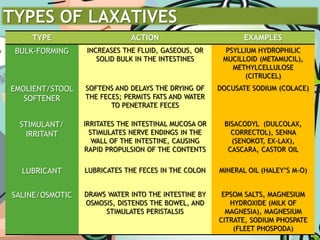
Laxative
Stool – white for 24-72 hrs.
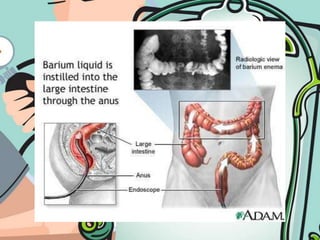
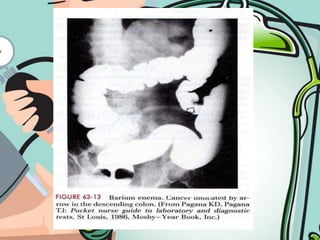
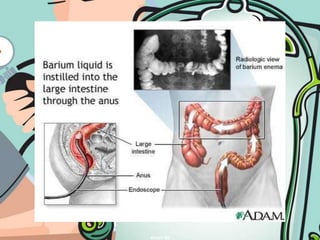
Observe for:  impaction, distended abdomen, constipationLOWER GI SERIES (BARIUM ENEMA)Barium is instilled into the colon by enema
Client retains the contrast medium while x-rays are taken to identify structural abnormalities of the large intestine or the colon.Nursing care: pretestNPO for 8 hours pretest
Give enemas until clear the morning of the test.
Administer laxative or suppository.
Explain that cramping may be experienced during procedure.Nursing care: posttestAdminister laxatives and fluids to assist in expelling the barium
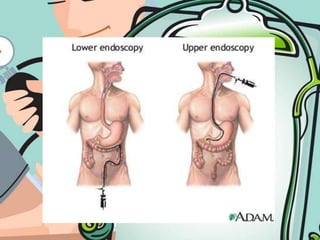
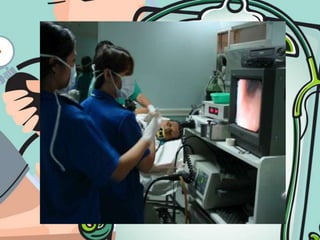
ESOPHAGOGASTRODUODENOSCOPY (EGD)Direct visualization of the esophagus, stomach, and duodenum by insertion of a lighted fiberscope.
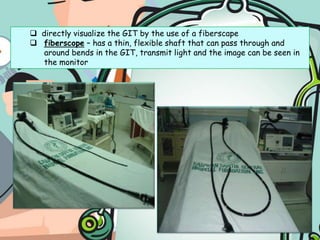
Used to observe structures, ulcerations, inflammation, tumors; may include biopsy.  directly visualize the GIT by the use of a fiberscape

Elimination

  • 1.
    ELIMINATION FECALMa. ToscaCybil A. Torres, RN, MAN
  • 2.
    DEFECATIONDefecation is theexpulsion of feces from the anus and rectum.
  • 3.
    Also known asbowel movementDefecation reflexIntrinsic defecation reflex
  • 4.
    Feces enter rectumdistension of rectal walls initiates signal through mesenteric plexus initiate peristaltic waves (descending, sigmoid colon, rectum)anus internal sphincter inhibited from closing relaxed external sphincter defecation
  • 5.
    Parasympathetic defecation reflexCommonBowel Elimination ProblemsConstipation. Decreased frequency of bowel movements accompanied by prolonged or difficult passage of dry hard stoolImpaction. Collection of hardened feces wedged in the rectumDiarrhea. Increase in number of stools and the passage of liquid, unformed feces.Incontinence Flatulence Hemorrhoids
  • 7.
    FACTORS AFFECTING DEFECATIONAgeDietFluidintakePhysical ActivityPsychological FactorsPersonal HabitsPosition During DefecationPain PregnancySurgery and AnesthesiaMedicationsDiagnostic Tests
  • 8.
    AssessmentNursing HistoryUsual patternof elimination, frequency and time of the day.
  • 9.
    Normal routines followedto promote normal elimination.
  • 10.
    Description of anyrecent change in elimination pattern.
  • 11.
    Description of usualcharacteristics of stool.
  • 12.
  • 13.
  • 14.
    History of surgeryor illness affecting the GI tract.
  • 15.
  • 16.
    Emotional state.Assessment ofthe GITMTCAT '09Nursing History : Subjective Data1. General Datapresence of dental prosthesis, comfort of usagedifficulty eating or digesting foodnausea or vomitingweight losspain – may be caused by distention or sudden contraction of any part of the GIT - specify the area, describe the pain2. Specific data if symptoms are presentsituations or events that effect symptomsonset, possible cause, location, duration, character of symptomsrelationship of specific foods, smoking or alcohol to severity of symptomshow the symptoms was managed before seeking medical help
  • 17.
    Assessment of theGITMTCAT '093. Normal pattern of bowel eliminationfrequency and character of stooluse of laxatives, enemas4. Recent changes in normal patternschanges in character of stool (constipation, diarrhea, or alternating constipation and diarrhea)changes in color of stool melena - black tarry stool (upper GI bleeding)hematochezia – fresh blood in the stool (lower GI bleeding)c. drugs /medications being takend. measures taken to relieve symptoms
  • 18.
    Assessment of theGITMTCAT '09B. Physical Examination : Objective Dataa.) Mouth and Pharynxlips – color, moisture, swelling, cracks or lesionsteeth – completeness (20 in children, 32 in adults), caries, loose teeth, absence of teeth  impair adequate chewinggums – color, redness, swelling, bleeding, pain (gingivitis)mucosa – color (light pink)examine for moisture, white spots or patches, areas of bleeding, or ulcers
  • 19.
    white patches –due to candidiasis (oral thrush)
  • 20.
    white plaques w/in red patches may be malignant lesionstongue – color, mobility, symmetry, ulcerations / lesions or nodulespharynx – observe the uvula, soft palate, tonsils, posterior pharynx signs of inflammation (redness, edema, ulceration, thick yellowish secretions), assess also for symmetry of uvula and palateAssessment of the GITMTCAT '09b.) Abdomen - assess for the presence or absence of tenderness, organ enlargement, masses, spasm or rigidity of the abdominal muscles, fluid or air in the abdominal cavityAnatomic Location of OrgansRUQ – liver, gallbladder, duodenum, right kidney, hepatic flexure of colonRLQ - cecum, appendix, right ovary and fallopian tubeLUQ – stomach, spleen, left kidney, pancreas, splenic flexure of colonLLQ – sigmoid colon, left ovary and tube
  • 21.
    Assessment of theGITMTCAT '09
  • 22.
    Assessment of theGITMTCAT '091. Inspectionassess the skin for color, texture, scars, striae, engorged veins, visible peristalsis (intestinal obstruction), visible pulsations (abdominal aorta), visible masses (hernia)
  • 23.
    assess contour (flat,protuberant, globular)
  • 24.
    abdominal distension, measureabdominal girth or circumference at the level of umbilicus or 2-5 cm. belowAssessment of the GITMTCAT '092. Auscultationpresence or absence of peristalsis or bowel sounds
  • 25.
  • 26.
    Hypoactive – 1or 2 sounds in 2 mins.
  • 27.
    Absent – nosounds in 3-5 mins.  peritonitis, paralytic ileus, Hyperactive – 5-6 sounds in less than 30 sec. diarrhea, gastroenteritis, early intestinal obstruction
  • 28.
    Assessment of theGITMTCAT '093. Percussiondone to confirm the size of various organs
  • 29.
    to determine presenceof excessive amounts of air or fluid
  • 30.
  • 31.
    dullness or flatness– area of liver and spleen, solid structure – tumor4. Palpationto determine size of liver, spleen, uterus, kidneys – if enlarged
  • 32.
    determine presence andchac. of abdominal masses
  • 33.
    determine degree oftenderness and muscle rigidity (rebound or direct)c.) Rectumperineal skin and perianal skin
  • 34.
    assessfor presence of pruritus, fissures, external hemorrhoids, rectal prolapse
  • 35.
    FECAL STUDIESFor blood,fat, infectious organismsA freshly passed, warm stool is the best specimen.
  • 36.
    From fat orinfections organisms, collect three separate specimens and label day # 1, day #2, day # 3.Stool examination (fecalysis)Stool for occult blood(Guaiac Test)
  • 37.
  • 38.
    No red meat,turnips, horseradish, steroids, NSAIDS, iron
  • 39.
    Stool for Ovaand parasites
  • 40.
    proper collection ofspecimen  should not be mixed with water or urine, should be sent immediately to the laboratoryUPPER GI SERIES (BARIUM SWALLOW)Fluoroscopic examination of upper GI tract to determine structural problems and gastric emptying time.
  • 41.
    Client must swallowbarium sulfate
  • 42.
    Sequential films takenas it moves through the system.Barium – is a radiopaque substance that when ingested or given by enema in solution, outlines the passage ways of the GIT for viewing by x-ray or fluoroscopy
  • 43.
    UPPER GI SERIES(BARIUM SWALLOW)for identification disorders of esophagus, stomach, duodenum – esophageal lesions, hiatal hernia, esophageal reflux, tumors, ulcers, inflammation
  • 44.
    Pt. swallows a flavored barium solution and the radiologist observes the progress of the barium through the esophagus and take x-ray films
  • 45.
  • 46.
  • 47.
  • 48.
  • 49.
    Stool – whitefor 24-72 hrs.
  • 50.
    Observe for: impaction, distended abdomen, constipationLOWER GI SERIES (BARIUM ENEMA)Barium is instilled into the colon by enema
  • 51.
    Client retains thecontrast medium while x-rays are taken to identify structural abnormalities of the large intestine or the colon.Nursing care: pretestNPO for 8 hours pretest
  • 52.
    Give enemas untilclear the morning of the test.
  • 53.
  • 54.
    Explain that crampingmay be experienced during procedure.Nursing care: posttestAdminister laxatives and fluids to assist in expelling the barium
  • 56.
    ESOPHAGOGASTRODUODENOSCOPY (EGD)Direct visualizationof the esophagus, stomach, and duodenum by insertion of a lighted fiberscope.
  • 57.
    Used to observestructures, ulcerations, inflammation, tumors; may include biopsy. directly visualize the GIT by the use of a fiberscape