Problem Based Approach
Dr. Gregory Budiman
NEUROANATOMY
The aim of the lecture :
To help instantly understood neuroanatomy that is essential
to this module
To give summary of clinically relevant neuroanatomy with
examples of medical cases.
Stephen Goldberg : Most lecturers provide far more detail than
is necessary to applied anatomy. As a result student becomes
confused by mazes of unimportant structures.
What to do :
Before discussion : Watch and study the DVD :
Gross Neuroanatomy
Basic Neuronatomical Pathways
Jaras-jaras Neuroanatomi
During the discussion
Use Basic Neuroanatomical Pathways (Gregory) and Clinical
Neuroanatomy (Snell) as references
How can impulse be transmitted in our body? (physiology)
What structures supports the transmission of the impluse in
our body?
Central nervous system
BRAIN
Spinal cord
Ascending
tracts
Descending
tracts
Sensory
nerve
Motor nerve
Receptor effector
Peripheral Nervous System
Aff Eff
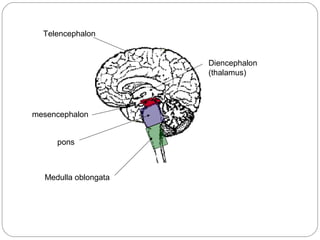
mesencephalon
pons
Medulla oblongata
Diencephalon
(thalamus)
Telencephalon
What happen if your head
got injured?
Subcutaneus haematom
Epidural haematom
Subdural hameatom
Subarachnoid bleeding/haemorrhage
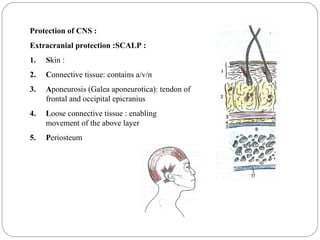
Protection of CNS :
Extracranial protection :SCALP :
1. Skin :
2. Connective tissue: contains a/v/n
3. Aponeurosis (Galea aponeurotica): tendon of
frontal and occipital epicranius
4. Loose connective tissue : enabling
movement of the above layer
5. Periosteum
Intracranial protection : MENINGES
duramater
arachnoid
piamater
periosteal
meningeal
Epidural space (potential)
Subdural space (potential)
Subarachnoid space
(actual)
What is the contain of
subarachnoid space?
Sinus duramatris
Epidural Haematom : occurred
when a.meningea media is ruptured.
The blood will fill the epidural space
Subdural haematom : occurred
when bridging vein (connects
cerebral vein to sinus sagitalis
superior) is ruptured..
Subarachnoid bleeding : occurred
when an aneurism of large artery of
the brain is ruptured. The blood fills
the subarachnoid space  usually
no space occupying lesion (SOL)
Intracerebral haemorrhage
(cerebrovascular accident) occurred
when small branch of artery is
ruptured.
Have you seen a newborn baby with a
very big head?
What do you think that cause this abnormality?
Ventricles (located inside the brain)
Lateral ventricles are located in cerebral
hemispheres and have several horns
•Anterior horn (frontal lobe)
•Posterior horn (occipital lobe)
•Inferior horn (temporal lobe)
Third ventricle : located in thalamus
Aquaductus cerebri Sylvii (cerebral
aquaduct)
Fourth ventricle  foramen luscha and
foramen Magendie
Central canal : along the spinal cord but
usually undergo obliteration
* On the wall of each ventricle there are choroidal
plexus which produce cerebrospinal fluid/CSF
CSF circulation
Choroid plexus
V.I-II – V.III – V.IV
Subarachnoid space
Granulatio arachnoidales
Pachioni
Sinus duramatris
Sinus duramatris
1. Falx cerebri
2. Falx cerebelli .
3. Tentorium cerebelli
4. Diafragma sellae
5. Sinus sagitalis superior
6. Sinus sagitalis inferior
7. Vena cerebri magna Galeni
8. Sinus rectus
9. Confluen sinuum
10. Sinus transversus
11. Sinus sigmoid
12. Vena jugularis
13. Sinus perosus superior
14. Sinus petrosus inferior
15. Sinus cavernosus
16. Vena ophtalmica
17. Menghub. Sinus sphenoparietalis
18. Lacuna lateralis
19. Vena emissaria
20. granulatio aracnoidales
In case of meningitis or encephalitis we
should
examine the CSF.
How can we get sample of CSF?
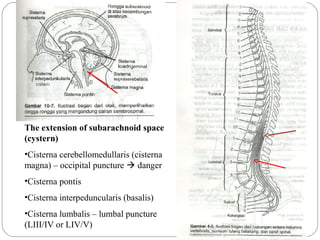
The extension of subarachnoid space
(cystern)
•Cisterna cerebellomedullaris (cisterna
magna) – occipital puncture  danger
•Cisterna pontis
•Cisterna interpeduncularis (basalis)
•Cisterna lumbalis – lumbal puncture
(LIII/IV or LIV/V)
Homework:
At what level of vertebral bone whould we puncture to get
CSF sample in a baby?
You know that if a patient get cerebrovascular accident he
usually get paralysis. However, can you explain why patient
A get arm and facial paralysis meanwhile patient B get leg
paralysis only. How can it be?
a.carotis
internaa.cerebri
anterior
a.communicans
anterior
a.cerebri
media
a.cerebri
posterior
a.communicans
posterior
a.basilaris
a.cerebelli superior
a.cerebelli inferior
anterior
a.cerebelli inferior
posterior
a.basilaris
a.vertebralis
L
A
H
Look at the picture of motor
homonculus
L
A
H
Homework :
Can infection of orbital or facial region affect the brain?
Patient A got paralysis of arm, leg, and face on the left side.
What area was probably affected?
Mr. X fell down in the bathroom and got paralysis of his left
arm and left leg. His facial muscles also got paralysis on the
right side! Thus, the facial muscles got paralysis on the right
side meanwhile the limb muscle got paralysis on the left side.
Where is the location of the affected area?
Cerebral cortex – brainstem – spinal cord?
lesion
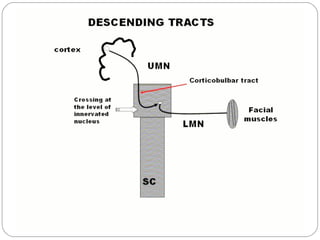
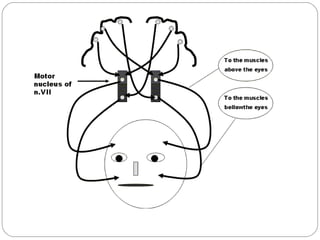
Mr. Y ride a motorcycle in a very long distance. After he got
off his bike he found that his facial muscle was retracted to
the left side. He couldn’t close his right eye. What happen
to Mr.Y?
Homework :
Mr. Z got cerebrovascular accident. According to the
attendant physician, he got an infarction at the area of left
internal capsule.
What limbs would get paralysis?
Could he close his both eyes?
To what side his face should be retracted?
If he ordered to protrude his tongue, to what side the tongue
would move?
Mr. A, fell down the stairs and got a back injury. He
complained that his right leg up to his right belly under the
navel was numb. It was proven by the absence of pain when
the doctor pinched the skin of the affected vigorously. When
he was ordere to lift his two legs, he could only lift his right
leg meanwhile his left leg was paralized.
According to the attending doctor Mr. Amir got hemisection
of the spinal cord.
Which segment of the spinal cord was injured?
Mention the injured pathways!
What were the result of the reflect examination of the patient?
What were the results of the discriminative tactile examination
of his both leg?
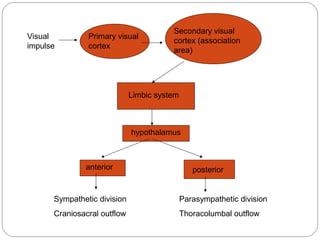
One day, Anto watched a horror film. When he saw a
murderer killed the victim, Anto’s face became pale,
sweated very much, and his heartbeat increased.
Can you explain how the visual impulse can be interpreted and
influence the autonomic nervous system?
Visual
impulse
Primary visual
cortex
Secondary visual
cortex (association
area)
Limbic system
hypothalamus
anterior posterior
Sympathetic division
Craniosacral outflow
Parasympathetic division
Thoracolumbal outflow
A physician found that Mr.Heru got pupillary constriction,
slight ptosis, and decreased sweating. The patient had a
history of pancoast tumor, tumor that affect the apex of the
lung.
What do you think to be the cause of the symptoms?
Lecture on peripheral nervous system and its clinical aspects
will be given in musculoskeletal module.
Thank You!
gregorybudiman@yahoo.com
http://scele.ui.ac.id  fakultas kedokteran  modul
neuroscience (neuroanatomi) by Deswaty F, M.Biomed

Neuroanatomy lecture

  • 1.
    Problem Based Approach Dr.Gregory Budiman NEUROANATOMY
  • 2.
    The aim ofthe lecture : To help instantly understood neuroanatomy that is essential to this module To give summary of clinically relevant neuroanatomy with examples of medical cases. Stephen Goldberg : Most lecturers provide far more detail than is necessary to applied anatomy. As a result student becomes confused by mazes of unimportant structures.
  • 3.
    What to do: Before discussion : Watch and study the DVD : Gross Neuroanatomy Basic Neuronatomical Pathways Jaras-jaras Neuroanatomi During the discussion Use Basic Neuroanatomical Pathways (Gregory) and Clinical Neuroanatomy (Snell) as references
  • 4.
    How can impulsebe transmitted in our body? (physiology) What structures supports the transmission of the impluse in our body?
  • 5.
    Central nervous system BRAIN Spinalcord Ascending tracts Descending tracts Sensory nerve Motor nerve Receptor effector Peripheral Nervous System Aff Eff
  • 7.
  • 8.
    What happen ifyour head got injured? Subcutaneus haematom Epidural haematom Subdural hameatom Subarachnoid bleeding/haemorrhage
  • 9.
    Protection of CNS: Extracranial protection :SCALP : 1. Skin : 2. Connective tissue: contains a/v/n 3. Aponeurosis (Galea aponeurotica): tendon of frontal and occipital epicranius 4. Loose connective tissue : enabling movement of the above layer 5. Periosteum
  • 10.
    Intracranial protection :MENINGES duramater arachnoid piamater periosteal meningeal Epidural space (potential) Subdural space (potential) Subarachnoid space (actual) What is the contain of subarachnoid space? Sinus duramatris
  • 11.
    Epidural Haematom :occurred when a.meningea media is ruptured. The blood will fill the epidural space Subdural haematom : occurred when bridging vein (connects cerebral vein to sinus sagitalis superior) is ruptured.. Subarachnoid bleeding : occurred when an aneurism of large artery of the brain is ruptured. The blood fills the subarachnoid space  usually no space occupying lesion (SOL) Intracerebral haemorrhage (cerebrovascular accident) occurred when small branch of artery is ruptured.
  • 12.
    Have you seena newborn baby with a very big head? What do you think that cause this abnormality?
  • 13.
    Ventricles (located insidethe brain) Lateral ventricles are located in cerebral hemispheres and have several horns •Anterior horn (frontal lobe) •Posterior horn (occipital lobe) •Inferior horn (temporal lobe) Third ventricle : located in thalamus Aquaductus cerebri Sylvii (cerebral aquaduct) Fourth ventricle  foramen luscha and foramen Magendie Central canal : along the spinal cord but usually undergo obliteration * On the wall of each ventricle there are choroidal plexus which produce cerebrospinal fluid/CSF
  • 14.
    CSF circulation Choroid plexus V.I-II– V.III – V.IV Subarachnoid space Granulatio arachnoidales Pachioni Sinus duramatris
  • 15.
    Sinus duramatris 1. Falxcerebri 2. Falx cerebelli . 3. Tentorium cerebelli 4. Diafragma sellae 5. Sinus sagitalis superior 6. Sinus sagitalis inferior 7. Vena cerebri magna Galeni 8. Sinus rectus 9. Confluen sinuum 10. Sinus transversus 11. Sinus sigmoid 12. Vena jugularis 13. Sinus perosus superior 14. Sinus petrosus inferior 15. Sinus cavernosus 16. Vena ophtalmica 17. Menghub. Sinus sphenoparietalis 18. Lacuna lateralis 19. Vena emissaria 20. granulatio aracnoidales
  • 16.
    In case ofmeningitis or encephalitis we should examine the CSF. How can we get sample of CSF?
  • 17.
    The extension ofsubarachnoid space (cystern) •Cisterna cerebellomedullaris (cisterna magna) – occipital puncture  danger •Cisterna pontis •Cisterna interpeduncularis (basalis) •Cisterna lumbalis – lumbal puncture (LIII/IV or LIV/V)
  • 18.
    Homework: At what levelof vertebral bone whould we puncture to get CSF sample in a baby?
  • 19.
    You know thatif a patient get cerebrovascular accident he usually get paralysis. However, can you explain why patient A get arm and facial paralysis meanwhile patient B get leg paralysis only. How can it be?
  • 20.
  • 21.
    a.cerebelli superior a.cerebelli inferior anterior a.cerebelliinferior posterior a.basilaris a.vertebralis
  • 22.
    L A H Look at thepicture of motor homonculus
  • 23.
  • 24.
    Homework : Can infectionof orbital or facial region affect the brain? Patient A got paralysis of arm, leg, and face on the left side. What area was probably affected?
  • 25.
    Mr. X felldown in the bathroom and got paralysis of his left arm and left leg. His facial muscles also got paralysis on the right side! Thus, the facial muscles got paralysis on the right side meanwhile the limb muscle got paralysis on the left side. Where is the location of the affected area? Cerebral cortex – brainstem – spinal cord?
  • 28.
  • 29.
    Mr. Y ridea motorcycle in a very long distance. After he got off his bike he found that his facial muscle was retracted to the left side. He couldn’t close his right eye. What happen to Mr.Y?
  • 32.
    Homework : Mr. Zgot cerebrovascular accident. According to the attendant physician, he got an infarction at the area of left internal capsule. What limbs would get paralysis? Could he close his both eyes? To what side his face should be retracted? If he ordered to protrude his tongue, to what side the tongue would move?
  • 33.
    Mr. A, felldown the stairs and got a back injury. He complained that his right leg up to his right belly under the navel was numb. It was proven by the absence of pain when the doctor pinched the skin of the affected vigorously. When he was ordere to lift his two legs, he could only lift his right leg meanwhile his left leg was paralized.
  • 34.
    According to theattending doctor Mr. Amir got hemisection of the spinal cord. Which segment of the spinal cord was injured? Mention the injured pathways! What were the result of the reflect examination of the patient? What were the results of the discriminative tactile examination of his both leg?
  • 40.
    One day, Antowatched a horror film. When he saw a murderer killed the victim, Anto’s face became pale, sweated very much, and his heartbeat increased. Can you explain how the visual impulse can be interpreted and influence the autonomic nervous system?
  • 41.
    Visual impulse Primary visual cortex Secondary visual cortex(association area) Limbic system hypothalamus anterior posterior Sympathetic division Craniosacral outflow Parasympathetic division Thoracolumbal outflow
  • 45.
    A physician foundthat Mr.Heru got pupillary constriction, slight ptosis, and decreased sweating. The patient had a history of pancoast tumor, tumor that affect the apex of the lung. What do you think to be the cause of the symptoms?
  • 48.
    Lecture on peripheralnervous system and its clinical aspects will be given in musculoskeletal module.
  • 49.
    Thank You! gregorybudiman@yahoo.com http://scele.ui.ac.id fakultas kedokteran  modul neuroscience (neuroanatomi) by Deswaty F, M.Biomed