Neurological System Nursing 330 Governors State University Shirley Comer
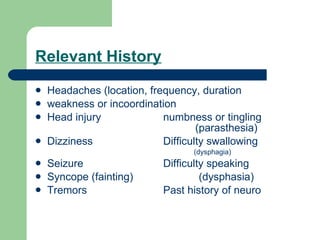
Relevant History Headaches (location, frequency, duration weakness or incoordination Head injury numbness or tingling  (parasthesia) Dizziness Difficulty swallowing (dysphagia) Seizure Difficulty speaking Syncope (fainting)  (dysphasia) Tremors Past history of neuro
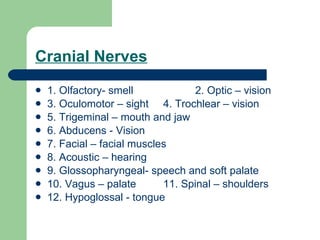
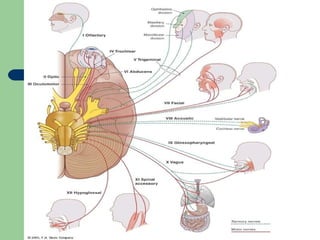
Cranial Nerves 1. Olfactory- smell 2. Optic – vision 3. Oculomotor – sight 4. Trochlear – vision 5. Trigeminal – mouth and jaw  6. Abducens - Vision 7. Facial – facial muscles 8. Acoustic – hearing 9. Glossopharyngeal- speech and soft palate 10. Vagus – palate  11. Spinal – shoulders 12. Hypoglossal - tongue
Pix Cranial Nerves
Testing Cranial Nerves I - Olfactory- test when pt reports decreased sense of smell Place aromatic substance under each nostril  Should be able to identify bilaterally II – Optic  Test visual fields Use ophthalmoscope to examine retina and observe optic disk
Testing Cont III, IV, and VI – Oculomotor, Trochlear and Abducens Observe pupil size and reactivity (PERRLA) Assess extraocular movements and cardinal positions of gaze Nystagmus oscillation of eye abnormal Ptosis – drooping eye lids
Testing Cont V –  Trigeminal Palpate muscles as pt clenches teeth Test sensory function by touching cotton wisp to face /c eyes closed. Pt says “now” when felt Corneal Reflex for those /c abnormal facial movements Touch cotton to cornea – should blink bilaterally VII – Facial  Observe for facial symmetry Smile, frown Close eyes Lift eyebrows Puff cheeks
Testing Cont VIII – Acoustic – test hearing acuity with whispered voice, Rinne and Weber tests IX and X – Glossopharyngeal and Vagus Watch uvula as pt says “Ahhh”- use tongue blade Test gag reflex when appropriate – use blade XI – Spinal Accessory  Shrug shoulders and turn head against your resistance XII – Hypoglossal – stick out tongue No tremors or deviations from midline
Cerebellar Function Gait  – normal gait smooth with arms swinging opposite. Step is 15 inches Walk 10 to 20 feet- Ataxia= uncoordinated or unsteady gait Walk heel to toe – will accentuate any problems Balance Romberg test- stand /c hands at side and feet together /c eyes closed Should hold position (protect pt from fall) Hop in place – demonstrates normal strength and cerebellar function
Coordination and Skilled Movements Rapid Alternating Movements Pat knee alternating palm /c back of hand and increase speed Finger to finger test Touch your finger and then touch his nose- change finger position several times Finger to nose test /c eyes closed have pt touch his own nose /c out stretched arms Heel to shin test While supine have pt touch  heel to opposite shin and slide heel down leg
Sensory System Test sensory function of extremities and trunk  Perform on those exhibiting deficits Pain Use pin prick- ask pt if dull or sharp Do bilaterally and compare Temperature - do only when pain is abnormal Test tubes of hot v. cold water Light touch - Use cotton wisp
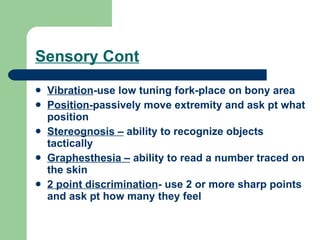
Sensory Cont Vibration -use low tuning fork-place on bony area Position- passively move extremity and ask pt what position Stereognosis –  ability to recognize objects tactically Graphesthesia –  ability to read a number traced on the skin 2 point discrimination - use 2 or more sharp points and ask pt how many they feel
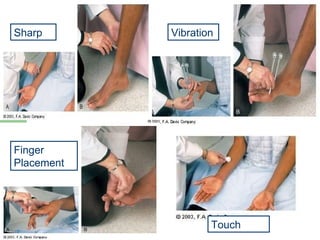
Sensory assessment pix Sharp Vibration Finger Placement Touch
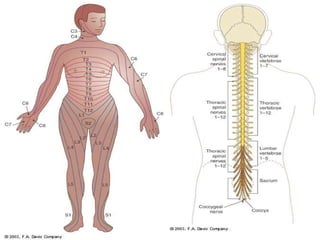
Dermatomes/spine
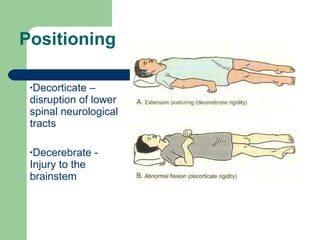
Positioning Decorticate – disruption of lower spinal neurological tracts Decerebrate -  Injury to the brainstem
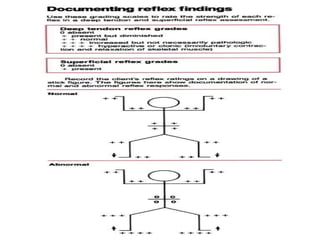
Deep Tendon Reflexes 4+ =Very Brisk, hyperactive /c clonus 3+ = more brisk than average 2+ = average, normal 1+ = Diminished, Low normal 0 = no response
Deep Tendon Reflexes cont Hyperreflexia  an exaggerated reflex  occurs /c upper motor neuron lesions Hyporeflexia  absense of reflex  occurs /c lower motor neuron lesion Clonus – set of short jerky contractions of the muscle
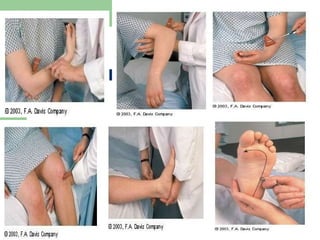
Deep Tendon Reflexes cont Biceps- above antecubital area on inner arm place thumb on biceps tendon Triceps – above elbow lift arm at elbow Brachioradialis- above thumb on arm  lift thumb Quadriceps – below knee Let leg dangle Achilles – behind heel Dorsal flex foot
 
 
Superficial Reflexes Abdominal reflex – stroke abdomen from flank toward umbilicus Cremasteric Reflex – stroke inner thigh of male should result in elevation of testicle  Babinski Reflex – stroke lateral side of sole of foot in upside down “J” pattern In adult- toes curl In infants- toes fan
Mental Status A person’s emotional and cognitive functioning.  Mental Status is subjective and Inferred from Consciousness Language Mood and affect Orientation Attention Memory Abstract reasoning Thought process Thought content  perceptions
Factors Effecting Mental Status Evaluation Illness or health problems Current medications and their side effects Educational background Usual behavior Stress level Sleep habits Drug and alcohol use
Levels of Consciousness Alert-  awake and easily arousable- oriented x3 Lethargic  (somnolent)-Difficult to arouse, drowsy, thinking slow but appropriate Obtunded -  Sleeps most of the time, confused when aroused, speech mumbled Stupor  ( semi comatose)- responds only to vigorous shake or pain  non verbal except for moans ect Unresponsive -  completely unconscious, no response to pain Delirium - awake but extremely confused esp @ noc, may be violent, incoherent speech
Assessing Level of Consciousness 1 st  call name, if no response call louder 2 nd  call name and lightly touch person 3 rd  call name and shake shoulder of person, if no response shake harder 4 th  Apply pain Sternal rub Pressure on eyebrow ridge  Pinch sternal or chest area Don’t pinch or twist nipples May try shining light in eye
Assess Cognitive Function Orientation Time, Place and Person = oriented x 3 Attention span Recent memory- often impaired in Alzheimer’s Remote memory- often intact even when acutely confused Judgment- assists in planning safety needs
Assess Thought Process and Perceptions Thought Processes - are thoughts logical and orderly Thought content - is the subject appropriate and logical Perceptions-  How does world treat him- paranoid? Screen for suicidal thoughts - If depressed ask about thoughts “have you felt like hurting yourself”
Age Specific Consideration Infants and children  may be difficult to assess r/t lack of verbal skills Must use keen observation Teens appearance is often bizarre Elderly may be forgetful or slow to answer give them adequate time to respond
Age Specific Considerations Infants  Cannot directly assess cranial nerves, must observe infant behavior II,III,IV,VI – assess pupil response, regards face of others, blinks eyes in response to light V- Rooting and sucking reflexes VII – Facial movements, smiling, wrinkling forehead, symmetrical VIII- Moro Reflex /c loud noise to 4 months IX, X – Swallowing, gag reflex XII- Pinch infant’s nose results in mouth opening /c tongue midline
Age Specific Considerations cont Infants (cont) Observe for symmetrical movements Denver Developmental assessment Infants prefer a flexed position Head lag, limp, floppy trunk are abnormal Spasticity is a sign of Cerebral Palsy
Age Specific Considerations cont Infant Reflexes Rooting reflex – will turn head to side when cheek is touched – lasts till 3-4 months Sucking Reflex-will suck anything in mouth- lasts until 1 yr Palmer Grasp- will grasp anything in hand – lasts until 3-4 months Planter grasp – toes curl – lasts till 8-10 months
Infant reflexes Cont Babinski- toes fan until 24 months Moro – startle reflex –  throws out limbs and then pulls in - lasts 1 to 4 months Stepping Reflex – will place feet as if walking until 1 yo
Age Specific Considerations cont Children Use Denver II to screen for developmental delays Toddlers have broad gait DTR are hard to assess as child cannot cooperate Observe child’s voluntary movements Make sure child cognitively understands test directions before recording a deficit
Age Specific Considerations cont Elderly Responses may be slower Taste and smell may decrease Senile Tremors may occur, hands, head, tongue Slow and deliberate gait r/t decreased spacial sense /p 65 Achilles reflex often absent DTR less brisk Abdominal reflex may be lost if obese or skin has been stretched in pregnancy
Practice Exam Question 1 In report, the previous nurse told you that Mr.  Jones was alert and oriented x 3.  While assessing Mr. Jones, you find him to be slow to respond but mostly appropriate.  His speech is slurred and he often falls asleep during your assessment.  How would you describe Mr. Jones, mental status? A. He is alert and oriented just somewhat slow B. He is obtunded C. He is alert but not oriented D. He is Oriented but not alert
Rationale D is the correct answer. He is not alert and this represents a change in his status which requires notifying the PHCP.
Practice exam Question 2 Mrs. James has fallen and has a subdural hematoma. She is having trouble keeping her mouth closed and is drooling.  What can you do to assess the appropriate cranial nerve? A. Have her blink rapidly B. have her clench her jaw and assess the muscle strength C. Use a cotton wisp and gently touch her cornea D. use a cotton wisp and gently touch her face
Rationale B is the right answer.  Cranial nerve V (Trigeminal) controls the jaw muscles

Neurological System

  • 1.
    Neurological System Nursing330 Governors State University Shirley Comer
  • 2.
    Relevant History Headaches(location, frequency, duration weakness or incoordination Head injury numbness or tingling (parasthesia) Dizziness Difficulty swallowing (dysphagia) Seizure Difficulty speaking Syncope (fainting) (dysphasia) Tremors Past history of neuro
  • 3.
    Cranial Nerves 1.Olfactory- smell 2. Optic – vision 3. Oculomotor – sight 4. Trochlear – vision 5. Trigeminal – mouth and jaw 6. Abducens - Vision 7. Facial – facial muscles 8. Acoustic – hearing 9. Glossopharyngeal- speech and soft palate 10. Vagus – palate 11. Spinal – shoulders 12. Hypoglossal - tongue
  • 4.
  • 5.
    Testing Cranial NervesI - Olfactory- test when pt reports decreased sense of smell Place aromatic substance under each nostril Should be able to identify bilaterally II – Optic Test visual fields Use ophthalmoscope to examine retina and observe optic disk
  • 6.
    Testing Cont III,IV, and VI – Oculomotor, Trochlear and Abducens Observe pupil size and reactivity (PERRLA) Assess extraocular movements and cardinal positions of gaze Nystagmus oscillation of eye abnormal Ptosis – drooping eye lids
  • 7.
    Testing Cont V– Trigeminal Palpate muscles as pt clenches teeth Test sensory function by touching cotton wisp to face /c eyes closed. Pt says “now” when felt Corneal Reflex for those /c abnormal facial movements Touch cotton to cornea – should blink bilaterally VII – Facial Observe for facial symmetry Smile, frown Close eyes Lift eyebrows Puff cheeks
  • 8.
    Testing Cont VIII– Acoustic – test hearing acuity with whispered voice, Rinne and Weber tests IX and X – Glossopharyngeal and Vagus Watch uvula as pt says “Ahhh”- use tongue blade Test gag reflex when appropriate – use blade XI – Spinal Accessory Shrug shoulders and turn head against your resistance XII – Hypoglossal – stick out tongue No tremors or deviations from midline
  • 9.
    Cerebellar Function Gait – normal gait smooth with arms swinging opposite. Step is 15 inches Walk 10 to 20 feet- Ataxia= uncoordinated or unsteady gait Walk heel to toe – will accentuate any problems Balance Romberg test- stand /c hands at side and feet together /c eyes closed Should hold position (protect pt from fall) Hop in place – demonstrates normal strength and cerebellar function
  • 10.
    Coordination and SkilledMovements Rapid Alternating Movements Pat knee alternating palm /c back of hand and increase speed Finger to finger test Touch your finger and then touch his nose- change finger position several times Finger to nose test /c eyes closed have pt touch his own nose /c out stretched arms Heel to shin test While supine have pt touch heel to opposite shin and slide heel down leg
  • 11.
    Sensory System Testsensory function of extremities and trunk Perform on those exhibiting deficits Pain Use pin prick- ask pt if dull or sharp Do bilaterally and compare Temperature - do only when pain is abnormal Test tubes of hot v. cold water Light touch - Use cotton wisp
  • 12.
    Sensory Cont Vibration-use low tuning fork-place on bony area Position- passively move extremity and ask pt what position Stereognosis – ability to recognize objects tactically Graphesthesia – ability to read a number traced on the skin 2 point discrimination - use 2 or more sharp points and ask pt how many they feel
  • 13.
    Sensory assessment pixSharp Vibration Finger Placement Touch
  • 14.
  • 15.
    Positioning Decorticate –disruption of lower spinal neurological tracts Decerebrate - Injury to the brainstem
  • 16.
    Deep Tendon Reflexes4+ =Very Brisk, hyperactive /c clonus 3+ = more brisk than average 2+ = average, normal 1+ = Diminished, Low normal 0 = no response
  • 17.
    Deep Tendon Reflexescont Hyperreflexia an exaggerated reflex occurs /c upper motor neuron lesions Hyporeflexia absense of reflex occurs /c lower motor neuron lesion Clonus – set of short jerky contractions of the muscle
  • 18.
    Deep Tendon Reflexescont Biceps- above antecubital area on inner arm place thumb on biceps tendon Triceps – above elbow lift arm at elbow Brachioradialis- above thumb on arm lift thumb Quadriceps – below knee Let leg dangle Achilles – behind heel Dorsal flex foot
  • 19.
  • 20.
  • 21.
    Superficial Reflexes Abdominalreflex – stroke abdomen from flank toward umbilicus Cremasteric Reflex – stroke inner thigh of male should result in elevation of testicle Babinski Reflex – stroke lateral side of sole of foot in upside down “J” pattern In adult- toes curl In infants- toes fan
  • 22.
    Mental Status Aperson’s emotional and cognitive functioning. Mental Status is subjective and Inferred from Consciousness Language Mood and affect Orientation Attention Memory Abstract reasoning Thought process Thought content perceptions
  • 23.
    Factors Effecting MentalStatus Evaluation Illness or health problems Current medications and their side effects Educational background Usual behavior Stress level Sleep habits Drug and alcohol use
  • 24.
    Levels of ConsciousnessAlert- awake and easily arousable- oriented x3 Lethargic (somnolent)-Difficult to arouse, drowsy, thinking slow but appropriate Obtunded - Sleeps most of the time, confused when aroused, speech mumbled Stupor ( semi comatose)- responds only to vigorous shake or pain non verbal except for moans ect Unresponsive - completely unconscious, no response to pain Delirium - awake but extremely confused esp @ noc, may be violent, incoherent speech
  • 25.
    Assessing Level ofConsciousness 1 st call name, if no response call louder 2 nd call name and lightly touch person 3 rd call name and shake shoulder of person, if no response shake harder 4 th Apply pain Sternal rub Pressure on eyebrow ridge Pinch sternal or chest area Don’t pinch or twist nipples May try shining light in eye
  • 26.
    Assess Cognitive FunctionOrientation Time, Place and Person = oriented x 3 Attention span Recent memory- often impaired in Alzheimer’s Remote memory- often intact even when acutely confused Judgment- assists in planning safety needs
  • 27.
    Assess Thought Processand Perceptions Thought Processes - are thoughts logical and orderly Thought content - is the subject appropriate and logical Perceptions- How does world treat him- paranoid? Screen for suicidal thoughts - If depressed ask about thoughts “have you felt like hurting yourself”
  • 28.
    Age Specific ConsiderationInfants and children may be difficult to assess r/t lack of verbal skills Must use keen observation Teens appearance is often bizarre Elderly may be forgetful or slow to answer give them adequate time to respond
  • 29.
    Age Specific ConsiderationsInfants Cannot directly assess cranial nerves, must observe infant behavior II,III,IV,VI – assess pupil response, regards face of others, blinks eyes in response to light V- Rooting and sucking reflexes VII – Facial movements, smiling, wrinkling forehead, symmetrical VIII- Moro Reflex /c loud noise to 4 months IX, X – Swallowing, gag reflex XII- Pinch infant’s nose results in mouth opening /c tongue midline
  • 30.
    Age Specific Considerationscont Infants (cont) Observe for symmetrical movements Denver Developmental assessment Infants prefer a flexed position Head lag, limp, floppy trunk are abnormal Spasticity is a sign of Cerebral Palsy
  • 31.
    Age Specific Considerationscont Infant Reflexes Rooting reflex – will turn head to side when cheek is touched – lasts till 3-4 months Sucking Reflex-will suck anything in mouth- lasts until 1 yr Palmer Grasp- will grasp anything in hand – lasts until 3-4 months Planter grasp – toes curl – lasts till 8-10 months
  • 32.
    Infant reflexes ContBabinski- toes fan until 24 months Moro – startle reflex – throws out limbs and then pulls in - lasts 1 to 4 months Stepping Reflex – will place feet as if walking until 1 yo
  • 33.
    Age Specific Considerationscont Children Use Denver II to screen for developmental delays Toddlers have broad gait DTR are hard to assess as child cannot cooperate Observe child’s voluntary movements Make sure child cognitively understands test directions before recording a deficit
  • 34.
    Age Specific Considerationscont Elderly Responses may be slower Taste and smell may decrease Senile Tremors may occur, hands, head, tongue Slow and deliberate gait r/t decreased spacial sense /p 65 Achilles reflex often absent DTR less brisk Abdominal reflex may be lost if obese or skin has been stretched in pregnancy
  • 35.
    Practice Exam Question1 In report, the previous nurse told you that Mr. Jones was alert and oriented x 3. While assessing Mr. Jones, you find him to be slow to respond but mostly appropriate. His speech is slurred and he often falls asleep during your assessment. How would you describe Mr. Jones, mental status? A. He is alert and oriented just somewhat slow B. He is obtunded C. He is alert but not oriented D. He is Oriented but not alert
  • 36.
    Rationale D isthe correct answer. He is not alert and this represents a change in his status which requires notifying the PHCP.
  • 37.
    Practice exam Question2 Mrs. James has fallen and has a subdural hematoma. She is having trouble keeping her mouth closed and is drooling. What can you do to assess the appropriate cranial nerve? A. Have her blink rapidly B. have her clench her jaw and assess the muscle strength C. Use a cotton wisp and gently touch her cornea D. use a cotton wisp and gently touch her face
  • 38.
    Rationale B isthe right answer. Cranial nerve V (Trigeminal) controls the jaw muscles