THE BRAIN
4 major parts of the brain:
(a) Brain stem
(b) Cerebellum
(c) Diencephalon (thalamus, hypothalamus, epithalamus)
(d) Cerebrum
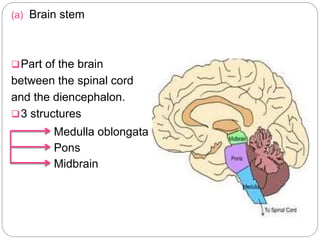
(a) Brain stem
Part of the brain
between the spinal cord
and the diencephalon.
3 structures
Medulla oblongata
Pons
Midbrain
Medulla Oblongata
 Medulla’s white matter
Ascending (sensory) tracts
Descending (motor) tracts
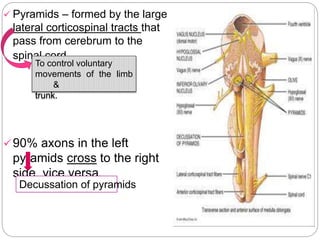
 Pyramids – formed by the large
lateral corticospinal tracts that
pass from cerebrum to the
spinal cord.
90% axons in the left
pyramids cross to the right
side, vice versa.
To control voluntary
movements of the limb
&
trunk.
Decussation of pyramids
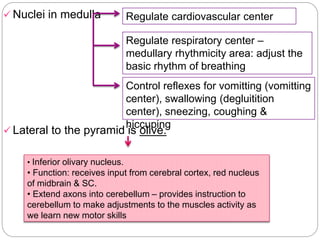
 Nuclei in medulla
 Lateral to the pyramid is olive.
• Inferior olivary nucleus.
• Function: receives input from cerebral cortex, red nucleus
of midbrain & SC.
• Extend axons into cerebellum – provides instruction to
cerebellum to make adjustments to the muscles activity as
we learn new motor skills
Regulate cardiovascular center
Regulate respiratory center –
medullary rhythmicity area: adjust the
basic rhythm of breathing
Control reflexes for vomitting (vomitting
center), swallowing (degluitition
center), sneezing, coughing &
hiccuping
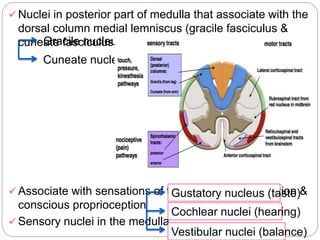
 Nuclei in posterior part of medulla that associate with the
dorsal column medial lemniscus (gracile fasciculus &
cuneate fasciculus):
 Associate with sensations of touch, pressure, vibration &
conscious proprioception
 Sensory nuclei in the medulla
Gracile nucleus
Cuneate nucleus
Gustatory nucleus (taste)
Cochlear nuclei (hearing)
Vestibular nuclei (balance)
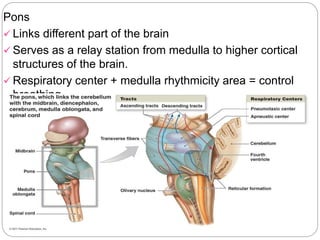
Pons
 Links different part of the brain
 Serves as a relay station from medulla to higher cortical
structures of the brain.
 Respiratory center + medulla rhythmicity area = control
breathing
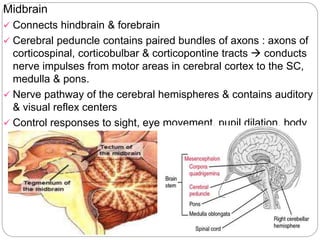
Midbrain
 Connects hindbrain & forebrain
 Cerebral peduncle contains paired bundles of axons : axons of
corticospinal, corticobulbar & corticopontine tracts  conducts
nerve impulses from motor areas in cerebral cortex to the SC,
medulla & pons.
 Nerve pathway of the cerebral hemispheres & contains auditory
& visual reflex centers
 Control responses to sight, eye movement, pupil dilation, body
movement & hearing
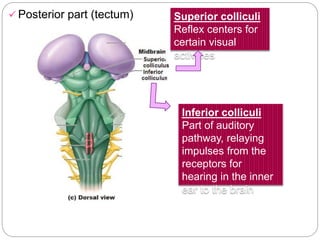
 Posterior part (tectum) Superior colliculi
Reflex centers for
certain visual
activities
Inferior colliculi
Part of auditory
pathway, relaying
impulses from the
receptors for
hearing in the inner
ear to the brain
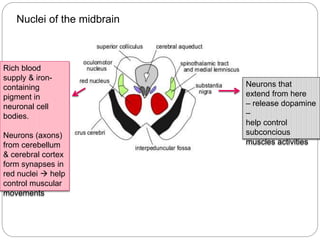
Nuclei of the midbrain
Neurons that
extend from here
– release dopamine
–
help control
subconcious
muscles activities
Rich blood
supply & iron-
containing
pigment in
neuronal cell
bodies.
Neurons (axons)
from cerebellum
& cerebral cortex
form synapses in
red nuclei  help
control muscular
movements
What a physiotherapist should know?
1. There are 4 structures in the ‘midline‘ beginning with M
2. There are 4 structures to the ‘side‘ (lateral) beginning with S
3. There are 4 cranial nerves in the medulla, 4 in the pons and 4 above
the pons(2 in the midbrain)
4. The 4 motor nuclei that are in the midline are those that divide equally
into 12 except for 1 and 2, that is 3, 4, 6 and 12 (5, 7, 9 and 11 are in the
lateral brainstem)
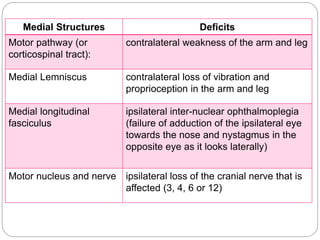
Medial Structures Deficits
Motor pathway (or
corticospinal tract):
contralateral weakness of the arm and leg
Medial Lemniscus contralateral loss of vibration and
proprioception in the arm and leg
Medial longitudinal
fasciculus
ipsilateral inter-nuclear ophthalmoplegia
(failure of adduction of the ipsilateral eye
towards the nose and nystagmus in the
opposite eye as it looks laterally)
Motor nucleus and nerve ipsilateral loss of the cranial nerve that is
affected (3, 4, 6 or 12)
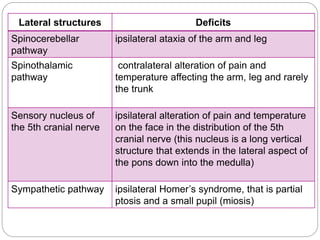
Lateral structures Deficits
Spinocerebellar
pathway
ipsilateral ataxia of the arm and leg
Spinothalamic
pathway
contralateral alteration of pain and
temperature affecting the arm, leg and rarely
the trunk
Sensory nucleus of
the 5th cranial nerve
ipsilateral alteration of pain and temperature
on the face in the distribution of the 5th
cranial nerve (this nucleus is a long vertical
structure that extends in the lateral aspect of
the pons down into the medulla)
Sympathetic pathway ipsilateral Homer’s syndrome, that is partial
ptosis and a small pupil (miosis)
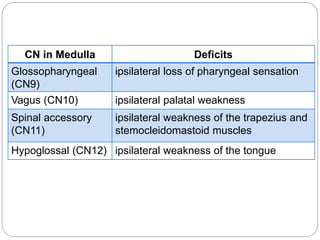
CN in Medulla Deficits
Glossopharyngeal
(CN9)
ipsilateral loss of pharyngeal sensation
Vagus (CN10) ipsilateral palatal weakness
Spinal accessory
(CN11)
ipsilateral weakness of the trapezius and
stemocleidomastoid muscles
Hypoglossal (CN12) ipsilateral weakness of the tongue
CN in Pons Deficits
Trigeminal (CN5) ipsilateral alteration of pain, temperature and light
touch on the face back as far as the anterior two-
thirds of the scalp and sparing the angle of the
jaw.
Abducent (CN6) ipsilateral weakness of abduction (lateral
movement) of the eye (lateral rectus)
Facial (CN7) ipsilateral facial weakness
Auditory (CN8) ipsilateral deafness.The 6th cranial nerve is the
motor nerve in the medial pons
CN above Pons Deficits
Oculomotor
(CN3)
impaired adduction, supradduction and
infradduction of the ipsilateral eye with or without
a dilated pupil. The eye is turned out and slightly
down
Trochlear (CN4):
eye unable to look down when the eye is looking
in towards the nose (superior oblique).The 3rd
(b) Cerebellum
primarily contains efferent
fibers from the cerebellar
nuclei, as well as some
afferents from the
spinocerebellar tract.
primarily contains
afferents from the pontine
nuclei (from motor areas
of the cerebral cortex) into
cerebellum
primarily contains afferent
fibers from the medulla, as
well as efferents to the
vestibular nuclei
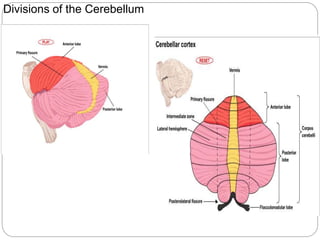
Divisions of the Cerebellum
Functional subdivisions of cerebellum
Cerebrocerebellum
• consist of lateral
hemisphere& the dentate
nuclei.
• its extensive
connections with the
cerebral cortex, via the
pontine nuclei (afferents)
and the VL thalamus
(efferents).
•Functions:
1. Planning & timing of
movement
2. Involved in cognitive
function of
cerebellum
Functional subdivisions of cerebellum
Vestibulocerebellum
• consist of
the flocculonodular
lobe and its connections
with the lateral vestibular
nuclei,
• Functions:
1. Vestibular reflexes
2. Postural
maintenance
Functional subdivisions of cerebellum
Spinocerebellum
•Consist of the vermis and
the intermediate zones , as
well as the fastigial and
interposed nuclei.
•it receives major inputs
from the spinocerebellar
tract.
•Its output projects to
rubrospinal,
vestibulospinal, and
reticulospinal tracts.
•involved in the integration
of sensory input with motor
commands to produce
adaptive motor
coordination.
What happened when there is damage to the cerebellum?
1. Decomposition of movement
2. Intention tremor
3. Dysdiadochokinesia
4. Deficits in motor learning
(c ) Diencephalon (thalamus, epithalamus &
hypothalamus)
Extends from the brainstem to the cerebrum
& surrounds 3rd ventricle:
thalamus, hypothalamus & epithalamus
•Surrounded by
cerebral hemisphere.
•Contains numerous
nuclei involved in wide
variety of sensory &
motor processing
between higher & lower
brain.
Thalamus
 The intermediate mass (interthalamic adhesion) : a
bridge of gray matter
 The internal medullary lamina: a vertical Y-shaped sheet
of white matter
Functions: to divide right side & left side of thalamus gray
matter
 Internal capsule: pathway for axons connect the
thalamus & cerebral cortex.
 Functions of thalamus:
 Major relay station for most sensory impulses that reach
primary sensory areas of the cerebral cortex from SC &
brain stem.
 Motor function (transmit information from the cerebellum
& basal nuclei to the primary motor area of the cerebral
cortex)
Receives input: the hypothalamus
Sends output: the limbic system
Functions: emotions & memory
Receive input: the limbic
system& basal nuclei
Send output: cerebral
cortex
Functions: emotions,
learning, memory &
cognition
Lateral group nuclei
Receives input: the
limbic system, superior
colliculi & cerebral
cortex
Sends output: the
cerebral cortex.
Functions:
expressions of emotions
Functions:
Help integrate
sensory
information
Receives input: the
basal nuclei
Sends output: motor
areas of cerebral
cortex
Functions: plays a
role in movement
control
Receives input:the
cerebellum & the
basal nuclei
Sends output: motor
areas of cerebral
cortex
Functions: plays a
Relays impulses for somatic
sensations: touch, pressure,
vibartion, itch, tickle,
temperature,pain &
Relays impulses for
sight from retina to
the primary visual
area of the cerebral
Relays
auditory
impulses for
hearing from
the ear to
the primary
auditory area
of cerebral
cortex
Intralaminar nuclei
(within the internal
medullary lamina)
•Connects with the
reticular formation,
cerebellum,
basal nuclei & wide
areas of the cerebral
cortex.
•Function:
- Arousal (activation of
the cerebral cortex from
the brain stem reticular
formation)
- Integration of sensory &
motor information
Midline nucleus
• a thin band adjacent to the
3rd ventricle
•Functions: memory &
olfaction
Reticular nucleus
• lateral aspect of the
thalamus
•Functions: monitors, filters
& integrate activities of
other thalamic nuclei.
Body temperature
Water balance/stress
Shivering
GI tract
satiety
Feeding
Body clock
Water balance
Blood pressure
Hypothalamus
Important functions of the hypothalamus:
 Control of the ANS
 Production of hormones
 Regulation of emotional & behavioral patterns
 Regulation of eating & drinking
 Control of body temperature
 Regulation circadian rhythms& states of consciouness
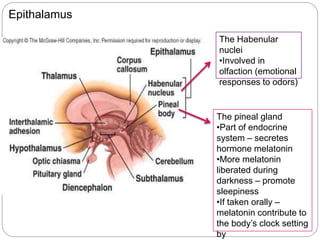
Epithalamus
The pineal gland
•Part of endocrine
system – secretes
hormone melatonin
•More melatonin
liberated during
darkness – promote
sleepiness
•If taken orally –
melatonin contribute to
the body’s clock setting
by
The Habenular
nuclei
•Involved in
olfaction (emotional
responses to odors)
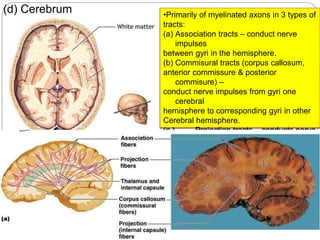
(d) Cerebrum •Primarily of myelinated axons in 3 types of
tracts:
(a) Association tracts – conduct nerve
impulses
between gyri in the hemisphere.
(b) Commisural tracts (corpus callosum,
anterior commissure & posterior
commisure) –
conduct nerve impulses from gyri one
cerebral
hemisphere to corresponding gyri in other
Cerebral hemisphere.
(c ) Projection tracts – conducts nerve
impulses
from cerebrum to lower part of CNS
(thalamus,
brainstem /SC) of from lower parta of the
CNS
To the cerebrum.
• Also known as cerebral cortex.
• Gyri : folds
• Fissures: the deepest grooves
• Sulci: the shallower grooves
between folds
• Longitudinal Fissue: prominent
fissures that
divide brain into cerebral
hemisphere
Basal Nuclei / Basal Ganglia
 receive input from cerebral cortex
Provide output to motor parts of
the cortex via the medial & ventral
group nuclei of thalamus
Major function:
•To help regulate initiation and
termination of movement
•Globus pallidus: helps regulate
muscle tone required for specific
body movements
•Control subconscious contraction of
skeletal muscles
•Initiate and terminate cognitive
processes (attention, memory,
planning & act with limbic system to
regulate emotional behaviors
The Limbic System
 “emotional brain”
 Functions:
 Promotes range of emotions,
including pleasure, pain,
docility, affection, fear & anger.
 Works together with cerebrum
for memory functions –
damage to the limbic system
cause memory impairment
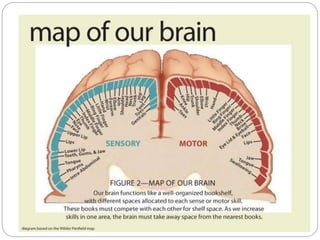
Primary Motor Area
•Voluntary contractions of specific
Broca’s speech area
•Speaking & understanding language
•CVA – can still have clear thoughts but unable to
form words.
Premotor area
•Storage of motor pattern
Frontal eye field area
•Scanning movements of the eyes
Prefrontal cortex
•Concentration, elaboration of thought, judgement,
inhibition, personality, emotional traits.
•Bilateral damage of the area – rude, inconsiderate,
incapable of accepting advice, moody, inattentive,
less creative.
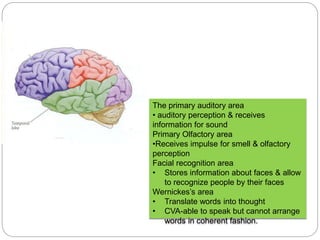
The primary auditory area
• auditory perception & receives
information for sound
Primary Olfactory area
•Receives impulse for smell & olfactory
perception
Facial recognition area
• Stores information about faces & allow
to recognize people by their faces
Wernickes’s area
• Translate words into thought
• CVA-able to speak but cannot arrange
words in coherent fashion.
Primary Visual Area
•Receives visual information &
visual perception
Visual Association Area
•Allow to recognize & evaluating
what is seen
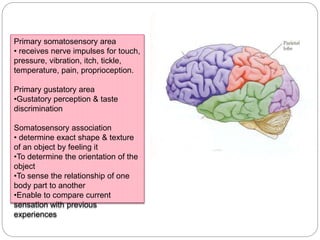
Primary somatosensory area
• receives nerve impulses for touch,
pressure, vibration, itch, tickle,
temperature, pain, proprioception.
Primary gustatory area
•Gustatory perception & taste
discrimination
Somatosensory association
• determine exact shape & texture
of an object by feeling it
•To determine the orientation of the
object
•To sense the relationship of one
body part to another
•Enable to compare current
sensation with previous
experiences
Neuroanatomy (generally)

Neuroanatomy (generally)

  • 2.
    THE BRAIN 4 majorparts of the brain: (a) Brain stem (b) Cerebellum (c) Diencephalon (thalamus, hypothalamus, epithalamus) (d) Cerebrum
  • 3.
    (a) Brain stem Partof the brain between the spinal cord and the diencephalon. 3 structures Medulla oblongata Pons Midbrain
  • 4.
    Medulla Oblongata  Medulla’swhite matter Ascending (sensory) tracts Descending (motor) tracts
  • 5.
     Pyramids –formed by the large lateral corticospinal tracts that pass from cerebrum to the spinal cord. 90% axons in the left pyramids cross to the right side, vice versa. To control voluntary movements of the limb & trunk. Decussation of pyramids
  • 6.
     Nuclei inmedulla  Lateral to the pyramid is olive. • Inferior olivary nucleus. • Function: receives input from cerebral cortex, red nucleus of midbrain & SC. • Extend axons into cerebellum – provides instruction to cerebellum to make adjustments to the muscles activity as we learn new motor skills Regulate cardiovascular center Regulate respiratory center – medullary rhythmicity area: adjust the basic rhythm of breathing Control reflexes for vomitting (vomitting center), swallowing (degluitition center), sneezing, coughing & hiccuping
  • 7.
     Nuclei inposterior part of medulla that associate with the dorsal column medial lemniscus (gracile fasciculus & cuneate fasciculus):  Associate with sensations of touch, pressure, vibration & conscious proprioception  Sensory nuclei in the medulla Gracile nucleus Cuneate nucleus Gustatory nucleus (taste) Cochlear nuclei (hearing) Vestibular nuclei (balance)
  • 8.
    Pons  Links differentpart of the brain  Serves as a relay station from medulla to higher cortical structures of the brain.  Respiratory center + medulla rhythmicity area = control breathing
  • 9.
    Midbrain  Connects hindbrain& forebrain  Cerebral peduncle contains paired bundles of axons : axons of corticospinal, corticobulbar & corticopontine tracts  conducts nerve impulses from motor areas in cerebral cortex to the SC, medulla & pons.  Nerve pathway of the cerebral hemispheres & contains auditory & visual reflex centers  Control responses to sight, eye movement, pupil dilation, body movement & hearing
  • 10.
     Posterior part(tectum) Superior colliculi Reflex centers for certain visual activities Inferior colliculi Part of auditory pathway, relaying impulses from the receptors for hearing in the inner ear to the brain
  • 11.
    Nuclei of themidbrain Neurons that extend from here – release dopamine – help control subconcious muscles activities Rich blood supply & iron- containing pigment in neuronal cell bodies. Neurons (axons) from cerebellum & cerebral cortex form synapses in red nuclei  help control muscular movements
  • 12.
  • 13.
    1. There are4 structures in the ‘midline‘ beginning with M 2. There are 4 structures to the ‘side‘ (lateral) beginning with S 3. There are 4 cranial nerves in the medulla, 4 in the pons and 4 above the pons(2 in the midbrain) 4. The 4 motor nuclei that are in the midline are those that divide equally into 12 except for 1 and 2, that is 3, 4, 6 and 12 (5, 7, 9 and 11 are in the lateral brainstem)
  • 14.
    Medial Structures Deficits Motorpathway (or corticospinal tract): contralateral weakness of the arm and leg Medial Lemniscus contralateral loss of vibration and proprioception in the arm and leg Medial longitudinal fasciculus ipsilateral inter-nuclear ophthalmoplegia (failure of adduction of the ipsilateral eye towards the nose and nystagmus in the opposite eye as it looks laterally) Motor nucleus and nerve ipsilateral loss of the cranial nerve that is affected (3, 4, 6 or 12)
  • 15.
    Lateral structures Deficits Spinocerebellar pathway ipsilateralataxia of the arm and leg Spinothalamic pathway contralateral alteration of pain and temperature affecting the arm, leg and rarely the trunk Sensory nucleus of the 5th cranial nerve ipsilateral alteration of pain and temperature on the face in the distribution of the 5th cranial nerve (this nucleus is a long vertical structure that extends in the lateral aspect of the pons down into the medulla) Sympathetic pathway ipsilateral Homer’s syndrome, that is partial ptosis and a small pupil (miosis)
  • 16.
    CN in MedullaDeficits Glossopharyngeal (CN9) ipsilateral loss of pharyngeal sensation Vagus (CN10) ipsilateral palatal weakness Spinal accessory (CN11) ipsilateral weakness of the trapezius and stemocleidomastoid muscles Hypoglossal (CN12) ipsilateral weakness of the tongue
  • 17.
    CN in PonsDeficits Trigeminal (CN5) ipsilateral alteration of pain, temperature and light touch on the face back as far as the anterior two- thirds of the scalp and sparing the angle of the jaw. Abducent (CN6) ipsilateral weakness of abduction (lateral movement) of the eye (lateral rectus) Facial (CN7) ipsilateral facial weakness Auditory (CN8) ipsilateral deafness.The 6th cranial nerve is the motor nerve in the medial pons CN above Pons Deficits Oculomotor (CN3) impaired adduction, supradduction and infradduction of the ipsilateral eye with or without a dilated pupil. The eye is turned out and slightly down Trochlear (CN4): eye unable to look down when the eye is looking in towards the nose (superior oblique).The 3rd
  • 18.
    (b) Cerebellum primarily containsefferent fibers from the cerebellar nuclei, as well as some afferents from the spinocerebellar tract. primarily contains afferents from the pontine nuclei (from motor areas of the cerebral cortex) into cerebellum primarily contains afferent fibers from the medulla, as well as efferents to the vestibular nuclei
  • 19.
    Divisions of theCerebellum
  • 20.
    Functional subdivisions ofcerebellum Cerebrocerebellum • consist of lateral hemisphere& the dentate nuclei. • its extensive connections with the cerebral cortex, via the pontine nuclei (afferents) and the VL thalamus (efferents). •Functions: 1. Planning & timing of movement 2. Involved in cognitive function of cerebellum
  • 21.
    Functional subdivisions ofcerebellum Vestibulocerebellum • consist of the flocculonodular lobe and its connections with the lateral vestibular nuclei, • Functions: 1. Vestibular reflexes 2. Postural maintenance
  • 22.
    Functional subdivisions ofcerebellum Spinocerebellum •Consist of the vermis and the intermediate zones , as well as the fastigial and interposed nuclei. •it receives major inputs from the spinocerebellar tract. •Its output projects to rubrospinal, vestibulospinal, and reticulospinal tracts. •involved in the integration of sensory input with motor commands to produce adaptive motor coordination.
  • 23.
    What happened whenthere is damage to the cerebellum? 1. Decomposition of movement 2. Intention tremor 3. Dysdiadochokinesia 4. Deficits in motor learning
  • 24.
    (c ) Diencephalon(thalamus, epithalamus & hypothalamus) Extends from the brainstem to the cerebrum & surrounds 3rd ventricle: thalamus, hypothalamus & epithalamus •Surrounded by cerebral hemisphere. •Contains numerous nuclei involved in wide variety of sensory & motor processing between higher & lower brain.
  • 25.
  • 26.
     The intermediatemass (interthalamic adhesion) : a bridge of gray matter  The internal medullary lamina: a vertical Y-shaped sheet of white matter Functions: to divide right side & left side of thalamus gray matter  Internal capsule: pathway for axons connect the thalamus & cerebral cortex.  Functions of thalamus:  Major relay station for most sensory impulses that reach primary sensory areas of the cerebral cortex from SC & brain stem.  Motor function (transmit information from the cerebellum & basal nuclei to the primary motor area of the cerebral cortex)
  • 27.
    Receives input: thehypothalamus Sends output: the limbic system Functions: emotions & memory Receive input: the limbic system& basal nuclei Send output: cerebral cortex Functions: emotions, learning, memory & cognition Lateral group nuclei Receives input: the limbic system, superior colliculi & cerebral cortex Sends output: the cerebral cortex. Functions: expressions of emotions Functions: Help integrate sensory information Receives input: the basal nuclei Sends output: motor areas of cerebral cortex Functions: plays a role in movement control Receives input:the cerebellum & the basal nuclei Sends output: motor areas of cerebral cortex Functions: plays a Relays impulses for somatic sensations: touch, pressure, vibartion, itch, tickle, temperature,pain & Relays impulses for sight from retina to the primary visual area of the cerebral Relays auditory impulses for hearing from the ear to the primary auditory area of cerebral cortex
  • 28.
    Intralaminar nuclei (within theinternal medullary lamina) •Connects with the reticular formation, cerebellum, basal nuclei & wide areas of the cerebral cortex. •Function: - Arousal (activation of the cerebral cortex from the brain stem reticular formation) - Integration of sensory & motor information Midline nucleus • a thin band adjacent to the 3rd ventricle •Functions: memory & olfaction Reticular nucleus • lateral aspect of the thalamus •Functions: monitors, filters & integrate activities of other thalamic nuclei.
  • 29.
    Body temperature Water balance/stress Shivering GItract satiety Feeding Body clock Water balance Blood pressure Hypothalamus
  • 30.
    Important functions ofthe hypothalamus:  Control of the ANS  Production of hormones  Regulation of emotional & behavioral patterns  Regulation of eating & drinking  Control of body temperature  Regulation circadian rhythms& states of consciouness
  • 31.
    Epithalamus The pineal gland •Partof endocrine system – secretes hormone melatonin •More melatonin liberated during darkness – promote sleepiness •If taken orally – melatonin contribute to the body’s clock setting by The Habenular nuclei •Involved in olfaction (emotional responses to odors)
  • 32.
    (d) Cerebrum •Primarilyof myelinated axons in 3 types of tracts: (a) Association tracts – conduct nerve impulses between gyri in the hemisphere. (b) Commisural tracts (corpus callosum, anterior commissure & posterior commisure) – conduct nerve impulses from gyri one cerebral hemisphere to corresponding gyri in other Cerebral hemisphere. (c ) Projection tracts – conducts nerve impulses from cerebrum to lower part of CNS (thalamus, brainstem /SC) of from lower parta of the CNS To the cerebrum.
  • 33.
    • Also knownas cerebral cortex. • Gyri : folds • Fissures: the deepest grooves • Sulci: the shallower grooves between folds • Longitudinal Fissue: prominent fissures that divide brain into cerebral hemisphere
  • 34.
    Basal Nuclei /Basal Ganglia  receive input from cerebral cortex Provide output to motor parts of the cortex via the medial & ventral group nuclei of thalamus Major function: •To help regulate initiation and termination of movement •Globus pallidus: helps regulate muscle tone required for specific body movements •Control subconscious contraction of skeletal muscles •Initiate and terminate cognitive processes (attention, memory, planning & act with limbic system to regulate emotional behaviors
  • 35.
    The Limbic System “emotional brain”  Functions:  Promotes range of emotions, including pleasure, pain, docility, affection, fear & anger.  Works together with cerebrum for memory functions – damage to the limbic system cause memory impairment
  • 36.
    Primary Motor Area •Voluntarycontractions of specific Broca’s speech area •Speaking & understanding language •CVA – can still have clear thoughts but unable to form words. Premotor area •Storage of motor pattern Frontal eye field area •Scanning movements of the eyes Prefrontal cortex •Concentration, elaboration of thought, judgement, inhibition, personality, emotional traits. •Bilateral damage of the area – rude, inconsiderate, incapable of accepting advice, moody, inattentive, less creative.
  • 37.
    The primary auditoryarea • auditory perception & receives information for sound Primary Olfactory area •Receives impulse for smell & olfactory perception Facial recognition area • Stores information about faces & allow to recognize people by their faces Wernickes’s area • Translate words into thought • CVA-able to speak but cannot arrange words in coherent fashion.
  • 38.
    Primary Visual Area •Receivesvisual information & visual perception Visual Association Area •Allow to recognize & evaluating what is seen
  • 39.
    Primary somatosensory area •receives nerve impulses for touch, pressure, vibration, itch, tickle, temperature, pain, proprioception. Primary gustatory area •Gustatory perception & taste discrimination Somatosensory association • determine exact shape & texture of an object by feeling it •To determine the orientation of the object •To sense the relationship of one body part to another •Enable to compare current sensation with previous experiences