INTRODUCTION
SYMPTOMS
CAUSES
COMPLICATIONS
TREATMENT AND DRUGS
TEST AND DIAGNOSIS
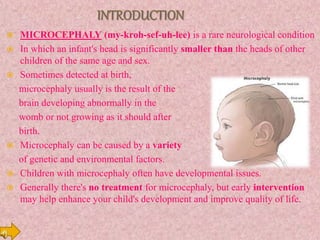
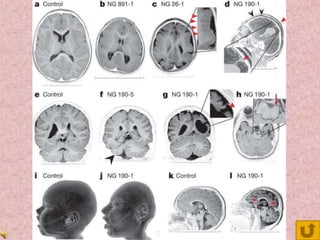
 MICROCEPHALY (my-kroh-sef-uh-lee) is a rare neurological condition
 In which an infant's head is significantly smaller than the heads of other
children of the same age and sex.
 Sometimes detected at birth,
microcephaly usually is the result of the
brain developing abnormally in the
womb or not growing as it should after
birth.
 Microcephaly can be caused by a variety
of genetic and environmental factors.
 Children with microcephaly often have developmental issues.
 Generally there's no treatment for microcephaly, but early intervention
may help enhance your child's development and improve quality of life.
 A head size significantly smaller than that of other children of the
same age and sex
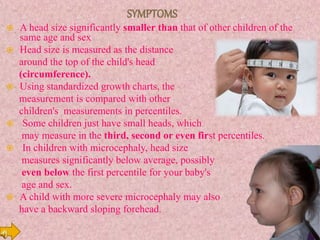
 Head size is measured as the distance
around the top of the child's head
(circumference).
 Using standardized growth charts, the
measurement is compared with other
children's measurements in percentiles.
 Some children just have small heads, which
may measure in the third, second or even first percentiles.
 In children with microcephaly, head size
measures significantly below average, possibly
even below the first percentile for your baby's
age and sex.
 A child with more severe microcephaly may also
have a backward sloping forehead.
 Microcephaly usually is the result of abnormal brain development,
which can occur in the womb (congenital) or in infancy.
Other causes may include:
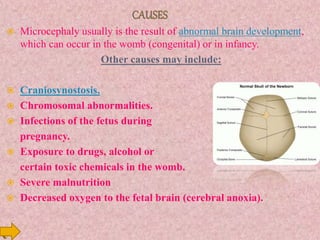
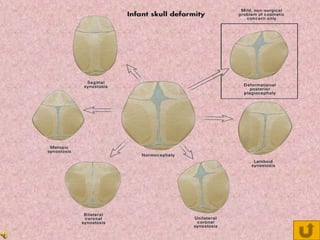
 Craniosynostosis.
 Chromosomal abnormalities.
 Infections of the fetus during
pregnancy.
 Exposure to drugs, alcohol or
certain toxic chemicals in the womb.
 Severe malnutrition
 Decreased oxygen to the fetal brain (cerebral anoxia).
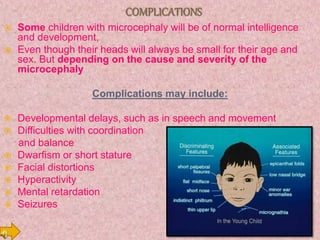
 Some children with microcephaly will be of normal intelligence
and development,
 Even though their heads will always be small for their age and
sex. But depending on the cause and severity of the
microcephaly
Complications may include:
 Developmental delays, such as in speech and movement
 Difficulties with coordination
and balance
 Dwarfism or short stature
 Facial distortions
 Hyperactivity
 Mental retardation
 Seizures
 Except for surgery for craniosynostosis, there's
generally no treatment that will enlarge your child's
head or reverse complications of microcephaly.
 Treatment focuses on ways to manage your child's
condition.
 Early childhood intervention programs that include
speech, physical and occupational therapy may help
your child strengthen abilities.
 Certain complications of microcephaly, such as
seizures or hyperactivity, may be treated with
medication.
 To determine whether your child has microcephaly, your doctor likely
will take a thorough prenatal, birth and family history and do a
physical exam.
 Parents' head sizes also may be measured to determine whether
small heads run in the family.
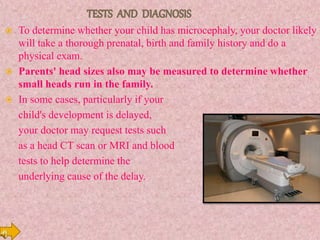
 In some cases, particularly if your
child's development is delayed,
your doctor may request tests such
as a head CT scan or MRI and blood
tests to help determine the
underlying cause of the delay.
Microcephaly
Microcephaly

Microcephaly

  • 3.
  • 4.
     MICROCEPHALY (my-kroh-sef-uh-lee)is a rare neurological condition  In which an infant's head is significantly smaller than the heads of other children of the same age and sex.  Sometimes detected at birth, microcephaly usually is the result of the brain developing abnormally in the womb or not growing as it should after birth.  Microcephaly can be caused by a variety of genetic and environmental factors.  Children with microcephaly often have developmental issues.  Generally there's no treatment for microcephaly, but early intervention may help enhance your child's development and improve quality of life.
  • 5.
     A headsize significantly smaller than that of other children of the same age and sex  Head size is measured as the distance around the top of the child's head (circumference).  Using standardized growth charts, the measurement is compared with other children's measurements in percentiles.  Some children just have small heads, which may measure in the third, second or even first percentiles.  In children with microcephaly, head size measures significantly below average, possibly even below the first percentile for your baby's age and sex.  A child with more severe microcephaly may also have a backward sloping forehead.
  • 6.
     Microcephaly usuallyis the result of abnormal brain development, which can occur in the womb (congenital) or in infancy. Other causes may include:  Craniosynostosis.  Chromosomal abnormalities.  Infections of the fetus during pregnancy.  Exposure to drugs, alcohol or certain toxic chemicals in the womb.  Severe malnutrition  Decreased oxygen to the fetal brain (cerebral anoxia).
  • 9.
     Some childrenwith microcephaly will be of normal intelligence and development,  Even though their heads will always be small for their age and sex. But depending on the cause and severity of the microcephaly Complications may include:  Developmental delays, such as in speech and movement  Difficulties with coordination and balance  Dwarfism or short stature  Facial distortions  Hyperactivity  Mental retardation  Seizures
  • 10.
     Except forsurgery for craniosynostosis, there's generally no treatment that will enlarge your child's head or reverse complications of microcephaly.  Treatment focuses on ways to manage your child's condition.  Early childhood intervention programs that include speech, physical and occupational therapy may help your child strengthen abilities.  Certain complications of microcephaly, such as seizures or hyperactivity, may be treated with medication.
  • 11.
     To determinewhether your child has microcephaly, your doctor likely will take a thorough prenatal, birth and family history and do a physical exam.  Parents' head sizes also may be measured to determine whether small heads run in the family.  In some cases, particularly if your child's development is delayed, your doctor may request tests such as a head CT scan or MRI and blood tests to help determine the underlying cause of the delay.