Neuro-endocrinology
{Pitutary
&
Thyroid Gland}
Mr. Jay Patidar
www.drjayeshpatidar.blogspot.com
 Neuro-endocrinology – It is the study of the
interaction between the nervous system and
te endocrine system and the effects of
various hormones on cognitive emotional
and behavioural functioning.
 Human endocrine functioning has a strong
foundation in central nervous system under
the direction of hypothalamus which has a
direct control over pitutary gland.
www.drjayeshpatidar.blogspot.in
 Pitutary Gland : It has two major lobes
namely –
 Anterior lobe adenohypophysis
 Posterior lobe Neurohypophysis
 Pitutary gland – size of pea – has powers to
control over endocrine functioning in human
being – called master gland.
 It’s a regulation have implications for
behavioural functioning.
www.drjayeshpatidar.blogspot.in
 Antidiuretic Hormone :
 Located in posterior pitutary
 Release stimulated by dehydration, pai &
stress
 Target organ - Kidney
 Function – Conservation of body water a &
maintenance of blood pressure
 Behavioural Correlation – Polydypsia, altered
pain, modified sleep pattern.
www.drjayeshpatidar.blogspot.in
 Oxytocin :
 Located – Posterior pitutary
 Release stimulated by pregnancy, stress
 Target organ – Breast
 Function – Contraction of uterus for labour,
release of breast milk
 Behavioural Correlation with altered secretion
– May play role in stress response by
stimulation of ACTH.
www.drjayeshpatidar.blogspot.in
 Growth Hormone :
 Location - Anterior pitutary
 Release stimulated by – Growth hormone
releasing hormone from hypothalamus
 Target organs – Bones & tissues
 Function – Growth in children, protein
synthesis in adult.
 Behavioural Correlation with altered
secretion – anorexia nervosa
www.drjayeshpatidar.blogspot.in
ho
Thyroid-Stimulating hormone
Anterior pituitary, release stimulated by thyrotropin releasing
hormone from hypothalamus
 Target organ –Thyroid organ
 Function-Stimulation of secretion of needed thyroid
hormone for metabolism of ,regulation of temperature.
 Behavioral corelation with alteration-insomia, emotional
lability is increased &decreased levels –fatigue depression
ADRENOCORTICOTROPIC HORMONE
 Location –Anterior pituitary release stimulating by
corticotropin-releasing hormone from hypothalamus
 Target Orgamulatn- adrenal cortex
 Function-stimulation of secretion of cortisol which play role
in stress
 Behavioral correlation-increased level –mood disorder
psycosis .decreased level –depression ,apathy
www.drjayeshpatidar.blogspot.in
Gonadotropic hormones
 Location-anterior pituitarty-release
gonadotrprin-releasing hormone from
hypothalamus
 Target organ- ovaries, testes
 Function-stimulation of sectretion of estrogen,
progesterone, testosterone
 Behavioral correlation –decreased level-
depression, anorexia nervosa.-increased level
 Sexual behaviour aggressiveness
www.drjayeshpatidar.blogspot.in
MELANOCYTE
STIMULATING HOR
 Anterior pituitary ,stimulated by onset of
darkness
 Target organ- pineal gland,
 Function- stimulation of sectretion of
melatonin
 Behavioral correlation-increased level
,depression
www.drjayeshpatidar.blogspot.in
 Circadian Rhythms:
 It is a near 24-hour rhythms cycle, in humans
affected to a large degree by cycles of lightness
and darkness and influences a variety of regulatory
functions like, sleep-wake cycle, body temperature
regulation, and patterns of activity.
 This is due to the pacemaker in the brain
(suprachiasmatic nuclei of the hypothalamus)
which receives projections of light through retina
and stimulates electrical impulses to
neurotransmitters for various functions
www.drjayeshpatidar.blogspot.in
 The sleep-wake cycle is genetically
determined rather than learned and is
established sometime after birth.
 Sleep can be measured by various types of
brain waves that occur during various stages
of sleep activity.
 Types of sleep –
 Rapid Eye movement sleep
 Non-Rapid Eye movement sleep
www.drjayeshpatidar.blogspot.in
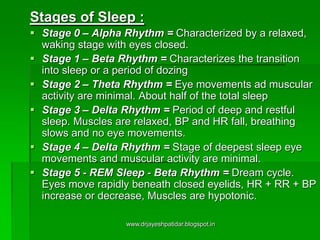
Stages of Sleep :
 Stage 0 – Alpha Rhythm = Characterized by a relaxed,
waking stage with eyes closed.
 Stage 1 – Beta Rhythm = Characterizes the transition
into sleep or a period of dozing
 Stage 2 – Theta Rhythm = Eye movements ad muscular
activity are minimal. About half of the total sleep
 Stage 3 – Delta Rhythm = Period of deep and restful
sleep. Muscles are relaxed, BP and HR fall, breathing
slows and no eye movements.
 Stage 4 – Delta Rhythm = Stage of deepest sleep eye
movements and muscular activity are minimal.
 Stage 5 - REM Sleep - Beta Rhythm = Dream cycle.
Eyes move rapidly beneath closed eyelids, HR + RR + BP
increase or decrease, Muscles are hypotonic.
www.drjayeshpatidar.blogspot.in
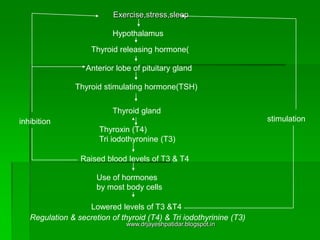
Exercise,stress,sleep
Hypothalamus
Thyroid releasing hormone(
Anterior lobe of pituitary gland
Thyroid stimulating hormone(TSH)
Thyroid gland
Thyroxin (T4)
Tri iodothyronine (T3)
Raised blood levels of T3 & T4
Use of hormones
by most body cells
Lowered levels of T3 &T4
stimulationinhibition
Regulation & secretion of thyroid (T4) & Tri iodothyrinine (T3)
www.drjayeshpatidar.blogspot.in
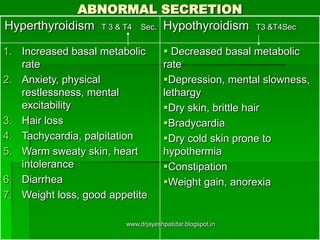
ABNORMAL SECRETION
Hyperthyroidism T 3 & T4 Sec. Hypothyroidism T3 &T4Sec
1. Increased basal metabolic
rate
2. Anxiety, physical
restlessness, mental
excitability
3. Hair loss
4. Tachycardia, palpitation
5. Warm sweaty skin, heart
intolerance
6. Diarrhea
7. Weight loss, good appetite
 Decreased basal metabolic
rate
Depression, mental slowness,
lethargy
Dry skin, brittle hair
Bradycardia
Dry cold skin prone to
hypothermia
Constipation
Weight gain, anorexia
www.drjayeshpatidar.blogspot.in
Cell responsible for non specific immune
reaction include neutrophiles monocytes
macrophages.
They work to destroy the invasive organism
& facilitate in accomplishing a satisfactory
healing response, specific-immune
mechanism take over.
Specific immune mechanism are divided into
major type 1 humoral response
2cellular response
- Controlling elements of the cellular response
T lymphocytes & B lymphocyteswww.drjayeshpatidar.blogspot.in
Psycho-Immunology:-
is the study of immunology as it
relate to emotion & behaviour.
The immune system protect the body from
foreign pathogens.
- NS regulate immune system.
- Immune system dysfunction may result
from damage to hypothalamus & pituitary
lead to psychiatric symptoms such as
depression.
www.drjayeshpatidar.blogspot.in
Example: SLE (systemic lupus erythematous)
autoimmune disease
Experiences symptoms of depression, insomnia,
IMMUNE SYSTEM IN PSYCHIATRIC ILLNESS:-
In stress there is increase of
glucocorticoid release from adrenal
cortex following stimulation from the
hypothalamic-pituitary adrenal axis
during stressful situation. The result is a
suppression in lymphocyte proliferation &
function.
www.drjayeshpatidar.blogspot.in
-Increased production of epinephrine &
nonepinephrine occur in response to stress &
may decrease immunity serotonin has
demonstrated both enhancing & inhibitory
affects on immunity.
Correlation a decrease in lymphocyte
functioning with period of grief & depression
associating the degree of altered immunity with
severity of the depression.
Correlate the onset of schizophrenia to
abnormalities of immune system.
Immunological abnormalities have been
investigated in psychiatric illness like
alcoholism. www.drjayeshpatidar.blogspot.in
IMPLICATION FOR NURSING:-
Role of mental health nursing in
holistic health care treatment- approach
that focuses psychological & social
factors.
Psychiatric Nurse:-
Must integrate the knowledge
of biological science into their practice if
they are to ensure safe & effective care
to people with mental illness.
www.drjayeshpatidar.blogspot.in
Thank you
www.drjayeshpatidar.blogspot.in

Neuro endocrinology

  • 1.
    Neuro-endocrinology {Pitutary & Thyroid Gland} Mr. JayPatidar www.drjayeshpatidar.blogspot.com
  • 2.
     Neuro-endocrinology –It is the study of the interaction between the nervous system and te endocrine system and the effects of various hormones on cognitive emotional and behavioural functioning.  Human endocrine functioning has a strong foundation in central nervous system under the direction of hypothalamus which has a direct control over pitutary gland. www.drjayeshpatidar.blogspot.in
  • 3.
     Pitutary Gland: It has two major lobes namely –  Anterior lobe adenohypophysis  Posterior lobe Neurohypophysis  Pitutary gland – size of pea – has powers to control over endocrine functioning in human being – called master gland.  It’s a regulation have implications for behavioural functioning. www.drjayeshpatidar.blogspot.in
  • 4.
     Antidiuretic Hormone:  Located in posterior pitutary  Release stimulated by dehydration, pai & stress  Target organ - Kidney  Function – Conservation of body water a & maintenance of blood pressure  Behavioural Correlation – Polydypsia, altered pain, modified sleep pattern. www.drjayeshpatidar.blogspot.in
  • 5.
     Oxytocin : Located – Posterior pitutary  Release stimulated by pregnancy, stress  Target organ – Breast  Function – Contraction of uterus for labour, release of breast milk  Behavioural Correlation with altered secretion – May play role in stress response by stimulation of ACTH. www.drjayeshpatidar.blogspot.in
  • 6.
     Growth Hormone:  Location - Anterior pitutary  Release stimulated by – Growth hormone releasing hormone from hypothalamus  Target organs – Bones & tissues  Function – Growth in children, protein synthesis in adult.  Behavioural Correlation with altered secretion – anorexia nervosa www.drjayeshpatidar.blogspot.in
  • 7.
    ho Thyroid-Stimulating hormone Anterior pituitary,release stimulated by thyrotropin releasing hormone from hypothalamus  Target organ –Thyroid organ  Function-Stimulation of secretion of needed thyroid hormone for metabolism of ,regulation of temperature.  Behavioral corelation with alteration-insomia, emotional lability is increased &decreased levels –fatigue depression ADRENOCORTICOTROPIC HORMONE  Location –Anterior pituitary release stimulating by corticotropin-releasing hormone from hypothalamus  Target Orgamulatn- adrenal cortex  Function-stimulation of secretion of cortisol which play role in stress  Behavioral correlation-increased level –mood disorder psycosis .decreased level –depression ,apathy www.drjayeshpatidar.blogspot.in
  • 8.
    Gonadotropic hormones  Location-anteriorpituitarty-release gonadotrprin-releasing hormone from hypothalamus  Target organ- ovaries, testes  Function-stimulation of sectretion of estrogen, progesterone, testosterone  Behavioral correlation –decreased level- depression, anorexia nervosa.-increased level  Sexual behaviour aggressiveness www.drjayeshpatidar.blogspot.in
  • 9.
    MELANOCYTE STIMULATING HOR  Anteriorpituitary ,stimulated by onset of darkness  Target organ- pineal gland,  Function- stimulation of sectretion of melatonin  Behavioral correlation-increased level ,depression www.drjayeshpatidar.blogspot.in
  • 10.
     Circadian Rhythms: It is a near 24-hour rhythms cycle, in humans affected to a large degree by cycles of lightness and darkness and influences a variety of regulatory functions like, sleep-wake cycle, body temperature regulation, and patterns of activity.  This is due to the pacemaker in the brain (suprachiasmatic nuclei of the hypothalamus) which receives projections of light through retina and stimulates electrical impulses to neurotransmitters for various functions www.drjayeshpatidar.blogspot.in
  • 11.
     The sleep-wakecycle is genetically determined rather than learned and is established sometime after birth.  Sleep can be measured by various types of brain waves that occur during various stages of sleep activity.  Types of sleep –  Rapid Eye movement sleep  Non-Rapid Eye movement sleep www.drjayeshpatidar.blogspot.in
  • 12.
    Stages of Sleep:  Stage 0 – Alpha Rhythm = Characterized by a relaxed, waking stage with eyes closed.  Stage 1 – Beta Rhythm = Characterizes the transition into sleep or a period of dozing  Stage 2 – Theta Rhythm = Eye movements ad muscular activity are minimal. About half of the total sleep  Stage 3 – Delta Rhythm = Period of deep and restful sleep. Muscles are relaxed, BP and HR fall, breathing slows and no eye movements.  Stage 4 – Delta Rhythm = Stage of deepest sleep eye movements and muscular activity are minimal.  Stage 5 - REM Sleep - Beta Rhythm = Dream cycle. Eyes move rapidly beneath closed eyelids, HR + RR + BP increase or decrease, Muscles are hypotonic. www.drjayeshpatidar.blogspot.in
  • 13.
    Exercise,stress,sleep Hypothalamus Thyroid releasing hormone( Anteriorlobe of pituitary gland Thyroid stimulating hormone(TSH) Thyroid gland Thyroxin (T4) Tri iodothyronine (T3) Raised blood levels of T3 & T4 Use of hormones by most body cells Lowered levels of T3 &T4 stimulationinhibition Regulation & secretion of thyroid (T4) & Tri iodothyrinine (T3) www.drjayeshpatidar.blogspot.in
  • 14.
    ABNORMAL SECRETION Hyperthyroidism T3 & T4 Sec. Hypothyroidism T3 &T4Sec 1. Increased basal metabolic rate 2. Anxiety, physical restlessness, mental excitability 3. Hair loss 4. Tachycardia, palpitation 5. Warm sweaty skin, heart intolerance 6. Diarrhea 7. Weight loss, good appetite  Decreased basal metabolic rate Depression, mental slowness, lethargy Dry skin, brittle hair Bradycardia Dry cold skin prone to hypothermia Constipation Weight gain, anorexia www.drjayeshpatidar.blogspot.in
  • 15.
    Cell responsible fornon specific immune reaction include neutrophiles monocytes macrophages. They work to destroy the invasive organism & facilitate in accomplishing a satisfactory healing response, specific-immune mechanism take over. Specific immune mechanism are divided into major type 1 humoral response 2cellular response - Controlling elements of the cellular response T lymphocytes & B lymphocyteswww.drjayeshpatidar.blogspot.in
  • 16.
    Psycho-Immunology:- is the studyof immunology as it relate to emotion & behaviour. The immune system protect the body from foreign pathogens. - NS regulate immune system. - Immune system dysfunction may result from damage to hypothalamus & pituitary lead to psychiatric symptoms such as depression. www.drjayeshpatidar.blogspot.in
  • 17.
    Example: SLE (systemiclupus erythematous) autoimmune disease Experiences symptoms of depression, insomnia, IMMUNE SYSTEM IN PSYCHIATRIC ILLNESS:- In stress there is increase of glucocorticoid release from adrenal cortex following stimulation from the hypothalamic-pituitary adrenal axis during stressful situation. The result is a suppression in lymphocyte proliferation & function. www.drjayeshpatidar.blogspot.in
  • 18.
    -Increased production ofepinephrine & nonepinephrine occur in response to stress & may decrease immunity serotonin has demonstrated both enhancing & inhibitory affects on immunity. Correlation a decrease in lymphocyte functioning with period of grief & depression associating the degree of altered immunity with severity of the depression. Correlate the onset of schizophrenia to abnormalities of immune system. Immunological abnormalities have been investigated in psychiatric illness like alcoholism. www.drjayeshpatidar.blogspot.in
  • 19.
    IMPLICATION FOR NURSING:- Roleof mental health nursing in holistic health care treatment- approach that focuses psychological & social factors. Psychiatric Nurse:- Must integrate the knowledge of biological science into their practice if they are to ensure safe & effective care to people with mental illness. www.drjayeshpatidar.blogspot.in
  • 20.