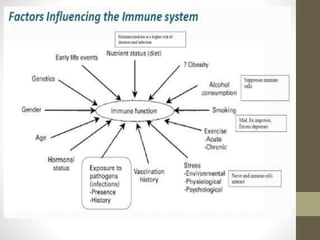
PSYCHOIMMUNOLOGY
V. BOOMINATHAN
M.Sc (Nursing) 1st year
MTPG & RIHS
INTRODUCTION
• Psycho immunology is relatively new field of
study , examines the effect of psychosocial
stressors on the body’s immune system.
• Nervous system and the immune system
represent two networks within the body.
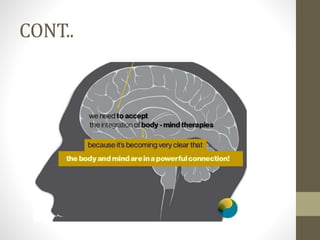
CONT..
HISTORY
• Relationship between psychiatric syndromes and
immune function has been a consistent theme
since the beginning of modern medicine.
• In 1964, George F. Solomon , from the university
of California and his research team coined the
term “Psychoimmunology” and published a
landmark paper : Emotions, immunity , and
disease : a speculative theoretical integration
DEFINITION
• PSYCHOIMMUNOLOGY
• “ The branch of medicine that studies the effect
of psychological and social factors on the
functioning of the immune system”.
OR
• “The study of the connection between the mind
and the immune system”.
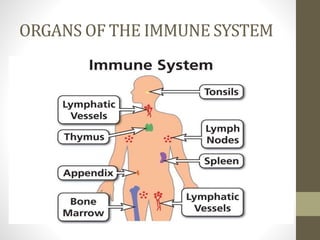
ORGANS OF THE IMMUNE SYSTEM
IMMUNITY
Immunity is the state of having sufficient
biological defenses to avoid infection, diseases , or
other unwanted biological invasion .It is the
capability of the body to resist harmful microbes
from entering it.
Types of Immunity
1. Innate immunity
2. Acquired immunity
• Active (own antibodies)
• Passive ( Readymade antibodies)
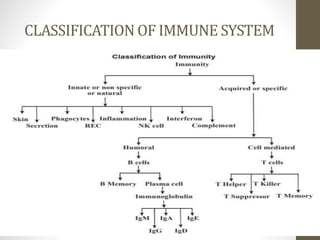
CLASSIFICATION OF IMMUNE SYSTEM
NORMAL IMMUNE
RESPONSES
• Cell responsible for nonspecific reactions
include neutrophils, monocytes and
macrophages
• They work to destroy the invasive organism
and initiate and facilitate damaged tissue.
• If these cells are not effective in
accomplishing a satisfactory healing
response, specific immune mechanism take
over
CONT..
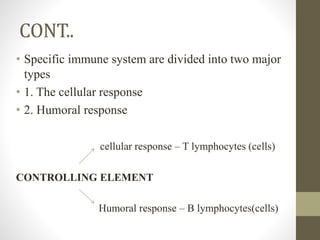
• Specific immune system are divided into two major
types
• 1. The cellular response
• 2. Humoral response
cellular response – T lymphocytes (cells)
CONTROLLING ELEMENT
Humoral response – B lymphocytes(cells)
CONT..
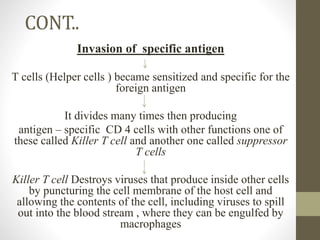
Invasion of specific antigen
T cells (Helper cells ) became sensitized and specific for the
foreign antigen
It divides many times then producing
antigen – specific CD 4 cells with other functions one of
these called Killer T cell and another one called suppressor
T cells
Killer T cell Destroys viruses that produce inside other cells
by puncturing the cell membrane of the host cell and
allowing the contents of the cell, including viruses to spill
out into the blood stream , where they can be engulfed by
macrophages
CONT..
• suppressor T cells - stops the immune response
once the foreign antigen has been destroyed
• The Humoral response is activated when antigen
specific CD 4 cells communicate with the B cells
in the spleen and lymph nodes. The B cells in
turn produce the antibodies specific to the foreign
antigen. Antibodies attach themselves to foreign
antigen so that they are unable to invade body
cells . These invaders cells are then destroyed
without being able to multiply
IMPLICATIONSOF THE IMMUNESYSTEM IN
PSYCHIATRICILLNESS
• In studies of the biological response to stress, it
has been hypnotized that individuals become more
susceptible to physical illness following a stressful
stimulus or life events this response is thought to be
due to increased glut cortical release form the cortex
following stimulation from the hypothalamic-
pituitary-adrenal axis during stressful situations.
CONT..
CONT..
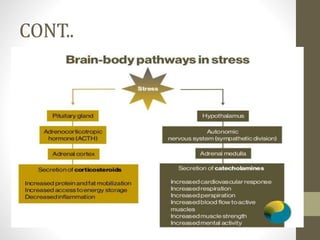
• Growth hormone, which may be released in
response to certain stressors, may enhance immune
functioning, whereas testosterone is thought to
inhibit immune functioning.
• Increased production of epinephrine and
norepinephrine occurs in response to stress, and
may decrease immunity.
CONT..
• Studies have correlated a decrease in lymphocyte
functioning with periods of grief, bereavement, and
depression, associating the degree of altered
immunity with severity of the depression.
• A number of research studies have been
conducted attempting to correlate the onset of
schizophrenia abnormalities of the immune system.
These studies have considered autoimmune
responses, viral infections, and immunogenetics
CONT..
• Immunological abnormalities have also been
investigated in a number of other psychiatric
illness, including alcoholism, autism spectrum
disorder, and neurocognitive disorder.
THANK YOU

Psychoimmunology

  • 1.
  • 2.
    INTRODUCTION • Psycho immunologyis relatively new field of study , examines the effect of psychosocial stressors on the body’s immune system. • Nervous system and the immune system represent two networks within the body.
  • 3.
  • 4.
    HISTORY • Relationship betweenpsychiatric syndromes and immune function has been a consistent theme since the beginning of modern medicine. • In 1964, George F. Solomon , from the university of California and his research team coined the term “Psychoimmunology” and published a landmark paper : Emotions, immunity , and disease : a speculative theoretical integration
  • 5.
    DEFINITION • PSYCHOIMMUNOLOGY • “The branch of medicine that studies the effect of psychological and social factors on the functioning of the immune system”. OR • “The study of the connection between the mind and the immune system”.
  • 6.
    ORGANS OF THEIMMUNE SYSTEM
  • 7.
    IMMUNITY Immunity is thestate of having sufficient biological defenses to avoid infection, diseases , or other unwanted biological invasion .It is the capability of the body to resist harmful microbes from entering it. Types of Immunity 1. Innate immunity 2. Acquired immunity • Active (own antibodies) • Passive ( Readymade antibodies)
  • 8.
  • 9.
    NORMAL IMMUNE RESPONSES • Cellresponsible for nonspecific reactions include neutrophils, monocytes and macrophages • They work to destroy the invasive organism and initiate and facilitate damaged tissue. • If these cells are not effective in accomplishing a satisfactory healing response, specific immune mechanism take over
  • 10.
    CONT.. • Specific immunesystem are divided into two major types • 1. The cellular response • 2. Humoral response cellular response – T lymphocytes (cells) CONTROLLING ELEMENT Humoral response – B lymphocytes(cells)
  • 11.
    CONT.. Invasion of specificantigen T cells (Helper cells ) became sensitized and specific for the foreign antigen It divides many times then producing antigen – specific CD 4 cells with other functions one of these called Killer T cell and another one called suppressor T cells Killer T cell Destroys viruses that produce inside other cells by puncturing the cell membrane of the host cell and allowing the contents of the cell, including viruses to spill out into the blood stream , where they can be engulfed by macrophages
  • 12.
    CONT.. • suppressor Tcells - stops the immune response once the foreign antigen has been destroyed • The Humoral response is activated when antigen specific CD 4 cells communicate with the B cells in the spleen and lymph nodes. The B cells in turn produce the antibodies specific to the foreign antigen. Antibodies attach themselves to foreign antigen so that they are unable to invade body cells . These invaders cells are then destroyed without being able to multiply
  • 14.
    IMPLICATIONSOF THE IMMUNESYSTEMIN PSYCHIATRICILLNESS • In studies of the biological response to stress, it has been hypnotized that individuals become more susceptible to physical illness following a stressful stimulus or life events this response is thought to be due to increased glut cortical release form the cortex following stimulation from the hypothalamic- pituitary-adrenal axis during stressful situations.
  • 15.
  • 16.
    CONT.. • Growth hormone,which may be released in response to certain stressors, may enhance immune functioning, whereas testosterone is thought to inhibit immune functioning. • Increased production of epinephrine and norepinephrine occurs in response to stress, and may decrease immunity.
  • 17.
    CONT.. • Studies havecorrelated a decrease in lymphocyte functioning with periods of grief, bereavement, and depression, associating the degree of altered immunity with severity of the depression. • A number of research studies have been conducted attempting to correlate the onset of schizophrenia abnormalities of the immune system. These studies have considered autoimmune responses, viral infections, and immunogenetics
  • 18.
    CONT.. • Immunological abnormalitieshave also been investigated in a number of other psychiatric illness, including alcoholism, autism spectrum disorder, and neurocognitive disorder.
  • 19.