NEURAL TUBE DEFECTSNEURAL TUBE DEFECTS
BY
ALIYU USMAN MUHAMMAD
AND ABDIRAHMAN BASHIR
MBchB STUDENT KAMPALA INTERNATIONAL
UNIVERSITY, UGANDA
OBJECTIVES
INTRODUCTION
AETIOLOGY
CLASSIFICATION
 DIAGONOSIS
INVESTIGATION
MANAGEMENT
COMPLICATION
PREVENTION
INTRODUCTION
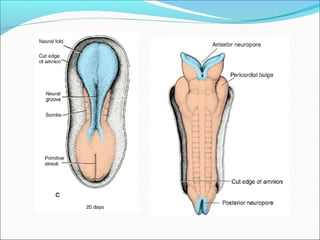
The human nervous system originates from the primitive
ectoderm that also develops into the epidermis.
The ectoderm, endoderm, and mesoderm form the three
primary germ layers that are developed by the 3rd wk.
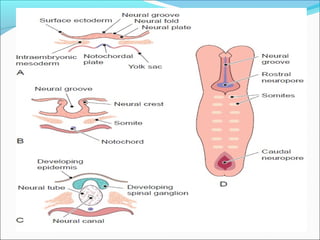
The endoderm, particularly the notochordal plate and the
intraembryonic mesoderm, induces the overlying ectoderm to
develop the neural plate in the 3rd wk of development
Failure of normal induction is responsible for most of the NTDs,
as well as disorders of prosencephalic development.
Neural tube defects (NTDs) account for the largest
proportion of congenital anomalies of the CNS and
result from failure of the neural tube to close
spontaneously between the 3rd and 4th wk of in utero
development.
Although the precise cause of NTDs remains
unknown,
epidemiology
Occurrence of these types of defects Is common and varíes
by different regions. For example, prior to fortification of
enriched flour with folie acid in the United States, the
over- all rate was 1 in 1,000 births, but in North and South
Carolina, the rate was 1 in 500 births.
In parts of China, rates were as high as 1 in 200 births.
Various genetic and environmental factors apparently
account for the vari- ability.
Risk factors
Family history of NTDs
Certain syndromes and chromosomal disorders.
Low dietary low folic acid
Administration of sodium valproate and folic acid
antagonists, e.g. some anti-epileptics,
trimethoprim
con’t
 hyperthermia
 malnutrition
 low red cell folate levels
 chemicals, Radiation
maternal obesity or diabetes
 genetic determinants (mutations in folate-responsive
or folate-dependent enzyme pathways)
CLASSIFICATION OF NTDs
• NTDs are classified as:
1. Open: often involve the entire CNS with neural
tissue is exposed and CSF leaking
2. Closed: localised to the spine; brain rarely affected;
neural tissue not exposed although the skin
covering the defect may be dysplastic
Cranial NTDs
Anencephaly
Encephalocele
- meningocele
- meningomyelocele
Congenital dermal sinus
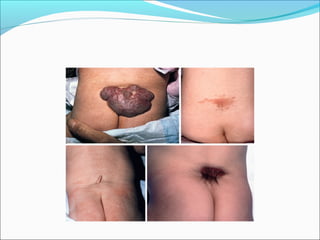
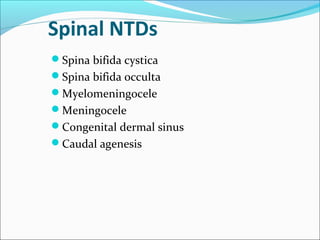
Spinal NTDs
Spina bifida cystica
Spina bifida occulta
Myelomeningocele
Meningocele
Congenital dermal sinus
Caudal agenesis
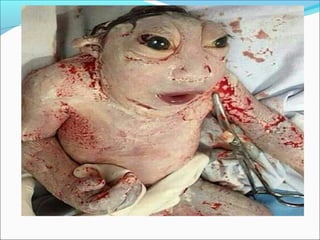
ANENCEPHALIC
An anencephalic infant presents a distinctive appearance with a
large defect of the calvarium, meninges, and scalp associated
with a rudimentary brain.
which results from failure of closure of the rostral neuropore,
the opening of the anterior neural tube.
The cerebral hemispheres and cerebellum are usually
absent, and only a residue of the brainstem can be
identified.
Additional anomalies
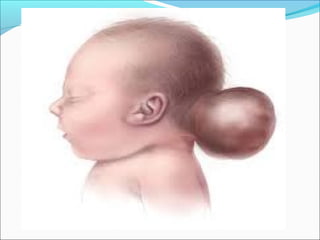
ENCEPHALOCELE
Two major forms of dysraphism affect the skull,
resulting in protrusion of tissue through a bony
midline defect, called cranium bifidum.
A cranial meningocele consists of a CSF-filled
meningeal sac only, and a cranial encephalocele
contains the sac plus cerebral cortex, cerebellum,
or portions of the brainstem.
Infants with a cranial encephalocele are at
increased risk for developing hydrocephalus
because of aqueductal stenosis, Chiari
malformation, or the Dandy-Walker
syndrome.
 Examination might show a small sac with a
pedunculated stalk or a large cyst-like structure
that can exceed the size of the cranium.
The lesion may be completely covered with skin,
but areas of denuded lesion can occur and require

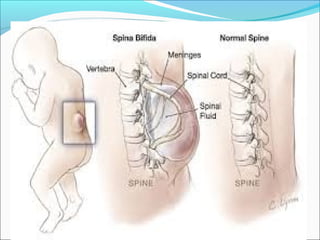
SPINA BIFIDA
Is one of the most serious veterbral defect is the result
of inperfect fusion or nonunioun of the veterbral
arches. Such an abnormalty as cleft veterbral ( spina
bifida)
Spina bifida Occulta it involve only the bony veterbral
arches leaving the spinal cord intact and the bony
defect is covered by skin and no neurological defecit.
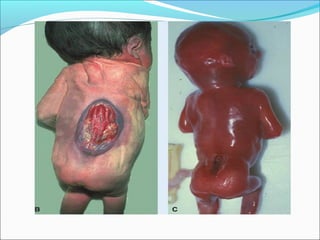
Spina bifida cystica more severe abnormality in
which the neural tube fails to close, veterbral archest
fail to form, and neural tissue is exposed.
Any neurological deficits depend on the level and the
extend of the lesion.
meningocele
A meningocele is formed when the meninges herniate
through a defect in the posterior vertebral arches or
the anterior sacrum.
The spinal cord is usually normal and assumes a
normal position in the spinal canal, although there
may be tethering of the cord, syringomyelia, or
diastematomyelia.
A fluctuant midline mass that might transilluminate
occurs along the vertebral column, usually in the
lower back.
 Most meningoceles are well covered with skin and
pose no immediate threat to the patient. Careful
neurologic examination is mandatory.
Myelomeningocele
Myelomeningocele represents the most severe form
of dysraphism, a so-called aperta or open form,
involving the vertebral column and spinal cord.
 incidence is approximately 1 in 4,000 live births.
anatomic expression of
myelomeningoceleThe presence of unfused or excessively separated
vertebral arches of the bony spine (spina bifida)
 Cystic dilation of the meninges that surround the spinal
cord (meningocele)
 Cystic dilation of the spinal cord itself (myelocele)
 Hydrocephalus and the spectrum of congenital cerebral
abnormalities
Investigations
MRI: best for imaging neural tissue & identifying
contents of the defect
CT: direct visualisation of the bony defect and
anatomy
Ultrasound: for prenatal screening
X-ray
Prenatal screening
Failure of closure of the neural tube allows excretion
of fetal substances (α-fetoprotein [AFP],
acetylcholinesterase) into the amniotic fluid, serving
as biochemical markers for a NTD.
Prenatal screening of maternal serum for AFP in the
16th-18th wk of gestation is an effective method for
identifying pregnancies at risk for fetuses with NTDs
in utero
Counseling
Outcome depends a lot on level.
Lower lesions may result in relatively mild defecits.
Another issue is the related hydrocephalus, cerebellar
malformation and long-term cognitive dysfunction.
Management
Multidisciplinary approach - to address any
associated physical, developmental, hearing,
visual and learning difficulties
Keep baby warm and the defect covered with a
sterile saline dressing
Position baby in prone position to avoid pressure
on the defect
Defect should be closed promptly
Treatment of hydrocephalus
Complications
Infections
Associated motor and sensory problems, particularly
lower limb
Associated learning disability, developmental delay
and hearing impairment
Bladder and bowel dysfunction
Prevention
Pre-conceptional folate supplementation
Food fortification with the addition of folate

Neural tube defects

  • 1.
    NEURAL TUBE DEFECTSNEURALTUBE DEFECTS BY ALIYU USMAN MUHAMMAD AND ABDIRAHMAN BASHIR MBchB STUDENT KAMPALA INTERNATIONAL UNIVERSITY, UGANDA
  • 2.
  • 3.
    INTRODUCTION The human nervoussystem originates from the primitive ectoderm that also develops into the epidermis. The ectoderm, endoderm, and mesoderm form the three primary germ layers that are developed by the 3rd wk. The endoderm, particularly the notochordal plate and the intraembryonic mesoderm, induces the overlying ectoderm to develop the neural plate in the 3rd wk of development Failure of normal induction is responsible for most of the NTDs, as well as disorders of prosencephalic development.
  • 6.
    Neural tube defects(NTDs) account for the largest proportion of congenital anomalies of the CNS and result from failure of the neural tube to close spontaneously between the 3rd and 4th wk of in utero development. Although the precise cause of NTDs remains unknown,
  • 7.
    epidemiology Occurrence of thesetypes of defects Is common and varíes by different regions. For example, prior to fortification of enriched flour with folie acid in the United States, the over- all rate was 1 in 1,000 births, but in North and South Carolina, the rate was 1 in 500 births. In parts of China, rates were as high as 1 in 200 births. Various genetic and environmental factors apparently account for the vari- ability.
  • 8.
    Risk factors Family historyof NTDs Certain syndromes and chromosomal disorders. Low dietary low folic acid Administration of sodium valproate and folic acid antagonists, e.g. some anti-epileptics, trimethoprim
  • 9.
    con’t  hyperthermia  malnutrition low red cell folate levels  chemicals, Radiation maternal obesity or diabetes  genetic determinants (mutations in folate-responsive or folate-dependent enzyme pathways)
  • 10.
    CLASSIFICATION OF NTDs •NTDs are classified as: 1. Open: often involve the entire CNS with neural tissue is exposed and CSF leaking 2. Closed: localised to the spine; brain rarely affected; neural tissue not exposed although the skin covering the defect may be dysplastic
  • 12.
    Cranial NTDs Anencephaly Encephalocele - meningocele -meningomyelocele Congenital dermal sinus
  • 13.
    Spinal NTDs Spina bifidacystica Spina bifida occulta Myelomeningocele Meningocele Congenital dermal sinus Caudal agenesis
  • 14.
    ANENCEPHALIC An anencephalic infantpresents a distinctive appearance with a large defect of the calvarium, meninges, and scalp associated with a rudimentary brain. which results from failure of closure of the rostral neuropore, the opening of the anterior neural tube. The cerebral hemispheres and cerebellum are usually absent, and only a residue of the brainstem can be identified. Additional anomalies
  • 16.
    ENCEPHALOCELE Two major formsof dysraphism affect the skull, resulting in protrusion of tissue through a bony midline defect, called cranium bifidum. A cranial meningocele consists of a CSF-filled meningeal sac only, and a cranial encephalocele contains the sac plus cerebral cortex, cerebellum, or portions of the brainstem.
  • 17.
    Infants with acranial encephalocele are at increased risk for developing hydrocephalus because of aqueductal stenosis, Chiari malformation, or the Dandy-Walker syndrome.  Examination might show a small sac with a pedunculated stalk or a large cyst-like structure that can exceed the size of the cranium. The lesion may be completely covered with skin, but areas of denuded lesion can occur and require 
  • 19.
    SPINA BIFIDA Is oneof the most serious veterbral defect is the result of inperfect fusion or nonunioun of the veterbral arches. Such an abnormalty as cleft veterbral ( spina bifida) Spina bifida Occulta it involve only the bony veterbral arches leaving the spinal cord intact and the bony defect is covered by skin and no neurological defecit.
  • 20.
    Spina bifida cysticamore severe abnormality in which the neural tube fails to close, veterbral archest fail to form, and neural tissue is exposed. Any neurological deficits depend on the level and the extend of the lesion.
  • 23.
    meningocele A meningocele isformed when the meninges herniate through a defect in the posterior vertebral arches or the anterior sacrum. The spinal cord is usually normal and assumes a normal position in the spinal canal, although there may be tethering of the cord, syringomyelia, or diastematomyelia.
  • 24.
    A fluctuant midlinemass that might transilluminate occurs along the vertebral column, usually in the lower back.  Most meningoceles are well covered with skin and pose no immediate threat to the patient. Careful neurologic examination is mandatory.
  • 25.
    Myelomeningocele Myelomeningocele represents themost severe form of dysraphism, a so-called aperta or open form, involving the vertebral column and spinal cord.  incidence is approximately 1 in 4,000 live births.
  • 26.
    anatomic expression of myelomeningoceleThepresence of unfused or excessively separated vertebral arches of the bony spine (spina bifida)  Cystic dilation of the meninges that surround the spinal cord (meningocele)  Cystic dilation of the spinal cord itself (myelocele)  Hydrocephalus and the spectrum of congenital cerebral abnormalities
  • 27.
    Investigations MRI: best forimaging neural tissue & identifying contents of the defect CT: direct visualisation of the bony defect and anatomy Ultrasound: for prenatal screening X-ray
  • 28.
    Prenatal screening Failure ofclosure of the neural tube allows excretion of fetal substances (α-fetoprotein [AFP], acetylcholinesterase) into the amniotic fluid, serving as biochemical markers for a NTD. Prenatal screening of maternal serum for AFP in the 16th-18th wk of gestation is an effective method for identifying pregnancies at risk for fetuses with NTDs in utero
  • 29.
    Counseling Outcome depends alot on level. Lower lesions may result in relatively mild defecits. Another issue is the related hydrocephalus, cerebellar malformation and long-term cognitive dysfunction.
  • 30.
    Management Multidisciplinary approach -to address any associated physical, developmental, hearing, visual and learning difficulties Keep baby warm and the defect covered with a sterile saline dressing Position baby in prone position to avoid pressure on the defect Defect should be closed promptly Treatment of hydrocephalus
  • 31.
    Complications Infections Associated motor andsensory problems, particularly lower limb Associated learning disability, developmental delay and hearing impairment Bladder and bowel dysfunction
  • 32.
    Prevention Pre-conceptional folate supplementation Foodfortification with the addition of folate