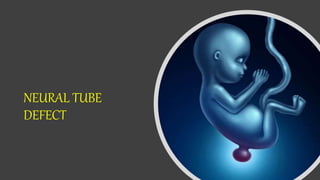
NEURAL TUBE
DEFECT
SPECIFIC OBJECTIVE:
At the end of the class student will be able to:-
• Introduction and definition neural tube defect.
• Etiology of neural tube defect.
• Enumerate cause of neural tube defect.
• Discuss type of neural tube defect with clinical manifestation.
CONT…..
• Discuss diagnostic evaluation.
• Explain management of neural tube defect.
• Explain nursing management.
DEFINITION:
Neural tube defect are the congenital
malformation of the central nervous system
resulting from defective closer of neural tube
during embryogenesis between 3rd -4th week
of life.
CAUSES AND RISK FACTOR:
The exact cause of neural tube defect is unknown. but
risk factor are-
• Folic acid deficiency during first trimester.
• Maternal radiation exposure.
• Use of teratogenic drugs.
• Exposure of chemical.
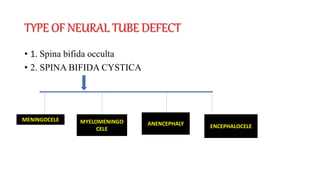
TYPE OF NEURAL TUBE DEFECT
• 1. Spina bifida occulta
• 2. SPINA BIFIDA CYSTICA
MENINGOCELE MYELOMENINGO
CELE
ANENCEPHALY ENCEPHALOCELE
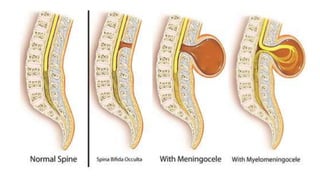
SPINA BIFIDA OCCULTA
There is defective closure of neural tube. There is
no protrusion of meninges
Eg., Hemangioma
• Tuft of hair
• Lipoma.
CLINICAL MANIFESTATION:
•A dimple in the skin.
• Growth of hair over malformed vertebra.
• Disturbance of bladder and bowel sphincter.
• Deformity of foot.
• Change in urination.
SPINA BIFIDA CYSTICA
There is defective closure of neural tube defect. There is
protrusion of
• Meninges and spinal cord.
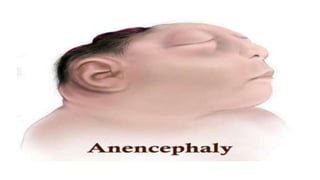
•Anencephaly is an congenital
•Absence of cranial vault with the cerebral hemisphere
•Completely missing or reduced to masses.
•Various congenital anomalies can be associated with this
•Condition like- congenital heart disease, cleft palate etc.
•This condition is incompatible with life, death usually
•Occur with the week of the birth.
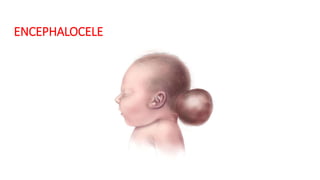
ENCEPHALOCELE
•It is a sac like protrusion of meninges with brain
substance (spinal cord with brain tissue).
•The size may vary from small to as big size of
head.
CLINICAL FEATURE
 Hydrocephalus.
 Visual problem.
 Seizure.
 Microcephaly.
 Mental retardation.
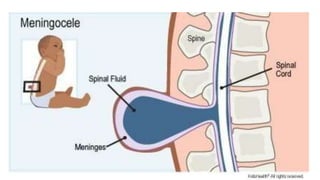
MENINGOCELE
•It is the protrusion of meninges through a
midline defect. Cyst filled with CSF protrude out
and covered by a thin transparent membrane.
•Spinal cord and nerve roots are normal.
•It is generally found in the lower back, i.e.,
lumbosacral
•Region.
•It may also found in the thoracic region and in the
skull (i.e. Cranial meningocele).
•There is no dysplasia of the spinal cord and the
child may
•Found asymptomatic.
CLINICAL MENIFESTATION:
• Weakness in the legs.
• Lack of sphincter control.
• Hydrocephalus.
• CSF Leakage.
• Risk of infection.
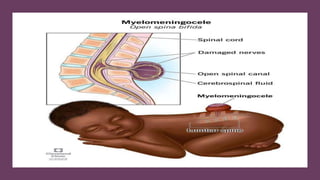
MYELOMENINGOCELE:
• It is a midline cystic
• Sac of meninges with spinal tissue and CSF. Which
herniates through a defect in the posterior vertebral
arch.
• It is one of the most common leasion(90-95%) and can
be present anywhere on the midline in the back, but
lumbosacral area is the most common.
Contt….
• There can be found as two types-
• MYELOCELE (Open type)
• MYELOMENINGOCELE (Close type)
• The most common cystic lesion containing neural
tissue
• Which may be dysplastic spinal cord and nerve fibers.
MANAGEMENT
The management of spina bifida depends on nature and
extent of defect
 Usually no intervention is require for spinal bifida
occulta.
 For spina bifida cystica surgery is required-
 LAMINECTOMY:- Removal of lamina.
 Closure of the defect or removal of the sac is done
with 24-48 hours of birth.
 T-closure of the skin graft is done.
 A co-ordinated multidisciplinary team approach is
required minimize the physical and intellectual
potential of each affected child
Summary
Spina bifida is a birth defect that occurs when
the spine and spinal cord don't form properly. It's a
type of neural tube defect. The neural tube is the
structure in a developing embryo that eventually
becomes the baby's brain, spinal cord and the tissues
that enclose them.
Conclusion
Spina bifida is a condition where the spine does not
develop properly, leaving a gap in the spine.
During the first month of life, an embryo (developing baby)
grows a structure called the neural tube that will eventually
form the spine and nervous system.When something goes
wrong with this process, the result is called a "neural tube
defect".Spina bifida is one type of neural tube defect.
neural tube defect.pptx

neural tube defect.pptx

  • 1.
  • 2.
    SPECIFIC OBJECTIVE: At theend of the class student will be able to:- • Introduction and definition neural tube defect. • Etiology of neural tube defect. • Enumerate cause of neural tube defect. • Discuss type of neural tube defect with clinical manifestation.
  • 3.
    CONT….. • Discuss diagnosticevaluation. • Explain management of neural tube defect. • Explain nursing management.
  • 4.
    DEFINITION: Neural tube defectare the congenital malformation of the central nervous system resulting from defective closer of neural tube during embryogenesis between 3rd -4th week of life.
  • 5.
    CAUSES AND RISKFACTOR: The exact cause of neural tube defect is unknown. but risk factor are- • Folic acid deficiency during first trimester. • Maternal radiation exposure. • Use of teratogenic drugs. • Exposure of chemical.
  • 6.
    TYPE OF NEURALTUBE DEFECT • 1. Spina bifida occulta • 2. SPINA BIFIDA CYSTICA MENINGOCELE MYELOMENINGO CELE ANENCEPHALY ENCEPHALOCELE
  • 8.
    SPINA BIFIDA OCCULTA Thereis defective closure of neural tube. There is no protrusion of meninges Eg., Hemangioma • Tuft of hair • Lipoma.
  • 9.
    CLINICAL MANIFESTATION: •A dimplein the skin. • Growth of hair over malformed vertebra. • Disturbance of bladder and bowel sphincter. • Deformity of foot. • Change in urination.
  • 10.
    SPINA BIFIDA CYSTICA Thereis defective closure of neural tube defect. There is protrusion of • Meninges and spinal cord.
  • 12.
    •Anencephaly is ancongenital •Absence of cranial vault with the cerebral hemisphere •Completely missing or reduced to masses. •Various congenital anomalies can be associated with this •Condition like- congenital heart disease, cleft palate etc. •This condition is incompatible with life, death usually •Occur with the week of the birth.
  • 13.
  • 14.
    •It is asac like protrusion of meninges with brain substance (spinal cord with brain tissue). •The size may vary from small to as big size of head.
  • 15.
    CLINICAL FEATURE  Hydrocephalus. Visual problem.  Seizure.  Microcephaly.  Mental retardation.
  • 17.
    MENINGOCELE •It is theprotrusion of meninges through a midline defect. Cyst filled with CSF protrude out and covered by a thin transparent membrane. •Spinal cord and nerve roots are normal.
  • 18.
    •It is generallyfound in the lower back, i.e., lumbosacral •Region. •It may also found in the thoracic region and in the skull (i.e. Cranial meningocele). •There is no dysplasia of the spinal cord and the child may •Found asymptomatic.
  • 19.
    CLINICAL MENIFESTATION: • Weaknessin the legs. • Lack of sphincter control. • Hydrocephalus. • CSF Leakage. • Risk of infection.
  • 21.
    MYELOMENINGOCELE: • It isa midline cystic • Sac of meninges with spinal tissue and CSF. Which herniates through a defect in the posterior vertebral arch. • It is one of the most common leasion(90-95%) and can be present anywhere on the midline in the back, but lumbosacral area is the most common.
  • 22.
    Contt…. • There canbe found as two types- • MYELOCELE (Open type) • MYELOMENINGOCELE (Close type) • The most common cystic lesion containing neural tissue • Which may be dysplastic spinal cord and nerve fibers.
  • 25.
    MANAGEMENT The management ofspina bifida depends on nature and extent of defect  Usually no intervention is require for spinal bifida occulta.  For spina bifida cystica surgery is required-  LAMINECTOMY:- Removal of lamina.
  • 26.
     Closure ofthe defect or removal of the sac is done with 24-48 hours of birth.  T-closure of the skin graft is done.  A co-ordinated multidisciplinary team approach is required minimize the physical and intellectual potential of each affected child
  • 31.
    Summary Spina bifida isa birth defect that occurs when the spine and spinal cord don't form properly. It's a type of neural tube defect. The neural tube is the structure in a developing embryo that eventually becomes the baby's brain, spinal cord and the tissues that enclose them.
  • 32.
    Conclusion Spina bifida isa condition where the spine does not develop properly, leaving a gap in the spine. During the first month of life, an embryo (developing baby) grows a structure called the neural tube that will eventually form the spine and nervous system.When something goes wrong with this process, the result is called a "neural tube defect".Spina bifida is one type of neural tube defect.