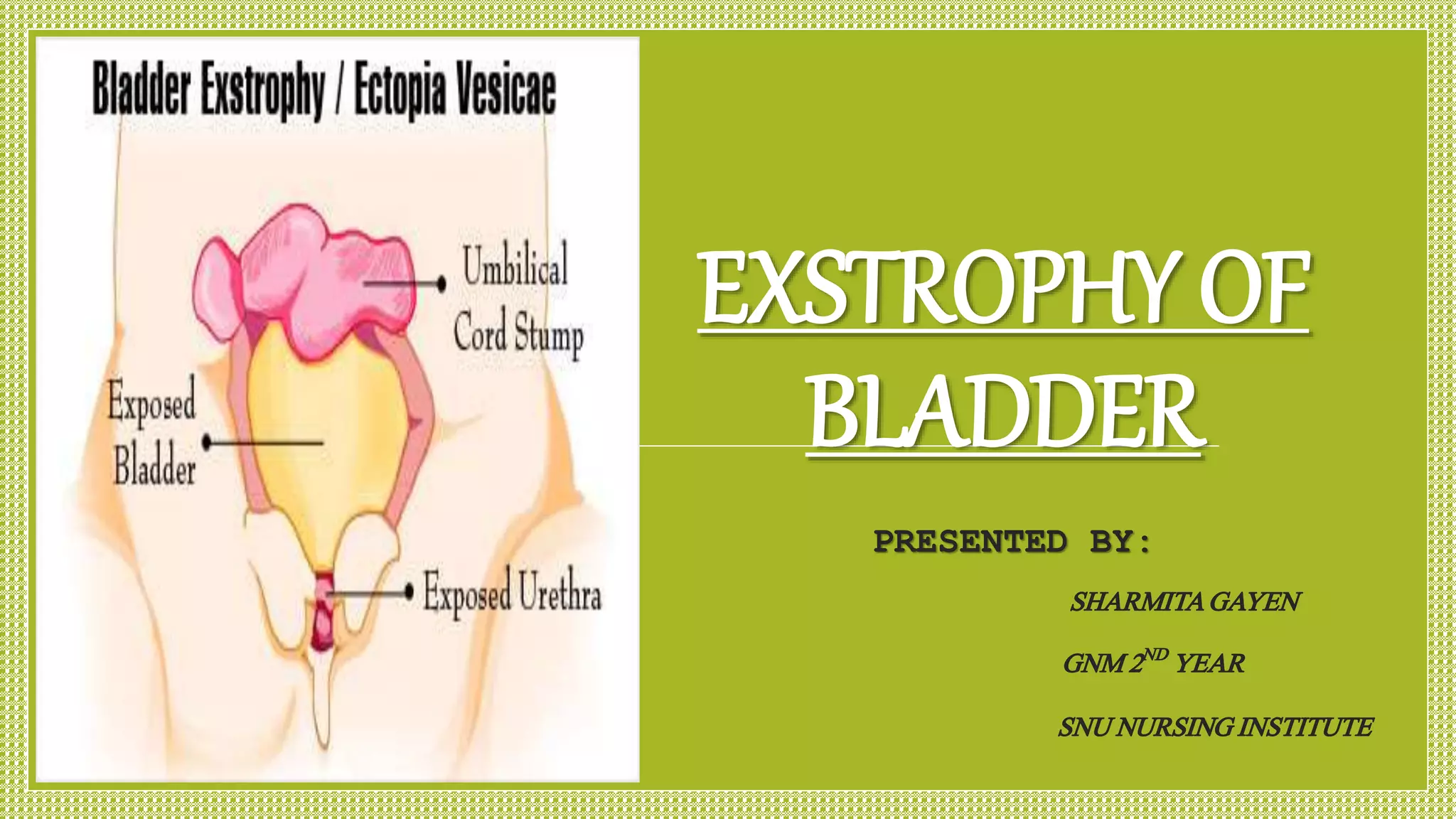
EXSTROPHY OF
BLADDER
PRESENTED BY:
SHARMITAGAYEN
GNM2ND YEAR
SNUNURSINGINSTITUTE
INTRODUCTION:
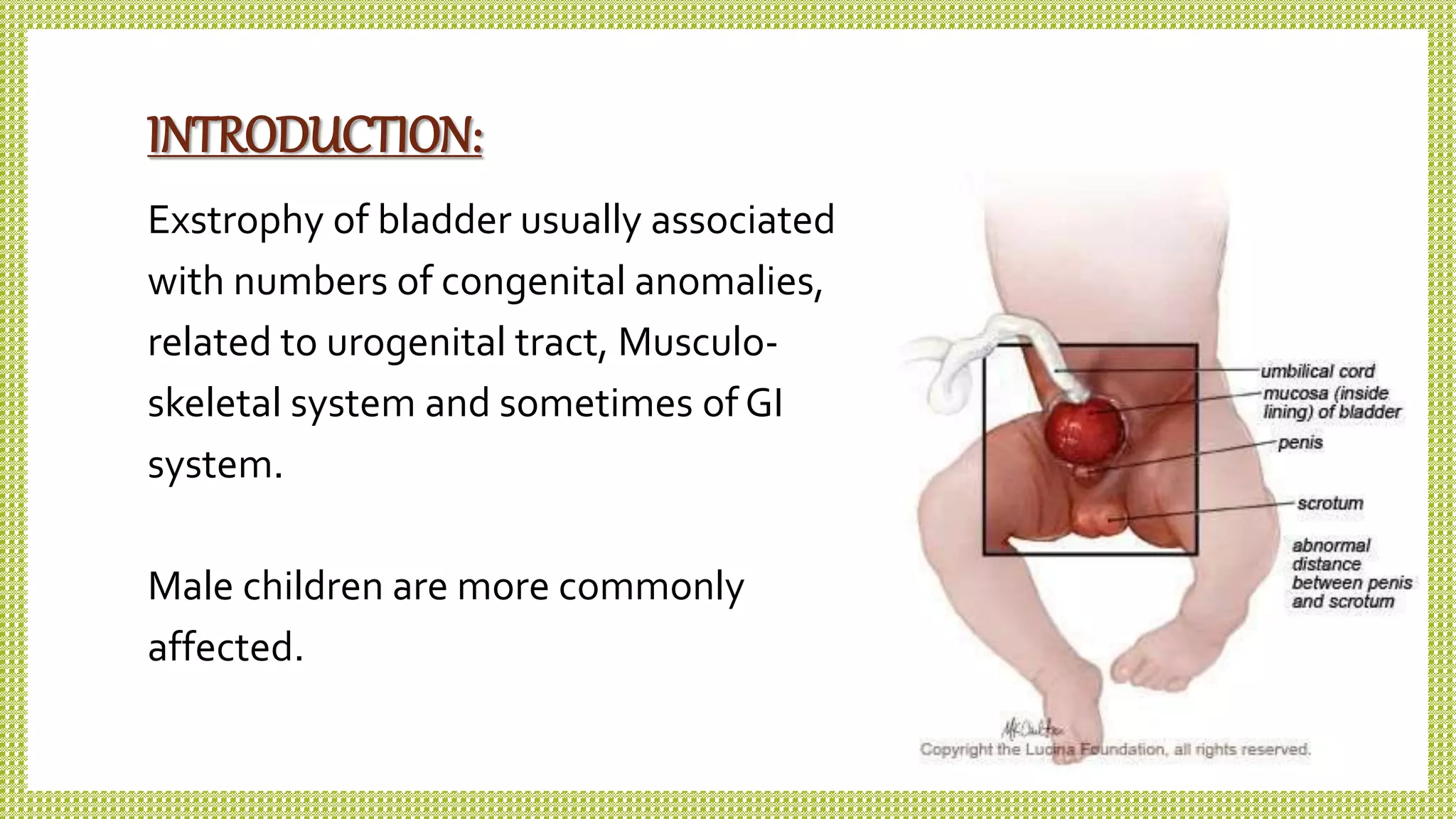
Exstrophy of bladder usually associated
with numbers of congenital anomalies,
related to urogenital tract, Musculo-
skeletal system and sometimes of GI
system.
Male children are more commonly
affected.
Contd.
 It is also termed as ‘ectopic vesicae’ i.e. malposition or
displacement of urinary bladder from its normal position
in the pelvis.
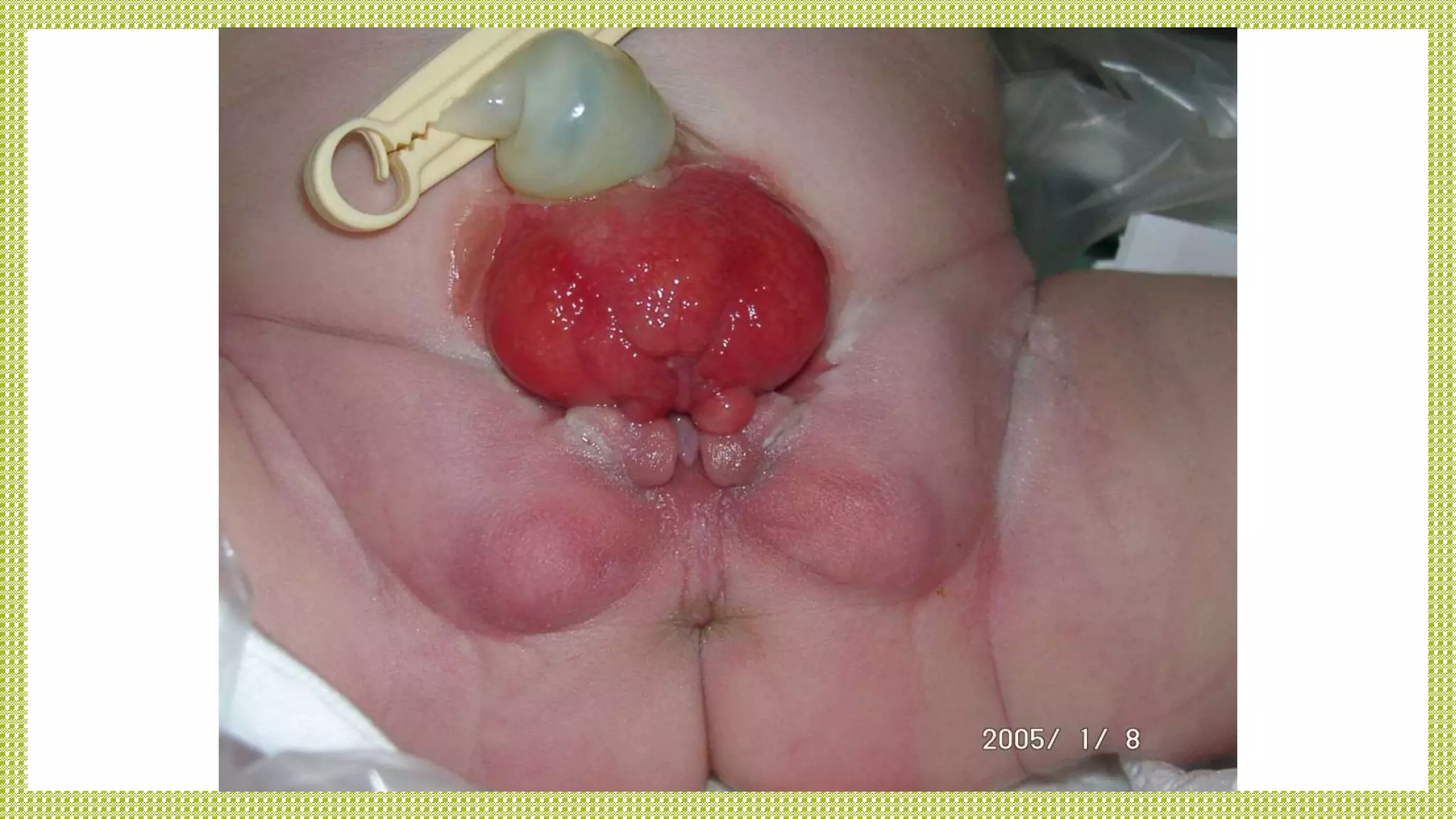
 Exstrophy of bladder is a congenital malformation in
which the lower portion of the abdominal wall and the
anterior wall of the bladder are missing, so that the
bladder is everted through the opening and may found on
the lower abdomen just above the symphysis pubis, with
continuous passage of urine to the outside.
DEFINITION:
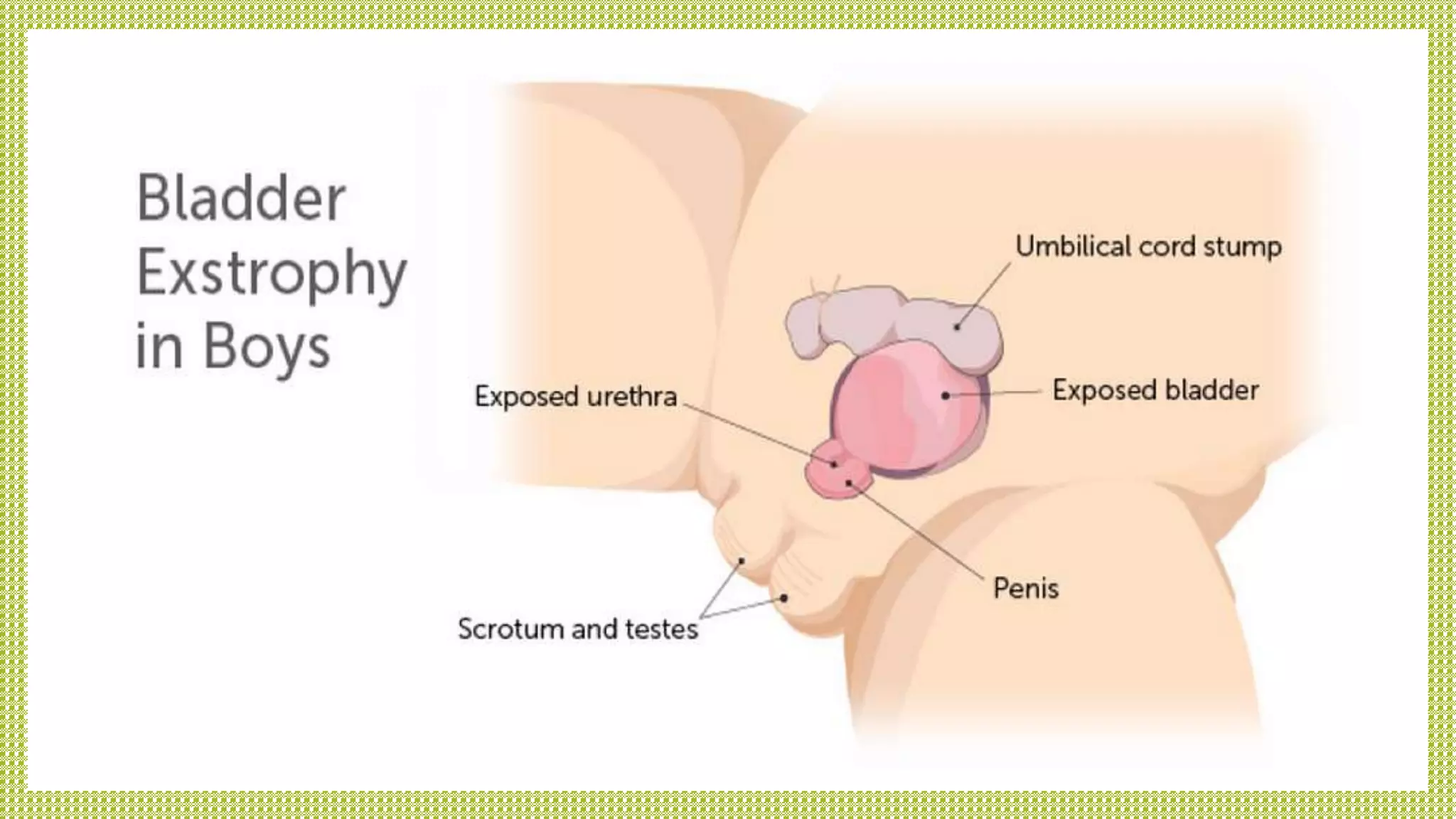
• Exstrophy means ‘turned inside out’. Bladder exstrophy is a
congenital (present at birth) abnormality of the bladder. It
happens when the skin over the lower abdominal wall
(bottom part of the tummy) does not form properly, so the
bladder is open and exposed on the outside of the
abdomen.
INCIDENCE:
•The birth prevalence of classic bladder exstrophy has
been estimated to be between 1 in 10,000 and 1 in
50,000 livebirths. Males are affected 2-3 times more
often than females.
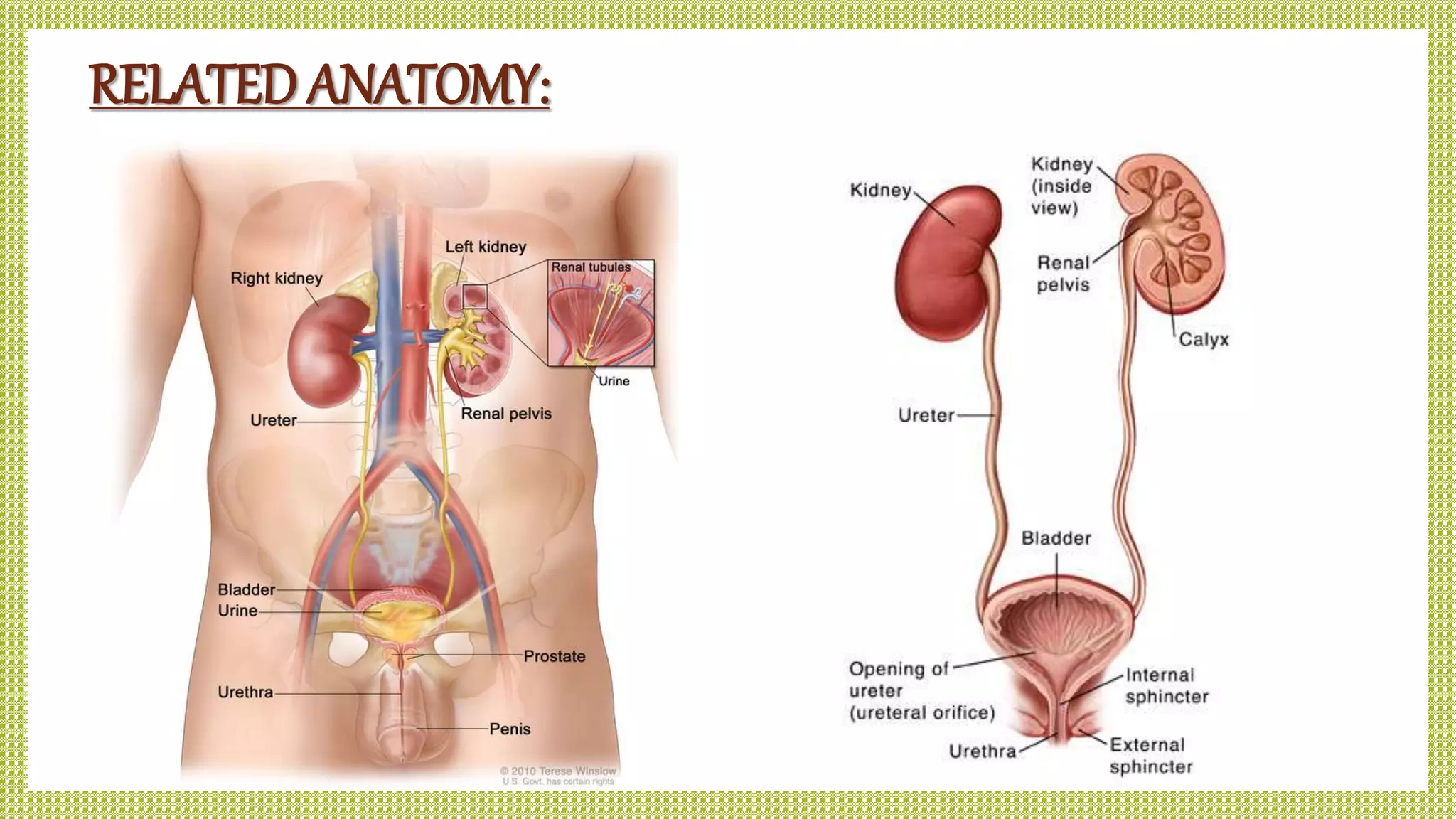
RELATED ANATOMY:
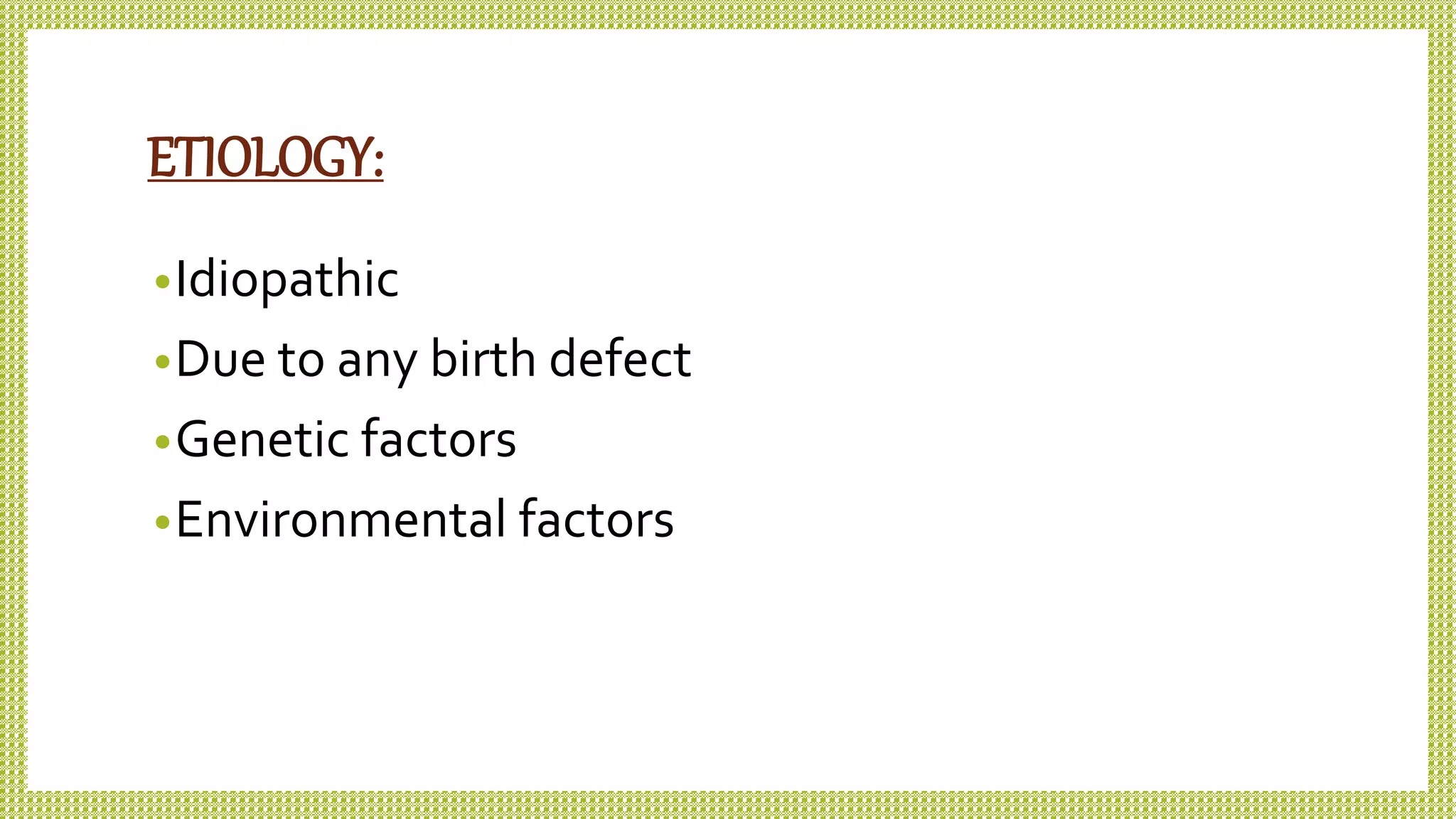
ETIOLOGY:
•Idiopathic
•Due to any birth defect
•Genetic factors
•Environmental factors
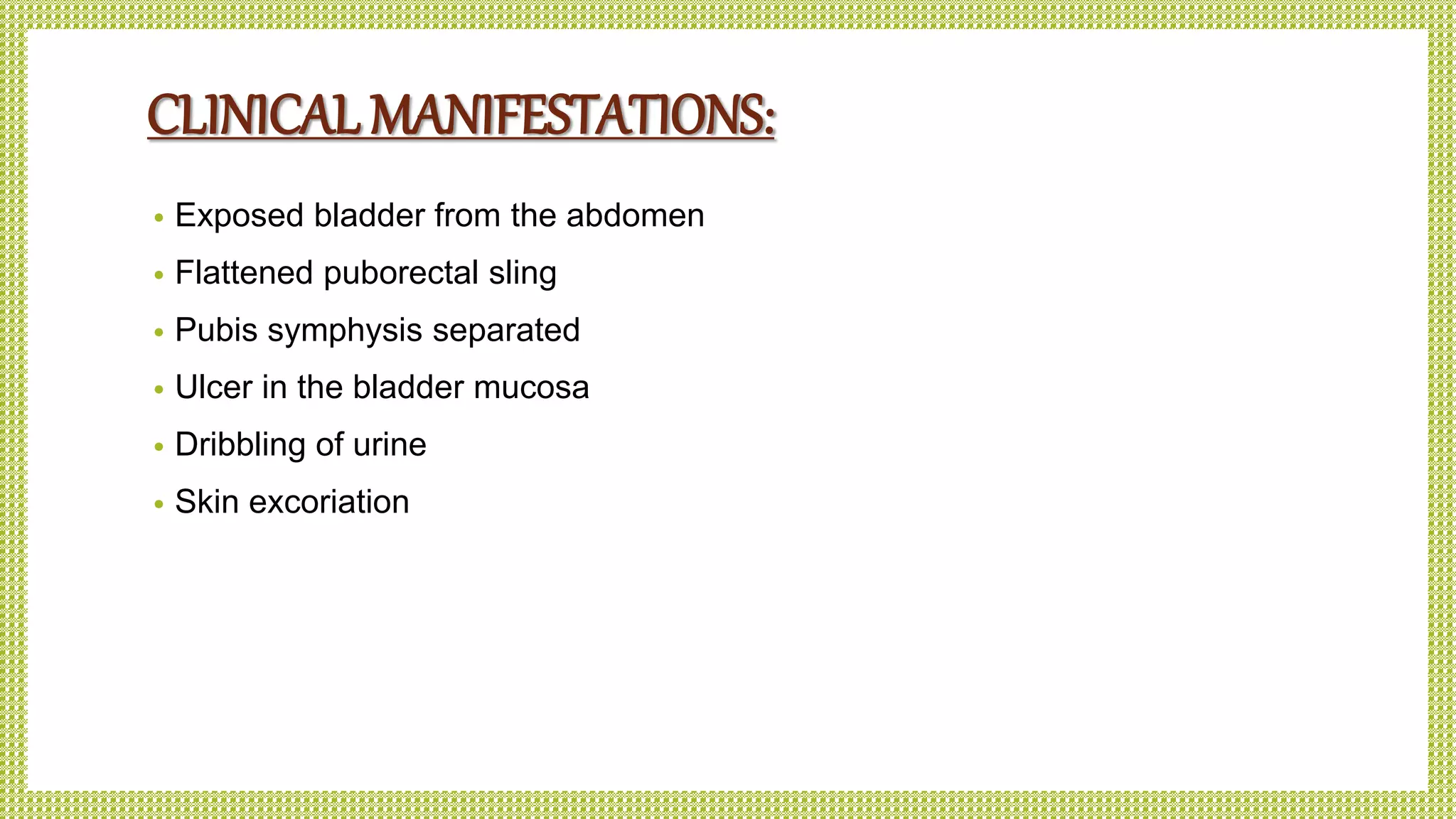
CLINICAL MANIFESTATIONS:
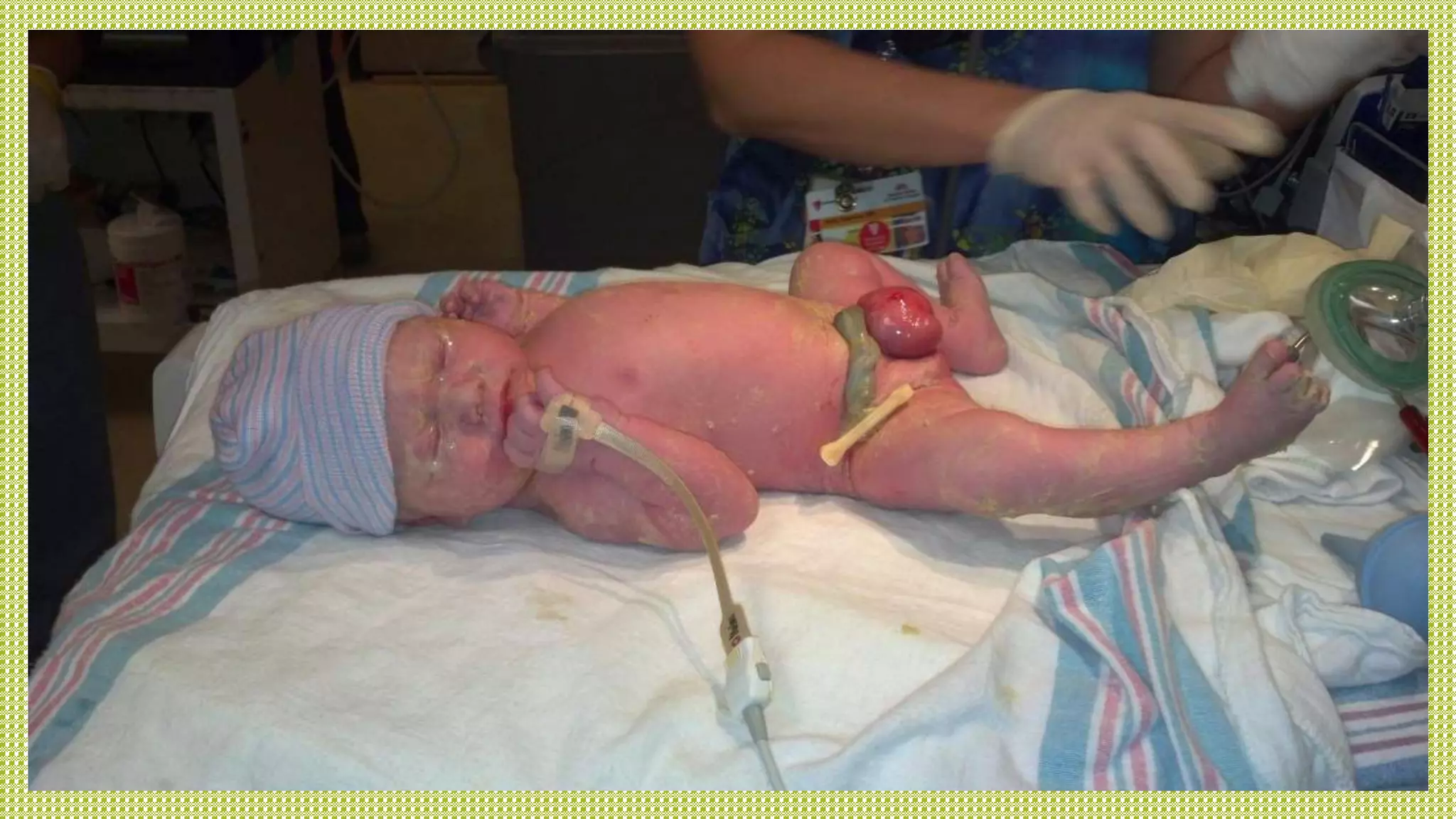
• Exposed bladder from the abdomen
• Flattened puborectal sling
• Pubis symphysis separated
• Ulcer in the bladder mucosa
• Dribbling of urine
• Skin excoriation
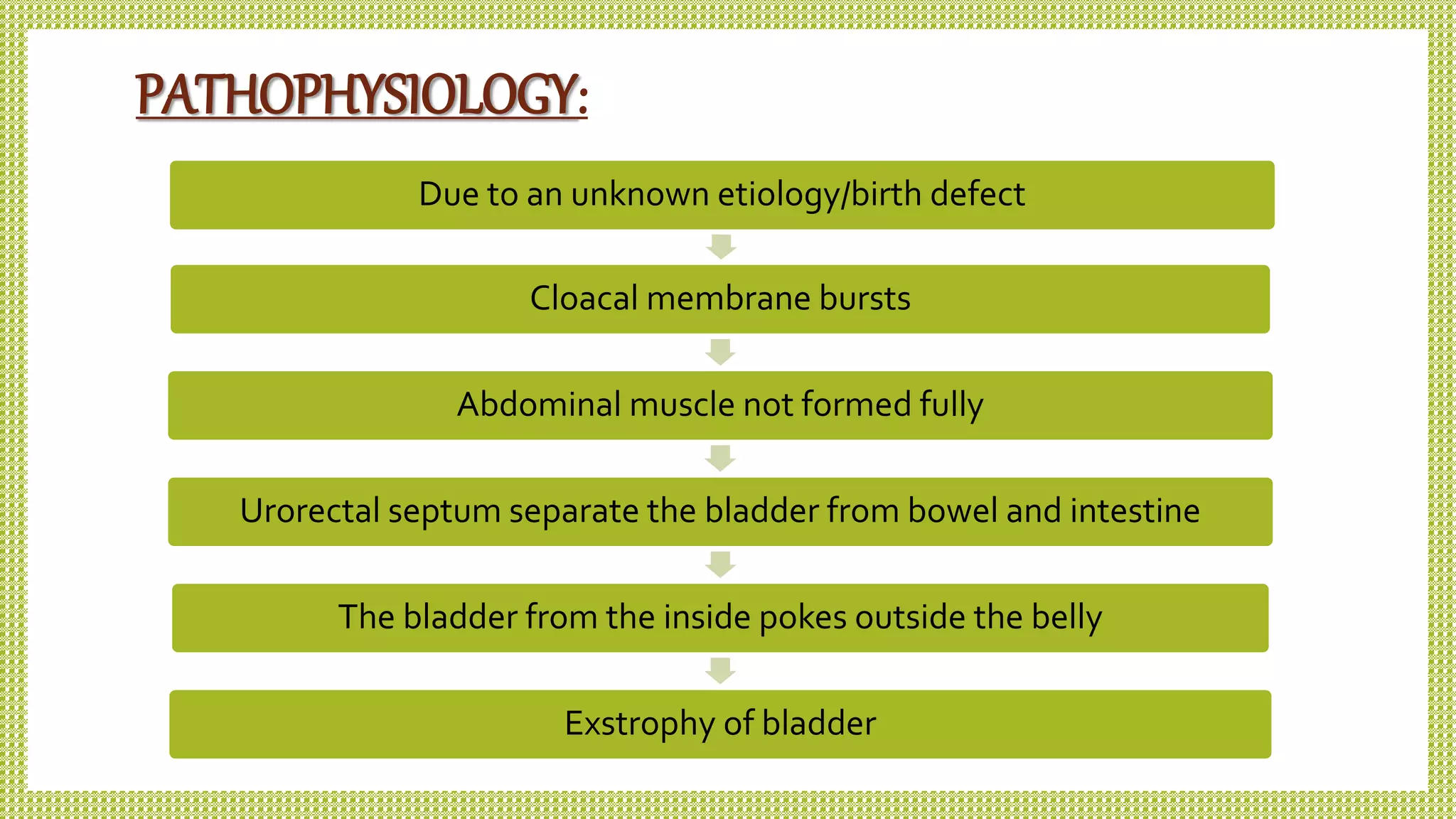
PATHOPHYSIOLOGY:
Due to an unknown etiology/birth defect
Cloacal membrane bursts
Abdominal muscle not formed fully
Urorectal septum separate the bladder from bowel and intestine
The bladder from the inside pokes outside the belly
Exstrophy of bladder
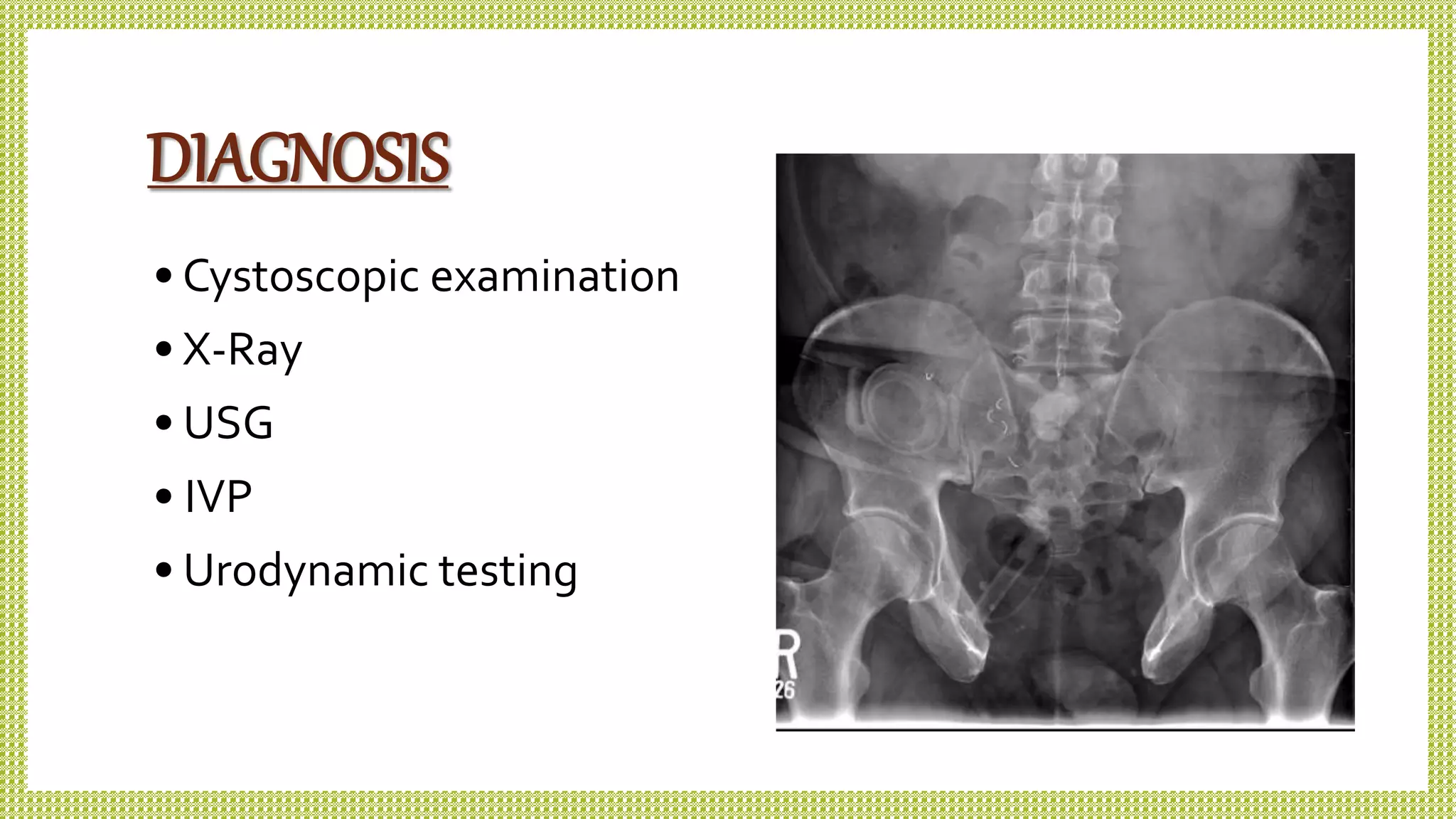
DIAGNOSIS
• Cystoscopic examination
• X-Ray
• USG
• IVP
• Urodynamic testing
MEDICAL MANAGEMENT
•Antibiotic 3rd gen: ceftriaxone
SURGICAL MANAGEMENT
• MSRE – Modern Staged Repair of
Exstrophy
• CPRE – Complete Primary Repair of
Exstrophy
Supportive Nursing care
Preoperative period:
• Protection of bladder area from infections and trauma.
• Avoid irritating clothing and linen over the exposed bladder
• Positioning the infant and back or side
• Humidifying the exposed bladder by covering with wet gauze
• Maintaining aseptic precautions and general hygiene measures along with other
routine care.
• Preparation of parents and child for planned reconstructive surgery
Postoperative period:
• Close monitoring of child condition, vitals signs, features of infection
• Maintaining intake output.
• Care of urinary catheter
• Maintaining urinary catheter position, drainage
• Maintain aseptic precaution during procedure.
• Instruct mother for necessary precautions related to urinary catheter
dislodgement or leakage, prevention of infections.
• Necessary information and demonstration to parents regarding home –based
care
NURSING DIAGNOSIS:
DAY-1 : PRE OPERATIVE DAY
• Impaired body image related to exstrophy of bladder as
evidenced by baby’s mother’s verbalization.
• Fluid volume deficit related to constant urine dribbling as
evidenced by dry skin.
• Risk for infection related to exposed bladder.
DAY-2 : OPERATIVE DAY
• Interrupted family process related to chronic illness and surgery
as evidenced by patient’s mother’s verbalization.
• Impaired nutrition less than body requirement related to NPM as
evidenced by mother’s verbalization.
• Incomplete preoperative preparation related to unable to
maintain by mother secondary to stress for operation as
evidenced by poor hygiene
POST OPERATIVE DAY 1
• Pain related to surgical incision as evidenced by irritable cry,
mother’s verbalization and unable to take breastmilk.
• Respiratory distress related to pain as evidenced by respiratory
rate 50 b/m.
• High risk for bleeding from the surgical site related to surgery in
bladder.
• High risk for impaired fluid balance related to surgery in bladder.
POST OPERATIVE DAY 2
•Risk for infection related to surgical incision.
COMPLICATIONS:
Incontinence of urine
Infection
Dehydration
Progressive weight loss
Even with successful surgery, people may have long-term
complications. Some of the most common include:
• Vesico-ureteral reflux
• Bladder spasm
• Bladder calculus
• Urinary tract infections
HEALTHEDUCATION:
• To keep the bladder area clean and dry.
• Covering the bladder with sterile petroleum gauze to prevent infection and
ulceration of mucosa.
• Preventing diaper from adhering to the area.
• Frequently changing the diaper for comfort and to prevent constant bad odour of
urine.
PROGNOSIS:
• After reconstructive surgery of the bladder, continence rates of about 80%
are expected during childhood. Though spontaneous voiding is the main
issue, additional surgery might be needed to optimize bladder storage and
emptying function. In cases of definite reconstruction failure, urinary
diversion should be undertaken. In puberty, genital and reproductive
function constitute increasingly important issues for both sexes.
Psychosocial and psychosexual outcome reflect the importance of long-
term care (from birth into adulthood) from a multidisciplinary team of
experts for parents and children which facilitate an adequate quality of life.
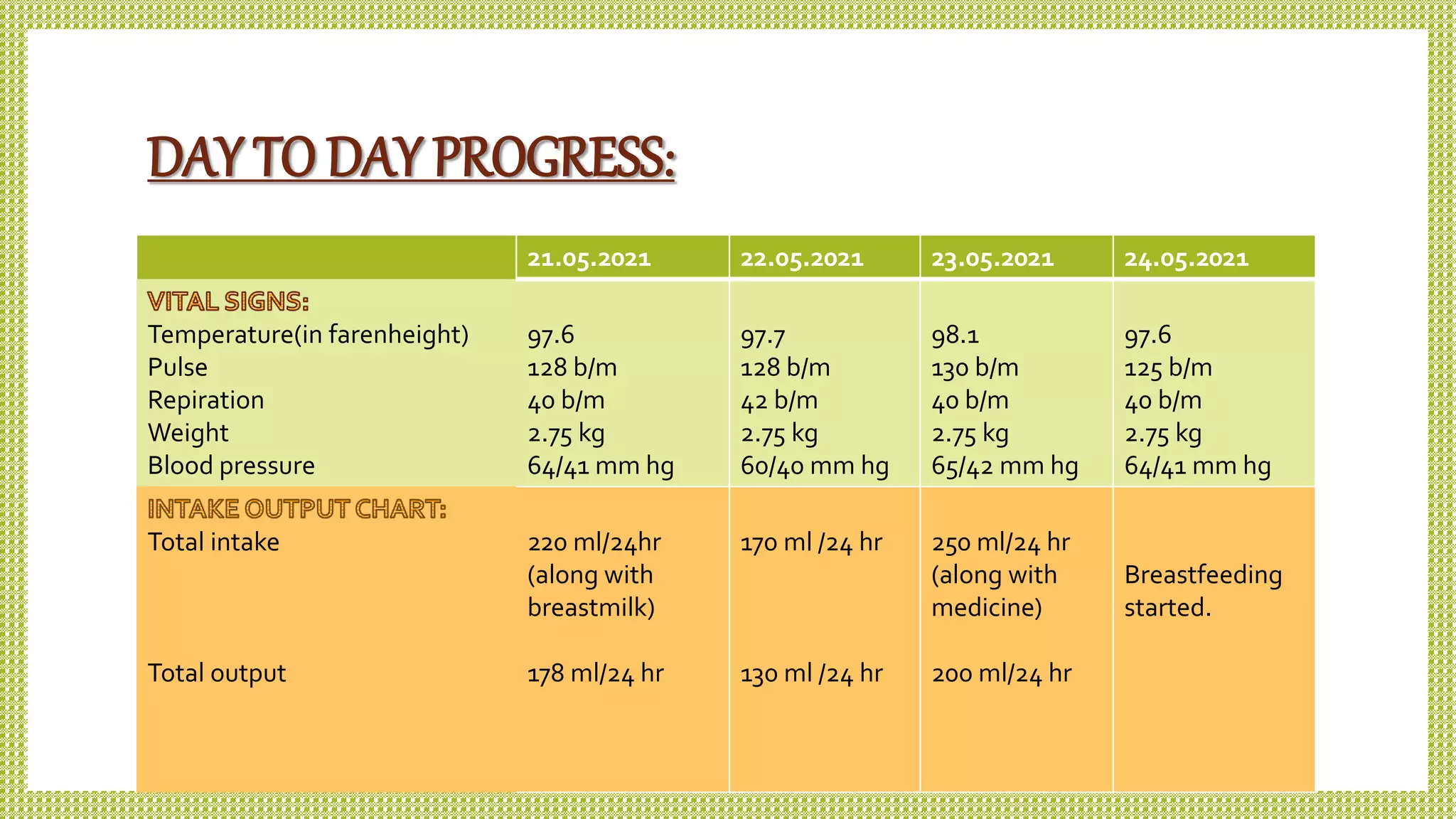
DAY TO DAY PROGRESS:
21.05.2021 22.05.2021 23.05.2021 24.05.2021
Temperature(in farenheight)
Pulse
Repiration
Weight
Blood pressure
97.6
128 b/m
40 b/m
2.75 kg
64/41 mm hg
97.7
128 b/m
42 b/m
2.75 kg
60/40 mm hg
98.1
130 b/m
40 b/m
2.75 kg
65/42 mm hg
97.6
125 b/m
40 b/m
2.75 kg
64/41 mm hg
Total intake
Total output
220 ml/24hr
(along with
breastmilk)
178 ml/24 hr
170 ml /24 hr
130 ml /24 hr
250 ml/24 hr
(along with
medicine)
200 ml/24 hr
Breastfeeding
started.
SUMMARIZATION:
• Introduction
• Definition
• Incidence
• Related anatomy and physiology
• Etiology
• Pathophysiology
• Clinical manifestations
• Diagnosis
• Management (medical,surgical, nursing)
• Nursing diagnosis and care plan
• Complication
• prognosis
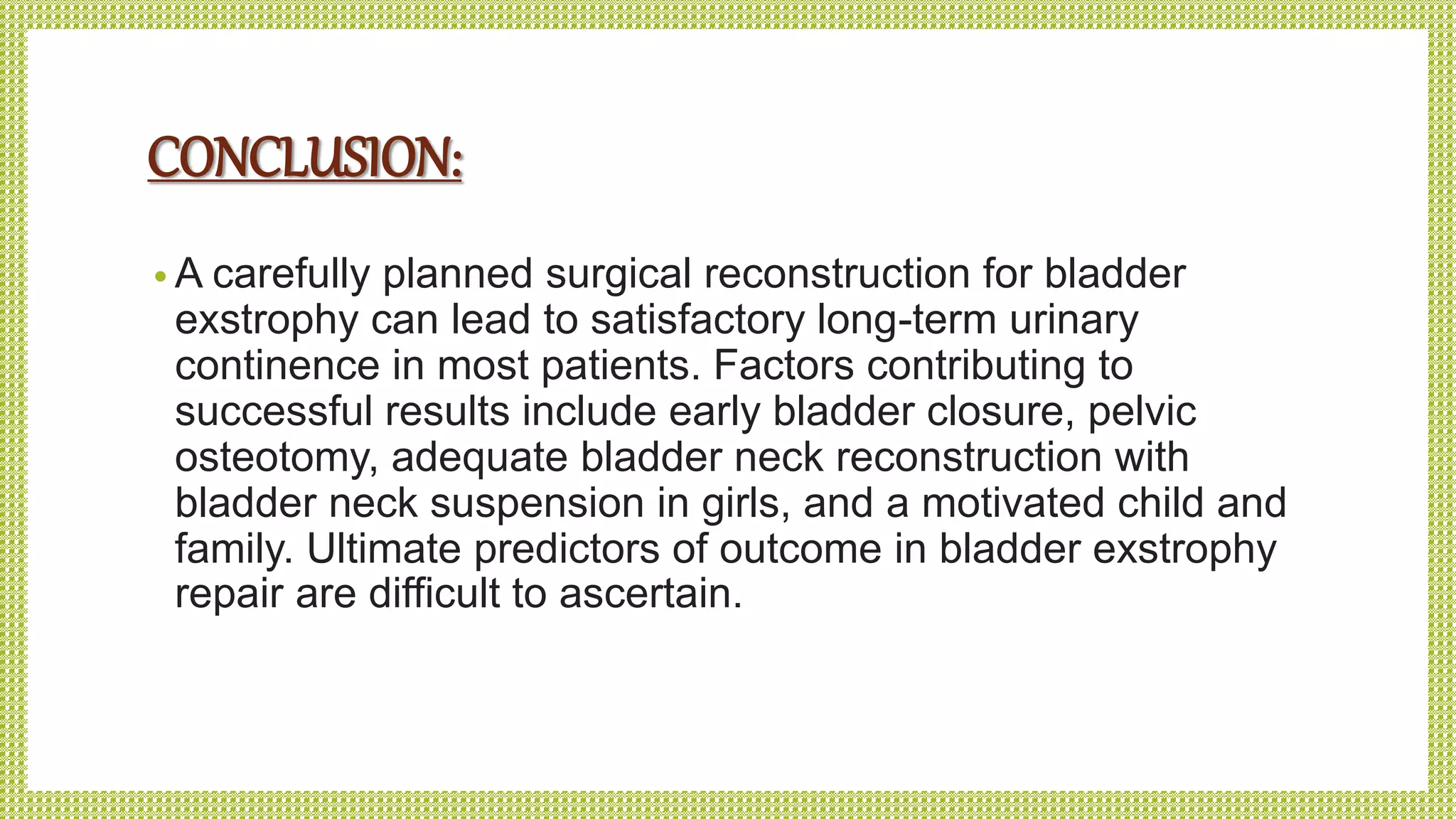
CONCLUSION:
• A carefully planned surgical reconstruction for bladder
exstrophy can lead to satisfactory long-term urinary
continence in most patients. Factors contributing to
successful results include early bladder closure, pelvic
osteotomy, adequate bladder neck reconstruction with
bladder neck suspension in girls, and a motivated child and
family. Ultimate predictors of outcome in bladder exstrophy
repair are difficult to ascertain.
Exstrophy of  bladder

Exstrophy of bladder

  • 1.
  • 2.
    INTRODUCTION: Exstrophy of bladderusually associated with numbers of congenital anomalies, related to urogenital tract, Musculo- skeletal system and sometimes of GI system. Male children are more commonly affected.
  • 3.
    Contd.  It isalso termed as ‘ectopic vesicae’ i.e. malposition or displacement of urinary bladder from its normal position in the pelvis.  Exstrophy of bladder is a congenital malformation in which the lower portion of the abdominal wall and the anterior wall of the bladder are missing, so that the bladder is everted through the opening and may found on the lower abdomen just above the symphysis pubis, with continuous passage of urine to the outside.
  • 4.
    DEFINITION: • Exstrophy means‘turned inside out’. Bladder exstrophy is a congenital (present at birth) abnormality of the bladder. It happens when the skin over the lower abdominal wall (bottom part of the tummy) does not form properly, so the bladder is open and exposed on the outside of the abdomen.
  • 5.
    INCIDENCE: •The birth prevalenceof classic bladder exstrophy has been estimated to be between 1 in 10,000 and 1 in 50,000 livebirths. Males are affected 2-3 times more often than females.
  • 6.
  • 10.
    ETIOLOGY: •Idiopathic •Due to anybirth defect •Genetic factors •Environmental factors
  • 11.
    CLINICAL MANIFESTATIONS: • Exposedbladder from the abdomen • Flattened puborectal sling • Pubis symphysis separated • Ulcer in the bladder mucosa • Dribbling of urine • Skin excoriation
  • 12.
    PATHOPHYSIOLOGY: Due to anunknown etiology/birth defect Cloacal membrane bursts Abdominal muscle not formed fully Urorectal septum separate the bladder from bowel and intestine The bladder from the inside pokes outside the belly Exstrophy of bladder
  • 13.
    DIAGNOSIS • Cystoscopic examination •X-Ray • USG • IVP • Urodynamic testing
  • 14.
  • 15.
    SURGICAL MANAGEMENT • MSRE– Modern Staged Repair of Exstrophy • CPRE – Complete Primary Repair of Exstrophy
  • 16.
    Supportive Nursing care Preoperativeperiod: • Protection of bladder area from infections and trauma. • Avoid irritating clothing and linen over the exposed bladder • Positioning the infant and back or side • Humidifying the exposed bladder by covering with wet gauze • Maintaining aseptic precautions and general hygiene measures along with other routine care. • Preparation of parents and child for planned reconstructive surgery
  • 17.
    Postoperative period: • Closemonitoring of child condition, vitals signs, features of infection • Maintaining intake output. • Care of urinary catheter • Maintaining urinary catheter position, drainage • Maintain aseptic precaution during procedure. • Instruct mother for necessary precautions related to urinary catheter dislodgement or leakage, prevention of infections. • Necessary information and demonstration to parents regarding home –based care
  • 18.
    NURSING DIAGNOSIS: DAY-1 :PRE OPERATIVE DAY • Impaired body image related to exstrophy of bladder as evidenced by baby’s mother’s verbalization. • Fluid volume deficit related to constant urine dribbling as evidenced by dry skin. • Risk for infection related to exposed bladder.
  • 19.
    DAY-2 : OPERATIVEDAY • Interrupted family process related to chronic illness and surgery as evidenced by patient’s mother’s verbalization. • Impaired nutrition less than body requirement related to NPM as evidenced by mother’s verbalization. • Incomplete preoperative preparation related to unable to maintain by mother secondary to stress for operation as evidenced by poor hygiene
  • 20.
    POST OPERATIVE DAY1 • Pain related to surgical incision as evidenced by irritable cry, mother’s verbalization and unable to take breastmilk. • Respiratory distress related to pain as evidenced by respiratory rate 50 b/m. • High risk for bleeding from the surgical site related to surgery in bladder. • High risk for impaired fluid balance related to surgery in bladder.
  • 21.
    POST OPERATIVE DAY2 •Risk for infection related to surgical incision.
  • 22.
    COMPLICATIONS: Incontinence of urine Infection Dehydration Progressiveweight loss Even with successful surgery, people may have long-term complications. Some of the most common include: • Vesico-ureteral reflux • Bladder spasm • Bladder calculus • Urinary tract infections
  • 23.
    HEALTHEDUCATION: • To keepthe bladder area clean and dry. • Covering the bladder with sterile petroleum gauze to prevent infection and ulceration of mucosa. • Preventing diaper from adhering to the area. • Frequently changing the diaper for comfort and to prevent constant bad odour of urine.
  • 24.
    PROGNOSIS: • After reconstructivesurgery of the bladder, continence rates of about 80% are expected during childhood. Though spontaneous voiding is the main issue, additional surgery might be needed to optimize bladder storage and emptying function. In cases of definite reconstruction failure, urinary diversion should be undertaken. In puberty, genital and reproductive function constitute increasingly important issues for both sexes. Psychosocial and psychosexual outcome reflect the importance of long- term care (from birth into adulthood) from a multidisciplinary team of experts for parents and children which facilitate an adequate quality of life.
  • 25.
    DAY TO DAYPROGRESS: 21.05.2021 22.05.2021 23.05.2021 24.05.2021 Temperature(in farenheight) Pulse Repiration Weight Blood pressure 97.6 128 b/m 40 b/m 2.75 kg 64/41 mm hg 97.7 128 b/m 42 b/m 2.75 kg 60/40 mm hg 98.1 130 b/m 40 b/m 2.75 kg 65/42 mm hg 97.6 125 b/m 40 b/m 2.75 kg 64/41 mm hg Total intake Total output 220 ml/24hr (along with breastmilk) 178 ml/24 hr 170 ml /24 hr 130 ml /24 hr 250 ml/24 hr (along with medicine) 200 ml/24 hr Breastfeeding started.
  • 26.
    SUMMARIZATION: • Introduction • Definition •Incidence • Related anatomy and physiology • Etiology • Pathophysiology • Clinical manifestations • Diagnosis • Management (medical,surgical, nursing) • Nursing diagnosis and care plan • Complication • prognosis
  • 27.
    CONCLUSION: • A carefullyplanned surgical reconstruction for bladder exstrophy can lead to satisfactory long-term urinary continence in most patients. Factors contributing to successful results include early bladder closure, pelvic osteotomy, adequate bladder neck reconstruction with bladder neck suspension in girls, and a motivated child and family. Ultimate predictors of outcome in bladder exstrophy repair are difficult to ascertain.