GRACIOUS COLLEGE OF NURSING RAIPUR
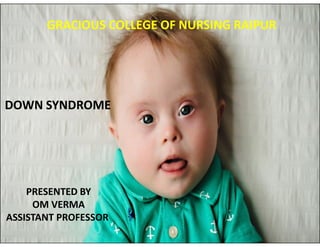
DOWN SYNDROME
PRESENTED BY
OM VERMA
ASSISTANT PROFESSOR
INTRODUCTION
Down syndrome is also referred to as Trisomy
21. Down syndrome is a genetic condition
where people are at the birth with an
extra chromosome. Most people have 23 pairs
of chromosomes within each cell in their body,
for a total of 46. A person diagnosed with
Down syndrome has an extra copy of
chromosome 21, which means their cells
contain 47 total chromosomes instead of 46.
This changes the way their brain and body
develop. and lead congenital abnormality
A genetic chromosome 21 disorder
causing developmental and
intellectual delays.
According to Prof. Suresh K
Sharma,
Down's syndrome is a genetic
disorder caused when abnormal
cell division results in extra genetic
material from chromosome 21.
According to S.S. Randhawa
Down syndrome is a genetic disorder
caused when abnormal cell division
results in an extra full or partial copy of
chromosome 21. This extra genetic
material causes the developmental
changes and physical features of Down
syndrome.
According to Dr. Purnima S. Rao
According to K. Swaminathan
TYPES OF DOWN SYNDROME
There are four types of Down syndrome:
1. Trisomy 21
2. Translocation Down syndrome.
3. Nondisjunction
4. Mosaicism Down syndrome.
1. Trisomy 21
the most common form of Down's syndrome,
caused by an extra copy
of chromosome number 21. embryo with
three copies of chromosome 21 in somatic
cells.
2. Translocation
2. Translocation
Translocation as related to genetics, occurs
when a chromosome breaks and the (typically
two) fragmented pieces re-attach to
different chromosomes.
3. Nondisjunction
It is the first meiotic Division of
gametogenesis and responsible for
trisomy 21 in most of patients .
Nondisjunction is the failure of the
chromosomes to separate, which
produces daughter cells with
abnormal numbers of chromosomes.
4. Mosaicism
In this rare form of Down syndrome, a person
has only some cells with an extra copy of
chromosome 21. This mosaic of normal and
abnormal cells is caused by abnormal cell
division after fertilization. it can lead to disease
that can be traced from the cellular level to
affected tissue, like skin, the brain, or other
organs. It is diagnosed when there is a mixture
of two types of cells. Some have the usual 46
chromosomes, and some have 47.
MATERNAL AGE
Factor that increases the risk for having a baby
with Down syndrome is the mother’s age.
Women who are 35 years or older when they
become pregnant are more likely to have a
pregnancy affected by Down syndrome.
TRANSLOCATION CHROMOSOME
Translocation, as related to genetics, occurs
when a chromosome breaks and the (typically
two) fragmented pieces re-attach to
different chromosomes.
OTHER FACTORS –
Increased incidence may be
associated with exposure of mother
to pesticides ,electromagnetic fields
,anesthetic drugs, alcohol and
caffeine.
CLINICAL FEATURES
CLINICAL FEATURES
PHYSICAL SIGNS OF DOWN SYNDROME
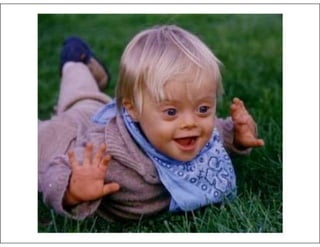
Physical signs of Down syndrome are usually
present at birth and become more apparent as
your baby grows. They can include:
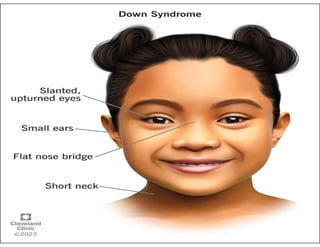
A flat nose bridge.
Flat Face Slanted eyes curve eye that point
upward. ( thus the name Mongolism )
A short neck.
Small ears, hands and feet.
Short stature
Loose joints
Weak muscle tone at birth.
Shorter-than-average height.
Broad short skulls with
Wide nostrils
Tiny white spots on the iris (colored part) of
the eye.
the eye.
Almond-shaped eyes
A tongue that tends to stick out of the
mouth.
Shorter in height as children and adults
OTHER PROBLEMS
Ear infections or hearing loss.
Vision problems or eye diseases.
Dental problems.
Dental problems.
Obstructive sleep apnea.
Congenital heart disease.
Cognitive symptoms of Down
syndrome-
This can cause intellectual or
developmental disabilities.
Short time attention.
Poor judgment.
Poor judgment.
Impulsive behavior.
Slow learning.
Delayed language and speech
development.
DOWN SYNDROME
DIAGNOSED BEFORE
BIRTH
BIRTH
DIAGNOSTIC TESTS DURING
PREGNANCY
Diagnostic tests during pregnancy can
confirm a Down syndrome diagnosis
AMNIOCENTESIS
Amniocentesis is a prenatal test that can
diagnose genetic disorders (such as Down
syndrome and spina bifida) and other health
issues in a fetus. A provider uses a needle to
remove a small amount of amniotic fluid from
inside uterus, and then a lab tests the sample
for specific conditions
CHORIONIC VILLUS SAMPLING (CVS)
Chorionic Villus Sampling is a type of
prenatal testing. You may choose to undergo
this genetic testing during pregnancy to check
the fetus for health conditions like Down
syndrome. It also confirms sex.
Chorionic Villus Sampling chorionic villus
biopsy, is a prenatal test that involves taking a
sample of tissue from the placenta to test for
chromosomal abnormalities and certain other
genetic problems.
PERCUTANEOUS UMBILICAL BLOOD
SAMPLING (PUBS)
This quick test — also called
cordocentesis, fetal blood sampling,
or umbilical vein sampling — takes fetal
blood directly from the umbilical
cord. It is done after the 20th week of
pregnancy. And to detect any
abnormality of fetus
KARYOTYPE TEST
Examines blood or body fluids for
abnormal chromosomes.
Chromosomes are the parts of our
cells that contain genes, It’s often
used to detect genetic diseases in
the developing fetus.
Down Syndrome Treatments
There’s no specific treatment for Down syndrome. But
there is a wide range of physical and developmental
therapies designed to help people with Down
syndrome reach their full potential. Each child will
have different needs.
Physical, occupational, and speech therapy
Specialized education services
Social and recreation activities
Programs that offer job training and teach self-care
skills
Down Syndrome Complications
Babies with Down syndrome may be born with other
physical problems, and they’re at higher risk for certain
health issues later in life.
Possible complications of Down syndrome include:
Heart problems. About half of babies with Down syndrome
are born with a heart defect that may need surgery.
Hearing and vision problems, including
crossed eyes and cataracts
Gastrointestinal disorders, like blockages, reflux, and celiac
disease
Obesity
Breathing issues, including sleep
apnea, asthma, and pulmonary hypertension
Underactive thyroid
Underactive thyroid
Seizures
Childhood leukemia
Early-onset dementia
Dementia is a term used to describe a group
of symptoms affecting memory, thinking and
social abilities severely enough to interfere
with your daily life.
DOWN SYNDROME.pdf

DOWN SYNDROME.pdf

  • 1.
    GRACIOUS COLLEGE OFNURSING RAIPUR DOWN SYNDROME PRESENTED BY OM VERMA ASSISTANT PROFESSOR
  • 2.
    INTRODUCTION Down syndrome isalso referred to as Trisomy 21. Down syndrome is a genetic condition where people are at the birth with an extra chromosome. Most people have 23 pairs of chromosomes within each cell in their body, of chromosomes within each cell in their body, for a total of 46. A person diagnosed with Down syndrome has an extra copy of chromosome 21, which means their cells contain 47 total chromosomes instead of 46. This changes the way their brain and body develop. and lead congenital abnormality
  • 4.
    A genetic chromosome21 disorder causing developmental and intellectual delays. According to Prof. Suresh K According to Prof. Suresh K Sharma,
  • 5.
    Down's syndrome isa genetic disorder caused when abnormal cell division results in extra genetic material from chromosome 21. According to S.S. Randhawa
  • 6.
    Down syndrome isa genetic disorder caused when abnormal cell division results in an extra full or partial copy of chromosome 21. This extra genetic material causes the developmental material causes the developmental changes and physical features of Down syndrome. According to Dr. Purnima S. Rao
  • 7.
    According to K.Swaminathan
  • 9.
    TYPES OF DOWNSYNDROME
  • 10.
    TYPES OF DOWNSYNDROME There are four types of Down syndrome: 1. Trisomy 21 2. Translocation Down syndrome. 2. Translocation Down syndrome. 3. Nondisjunction 4. Mosaicism Down syndrome.
  • 11.
    1. Trisomy 21 themost common form of Down's syndrome, caused by an extra copy of chromosome number 21. embryo with three copies of chromosome 21 in somatic cells. 2. Translocation 2. Translocation Translocation as related to genetics, occurs when a chromosome breaks and the (typically two) fragmented pieces re-attach to different chromosomes.
  • 12.
    3. Nondisjunction It isthe first meiotic Division of gametogenesis and responsible for trisomy 21 in most of patients . Nondisjunction is the failure of the Nondisjunction is the failure of the chromosomes to separate, which produces daughter cells with abnormal numbers of chromosomes.
  • 13.
    4. Mosaicism In thisrare form of Down syndrome, a person has only some cells with an extra copy of chromosome 21. This mosaic of normal and abnormal cells is caused by abnormal cell division after fertilization. it can lead to disease division after fertilization. it can lead to disease that can be traced from the cellular level to affected tissue, like skin, the brain, or other organs. It is diagnosed when there is a mixture of two types of cells. Some have the usual 46 chromosomes, and some have 47.
  • 15.
    MATERNAL AGE Factor thatincreases the risk for having a baby with Down syndrome is the mother’s age. Women who are 35 years or older when they become pregnant are more likely to have a pregnancy affected by Down syndrome. TRANSLOCATION CHROMOSOME Translocation, as related to genetics, occurs when a chromosome breaks and the (typically two) fragmented pieces re-attach to different chromosomes.
  • 16.
    OTHER FACTORS – Increasedincidence may be associated with exposure of mother to pesticides ,electromagnetic fields to pesticides ,electromagnetic fields ,anesthetic drugs, alcohol and caffeine.
  • 17.
  • 18.
    PHYSICAL SIGNS OFDOWN SYNDROME Physical signs of Down syndrome are usually present at birth and become more apparent as your baby grows. They can include: A flat nose bridge. Flat Face Slanted eyes curve eye that point Flat Face Slanted eyes curve eye that point upward. ( thus the name Mongolism ) A short neck. Small ears, hands and feet. Short stature Loose joints
  • 19.
    Weak muscle toneat birth. Shorter-than-average height. Broad short skulls with Wide nostrils Tiny white spots on the iris (colored part) of the eye. the eye. Almond-shaped eyes A tongue that tends to stick out of the mouth. Shorter in height as children and adults
  • 20.
    OTHER PROBLEMS Ear infectionsor hearing loss. Vision problems or eye diseases. Dental problems. Dental problems. Obstructive sleep apnea. Congenital heart disease.
  • 21.
    Cognitive symptoms ofDown syndrome- This can cause intellectual or developmental disabilities. Short time attention. Poor judgment. Poor judgment. Impulsive behavior. Slow learning. Delayed language and speech development.
  • 22.
  • 23.
    DIAGNOSTIC TESTS DURING PREGNANCY Diagnostictests during pregnancy can confirm a Down syndrome diagnosis AMNIOCENTESIS Amniocentesis is a prenatal test that can Amniocentesis is a prenatal test that can diagnose genetic disorders (such as Down syndrome and spina bifida) and other health issues in a fetus. A provider uses a needle to remove a small amount of amniotic fluid from inside uterus, and then a lab tests the sample for specific conditions
  • 24.
    CHORIONIC VILLUS SAMPLING(CVS) Chorionic Villus Sampling is a type of prenatal testing. You may choose to undergo this genetic testing during pregnancy to check the fetus for health conditions like Down syndrome. It also confirms sex. syndrome. It also confirms sex. Chorionic Villus Sampling chorionic villus biopsy, is a prenatal test that involves taking a sample of tissue from the placenta to test for chromosomal abnormalities and certain other genetic problems.
  • 25.
    PERCUTANEOUS UMBILICAL BLOOD SAMPLING(PUBS) This quick test — also called cordocentesis, fetal blood sampling, or umbilical vein sampling — takes fetal blood directly from the umbilical blood directly from the umbilical cord. It is done after the 20th week of pregnancy. And to detect any abnormality of fetus
  • 26.
    KARYOTYPE TEST Examines bloodor body fluids for abnormal chromosomes. Chromosomes are the parts of our cells that contain genes, It’s often cells that contain genes, It’s often used to detect genetic diseases in the developing fetus.
  • 28.
    Down Syndrome Treatments There’sno specific treatment for Down syndrome. But there is a wide range of physical and developmental therapies designed to help people with Down syndrome reach their full potential. Each child will have different needs. Physical, occupational, and speech therapy Physical, occupational, and speech therapy Specialized education services Social and recreation activities Programs that offer job training and teach self-care skills
  • 29.
    Down Syndrome Complications Babieswith Down syndrome may be born with other physical problems, and they’re at higher risk for certain health issues later in life. Possible complications of Down syndrome include: Heart problems. About half of babies with Down syndrome Heart problems. About half of babies with Down syndrome are born with a heart defect that may need surgery. Hearing and vision problems, including crossed eyes and cataracts Gastrointestinal disorders, like blockages, reflux, and celiac disease
  • 30.
    Obesity Breathing issues, includingsleep apnea, asthma, and pulmonary hypertension Underactive thyroid Underactive thyroid Seizures Childhood leukemia
  • 31.
    Early-onset dementia Dementia isa term used to describe a group of symptoms affecting memory, thinking and social abilities severely enough to interfere social abilities severely enough to interfere with your daily life.