POSTTERM PREGNANCY
BY
ALIYU USMAN MUHAMMAD
MBchB
KAMPALA INTERNATIONL UNIVERSITY, UGANDA.
DEFINITION
According to the International Federation of
Gynaecology and Obstetrics (FIGO),
prolonged pregnancy is defined as any
pregnancy that exceeds 42wks (294 days)
from the first day of the LMP in a woman
with regular 28-day cycles.
INCIDENCE
 The incidence of pregnancy lasting 42wks or
more is
 3-10%.
 With one previous prolonged pregnancy there is
a 30% chance of another one.
 With a history of two this rises to 40%.
 Incidence also varies depending on whether
EDD is based on LMP or dating USS.
 Women who book in the 1st trimester and have
an early dating scan have an incidence of
prolonged pregnancy of <5%.
DATES CANNOT BE RELIED UPON IN THE
FOLLOWING CIRCUMSTANCES:
 Uncertainty of LMP (10–30% of women).
 Irregular periods.
 Recent use of COCP.
 Conception during lactational amenorrhea.
ETIOLOGY:
So long as the complex mechanism in initiation of labor remains
unknown, the cause of the prolongation of pregnancy will
remain obscure. But certain factors are related with post-
maturity.
(1) Wrong dates—due to inaccurate LMP (most common)
(2) Biological variability (Hereditary) may be seen in the
family
(3) Maternal factors: Primiparity, previous prolonged
pregnancy, sedentary habit, elderly multiparae
 (4) Fetal factors: Congenital anomalies: Anencephaly →
abnormal fetal HPA axis and adrenal hypoplasia →
diminished fetal cortisol response
 (5) Placental factors: Sulphatase deficiency → low
estrogen.
ETIOGENESIS
 Parturition is a complex process that involves
events within the fetal brain, adrenals, placenta,
amnion, and chorion; it induces changes in the
maternal tissues, including the decidua,
myometrium, and cervix.
 The theorized mechanism of parturition begins
with a stimulus in the fetal brain, resulting in
activation of the fetal hypothalamic-pituitary
axis.
 Adrenocorticotropic hormone (ACTH) production results
in stimulation of the fetal adrenal. The fetal adrenal
increases production of dehydroepiandrosterone sulfate
(DHEAS) and cortisol
 . The presence of placental sulfatase in the
placenta is required so that the placenta can
convert the DHEAS to estradiol.
CONT’…….
 Estrogen is thought to be important in increasing
myometrial activity, and cortisol is thought to be
important in stimulating prostaglandin output in the
placental tissues.
 Prostaglandins are important for myometrial
contractility.
 Several disorders may result in delayed parturition
and postterm pregnancy.
 These disorders are all similar in that they are
associated with low estrogen production.
DIAGNOSIS
 1. Menstrual history—If the patient is sure about her
date with previous history of regular cycles, it is a
fairly reliable diagnostic aid in the calculation of the
period of gestation.
 2. The suggested clinical findings when a pregnancy
overruns the expected date by two weeks are:
 — Weight record: Regular periodic weight checking
reveals stationary or even falling weight.
 — Girth of the abdomen: It diminishes gradually
because of diminishing liquor .
 — History of false pain: Appearance of false pain
followed by its subsidence is suggestive.
OBSTETRIC PALPATION:
 —The following findings, taken together are
helpful. These are :
 height of the uterus,
 size of the fetus and hardness of the skull bones.
As the liquor amnii diminishes, the uterus feels
“full of fetus”— a feature usually associated
with postmaturity.
 — Internal examination:
 While a ripe cervix is usually suggestive of fetal
maturity, to find an unripe cervix does not
exclude maturity.
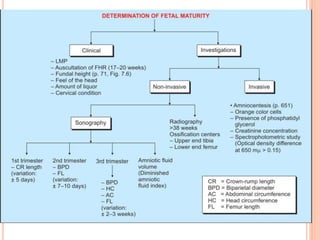
DETERMINING GESTATIONAL AGE
 EDD
 Quickening 16 -20wks.
 Uterine size The uterus is a pelvic organ until 12 weeks, at the
level of the iliac crests.
 palpable at the umbilicus around 20 weeks. Between 20 and 36
weeks, the measurement of the uterus in centimeters from the
symphysis pubis to the fundus approximates the gestational age.
 An electronic Doppler ultrasound may detect fetal heart tones
as early as 10 to 11 weeks' gestation.
 Ultrasound examination in the first trimester provides the most
accurate dating. Measurement of the CRL is accurate to within 5
to 7 days of the actual gestational age. Second- and third-
trimester BPD, FL, AC.
 In the second trimester, the BPD is the most accurate but only to
within 14 days of the actual gestational age.
 Measurements in the third trimester may have an error up to
±21 days of the actual gestational age.
BIOPHYSICAL PROFILE
 is a composite of tests utilizing fetal heart rate tracing
and ultrasound designed to identify a compromised
fetus during the antepartum period
 Components of the profile
 *NST
 Fetal breathing
 Fetal tone
 Fetal motion
 Quantity of amniotic fluid
 Scoring of the profile. Each test is given either 2 or 0 points, for
a maximum of 10 points. An important feature in the postterm
profile is the amniotic fluid profile component. Oligohydramnios
is an ominous sign that signifies placental insufficiency and
increased risk of poor perinatal outcome.
POST MATURITY SYNDROME
• Baby—(1) General appearance:
 Baby looks thin and old.
 Skin is wrinkled.
 There is absence of vernix caseosa.
 Body and the cord are stained with greenish yellow color.
 Head is hard without much evidence of moulding.
 Nails are protruding beyond the nail beds;
(2) Weight often more than 3 kg and length is about 54 cm.
Both are variable and even an IUGR baby may be born.
• Liquor amnii: Scanty and may be stained with meconium.
• Placenta: There is evidence of ageing of the placenta
manifested by excessive infarction and calcification.
• Cord: There is diminished quantity of Wharton’s jelly
which may precipitate cord compression
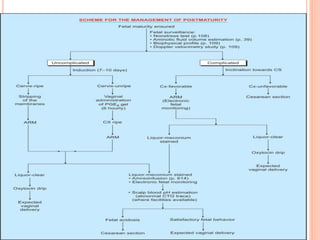
MANAGEMENT OF THE POSTTERM PREGNANCY
The goal of management of postterm pregnancy is to
decrease the risk of an adverse perinatal outcome
(including stillbirth).
Antenatal testing and induction of labor are the two
most widely used strategies for management.
 Antenatal testing is generally started twice weekly
between 41 and 42 weeks' gestation.
 It can include the nonstress test (NST), the
contraction stress test (CST), or the biophysical
profile (BPP)
COMPLICATIONS OF POST-TERM
PREGNANCY:
 When pregnancy overruns the expected date, there is risk of placental
insufficiency due to placental aging.
This is manifested by placental calcification and infarction.
Associated complications like hypertension and diabetes aggravates the pathology.
 FETAL: During pregnancy—There is diminished placental function,
oligohydramnios and meconium stained liquor.
 These lead to fetal hypoxia and fetal distress. During labor—
(1) Fetal hypoxia and acidosis;
(2) Labor dysfunction;
(3) Meconium aspiration;
(4) Risks of cord compression due to oligohydramnios;
(5) Shoulder dystocia;
(6) Increased incidence of birth trauma due to big size baby and non-moulding of head
due to hardening of skull bones;
(7) Increased incidence of operative delivery.
THE MAIN CLINICAL SIGNIFICANCE OF POST-TERM
PREGNANCY IS DYSMATURITY OR
MACROSOMIA.
Following birth—
(1) Chemical pneumonitis, atelectasis and pulmonary
hypertension are due to meconium aspiration;
(2) Hypoxia (low Apgar scores) and respiratory
failure;
(3) Hypoglycemia and polycythemia;
(4) Increased NICU admissions.
THANK
YOU
•ALL

Postterm pregnancy

  • 1.
    POSTTERM PREGNANCY BY ALIYU USMANMUHAMMAD MBchB KAMPALA INTERNATIONL UNIVERSITY, UGANDA.
  • 2.
    DEFINITION According to theInternational Federation of Gynaecology and Obstetrics (FIGO), prolonged pregnancy is defined as any pregnancy that exceeds 42wks (294 days) from the first day of the LMP in a woman with regular 28-day cycles.
  • 3.
    INCIDENCE  The incidenceof pregnancy lasting 42wks or more is  3-10%.  With one previous prolonged pregnancy there is a 30% chance of another one.  With a history of two this rises to 40%.  Incidence also varies depending on whether EDD is based on LMP or dating USS.  Women who book in the 1st trimester and have an early dating scan have an incidence of prolonged pregnancy of <5%.
  • 4.
    DATES CANNOT BERELIED UPON IN THE FOLLOWING CIRCUMSTANCES:  Uncertainty of LMP (10–30% of women).  Irregular periods.  Recent use of COCP.  Conception during lactational amenorrhea.
  • 5.
    ETIOLOGY: So long asthe complex mechanism in initiation of labor remains unknown, the cause of the prolongation of pregnancy will remain obscure. But certain factors are related with post- maturity. (1) Wrong dates—due to inaccurate LMP (most common) (2) Biological variability (Hereditary) may be seen in the family (3) Maternal factors: Primiparity, previous prolonged pregnancy, sedentary habit, elderly multiparae  (4) Fetal factors: Congenital anomalies: Anencephaly → abnormal fetal HPA axis and adrenal hypoplasia → diminished fetal cortisol response  (5) Placental factors: Sulphatase deficiency → low estrogen.
  • 6.
    ETIOGENESIS  Parturition isa complex process that involves events within the fetal brain, adrenals, placenta, amnion, and chorion; it induces changes in the maternal tissues, including the decidua, myometrium, and cervix.  The theorized mechanism of parturition begins with a stimulus in the fetal brain, resulting in activation of the fetal hypothalamic-pituitary axis.
  • 7.
     Adrenocorticotropic hormone(ACTH) production results in stimulation of the fetal adrenal. The fetal adrenal increases production of dehydroepiandrosterone sulfate (DHEAS) and cortisol  . The presence of placental sulfatase in the placenta is required so that the placenta can convert the DHEAS to estradiol.
  • 8.
    CONT’…….  Estrogen isthought to be important in increasing myometrial activity, and cortisol is thought to be important in stimulating prostaglandin output in the placental tissues.  Prostaglandins are important for myometrial contractility.  Several disorders may result in delayed parturition and postterm pregnancy.  These disorders are all similar in that they are associated with low estrogen production.
  • 9.
    DIAGNOSIS  1. Menstrualhistory—If the patient is sure about her date with previous history of regular cycles, it is a fairly reliable diagnostic aid in the calculation of the period of gestation.  2. The suggested clinical findings when a pregnancy overruns the expected date by two weeks are:  — Weight record: Regular periodic weight checking reveals stationary or even falling weight.  — Girth of the abdomen: It diminishes gradually because of diminishing liquor .  — History of false pain: Appearance of false pain followed by its subsidence is suggestive.
  • 10.
    OBSTETRIC PALPATION:  —Thefollowing findings, taken together are helpful. These are :  height of the uterus,  size of the fetus and hardness of the skull bones. As the liquor amnii diminishes, the uterus feels “full of fetus”— a feature usually associated with postmaturity.  — Internal examination:  While a ripe cervix is usually suggestive of fetal maturity, to find an unripe cervix does not exclude maturity.
  • 11.
    DETERMINING GESTATIONAL AGE EDD  Quickening 16 -20wks.  Uterine size The uterus is a pelvic organ until 12 weeks, at the level of the iliac crests.  palpable at the umbilicus around 20 weeks. Between 20 and 36 weeks, the measurement of the uterus in centimeters from the symphysis pubis to the fundus approximates the gestational age.  An electronic Doppler ultrasound may detect fetal heart tones as early as 10 to 11 weeks' gestation.  Ultrasound examination in the first trimester provides the most accurate dating. Measurement of the CRL is accurate to within 5 to 7 days of the actual gestational age. Second- and third- trimester BPD, FL, AC.  In the second trimester, the BPD is the most accurate but only to within 14 days of the actual gestational age.  Measurements in the third trimester may have an error up to ±21 days of the actual gestational age.
  • 13.
    BIOPHYSICAL PROFILE  isa composite of tests utilizing fetal heart rate tracing and ultrasound designed to identify a compromised fetus during the antepartum period  Components of the profile  *NST  Fetal breathing  Fetal tone  Fetal motion  Quantity of amniotic fluid  Scoring of the profile. Each test is given either 2 or 0 points, for a maximum of 10 points. An important feature in the postterm profile is the amniotic fluid profile component. Oligohydramnios is an ominous sign that signifies placental insufficiency and increased risk of poor perinatal outcome.
  • 14.
    POST MATURITY SYNDROME •Baby—(1) General appearance:  Baby looks thin and old.  Skin is wrinkled.  There is absence of vernix caseosa.  Body and the cord are stained with greenish yellow color.  Head is hard without much evidence of moulding.  Nails are protruding beyond the nail beds; (2) Weight often more than 3 kg and length is about 54 cm. Both are variable and even an IUGR baby may be born. • Liquor amnii: Scanty and may be stained with meconium. • Placenta: There is evidence of ageing of the placenta manifested by excessive infarction and calcification. • Cord: There is diminished quantity of Wharton’s jelly which may precipitate cord compression
  • 15.
    MANAGEMENT OF THEPOSTTERM PREGNANCY The goal of management of postterm pregnancy is to decrease the risk of an adverse perinatal outcome (including stillbirth). Antenatal testing and induction of labor are the two most widely used strategies for management.  Antenatal testing is generally started twice weekly between 41 and 42 weeks' gestation.  It can include the nonstress test (NST), the contraction stress test (CST), or the biophysical profile (BPP)
  • 17.
    COMPLICATIONS OF POST-TERM PREGNANCY: When pregnancy overruns the expected date, there is risk of placental insufficiency due to placental aging. This is manifested by placental calcification and infarction. Associated complications like hypertension and diabetes aggravates the pathology.  FETAL: During pregnancy—There is diminished placental function, oligohydramnios and meconium stained liquor.  These lead to fetal hypoxia and fetal distress. During labor— (1) Fetal hypoxia and acidosis; (2) Labor dysfunction; (3) Meconium aspiration; (4) Risks of cord compression due to oligohydramnios; (5) Shoulder dystocia; (6) Increased incidence of birth trauma due to big size baby and non-moulding of head due to hardening of skull bones; (7) Increased incidence of operative delivery.
  • 18.
    THE MAIN CLINICALSIGNIFICANCE OF POST-TERM PREGNANCY IS DYSMATURITY OR MACROSOMIA. Following birth— (1) Chemical pneumonitis, atelectasis and pulmonary hypertension are due to meconium aspiration; (2) Hypoxia (low Apgar scores) and respiratory failure; (3) Hypoglycemia and polycythemia; (4) Increased NICU admissions.
  • 19.