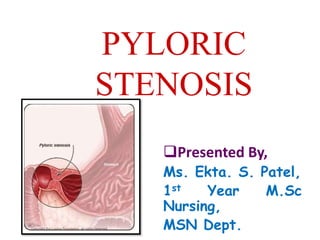
PYLORIC
STENOSIS
Presented By,
Ms. Ekta. S. Patel,
1st Year M.Sc
Nursing,
MSN Dept.
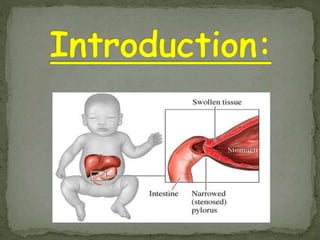
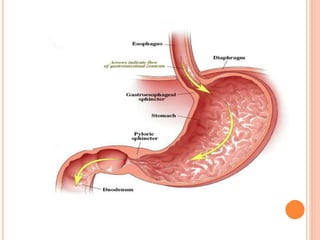
Pyloric stenosis or pylorostenosis is
narrowing (stenosis) of the opening
from the stomach to the first part of the
small intestine known as the
duodenum.
The pylorus, meaning "gate".
Due to enlargement (hypertrophy) of the
muscle surrounding this opening which
spasms when the stomach empties.
 This condition causes severe projectile
non-bilious vomiting.
It most often occurs in the first few months
of life.
 It more specifically labelled as infantile
hypertrophic pyloric stenosis.
The thickened pylorus is felt classically as
an olive-shaped mass in the middle upper
part or right upper quadrant of the infant's
abdomen.
Pyloric stenosis also occurs in adults,
where the cause is usually a narrowed
pylorus due to scarring from chronic
peptic ulceration.
Pyloric stenosis is defined as
“narrowing (stenosis) of the outlet of
the stomach so that food cannot pass
easily from it into the duodenum,
pyloric stenosis results in feeding
problems and projectile vomiting.”
3/1000 live birth
Male: Female = 4:1
Commonly in the first born male child
Most common cause for laparotomy
before 1 year.
Age 3weeks to 3 months.
Child of those parents who affected
with pyloric stenosis.
It affect more commonly child than the
adult.
Idiopathic
Nitric oxide syntheses deficiency
Nerve cell theory (ganglion cell theory)
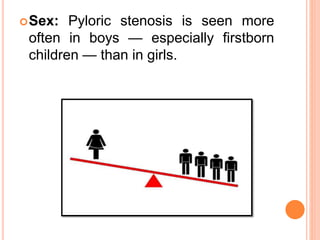
Sex: Pyloric stenosis is seen more
often in boys — especially firstborn
children — than in girls.
Race: Pyloric stenosis is more
common in Caucasians of northern
European ancestry, less common in
African-Americans and rare in Asians.
Premature birth: Pyloric stenosis is
more common in babies born
prematurely than in full-term babies.
Family history:
Studies found higher
rates of this disorder
among certain
families. Pyloric
stenosis develops in
about 20 percent of
male descendants and
10 percent of female
descendants of
mothers who had the
condition.
Smoking during
pregnancy: This
behavior can nearly
double the risk of
pyloric stenosis.
Early antibiotic use: Babies
given certain antibiotics in the
first weeks of life - erythromycin
to treat whooping cough, for
example - have an increased
risk of pyloric stenosis. In
addition, babies born to mothers
who took certain antibiotics in
late pregnancy also may have
an increased risk of pyloric
stenosis.
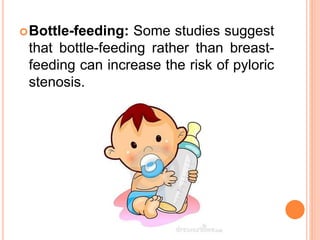
Bottle-feeding: Some studies suggest
that bottle-feeding rather than breast-
feeding can increase the risk of pyloric
stenosis.
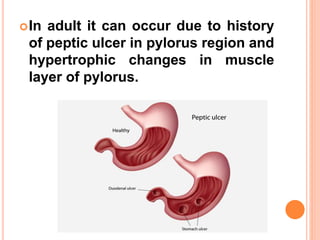
In adult it can occur due to history
of peptic ulcer in pylorus region and
hypertrophic changes in muscle
layer of pylorus.
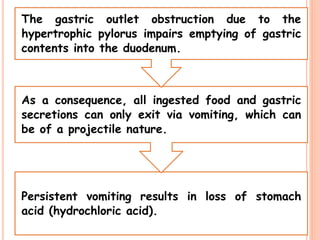
Persistent vomiting results in loss of stomach
acid (hydrochloric acid).
As a consequence, all ingested food and gastric
secretions can only exit via vomiting, which can
be of a projectile nature.
The gastric outlet obstruction due to the
hypertrophic pylorus impairs emptying of gastric
contents into the duodenum.
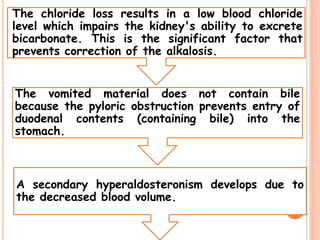
The chloride loss results in a low blood chloride
level which impairs the kidney's ability to excrete
bicarbonate. This is the significant factor that
prevents correction of the alkalosis.
A secondary hyperaldosteronism develops due to
the decreased blood volume.
The vomited material does not contain bile
because the pyloric obstruction prevents entry of
duodenal contents (containing bile) into the
stomach.
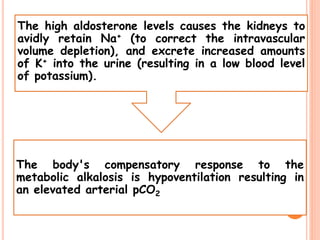
The high aldosterone levels causes the kidneys to
avidly retain Na+ (to correct the intravascular
volume depletion), and excrete increased amounts
of K+ into the urine (resulting in a low blood level
of potassium).
The body's compensatory response to the
metabolic alkalosis is hypoventilation resulting in
an elevated arterial pCO2
Signs of pyloric stenosis usually
appear within three to five weeks after
birth.
Pyloric stenosis is rare in babies older
than age 3 months. Signs and
symptoms include:
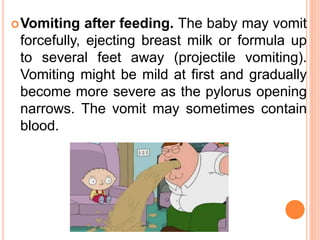
Vomiting after feeding. The baby may vomit
forcefully, ejecting breast milk or formula up
to several feet away (projectile vomiting).
Vomiting might be mild at first and gradually
become more severe as the pylorus opening
narrows. The vomit may sometimes contain
blood.
Persistent hunger. Babies who have
pyloric stenosis often want to eat soon
after vomiting.
Stomach contractions. Notice wave-
like contractions (peristalsis) that ripple
across baby's upper abdomen soon
after feeding, but before vomiting. This
is caused by stomach muscles trying
to force food through the narrowed
pylorus.
Dehydration. Baby might cry without
tears or become lethargic. You might
find yourself changing fewer wet
diapers or diapers that aren't as wet as
you expect.
Changes in bowel movements.
Since pyloric stenosis prevents food
from reaching the intestines, babies
with this condition might be
constipated.
Weight problems. Pyloric stenosis
can keep a baby from gaining weight,
and sometimes can cause weight loss.
Olive shaped mass “pyloric tumor” at
angle between right rectus muscle and
liver.
Infantile pyloric stenosis is typically
managed with surgery; very few cases
are mild enough to be treated
medically.
The danger of pyloric stenosis comes
from the dehydration and electrolyte
disturbance rather than the underlying
problem itself.
Therefore, the baby must be initially
stabilized by correcting the
dehydration and the abnormally high
blood pH seen in combination with low
chloride levels with IV fluids. This can
usually be accomplished in about 24–
48 hours.
Intravenous and oral atropine may be
used to treat pyloric stenosis. It has a
success rate of 85-89% compared to
nearly 100% for pyloromyotomy, however
it requires prolonged hospitalization,
skilled nursing and careful follow up during
treatment.
It might be an alternative to surgery in
children who have contraindications for
anaesthesia or surgery, or in children
whose parents do not want surgery.
Laparoscopic pyloromyotomy
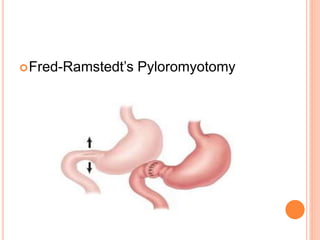
Fred-Ramstedt’s Pyloromyotomy
Consider thermoregulation at all
times,
Before transport to theatre, transfer
infant to incubator set at neutral
thermal environment (NTE)
temperature.
Ensure incubator will be plugged in
and pre-warmed for the infant to be
transferred into in recovery.
After return to the ward, ensure
temperature is stable prior to
transferring to open cot.
Monitor temperature hourly until stable.
Routine post anaesthetic observations.
Monitor wound and report abnormalities
to surgeon.
Observe for bleeding, redness, swelling,
ooze from incision site.
Maintain adequate fluid balance chart.
Monitor IV site.
Ensure adequate pain relief; use pain
assessment tool.
Wound infection
Incisional hernia
Persistent vomiting
Stagnation gastritis
Mucosal perforation
Shock
As long as pyloric stenosis is
diagnosed quickly, the prognosis
(expected outcome) is excellent. In
most cases, surgery cures the
condition and relieves all symptoms.
Most infants recover fully, without
complications, and are not at
increased risk for future problems
related to pyloric stenosis.
1.
What is definition of
pyloric stenosis?
2.
What are the causes of
pyloric stenosis?
3.
What are the sign and
symptoms of pyloric
stenosis?
4.
What are the diagnostic
evaluation of pyloric
stenosis?
5.
What is of nurses
responsibility while
handling patient with
pyloric stenosis?
Topic:
 New trends in treatment of pyloric
stenosis
Submit on: 27/03/2017
Pyloric stenosis

Pyloric stenosis

  • 1.
    PYLORIC STENOSIS Presented By, Ms. Ekta.S. Patel, 1st Year M.Sc Nursing, MSN Dept.
  • 3.
    Pyloric stenosis orpylorostenosis is narrowing (stenosis) of the opening from the stomach to the first part of the small intestine known as the duodenum. The pylorus, meaning "gate".
  • 5.
    Due to enlargement(hypertrophy) of the muscle surrounding this opening which spasms when the stomach empties.  This condition causes severe projectile non-bilious vomiting. It most often occurs in the first few months of life.  It more specifically labelled as infantile hypertrophic pyloric stenosis.
  • 6.
    The thickened pylorusis felt classically as an olive-shaped mass in the middle upper part or right upper quadrant of the infant's abdomen.
  • 7.
    Pyloric stenosis alsooccurs in adults, where the cause is usually a narrowed pylorus due to scarring from chronic peptic ulceration.
  • 9.
    Pyloric stenosis isdefined as “narrowing (stenosis) of the outlet of the stomach so that food cannot pass easily from it into the duodenum, pyloric stenosis results in feeding problems and projectile vomiting.”
  • 11.
    3/1000 live birth Male:Female = 4:1 Commonly in the first born male child Most common cause for laparotomy before 1 year. Age 3weeks to 3 months. Child of those parents who affected with pyloric stenosis. It affect more commonly child than the adult.
  • 13.
  • 14.
  • 15.
    Nerve cell theory(ganglion cell theory)
  • 16.
    Sex: Pyloric stenosisis seen more often in boys — especially firstborn children — than in girls.
  • 17.
    Race: Pyloric stenosisis more common in Caucasians of northern European ancestry, less common in African-Americans and rare in Asians.
  • 18.
    Premature birth: Pyloricstenosis is more common in babies born prematurely than in full-term babies.
  • 19.
    Family history: Studies foundhigher rates of this disorder among certain families. Pyloric stenosis develops in about 20 percent of male descendants and 10 percent of female descendants of mothers who had the condition.
  • 20.
    Smoking during pregnancy: This behaviorcan nearly double the risk of pyloric stenosis.
  • 21.
    Early antibiotic use:Babies given certain antibiotics in the first weeks of life - erythromycin to treat whooping cough, for example - have an increased risk of pyloric stenosis. In addition, babies born to mothers who took certain antibiotics in late pregnancy also may have an increased risk of pyloric stenosis.
  • 22.
    Bottle-feeding: Some studiessuggest that bottle-feeding rather than breast- feeding can increase the risk of pyloric stenosis.
  • 23.
    In adult itcan occur due to history of peptic ulcer in pylorus region and hypertrophic changes in muscle layer of pylorus.
  • 25.
    Persistent vomiting resultsin loss of stomach acid (hydrochloric acid). As a consequence, all ingested food and gastric secretions can only exit via vomiting, which can be of a projectile nature. The gastric outlet obstruction due to the hypertrophic pylorus impairs emptying of gastric contents into the duodenum.
  • 26.
    The chloride lossresults in a low blood chloride level which impairs the kidney's ability to excrete bicarbonate. This is the significant factor that prevents correction of the alkalosis. A secondary hyperaldosteronism develops due to the decreased blood volume. The vomited material does not contain bile because the pyloric obstruction prevents entry of duodenal contents (containing bile) into the stomach.
  • 27.
    The high aldosteronelevels causes the kidneys to avidly retain Na+ (to correct the intravascular volume depletion), and excrete increased amounts of K+ into the urine (resulting in a low blood level of potassium). The body's compensatory response to the metabolic alkalosis is hypoventilation resulting in an elevated arterial pCO2
  • 29.
    Signs of pyloricstenosis usually appear within three to five weeks after birth. Pyloric stenosis is rare in babies older than age 3 months. Signs and symptoms include:
  • 30.
    Vomiting after feeding.The baby may vomit forcefully, ejecting breast milk or formula up to several feet away (projectile vomiting). Vomiting might be mild at first and gradually become more severe as the pylorus opening narrows. The vomit may sometimes contain blood.
  • 31.
    Persistent hunger. Babieswho have pyloric stenosis often want to eat soon after vomiting.
  • 32.
    Stomach contractions. Noticewave- like contractions (peristalsis) that ripple across baby's upper abdomen soon after feeding, but before vomiting. This is caused by stomach muscles trying to force food through the narrowed pylorus.

  • 33.
    Dehydration. Baby mightcry without tears or become lethargic. You might find yourself changing fewer wet diapers or diapers that aren't as wet as you expect.
  • 34.
    Changes in bowelmovements. Since pyloric stenosis prevents food from reaching the intestines, babies with this condition might be constipated.
  • 35.
    Weight problems. Pyloricstenosis can keep a baby from gaining weight, and sometimes can cause weight loss.
  • 36.
    Olive shaped mass“pyloric tumor” at angle between right rectus muscle and liver.
  • 39.
    Infantile pyloric stenosisis typically managed with surgery; very few cases are mild enough to be treated medically. The danger of pyloric stenosis comes from the dehydration and electrolyte disturbance rather than the underlying problem itself.
  • 40.
    Therefore, the babymust be initially stabilized by correcting the dehydration and the abnormally high blood pH seen in combination with low chloride levels with IV fluids. This can usually be accomplished in about 24– 48 hours.
  • 41.
    Intravenous and oralatropine may be used to treat pyloric stenosis. It has a success rate of 85-89% compared to nearly 100% for pyloromyotomy, however it requires prolonged hospitalization, skilled nursing and careful follow up during treatment. It might be an alternative to surgery in children who have contraindications for anaesthesia or surgery, or in children whose parents do not want surgery.
  • 43.
  • 44.
  • 46.
    Consider thermoregulation atall times, Before transport to theatre, transfer infant to incubator set at neutral thermal environment (NTE) temperature. Ensure incubator will be plugged in and pre-warmed for the infant to be transferred into in recovery. After return to the ward, ensure temperature is stable prior to transferring to open cot.
  • 47.
    Monitor temperature hourlyuntil stable. Routine post anaesthetic observations. Monitor wound and report abnormalities to surgeon. Observe for bleeding, redness, swelling, ooze from incision site. Maintain adequate fluid balance chart. Monitor IV site. Ensure adequate pain relief; use pain assessment tool.
  • 49.
    Wound infection Incisional hernia Persistentvomiting Stagnation gastritis Mucosal perforation Shock
  • 51.
    As long aspyloric stenosis is diagnosed quickly, the prognosis (expected outcome) is excellent. In most cases, surgery cures the condition and relieves all symptoms. Most infants recover fully, without complications, and are not at increased risk for future problems related to pyloric stenosis.


  • 54.
    1. What is definitionof pyloric stenosis?
  • 55.
    2. What are thecauses of pyloric stenosis?
  • 56.
    3. What are thesign and symptoms of pyloric stenosis?
  • 57.
    4. What are thediagnostic evaluation of pyloric stenosis?
  • 58.
    5. What is ofnurses responsibility while handling patient with pyloric stenosis?
  • 60.
    Topic:  New trendsin treatment of pyloric stenosis Submit on: 27/03/2017