Network Security
By Gaurav Dalvi
Final Yr BTech
Roll no:A43
Reg
no:2011BCS501
Why Security?
 The Internet was initially designed for

connectivity.
 Fundamental aspects of information must be
protected.
 We can’t keep ourselves isolated from the
Internet.
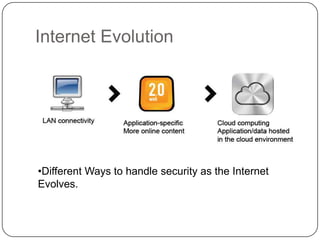
Internet Evolution

•Different Ways to handle security as the Internet
Evolves.
Type Of Security
 Computer Security

generic name for the collection of tools designed
to protect data and to thwart hackers
 Network Security
measures to protect the data during the
transmission.
 Internet Security
measure to protect the data during the
transmission over a collection of interconnected
networks.
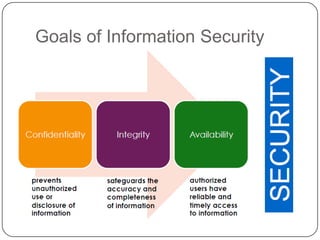
Goals of Information Security
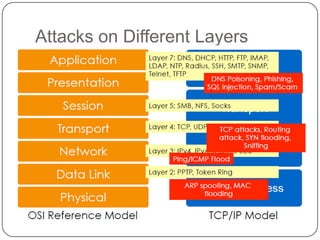
Attacks on Different Layers
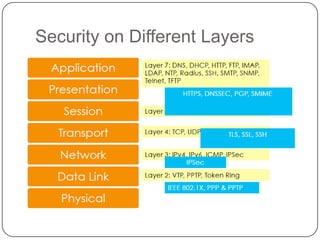
Security on Different Layers
IP
 IP is a network layer protocol.
 This is a layer that allows the hosts to actually

“talk ” to each other.
 IP has a number of very important features which
make it an extremely robust and flexible protocol.
Attacks on IP
 Attacks exploits the fact that IP does not perform

a robust mechanism for authentication, which is
proving that the packet came from where it claims
it did.
 This means that the host authentication must be
provided by higher layers.
 Eg: IP Spoofing, IP Session hijacking.
TCP Attacks
 Exploits TCP 3-way handshake.
 Attacker sends a series of SYN packets without

replying with the ACK packet.
 Finite queue size for incomplete connections.
TCP Attacks
DNS Cache Poisoning
Common Type of Attacks
 Ping sweeps and port scans – reconnaissance.
 Sniffing – capture packet as they travel through





the network.
Man in the Middle Attack – intercept messages
that are intended for a valid device.
Spoofing – set up a fake device and trick others
to send messages to it.
Hijacking – take control of a session.
Denial of Service (DoS) and Distributed DoS
(DDoS).
Trusted Network
 Standard defensive-oriented technologies.

- Firewall – first line of defense.
- Intrusion Detection.
 Built trust on the top of the TCP/IP infrastructure.
- Strong Authentication.
- Two factor authentication.
- something you have + something you
know.
- Public key Infrastructure.(PKI)
Firewall
 A choke point of control and monitoring.
 Interconnects networks with differing trust.
 Imposes restrictions on network services.
 only authorized traffic is allowed.

 Auditing and controlling access.
 can implement alarms for abnormal behavior.

 Itself immune to penetration.
 Provides perimeter defence.
Intrusion Detection System
An intrusion detection system (IDS) is a device
or software application that monitors network or
system activities for malicious activities or policy
violations and produces reports to a management
station. Some systems may attempt to stop an
intrusion attempt but this is neither required nor
expected of a monitoring system.
 Host IDS.
 Network IDS.
Access Control
 Access Control – ability to permit or deny the use

of an object by a subject.
 It provides 3 essential services (known as AAA):
- Authentication.(who can login)
- Authorization.(what authorized user can do)
- Accountability.(identifies what a user did)
Cryptography
 Has evolved into a complex science in the field of

information security.
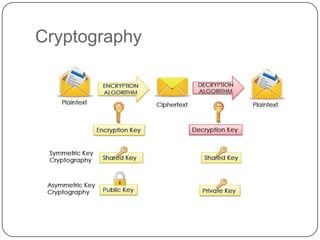
 Encryption – process of transforming plaintext to
ciphertext using a cryptographic key.
 Symmetric key cryptography.
- DES, 3DES, AES, etc.
 Asymmetric key cryptography.
- RSA, Diffie-Hellman, etc.
Cryptography
Public key Infrastructure
 Combines public key cryptography and digital

signatures to ensure confidentiality, integrity,
authentication, non-repudiation and access
control.
 Digital Certificate – basic element of PKI; secure
credential that identifies the owner.
 Basic Components:- Certificate Authority.
- Registry Authority.
- Repository.
- Archives.
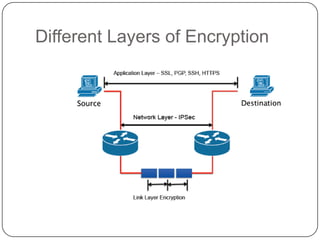
Different Layers of Encryption
IPSec
 Provides Layer 3 Security.
 Tunnel or Transport mode.

- Tunnel mode(entire IP packet is encrypted)
- Transport mode (IPSec header is inserted into
the packet)
 Combine different components:
- Security associations, Authentication headers
(AH), Encapsulating security payload (ESP),
Internet Key Exchange (IKE).
Security Management
 Loss Prevention.

Loss prevention focuses on what your critical assets
are and how you are going to protect them.
 Security risk management.
Management of security risks applies the principles of
risk management to the management of security
threats.
 Risk options.
 Risk avoidance.
 Risk reduction.
 Risk spreading.
 Risk transfer.
 Risk acceptance.
Whois Database
 Public network Management Database.
 Tracks network Resources.

- IP addresses, ASN, reverse routing.
 Records administrative info.
- Contacts(person/role), authorization(maintainer)
 All members must register their resources in the
Whois database.
 Must keep records up to date at all times.
Seminar (network security)

Seminar (network security)

  • 1.
    Network Security By GauravDalvi Final Yr BTech Roll no:A43 Reg no:2011BCS501
  • 2.
    Why Security?  TheInternet was initially designed for connectivity.  Fundamental aspects of information must be protected.  We can’t keep ourselves isolated from the Internet.
  • 3.
    Internet Evolution •Different Waysto handle security as the Internet Evolves.
  • 4.
    Type Of Security Computer Security generic name for the collection of tools designed to protect data and to thwart hackers  Network Security measures to protect the data during the transmission.  Internet Security measure to protect the data during the transmission over a collection of interconnected networks.
  • 5.
  • 6.
  • 7.
  • 8.
    IP  IP isa network layer protocol.  This is a layer that allows the hosts to actually “talk ” to each other.  IP has a number of very important features which make it an extremely robust and flexible protocol.
  • 9.
    Attacks on IP Attacks exploits the fact that IP does not perform a robust mechanism for authentication, which is proving that the packet came from where it claims it did.  This means that the host authentication must be provided by higher layers.  Eg: IP Spoofing, IP Session hijacking.
  • 10.
    TCP Attacks  ExploitsTCP 3-way handshake.  Attacker sends a series of SYN packets without replying with the ACK packet.  Finite queue size for incomplete connections.
  • 11.
  • 12.
  • 13.
    Common Type ofAttacks  Ping sweeps and port scans – reconnaissance.  Sniffing – capture packet as they travel through     the network. Man in the Middle Attack – intercept messages that are intended for a valid device. Spoofing – set up a fake device and trick others to send messages to it. Hijacking – take control of a session. Denial of Service (DoS) and Distributed DoS (DDoS).
  • 14.
    Trusted Network  Standarddefensive-oriented technologies. - Firewall – first line of defense. - Intrusion Detection.  Built trust on the top of the TCP/IP infrastructure. - Strong Authentication. - Two factor authentication. - something you have + something you know. - Public key Infrastructure.(PKI)
  • 15.
    Firewall  A chokepoint of control and monitoring.  Interconnects networks with differing trust.  Imposes restrictions on network services.  only authorized traffic is allowed.  Auditing and controlling access.  can implement alarms for abnormal behavior.  Itself immune to penetration.  Provides perimeter defence.
  • 16.
    Intrusion Detection System Anintrusion detection system (IDS) is a device or software application that monitors network or system activities for malicious activities or policy violations and produces reports to a management station. Some systems may attempt to stop an intrusion attempt but this is neither required nor expected of a monitoring system.  Host IDS.  Network IDS.
  • 17.
    Access Control  AccessControl – ability to permit or deny the use of an object by a subject.  It provides 3 essential services (known as AAA): - Authentication.(who can login) - Authorization.(what authorized user can do) - Accountability.(identifies what a user did)
  • 18.
    Cryptography  Has evolvedinto a complex science in the field of information security.  Encryption – process of transforming plaintext to ciphertext using a cryptographic key.  Symmetric key cryptography. - DES, 3DES, AES, etc.  Asymmetric key cryptography. - RSA, Diffie-Hellman, etc.
  • 19.
  • 20.
    Public key Infrastructure Combines public key cryptography and digital signatures to ensure confidentiality, integrity, authentication, non-repudiation and access control.  Digital Certificate – basic element of PKI; secure credential that identifies the owner.  Basic Components:- Certificate Authority. - Registry Authority. - Repository. - Archives.
  • 21.
  • 22.
    IPSec  Provides Layer3 Security.  Tunnel or Transport mode. - Tunnel mode(entire IP packet is encrypted) - Transport mode (IPSec header is inserted into the packet)  Combine different components: - Security associations, Authentication headers (AH), Encapsulating security payload (ESP), Internet Key Exchange (IKE).
  • 23.
    Security Management  LossPrevention. Loss prevention focuses on what your critical assets are and how you are going to protect them.  Security risk management. Management of security risks applies the principles of risk management to the management of security threats.  Risk options.  Risk avoidance.  Risk reduction.  Risk spreading.  Risk transfer.  Risk acceptance.
  • 24.
    Whois Database  Publicnetwork Management Database.  Tracks network Resources. - IP addresses, ASN, reverse routing.  Records administrative info. - Contacts(person/role), authorization(maintainer)  All members must register their resources in the Whois database.  Must keep records up to date at all times.