Network Packet
Analysis with Wireshark
Jim Gilsinn
National Institute of Standards & Technology
Engineering Laboratory
Standards
Certification
Education & Training
Publishing
Conferences & Exhibits
Jim Gilsinn - Bio
• Electronics Engineer with NIST/EL for over 20 years
• Cybersecurity for Factory Control Systems
– Co-Chair and General Editor, ISA99 Committee
– Co-Chair, ISA99 WG2, Security Program
– Co-Chair, ISA99 WG7, Safety & Security

• Factory Equipment Network Testing Framework
– Co-Investigator & Main Developer, FENT software
– Extension of previous IENetP project

• Education
– MSEE in Controls from Johns Hopkins University
– BSEE in Controls from Drexel University

2
What is Wireshark?
• The De-Factor Network Protocol Analyzer
–
–
–
–

Open-Source (GNU Public License)
Multi-platform
Easily extensible
Large development group

• Allows Users to…
– Capture network traffic
– Interactively browse that traffic
– Decode packet protocols using dissectors

• Previously Named “Ethereal”

3
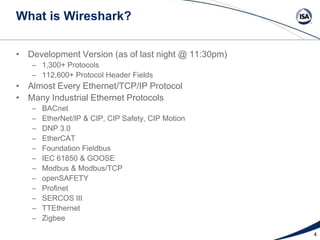
What is Wireshark?
• Development Version (as of last night @ 11:30pm)
– 1,300+ Protocols
– 112,600+ Protocol Header Fields

• Almost Every Ethernet/TCP/IP Protocol
• Many Industrial Ethernet Protocols
–
–
–
–
–
–
–
–
–
–
–
–

BACnet
EtherNet/IP & CIP, CIP Safety, CIP Motion
DNP 3.0
EtherCAT
Foundation Fieldbus
IEC 61850 & GOOSE
Modbus & Modbus/TCP
openSAFETY
Profinet
SERCOS III
TTEthernet
Zigbee
4
Network Layering
• Network Protocols Generally Have Some Header
–
–
–
–

Who sent the information
Who needs the information
Information about the payload
Other protocol specific information

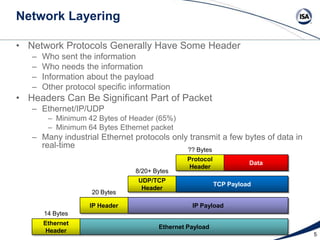
• Headers Can Be Significant Part of Packet
– Ethernet/IP/UDP
– Minimum 42 Bytes of Header (65%)
– Minimum 64 Bytes Ethernet packet

– Many industrial Ethernet protocols only transmit a few bytes of data in
real-time
?? Bytes
8/20+ Bytes

20 Bytes
IP Header

Protocol
Header

UDP/TCP
Header

Data
TCP Payload

IP Payload

14 Bytes
Ethernet
Header

Ethernet Payload
5
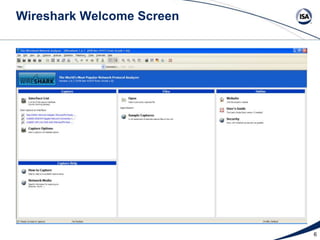
Wireshark Welcome Screen

6
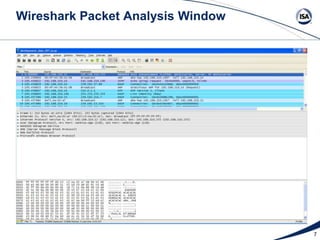
Wireshark Packet Analysis Window

7
Wireshark Packet Analysis Demo
•
•
•
•

Packet Decoder Window
Layering
Bytes on Wire
Protocol Filters
– Capture Filters
– Display Filters

8
Wireshark Capture & Exporting Demo
•
•
•
•

Capturing Live Traffic
Saving Packet Capture Files
Exporting Packet Capture Files
Marking Sections of Captures

9
Advanced Features of Wireshark GUI
• Statistics
–
–
–
–

Conversations
Endpoints
IO Graphs
Flow Graphs

• Firewall ACL Rules

10
Using & Interfacing With Wireshark
• Wireshark Strictly Uses GNU Public License
– Any derived work with Wireshark code SHALL be open-source

• You Can Use Wireshark Hands-Off, Though
– Network Socket Interface
– Tshark.exe

• Network Socket Interface
– Rudimentary control

• Tshark.exe
– Most features available through command-line interface

11
Developing Your Own Protocol Dissectors
• Not Every Protocol Exists in Wireshark
– When you need a protocol that doesn’t exist, you can relatively
easily build your own dissector

• Not Every Protocol Dissector Has Full Coverage
– Open-source software allows anyone to modify the code
– Protocols generally change over time
– The original dissector developer may not exist any longer

• Bugs Can Exist in Dissectors
– Code almost always has bugs

12
For More Information…
• Wireshark Website
– http://www.wireshark.org

• Wireshark Documentation
– http://www.wireshark.org/docs/

• Wireshark Wiki
– http://wiki.wireshark.org

13

Network Packet Analysis with Wireshark

  • 1.
    Network Packet Analysis withWireshark Jim Gilsinn National Institute of Standards & Technology Engineering Laboratory Standards Certification Education & Training Publishing Conferences & Exhibits
  • 2.
    Jim Gilsinn -Bio • Electronics Engineer with NIST/EL for over 20 years • Cybersecurity for Factory Control Systems – Co-Chair and General Editor, ISA99 Committee – Co-Chair, ISA99 WG2, Security Program – Co-Chair, ISA99 WG7, Safety & Security • Factory Equipment Network Testing Framework – Co-Investigator & Main Developer, FENT software – Extension of previous IENetP project • Education – MSEE in Controls from Johns Hopkins University – BSEE in Controls from Drexel University 2
  • 3.
    What is Wireshark? •The De-Factor Network Protocol Analyzer – – – – Open-Source (GNU Public License) Multi-platform Easily extensible Large development group • Allows Users to… – Capture network traffic – Interactively browse that traffic – Decode packet protocols using dissectors • Previously Named “Ethereal” 3
  • 4.
    What is Wireshark? •Development Version (as of last night @ 11:30pm) – 1,300+ Protocols – 112,600+ Protocol Header Fields • Almost Every Ethernet/TCP/IP Protocol • Many Industrial Ethernet Protocols – – – – – – – – – – – – BACnet EtherNet/IP & CIP, CIP Safety, CIP Motion DNP 3.0 EtherCAT Foundation Fieldbus IEC 61850 & GOOSE Modbus & Modbus/TCP openSAFETY Profinet SERCOS III TTEthernet Zigbee 4
  • 5.
    Network Layering • NetworkProtocols Generally Have Some Header – – – – Who sent the information Who needs the information Information about the payload Other protocol specific information • Headers Can Be Significant Part of Packet – Ethernet/IP/UDP – Minimum 42 Bytes of Header (65%) – Minimum 64 Bytes Ethernet packet – Many industrial Ethernet protocols only transmit a few bytes of data in real-time ?? Bytes 8/20+ Bytes 20 Bytes IP Header Protocol Header UDP/TCP Header Data TCP Payload IP Payload 14 Bytes Ethernet Header Ethernet Payload 5
  • 6.
  • 7.
  • 8.
    Wireshark Packet AnalysisDemo • • • • Packet Decoder Window Layering Bytes on Wire Protocol Filters – Capture Filters – Display Filters 8
  • 9.
    Wireshark Capture &Exporting Demo • • • • Capturing Live Traffic Saving Packet Capture Files Exporting Packet Capture Files Marking Sections of Captures 9
  • 10.
    Advanced Features ofWireshark GUI • Statistics – – – – Conversations Endpoints IO Graphs Flow Graphs • Firewall ACL Rules 10
  • 11.
    Using & InterfacingWith Wireshark • Wireshark Strictly Uses GNU Public License – Any derived work with Wireshark code SHALL be open-source • You Can Use Wireshark Hands-Off, Though – Network Socket Interface – Tshark.exe • Network Socket Interface – Rudimentary control • Tshark.exe – Most features available through command-line interface 11
  • 12.
    Developing Your OwnProtocol Dissectors • Not Every Protocol Exists in Wireshark – When you need a protocol that doesn’t exist, you can relatively easily build your own dissector • Not Every Protocol Dissector Has Full Coverage – Open-source software allows anyone to modify the code – Protocols generally change over time – The original dissector developer may not exist any longer • Bugs Can Exist in Dissectors – Code almost always has bugs 12
  • 13.
    For More Information… •Wireshark Website – http://www.wireshark.org • Wireshark Documentation – http://www.wireshark.org/docs/ • Wireshark Wiki – http://wiki.wireshark.org 13