






Applied Networking-IV (2231114)
        Lecture Week-12
 Basic of Network Management

   Lecture by: Djadja.Sardjana, S.T., M.M.
        www.slideshare.net/djadja


                   Monitis_network_
                     monitoring_
                   service_preview-
                          34s
Basic of Network Management
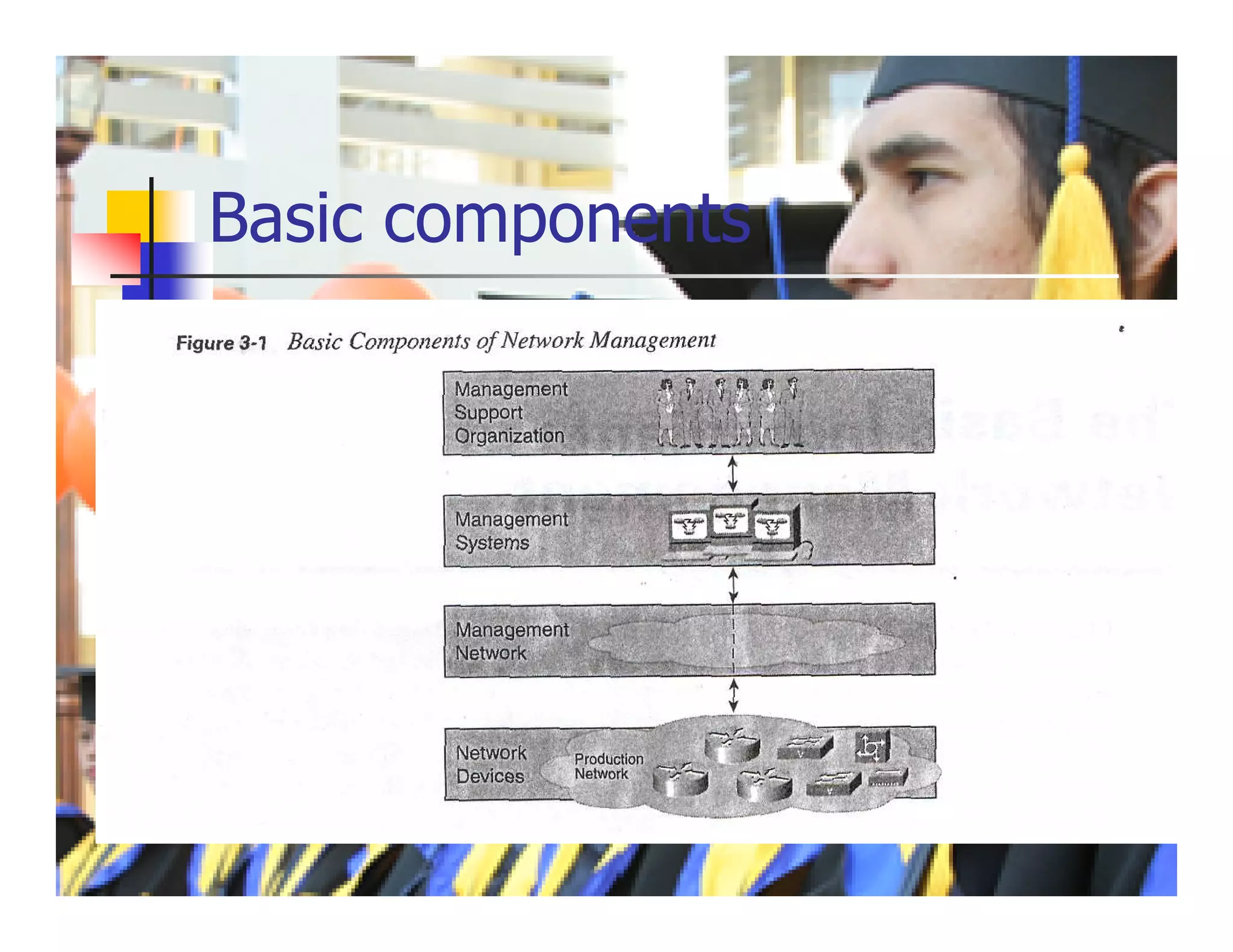
Basic components
 Fig 3-1
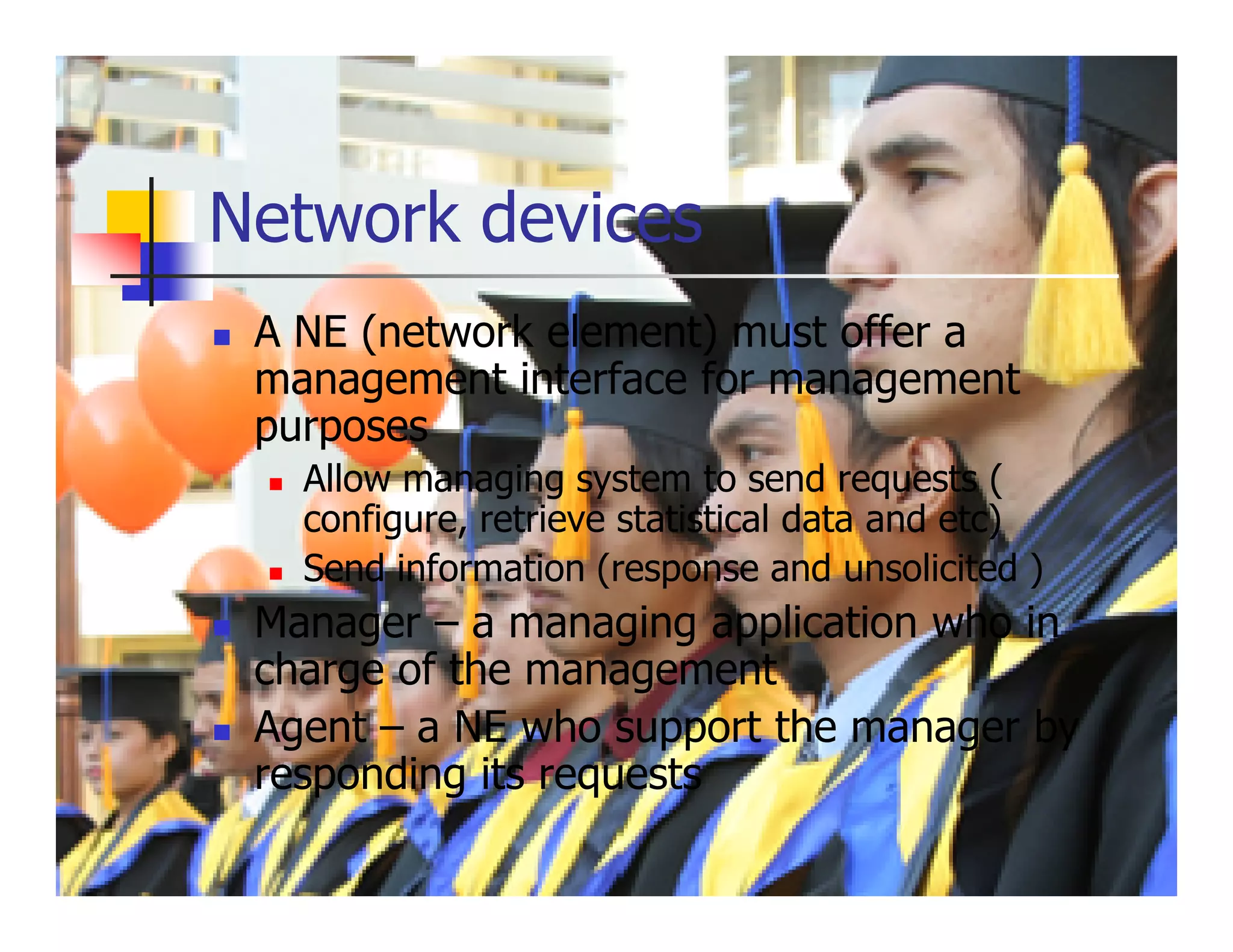
Network devices
 A NE (network element) must offer a
 management interface for management
 purposes
   Allow managing system to send requests (
   configure, retrieve statistical data and etc)
   Send information (response and unsolicited )
 Manager – a managing application who in
 charge of the management
 Agent – a NE who support the manager by
 responding its requests
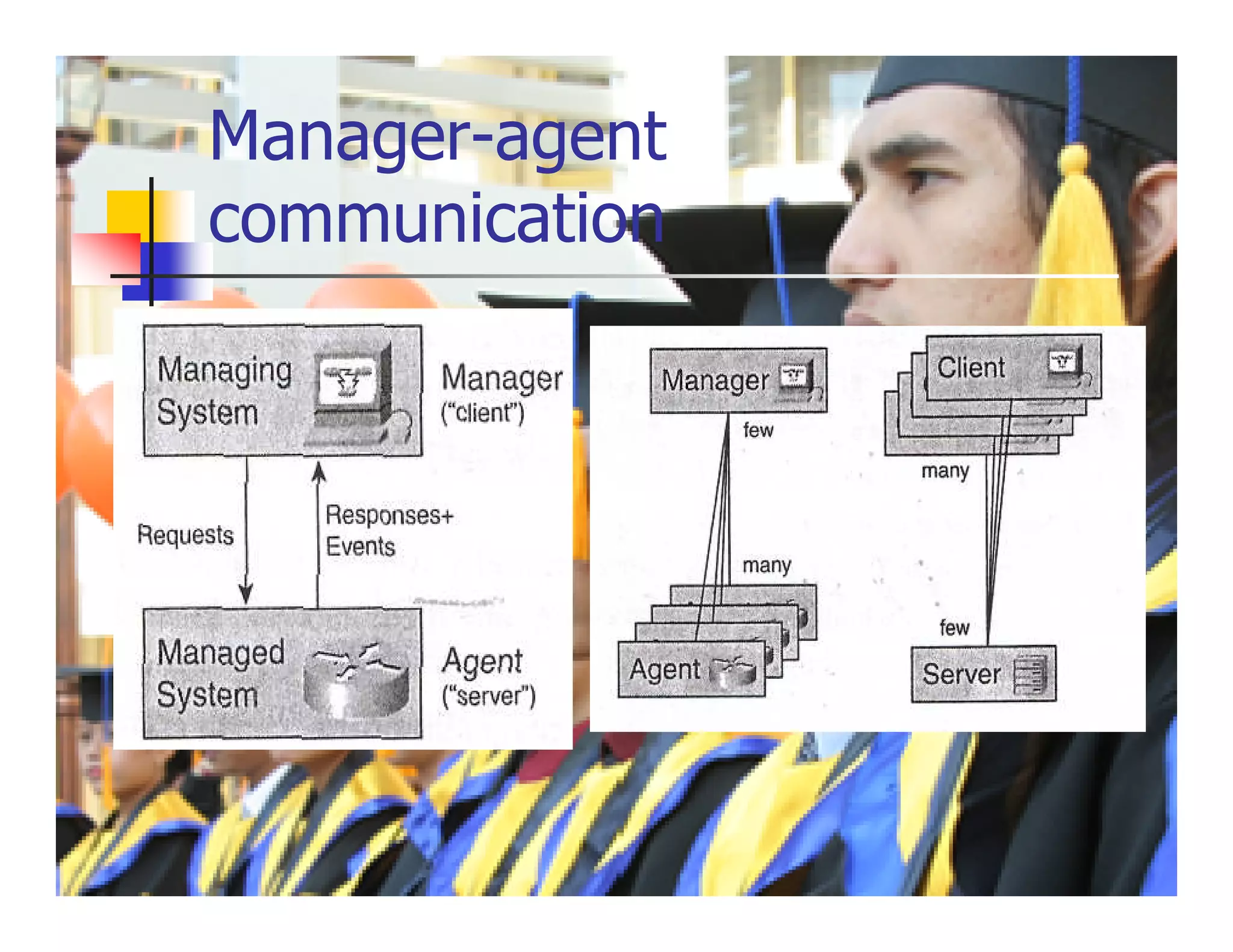
Manager-agent
communication
 Fig 3-2
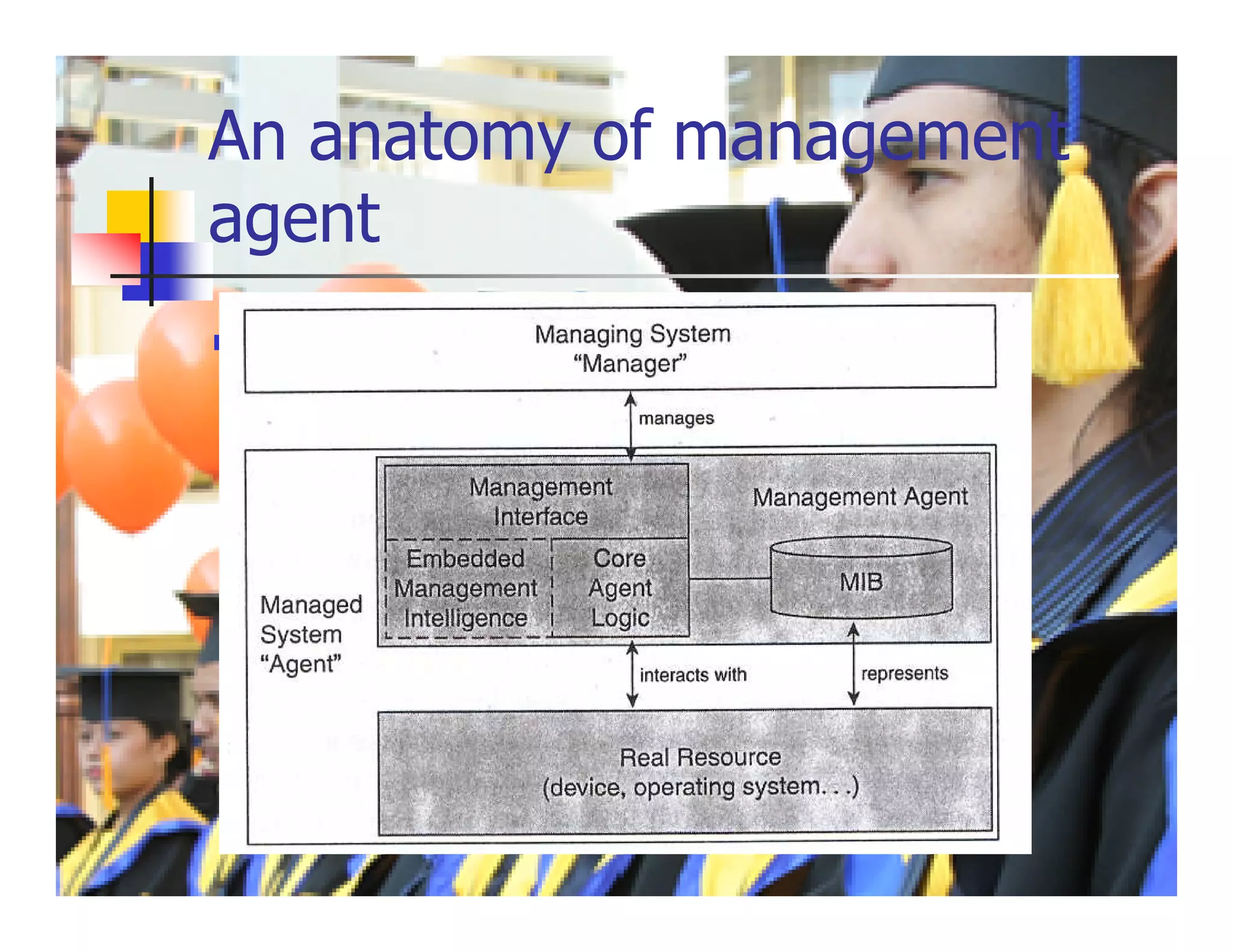
Management agent
 Consists of 3 parts
 A management interface
 A Management Information Base
 The core agent logic
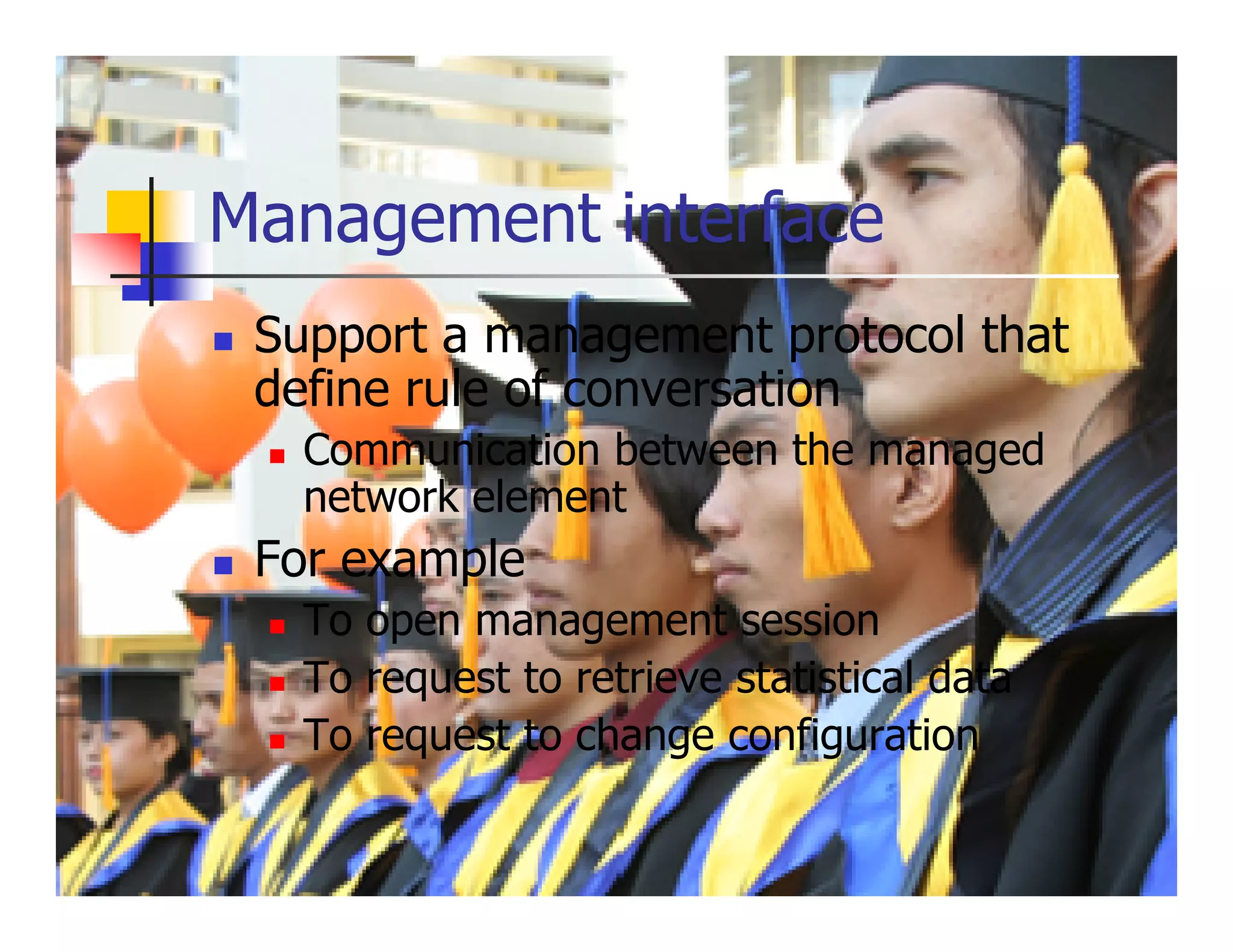
Management interface
 Support a management protocol that
 define rule of conversation
   Communication between the managed
   network element
 For example
   To open management session
   To request to retrieve statistical data
   To request to change configuration
Management Information Base
(MIB)
 Conceptual data store (management
 information) that contain management view
 of devices
 A type of database used to manage the
 devices in a communications network. It
 comprises a collection of objects in a (virtual)
 database used to manage entities (such as
 routers and switches) in a network. (Ref.
 from wikipedia)
MIB related standard
 RFC 1155
   Structure and Identification of Management
   Information for TCP/IP based internets
 RFC 1157
   Simple Network Management Protocol
 RFC 1213
   Management Information Base for Network
   Management of TCP/IP-based internets
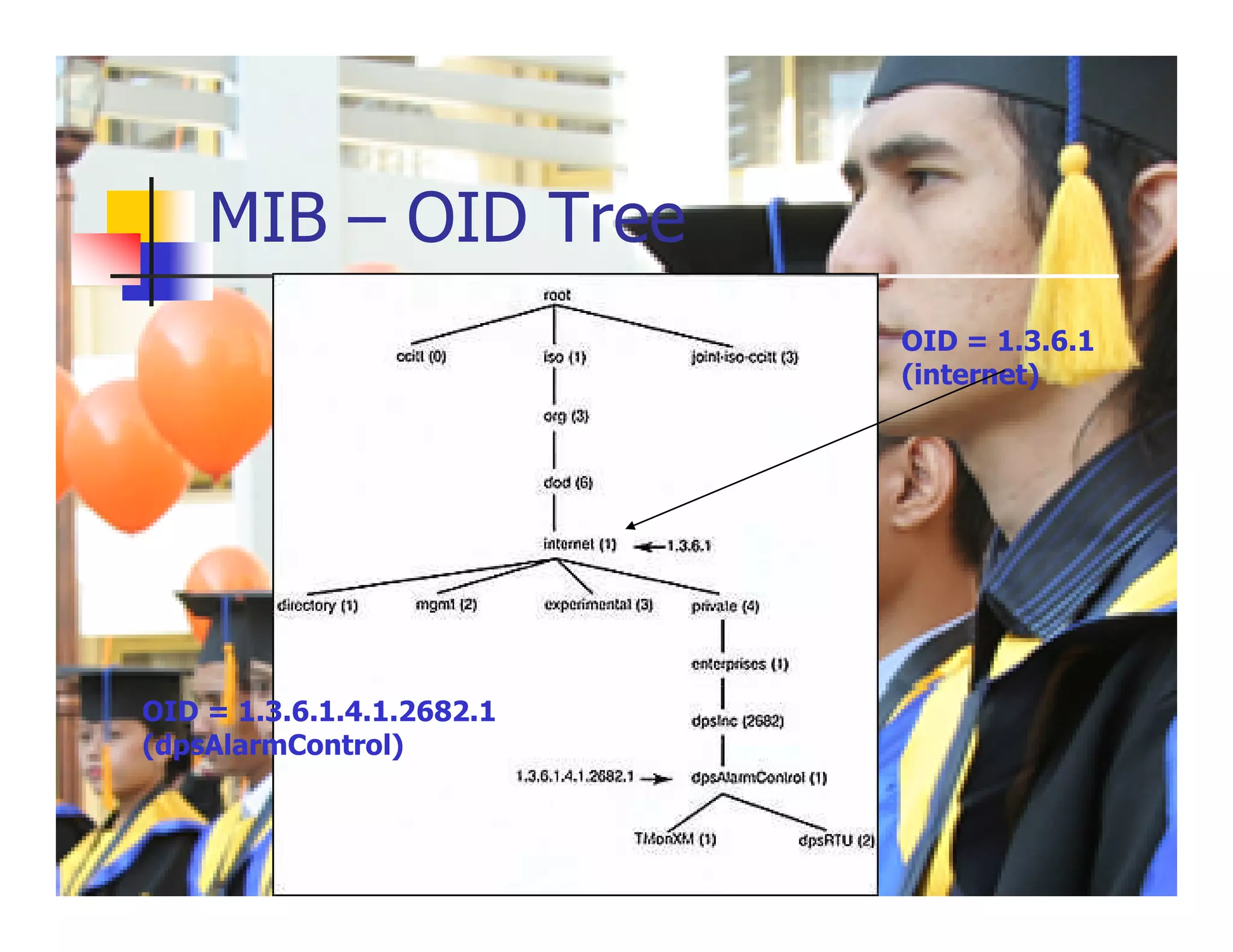
MIB – OID Tree
                           OID = 1.3.6.1
                           (internet)


OID = 1.3.6.1.4.1.2682.1
(dpsAlarmControl)
Core agent logic
 Translates between the operation of the
 management interface, MIB, and actual
 device
   Ex. Translate the request to “retrieve a counter”
   into internal operation that read out a device
   hardware register.
 Additionally, it can include more management
 functions that offload the processing required
 by management app.
   Pre-correlated raw events before sent out
An anatomy of management
agent
 Fig 3-4
Management information (1/2)
 The version of installed software
   To decide which devices need to have new
   software
 Utilization of port
   Whether capacity upgrades are necessary
 Environmental data (temperature and
 voltage)
   Ensuring that a device is not overheating
 Fans
   What is causing the temperature to rise
Management information (2/2)
 Packet counters for different interfaces
   Whether the network is under a certain type of
   attacks (DoS)
 Protocol timeout parameter
   To fine tune network communication performance
 Firewall rules
   Security purposes
 others ?
Managed object (MO)
 Refer to “ a chunk of management
 information that exposes one of the real
 world aspects”
   Ex. MO could represent a device fan along with its
   operational state, a port on a line card along with
   a set of statistical data
 MO could be
   a MIB object in SNMP
   a parameter in a CLI (command-line interface)
   An element of an XML document in web-based
   management interface
Not all aspects in the real world are modeled
  Color of devices
Real world object that MO represents is
referred to as the “real resource”
Since management information in MIB
represents real resource
  When querying the MIB for MO representing a
  packet counter 3 times, the value returned will be
  different
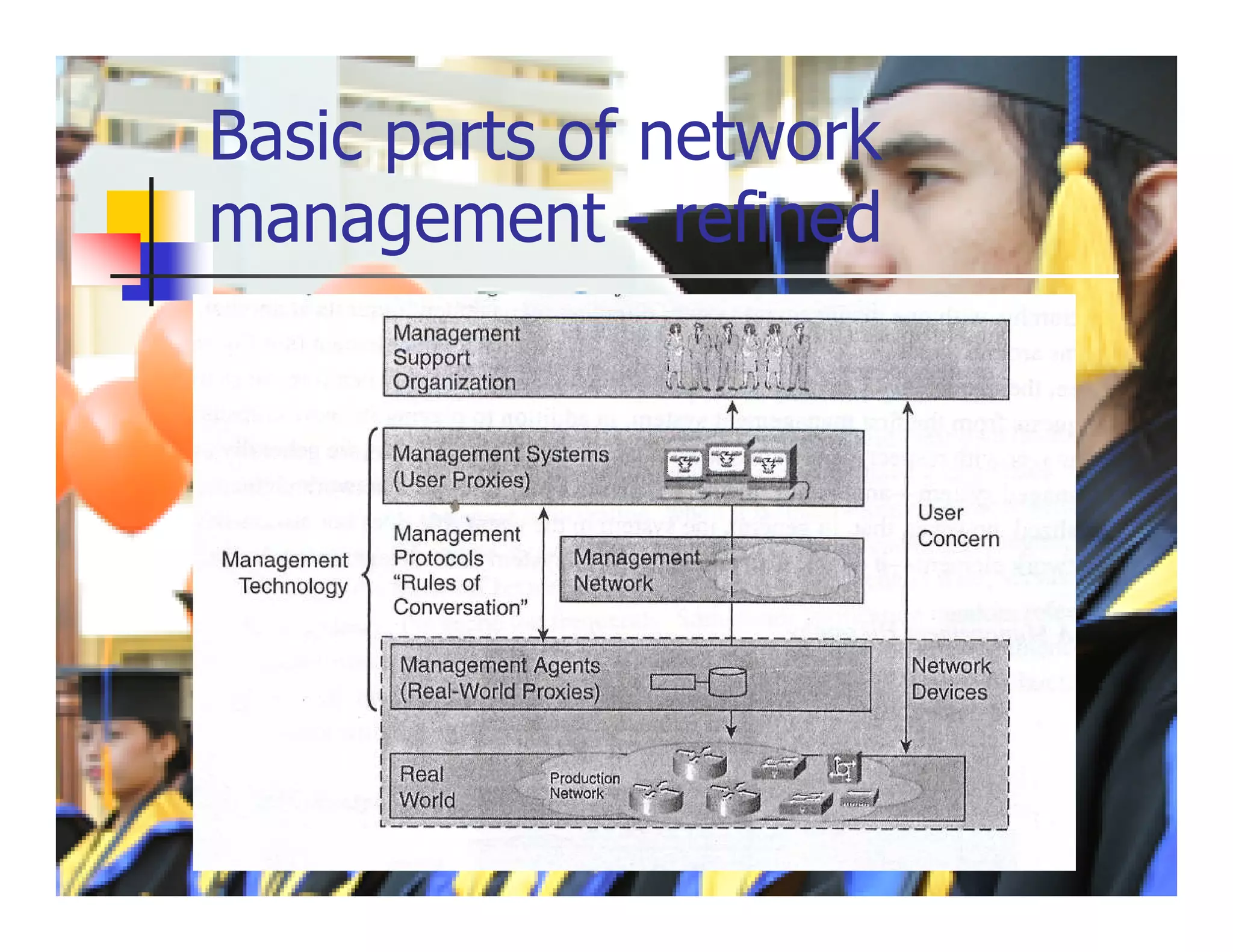
Basic parts of network
management - refined
 Fig 3-6
The Management System
 Tools to manage the network
   monitor the network
   Service provisioning system
   Craft terminal
 In fact, management system is different
 from management applications
 But often we can use both as the same
 meaning
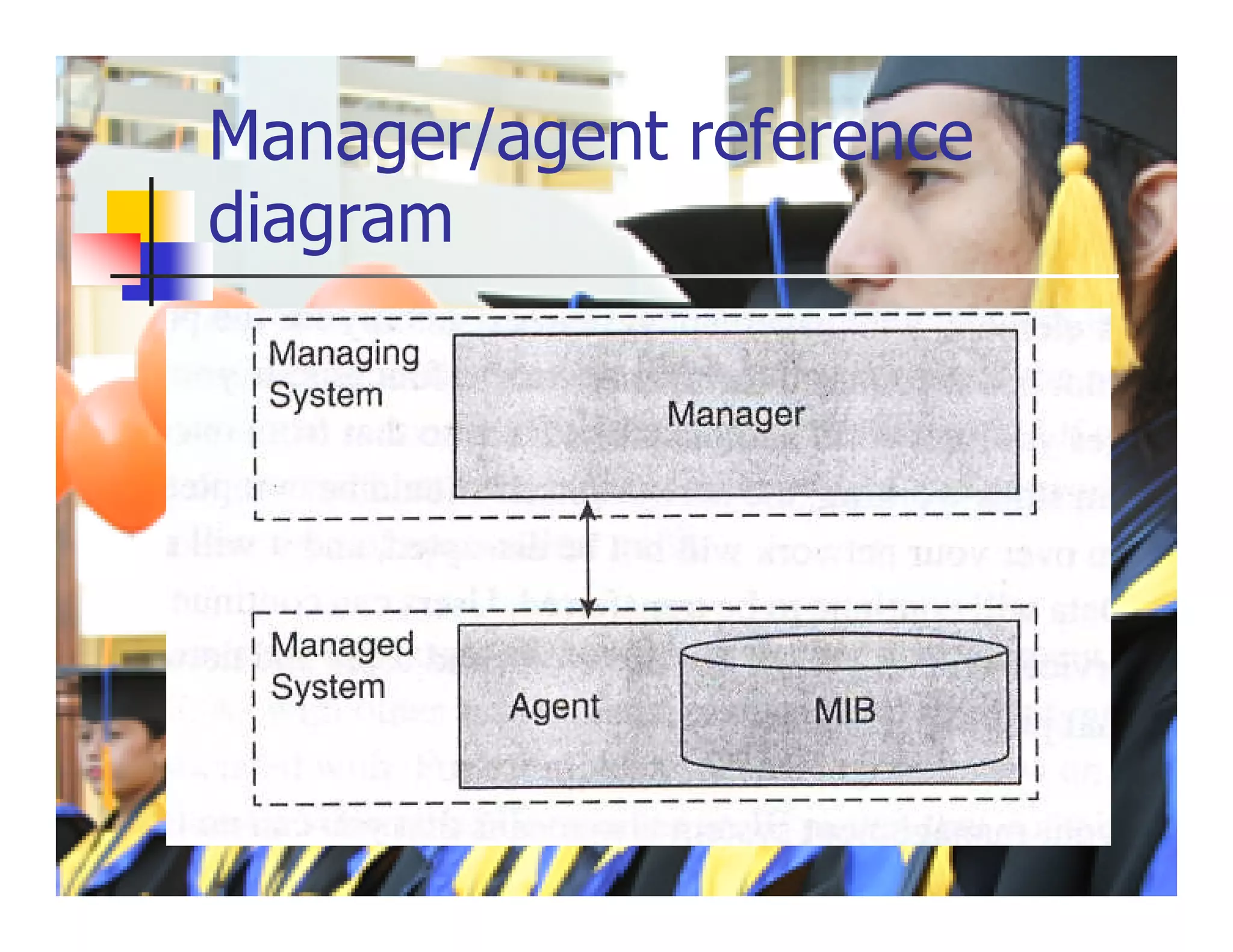
Manager/agent reference
diagram
 Fig 3-8
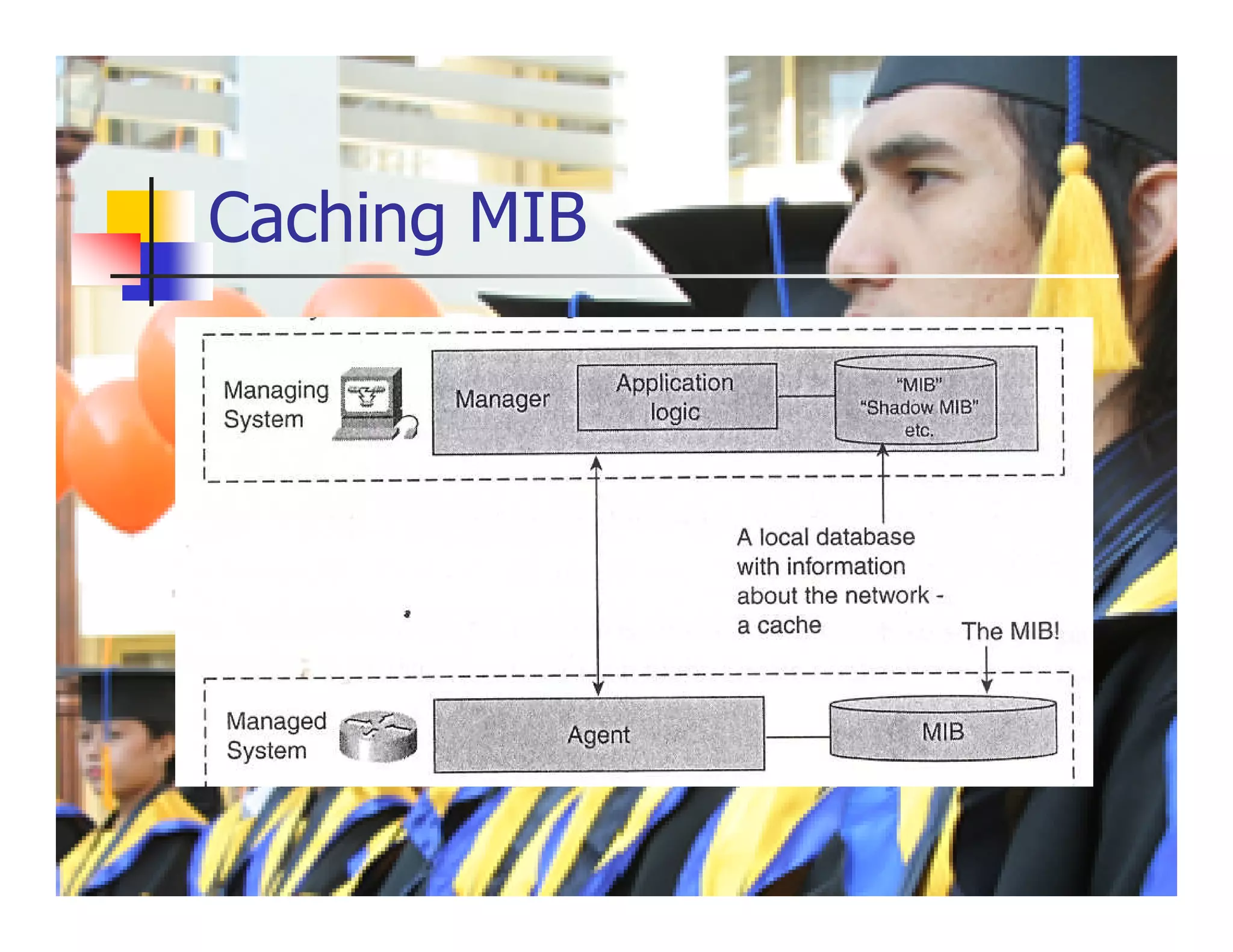
Caching MIB
 Fig 3-9
The Management network
 Networks for carrying traffic of
 subscriber or end user are referred as
 “production network”
 Networks for carrying management
 traffic are referred as “management
 network”
 Both can be physically separate
 networks or they can share the same
 physical network
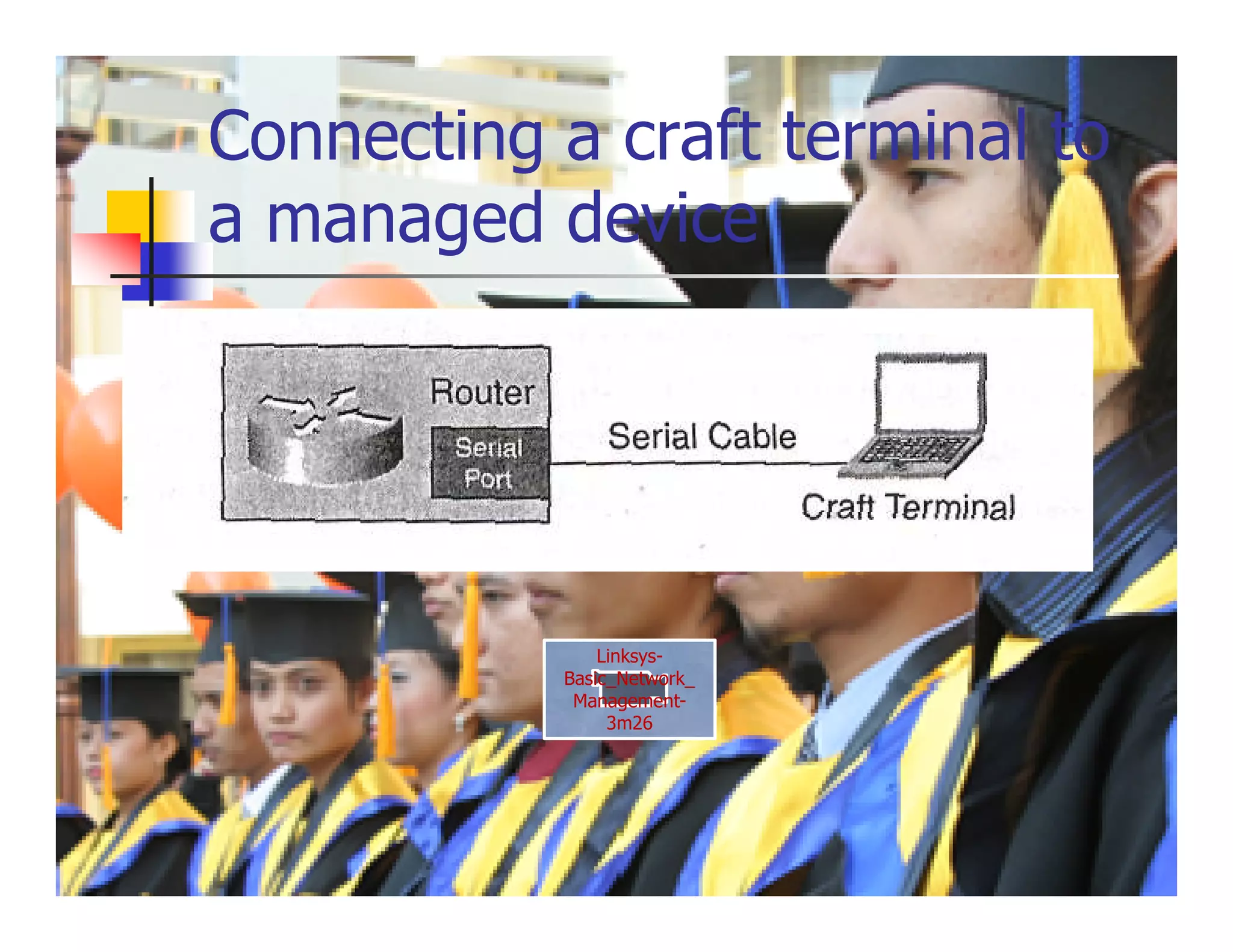
Connecting a craft terminal to
a managed device
 Fig 3-10


                Linksys-
            Basic_Network_
             Management-
                 3m26
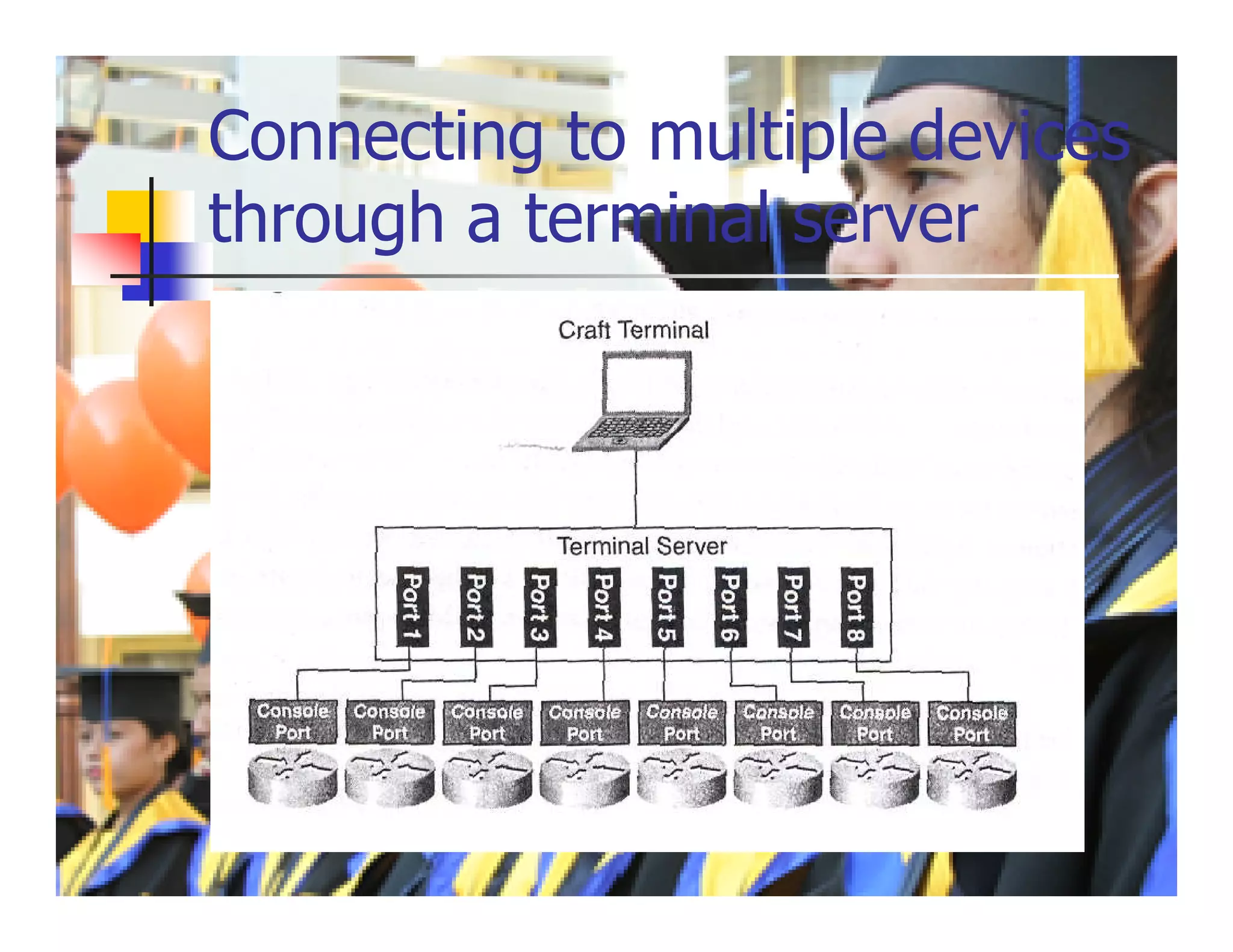
Connecting to multiple devices
through a terminal server
 Fig 3-11
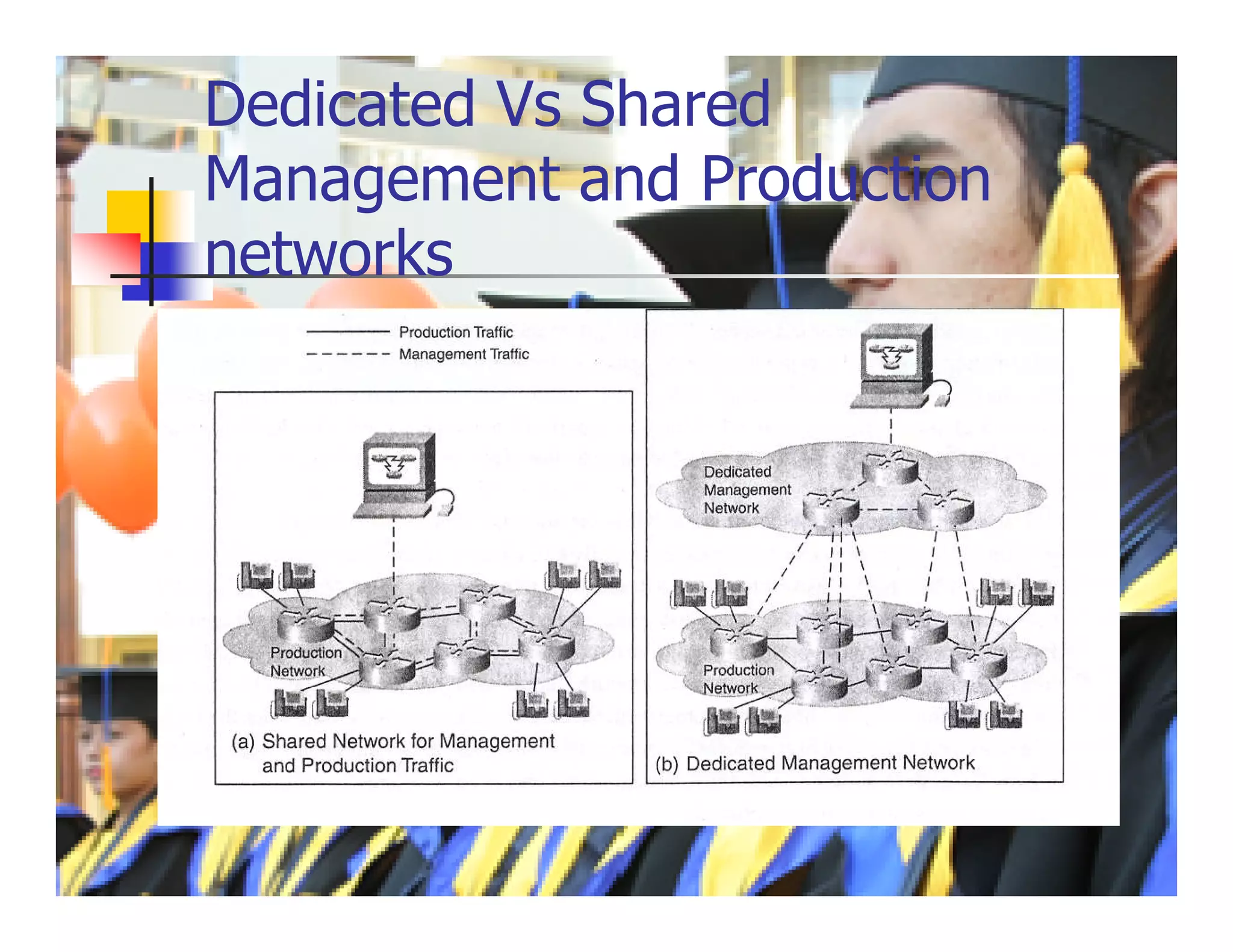
Dedicated Vs Shared
Management and Production
networks
 Fig 3-12
Pros of a dedicated
management network
 Reliability
    Congestion or network failure occurs somewhere in the
    network, it makes the devices hard to reach
    Also hard to find out what it happen
 Interference avoidance
    Compete with production traffic
    May interfere high QoS services (voice ,video streaming)
 Ease of network planning
    No need to consider on management traffic
 Security
    Hard to attack and more secure
Cons of a dedicated
management network
 Cost and overhead
   Addition cost for a management network
 No reasonable alternative
   Some devices do not provide a physical
   connection for another usage
   DSL router cannot be connected with two
   physical links
Final word
 Cost is the huge disadvantage
 So, the management network is needed
 only critical area
   Backbone of service providers or big
   enterprises)
 Hybrid solution
   Generally, it shares over production
   networks
   Only critical segments are used as
   dedicated networks
Managing the management
 The management support org. is responsible
 for making sure that the network is being run
 efficiently and effectively
 These tasks must be performed
   Monitoring the network for failures
   Diagnosing failures and communication outages
   Planning and carrying out repairs
   Provisioning new services and adding/removing
   users
Keeping an eye on performance of the
network
  Taking preventive measure
Planning network upgrades
  Increase capacity
Planning network topology and buildout
  Ensure that the network will meet future
  demand
Organization structure
 Network planning
   Analyzing network usage and traffic patterns and
   planning network build out
 Network operation
   Keeping the network running and monitoring the
   network failures
 Network administration
   Installing new devices / software
 Customer (user) management
   Interacting with the customers
Other thing are needed
 Establishment of process and
 operational policies, documentation of
 operational procedures
   Well-defined procedures
   Well-defined workflow
   Make management consistent and efficient
 Collection of audit trails
   Automatically logging activities of
   operations
Network documentation
  Must be accurate and up-to-date
  Important for network planning and software
  upgrades
  Identify some discrepancies
Reliable backup and restore procedures
  Bring network back to live again in case of
  disaster
Security emphasis
  Networks potentially most vulnerable from the
  inside
  Limit the damage that can cause by one person
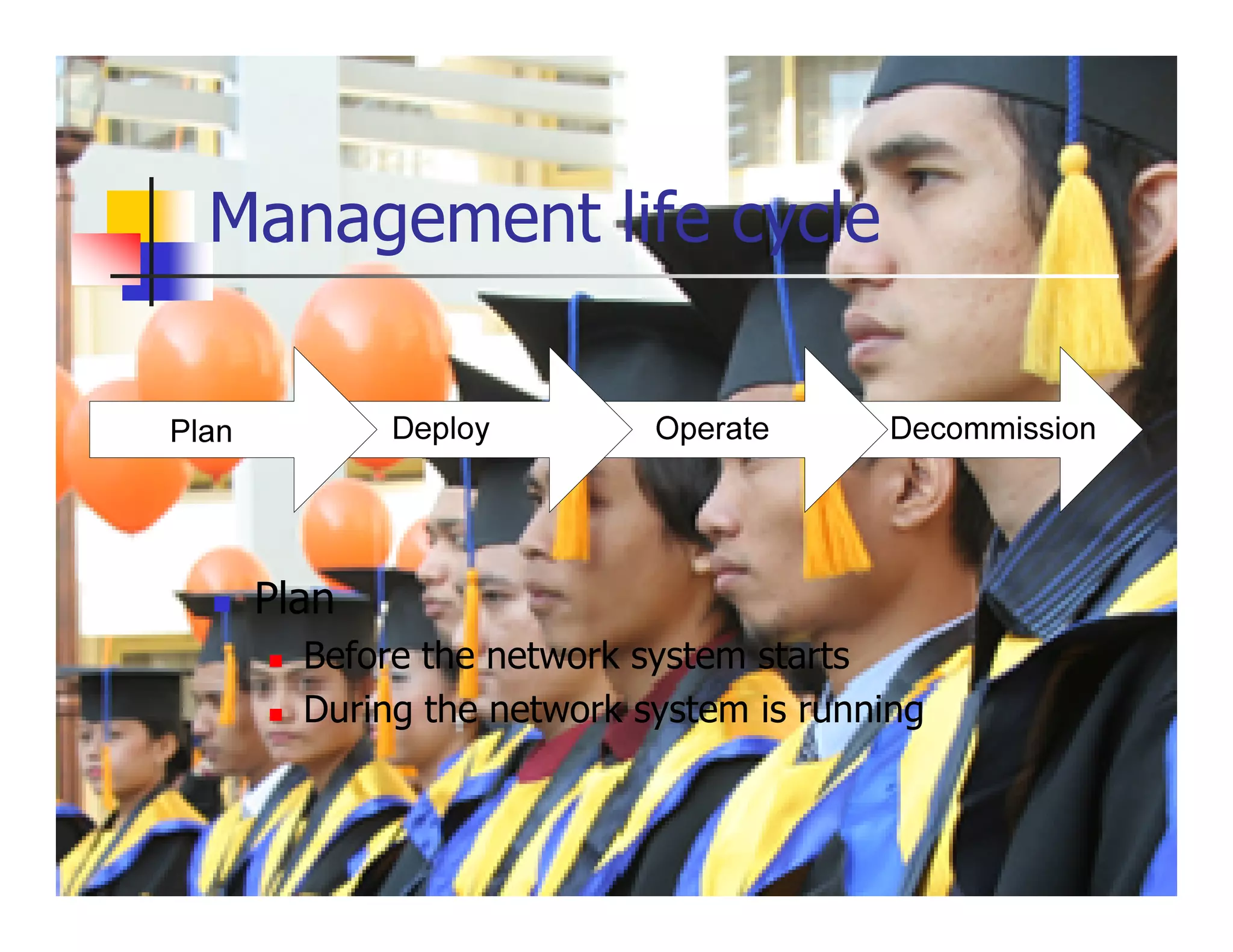
Management life cycle


 Plan
   Before the network system starts
   During the network system is running
Management life cycle
 Deploy
   Installation of the equipment
   Bootstrap mechanism to allow a device to obtain
   and IP address and have layer2 or 3 connectivity
 Operate
   Monitoring/troubleshooting/performance tuning
   and etc
 Decommission
   Old equipments (old technology) will be replace
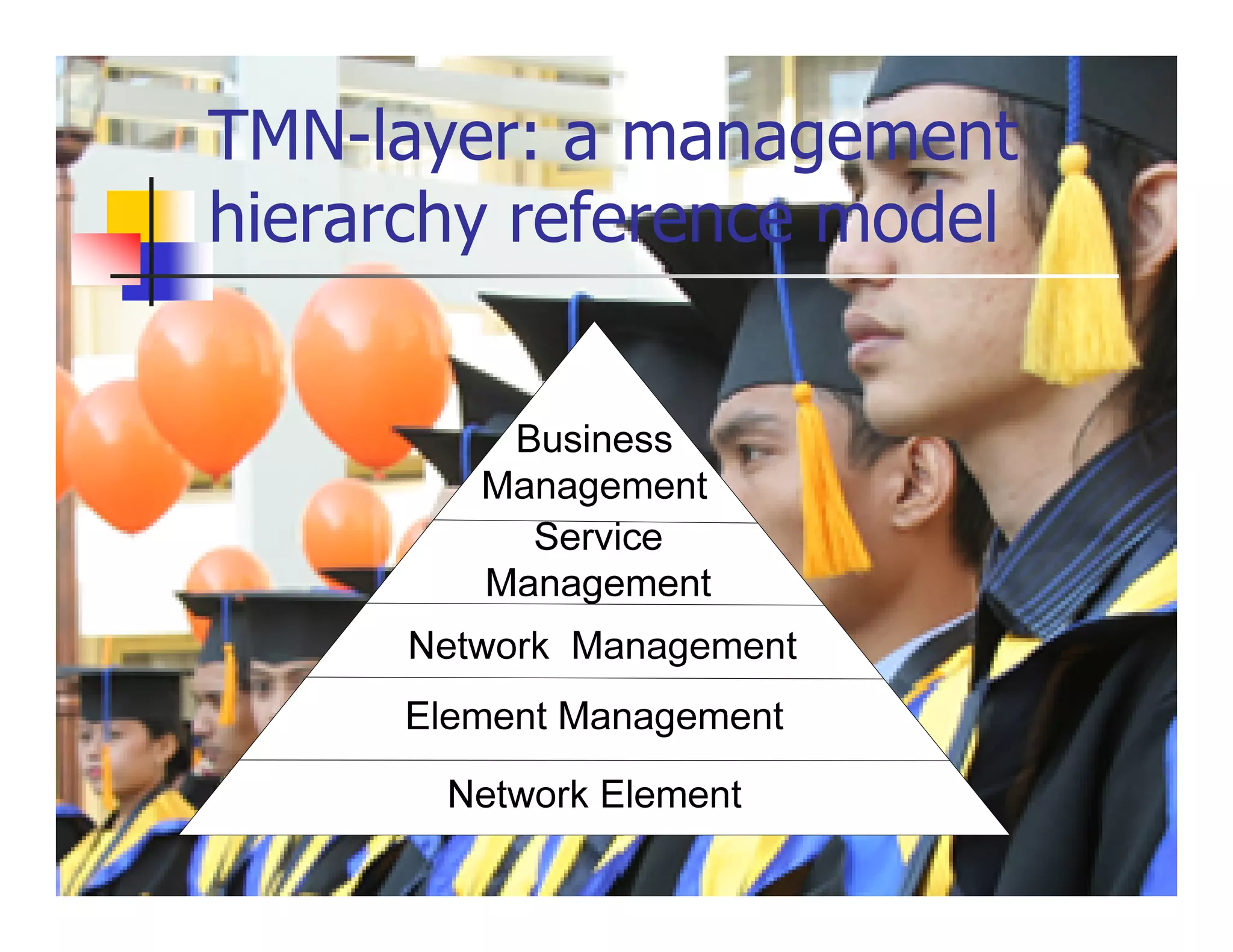
TMN-layer: a management
hierarchy reference model
Management layer
 TMN (telecommunication Management
 network)
  Network element
  Element management
  Network management
  Service management
  Business management
Network element
 It means “the management agent “
 It involves with
   the management functionality
   Communication pattern (protocols)
Element management
 Involve managing the individual devices
 and keep them running
 Functions such as
    to view and change a network element’s
   configuration
   To monitor alarm messages emitted from
   elements
   To instruct network elements to run self-
   test
Network management
 Concern with keeping the network
 running as a whole (end-to-end)
   Monitoring that involves ensuring that data
   flow to reach destination with acceptable
   throughput and delay
   Managing multiple devices in a concerted
   fashion
Service management
 Managing the services that the network
 provides and ensuring those services
 are running smoothly
 Let’s think as ISP (Internet service
 provider)
   ?
Business management
 Billing and invoicing
 Help desk management
 Business forecasting
 Etc ?
Applied Networking-IV (2231114)
        Lecture Week-11
 Basic of Network Management
              Final Word
   Lecture by: Djadja.Sardjana, S.T., M.M.
        www.slideshare.net/djadja

                       Network
                     Management
                    Fundamentals-
                        3m48

Widyatama.lecture.applied networking.iv-week-12.network-management

  • 1.
    Applied Networking-IV (2231114) Lecture Week-12 Basic of Network Management Lecture by: Djadja.Sardjana, S.T., M.M. www.slideshare.net/djadja Monitis_network_ monitoring_ service_preview- 34s
  • 2.
    Basic of NetworkManagement
  • 3.
  • 4.
    Network devices ANE (network element) must offer a management interface for management purposes Allow managing system to send requests ( configure, retrieve statistical data and etc) Send information (response and unsolicited ) Manager – a managing application who in charge of the management Agent – a NE who support the manager by responding its requests
  • 5.
  • 6.
    Management agent Consistsof 3 parts A management interface A Management Information Base The core agent logic
  • 7.
    Management interface Supporta management protocol that define rule of conversation Communication between the managed network element For example To open management session To request to retrieve statistical data To request to change configuration
  • 8.
    Management Information Base (MIB) Conceptual data store (management information) that contain management view of devices A type of database used to manage the devices in a communications network. It comprises a collection of objects in a (virtual) database used to manage entities (such as routers and switches) in a network. (Ref. from wikipedia)
  • 9.
    MIB related standard RFC 1155 Structure and Identification of Management Information for TCP/IP based internets RFC 1157 Simple Network Management Protocol RFC 1213 Management Information Base for Network Management of TCP/IP-based internets
  • 10.
    MIB – OIDTree OID = 1.3.6.1 (internet) OID = 1.3.6.1.4.1.2682.1 (dpsAlarmControl)
  • 11.
    Core agent logic Translates between the operation of the management interface, MIB, and actual device Ex. Translate the request to “retrieve a counter” into internal operation that read out a device hardware register. Additionally, it can include more management functions that offload the processing required by management app. Pre-correlated raw events before sent out
  • 12.
    An anatomy ofmanagement agent Fig 3-4
  • 13.
    Management information (1/2) The version of installed software To decide which devices need to have new software Utilization of port Whether capacity upgrades are necessary Environmental data (temperature and voltage) Ensuring that a device is not overheating Fans What is causing the temperature to rise
  • 14.
    Management information (2/2) Packet counters for different interfaces Whether the network is under a certain type of attacks (DoS) Protocol timeout parameter To fine tune network communication performance Firewall rules Security purposes others ?
  • 15.
    Managed object (MO) Refer to “ a chunk of management information that exposes one of the real world aspects” Ex. MO could represent a device fan along with its operational state, a port on a line card along with a set of statistical data MO could be a MIB object in SNMP a parameter in a CLI (command-line interface) An element of an XML document in web-based management interface
  • 16.
    Not all aspectsin the real world are modeled Color of devices Real world object that MO represents is referred to as the “real resource” Since management information in MIB represents real resource When querying the MIB for MO representing a packet counter 3 times, the value returned will be different
  • 17.
    Basic parts ofnetwork management - refined Fig 3-6
  • 18.
    The Management System Tools to manage the network monitor the network Service provisioning system Craft terminal In fact, management system is different from management applications But often we can use both as the same meaning
  • 19.
  • 20.
  • 21.
    The Management network Networks for carrying traffic of subscriber or end user are referred as “production network” Networks for carrying management traffic are referred as “management network” Both can be physically separate networks or they can share the same physical network
  • 22.
    Connecting a craftterminal to a managed device Fig 3-10 Linksys- Basic_Network_ Management- 3m26
  • 23.
    Connecting to multipledevices through a terminal server Fig 3-11
  • 24.
    Dedicated Vs Shared Managementand Production networks Fig 3-12
  • 25.
    Pros of adedicated management network Reliability Congestion or network failure occurs somewhere in the network, it makes the devices hard to reach Also hard to find out what it happen Interference avoidance Compete with production traffic May interfere high QoS services (voice ,video streaming) Ease of network planning No need to consider on management traffic Security Hard to attack and more secure
  • 26.
    Cons of adedicated management network Cost and overhead Addition cost for a management network No reasonable alternative Some devices do not provide a physical connection for another usage DSL router cannot be connected with two physical links
  • 27.
    Final word Costis the huge disadvantage So, the management network is needed only critical area Backbone of service providers or big enterprises) Hybrid solution Generally, it shares over production networks Only critical segments are used as dedicated networks
  • 28.
    Managing the management The management support org. is responsible for making sure that the network is being run efficiently and effectively These tasks must be performed Monitoring the network for failures Diagnosing failures and communication outages Planning and carrying out repairs Provisioning new services and adding/removing users
  • 29.
    Keeping an eyeon performance of the network Taking preventive measure Planning network upgrades Increase capacity Planning network topology and buildout Ensure that the network will meet future demand
  • 30.
    Organization structure Networkplanning Analyzing network usage and traffic patterns and planning network build out Network operation Keeping the network running and monitoring the network failures Network administration Installing new devices / software Customer (user) management Interacting with the customers
  • 31.
    Other thing areneeded Establishment of process and operational policies, documentation of operational procedures Well-defined procedures Well-defined workflow Make management consistent and efficient Collection of audit trails Automatically logging activities of operations
  • 32.
    Network documentation Must be accurate and up-to-date Important for network planning and software upgrades Identify some discrepancies Reliable backup and restore procedures Bring network back to live again in case of disaster Security emphasis Networks potentially most vulnerable from the inside Limit the damage that can cause by one person
  • 33.
    Management life cycle Plan Before the network system starts During the network system is running
  • 34.
    Management life cycle Deploy Installation of the equipment Bootstrap mechanism to allow a device to obtain and IP address and have layer2 or 3 connectivity Operate Monitoring/troubleshooting/performance tuning and etc Decommission Old equipments (old technology) will be replace
  • 35.
  • 36.
    Management layer TMN(telecommunication Management network) Network element Element management Network management Service management Business management
  • 37.
    Network element Itmeans “the management agent “ It involves with the management functionality Communication pattern (protocols)
  • 38.
    Element management Involvemanaging the individual devices and keep them running Functions such as to view and change a network element’s configuration To monitor alarm messages emitted from elements To instruct network elements to run self- test
  • 39.
    Network management Concernwith keeping the network running as a whole (end-to-end) Monitoring that involves ensuring that data flow to reach destination with acceptable throughput and delay Managing multiple devices in a concerted fashion
  • 40.
    Service management Managingthe services that the network provides and ensuring those services are running smoothly Let’s think as ISP (Internet service provider) ?
  • 41.
    Business management Billingand invoicing Help desk management Business forecasting Etc ?
  • 42.
    Applied Networking-IV (2231114) Lecture Week-11 Basic of Network Management Final Word Lecture by: Djadja.Sardjana, S.T., M.M. www.slideshare.net/djadja Network Management Fundamentals- 3m48