Wireless Sensor Network (WSN) By Nishant H. Shah Siddheshwar B. Sharma Bonee Soibam
Introduction of WSN Research and Systems Implemented till date   System Implementation & future Developments Conclusion
Introduction Difference between WSN & other wireless  Networks Key Application of WSNs What is a Sensor Node ?
 
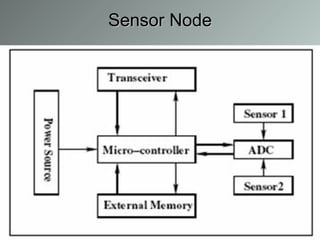
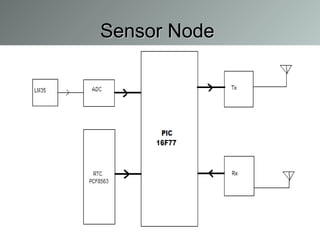
Sensor Node
 
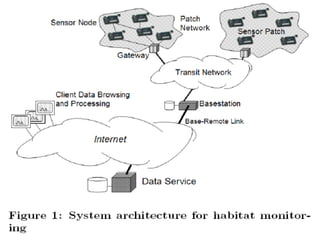
Research done till Date Habitat Monitoring System Topology Discovery algorithms  Data Routing Algorithms
Problems with WSN Energy Efficient and robust  No fixed topology  Algorithm for routing the data
Topology  Discovery Algorithm Ad hoc networking the main principle The conditions are dynamic and adaptive Nodes should  self organize themselves in particular topology
Several Topology Discovery Algorithms Ad Hoc Network Management Protocol (ANMP)  A Distributed Mechanism for Topology Discovery in Ad hoc Wireless Networks  “ TopDisc” Algorithm.
TOPDISC Algorithm Approximate topology is constructed using information of Neighborhood nodes Only distinguished nodes which have Neighborhood information communicate with  the main node
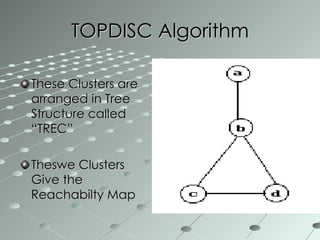
TOPDISC Algorithm These Clusters are arranged in Tree Structure called “TREC” Theswe Clusters Give the Reachabilty Map
Localization Technique Need for Localization As the network is adaptive it would be fair enough for us to address the nodes dynamically It can done Using DHCP protocol for addressing
DHCP Addressing Each node would get its own IP.V4 address The Dynamic Host Configuration Protocol (DHCP) automates the assignment of IP addresses, subnet masks, default gateway, and other IP parameters.
DHCP Addressing   Three Modes  of DHCP Addressing Manual Allocation Auto Allocation Dynamic Allocation
Routing protocols for WSN Depends on the Applications Existing Protocols Shortest path Tree  Spanning Tree Algorithm N-Safe link Algorithm
Our System Implementation
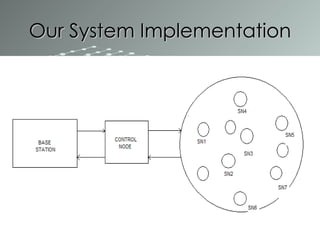
We have used four sensor nodes for  sensing temperature of the given habitat and one control node interfaced with the base station i.e.  PC in our case .  Handles two types of Monitoring Query Handling by user Updating the database on the base station after a given  time interval. Our System Implementation
Topology Discovery & Localization In our system We have Modified Topdisc Algorithm to meet our requirements Using DHCP Dynamic Mode of Addressing
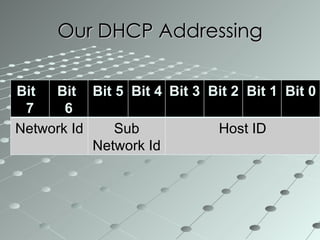
Our Modification in DHCP Addressing 8 bit IP Addresses Finite lease period of 5 mins
Our DHCP Addressing Bit  7 Bit  6 Bit 5  Bit 4 Bit 3 Bit 2 Bit 1  Bit 0 Network Id  Sub Network Id Host ID
Modified Version of Topdisc  as required for the System The main node i.e. our control node would be in sub-network 0 ( according to IP .V4 addressing techniques ). The next node which is in the range of sub-network 0 would be named as sub-network 1, subsequently this process gets on and on till all nodes in the network get its assigned sub-network
Modified Version of Topdisc  as required for the System The next part of the individual host addressing is based on the shortest distance algorithm. The node nearest to the control node gets its host id as 0, 1, 2, 3, ….And this comes under sub-network 1. Subsequently Nodes in Subnetwork 1 would address the nodes in subnetwork 2 and assign Host IDs
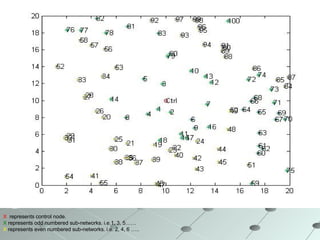
X  represents control node. X  represents odd numbered sub-networks. i.e.1, 3, 5…… X  represents even numbered sub-networks. i.e. 2, 4, 6 …..
Localization Technique Adopted Each Node has its Corresponding Parent  Child  Friend
Routing Algorithm For WSN Mixture Of Spanning Tree And N - Link state protocol For query purpose  Spanning Tree Algorithm For Updating Database  N- link State Algorithm (here we would Take N = 2)
Routing Tables Routing Tables would be based on the Localization Table It would be like  a family Tree chart
Sensor Node
Future Enhancements Implementaion of Fail Safe Method Completion of fully configurable Wireless Sensor Network And If time permits Softwrae simulation of the routing Algorithm to analyze the Systems Success Rate
Thanking You

Wsn

  • 1.
    Wireless Sensor Network(WSN) By Nishant H. Shah Siddheshwar B. Sharma Bonee Soibam
  • 2.
    Introduction of WSNResearch and Systems Implemented till date System Implementation & future Developments Conclusion
  • 3.
    Introduction Difference betweenWSN & other wireless Networks Key Application of WSNs What is a Sensor Node ?
  • 4.
  • 5.
  • 6.
  • 7.
    Research done tillDate Habitat Monitoring System Topology Discovery algorithms Data Routing Algorithms
  • 8.
    Problems with WSNEnergy Efficient and robust No fixed topology Algorithm for routing the data
  • 9.
    Topology DiscoveryAlgorithm Ad hoc networking the main principle The conditions are dynamic and adaptive Nodes should self organize themselves in particular topology
  • 10.
    Several Topology DiscoveryAlgorithms Ad Hoc Network Management Protocol (ANMP) A Distributed Mechanism for Topology Discovery in Ad hoc Wireless Networks “ TopDisc” Algorithm.
  • 11.
    TOPDISC Algorithm Approximatetopology is constructed using information of Neighborhood nodes Only distinguished nodes which have Neighborhood information communicate with the main node
  • 12.
    TOPDISC Algorithm TheseClusters are arranged in Tree Structure called “TREC” Theswe Clusters Give the Reachabilty Map
  • 13.
    Localization Technique Needfor Localization As the network is adaptive it would be fair enough for us to address the nodes dynamically It can done Using DHCP protocol for addressing
  • 14.
    DHCP Addressing Eachnode would get its own IP.V4 address The Dynamic Host Configuration Protocol (DHCP) automates the assignment of IP addresses, subnet masks, default gateway, and other IP parameters.
  • 15.
    DHCP Addressing Three Modes of DHCP Addressing Manual Allocation Auto Allocation Dynamic Allocation
  • 16.
    Routing protocols forWSN Depends on the Applications Existing Protocols Shortest path Tree Spanning Tree Algorithm N-Safe link Algorithm
  • 17.
  • 18.
    We have usedfour sensor nodes for sensing temperature of the given habitat and one control node interfaced with the base station i.e. PC in our case . Handles two types of Monitoring Query Handling by user Updating the database on the base station after a given time interval. Our System Implementation
  • 19.
    Topology Discovery &Localization In our system We have Modified Topdisc Algorithm to meet our requirements Using DHCP Dynamic Mode of Addressing
  • 20.
    Our Modification inDHCP Addressing 8 bit IP Addresses Finite lease period of 5 mins
  • 21.
    Our DHCP AddressingBit 7 Bit 6 Bit 5 Bit 4 Bit 3 Bit 2 Bit 1 Bit 0 Network Id Sub Network Id Host ID
  • 22.
    Modified Version ofTopdisc as required for the System The main node i.e. our control node would be in sub-network 0 ( according to IP .V4 addressing techniques ). The next node which is in the range of sub-network 0 would be named as sub-network 1, subsequently this process gets on and on till all nodes in the network get its assigned sub-network
  • 23.
    Modified Version ofTopdisc as required for the System The next part of the individual host addressing is based on the shortest distance algorithm. The node nearest to the control node gets its host id as 0, 1, 2, 3, ….And this comes under sub-network 1. Subsequently Nodes in Subnetwork 1 would address the nodes in subnetwork 2 and assign Host IDs
  • 24.
    X representscontrol node. X represents odd numbered sub-networks. i.e.1, 3, 5…… X represents even numbered sub-networks. i.e. 2, 4, 6 …..
  • 25.
    Localization Technique AdoptedEach Node has its Corresponding Parent Child Friend
  • 26.
    Routing Algorithm ForWSN Mixture Of Spanning Tree And N - Link state protocol For query purpose Spanning Tree Algorithm For Updating Database N- link State Algorithm (here we would Take N = 2)
  • 27.
    Routing Tables RoutingTables would be based on the Localization Table It would be like a family Tree chart
  • 28.
  • 29.
    Future Enhancements Implementaionof Fail Safe Method Completion of fully configurable Wireless Sensor Network And If time permits Softwrae simulation of the routing Algorithm to analyze the Systems Success Rate
  • 30.