MOBILE AD-HOC NETWORK
CONTENTS:
Introduction.
History of MANET.
Features or Advantages.
Types of MANET.
Routing protocols.
Application of MANET.
Limitations.
Conclusion.
What is Network?
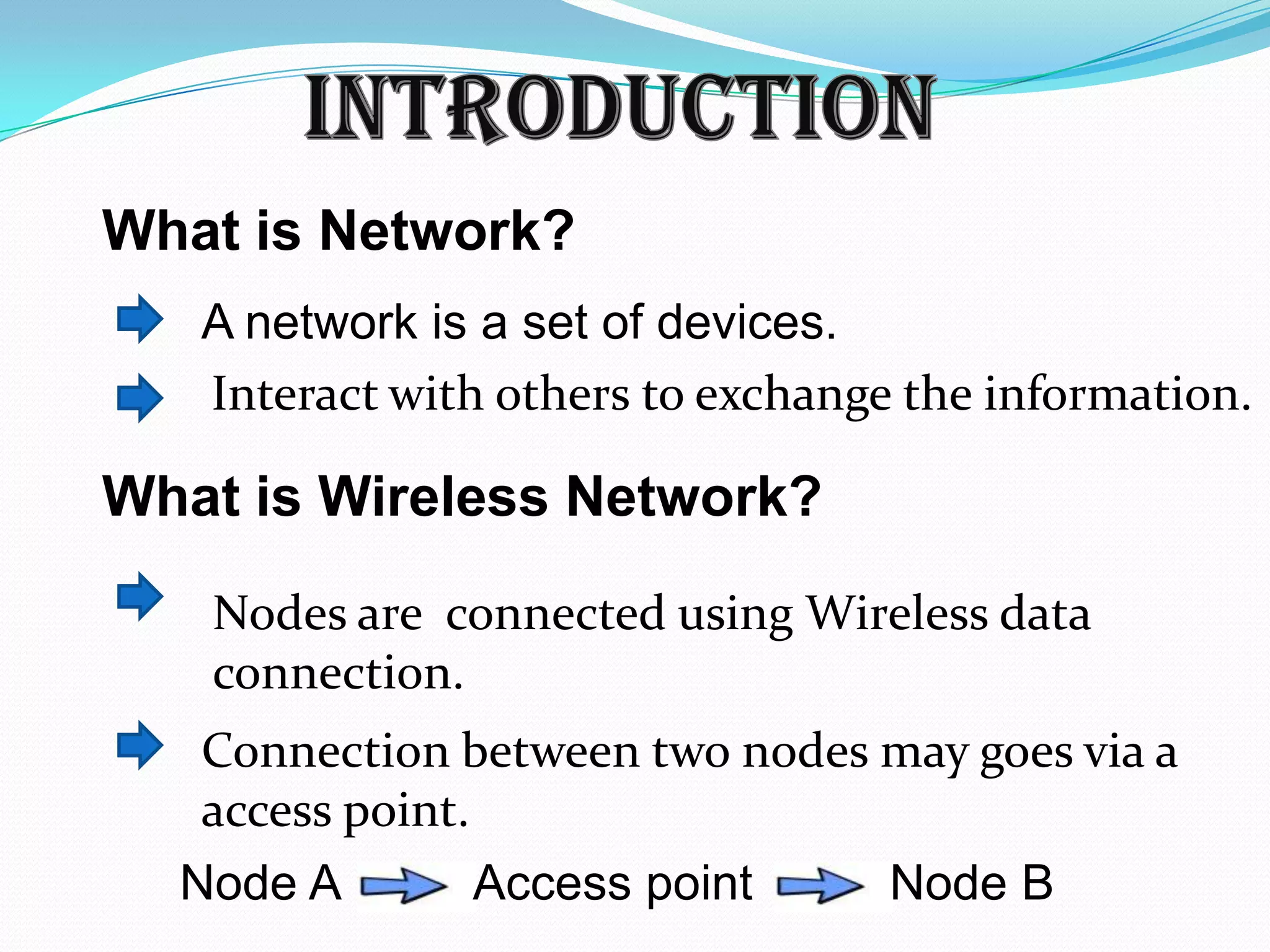
A network is a set of devices.
Interact with others to exchange the information.
What is Wireless Network?
Connection between two nodes may goes via a
access point.
Nodes are connected using Wireless data
connection.
Node A Access point Node B
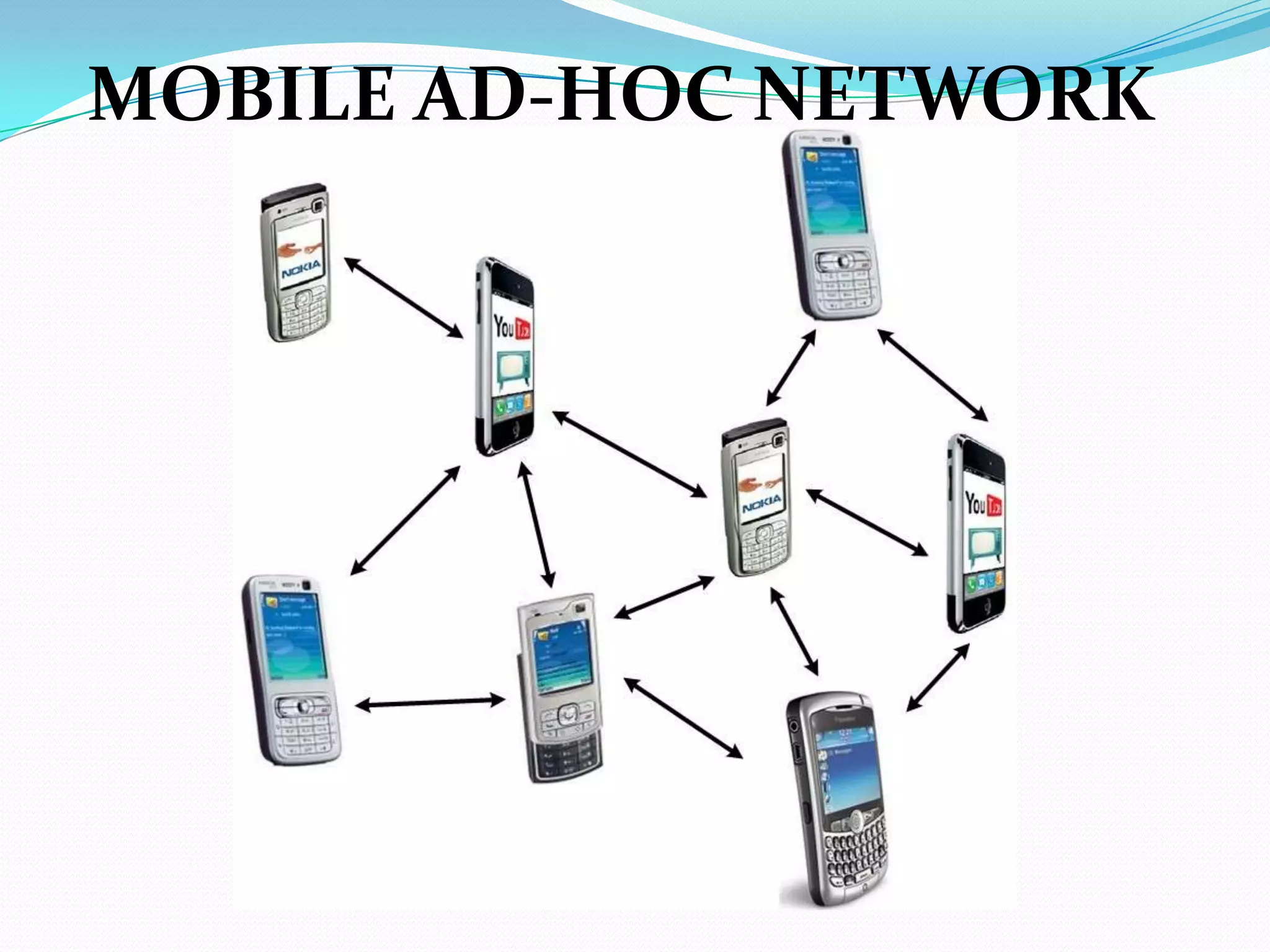
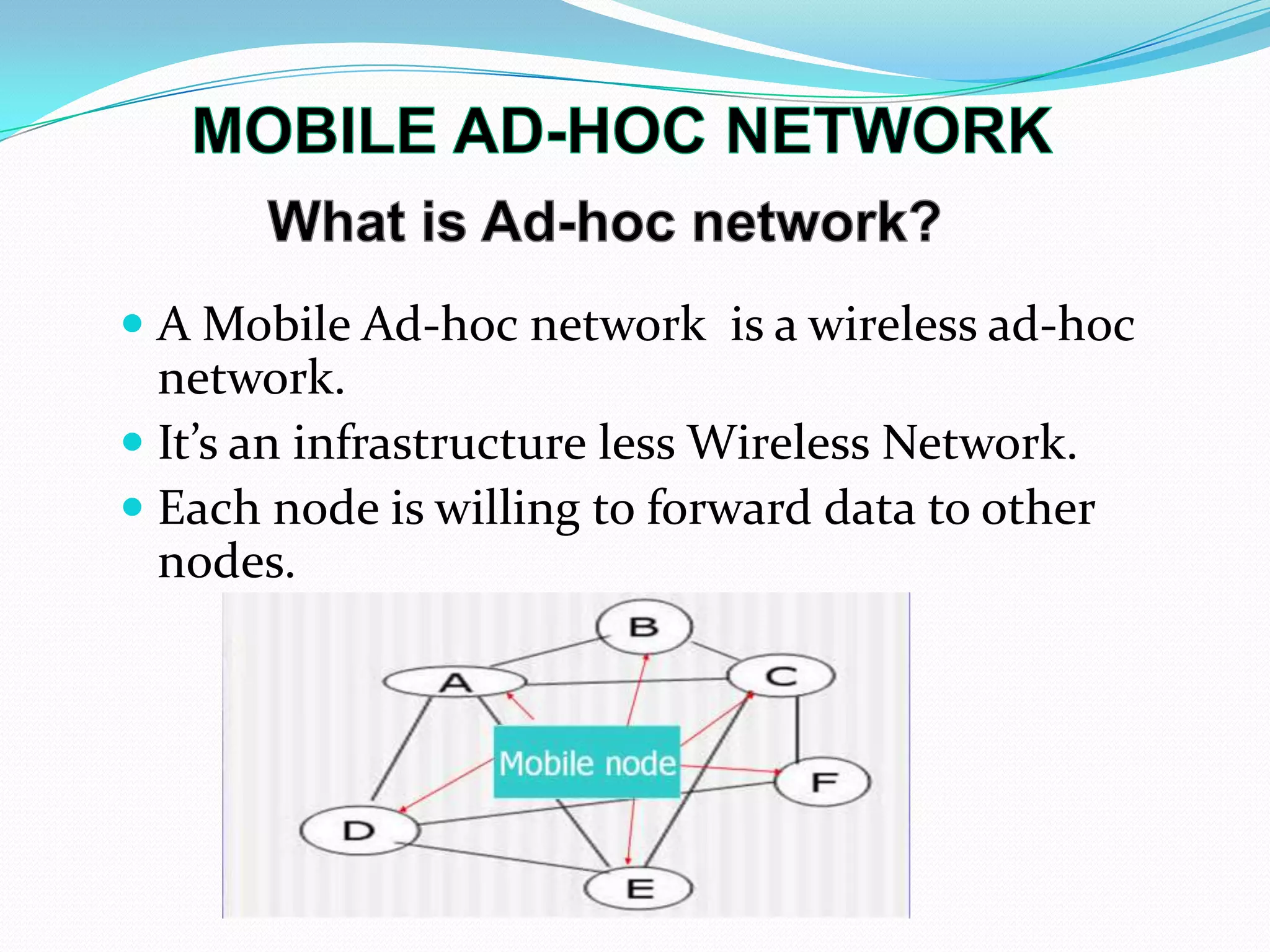
 A Mobile Ad-hoc network is a wireless ad-hoc
network.
 It’s an infrastructure less Wireless Network.
 Each node is willing to forward data to other
nodes.
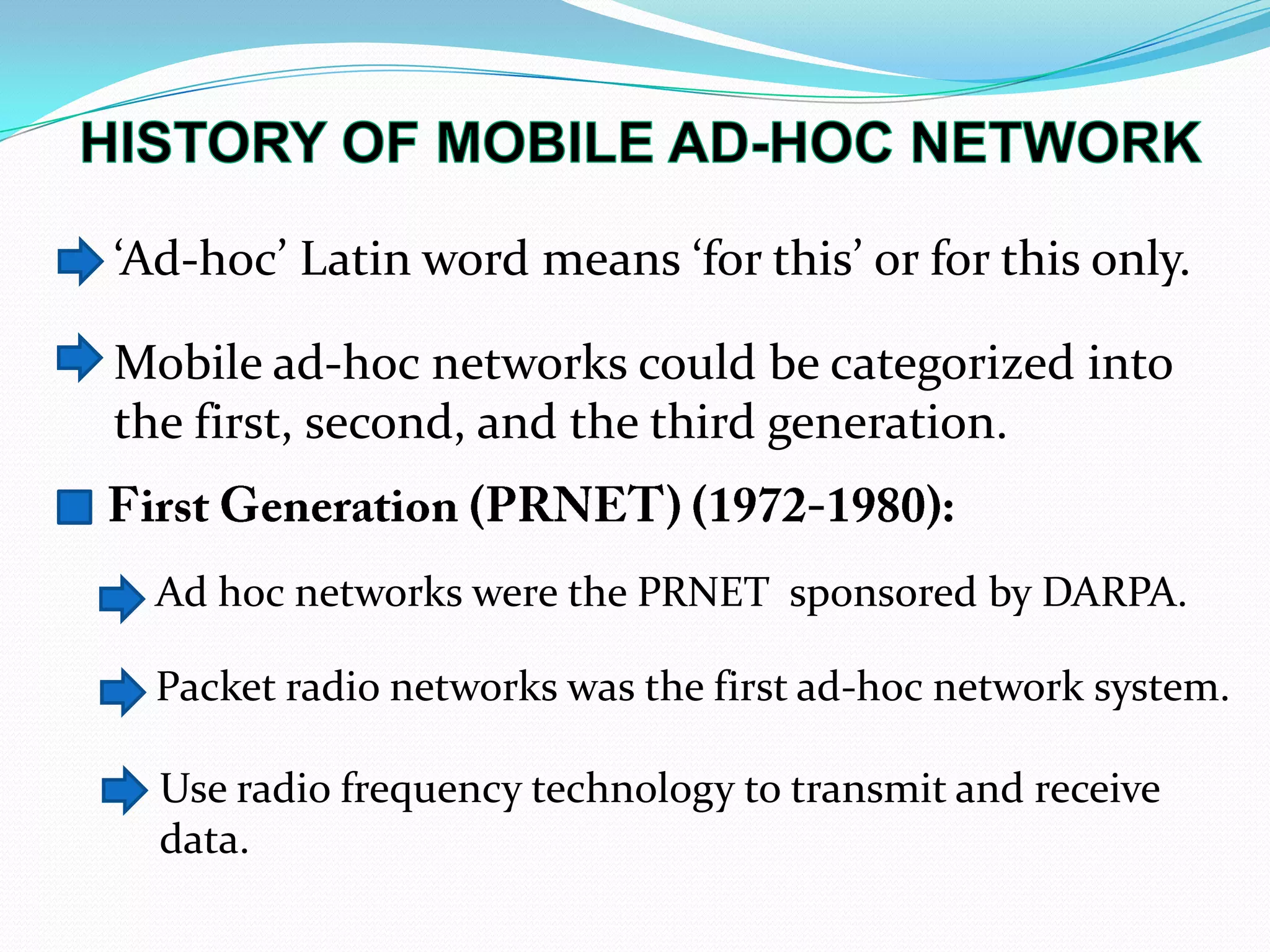
‘Ad-hoc’ Latin word means ‘for this’ or for this only.
Mobile ad-hoc networks could be categorized into
the first, second, and the third generation.
Packet radio networks was the first ad-hoc network system.
Use radio frequency technology to transmit and receive
data.
Ad hoc networks were the PRNET sponsored by DARPA.
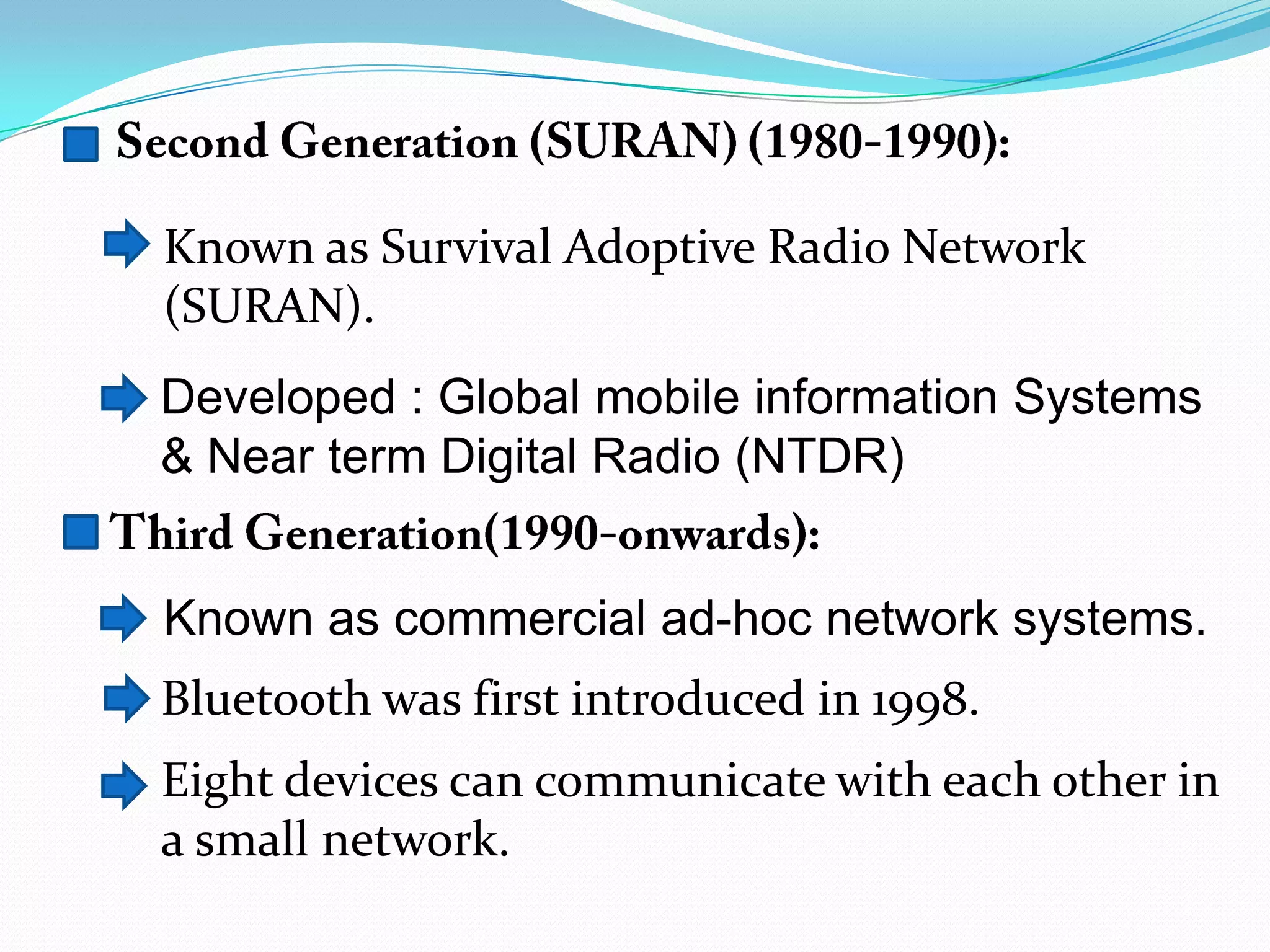
Known as Survival Adoptive Radio Network
(SURAN).
Developed : Global mobile information Systems
& Near term Digital Radio (NTDR)
Known as commercial ad-hoc network systems.
Bluetooth was first introduced in 1998.
Eight devices can communicate with each other in
a small network.
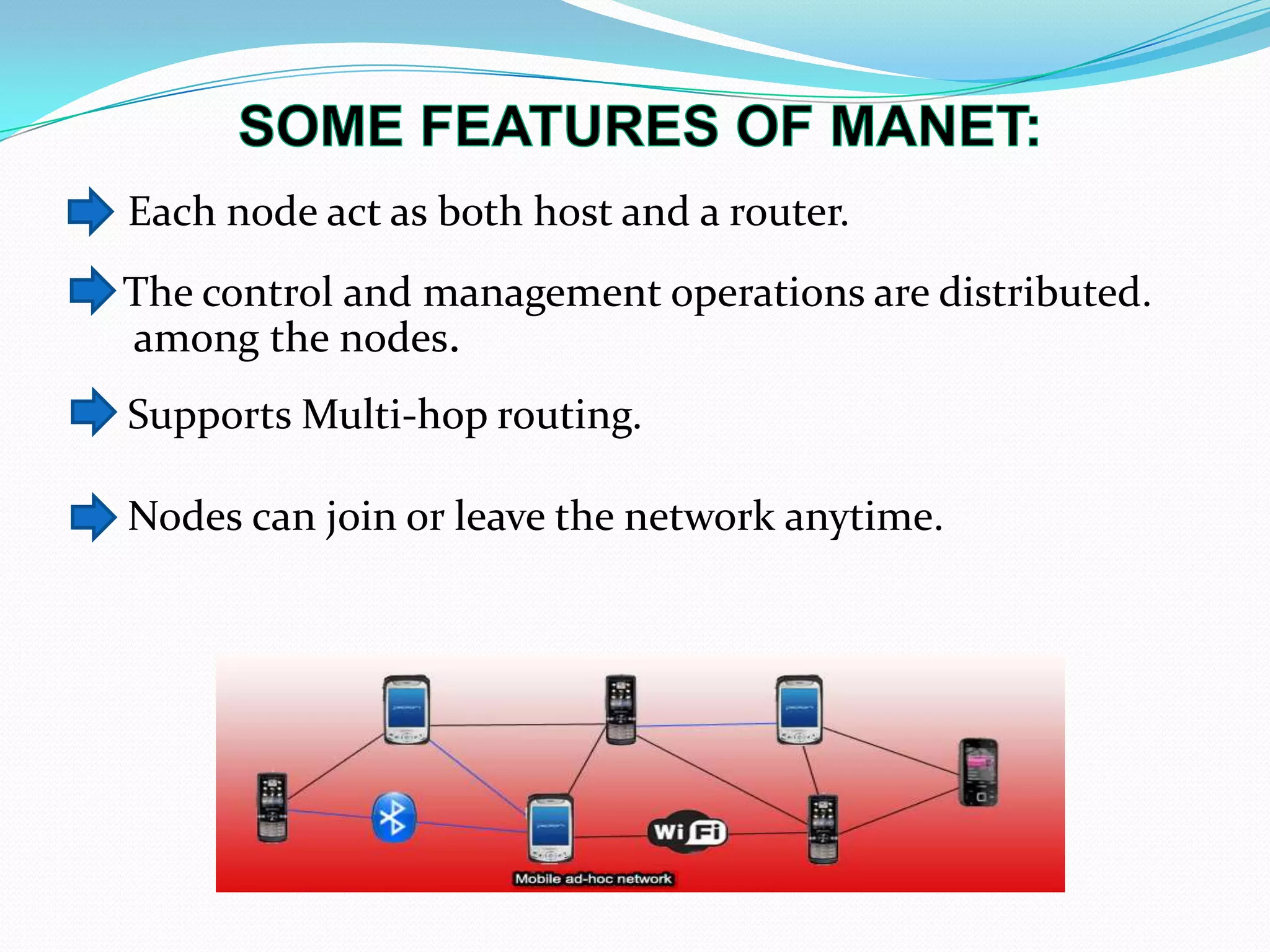
Each node act as both host and a router.
Supports Multi-hop routing.
Nodes can join or leave the network anytime.
among the nodes.
The control and management operations are distributed.
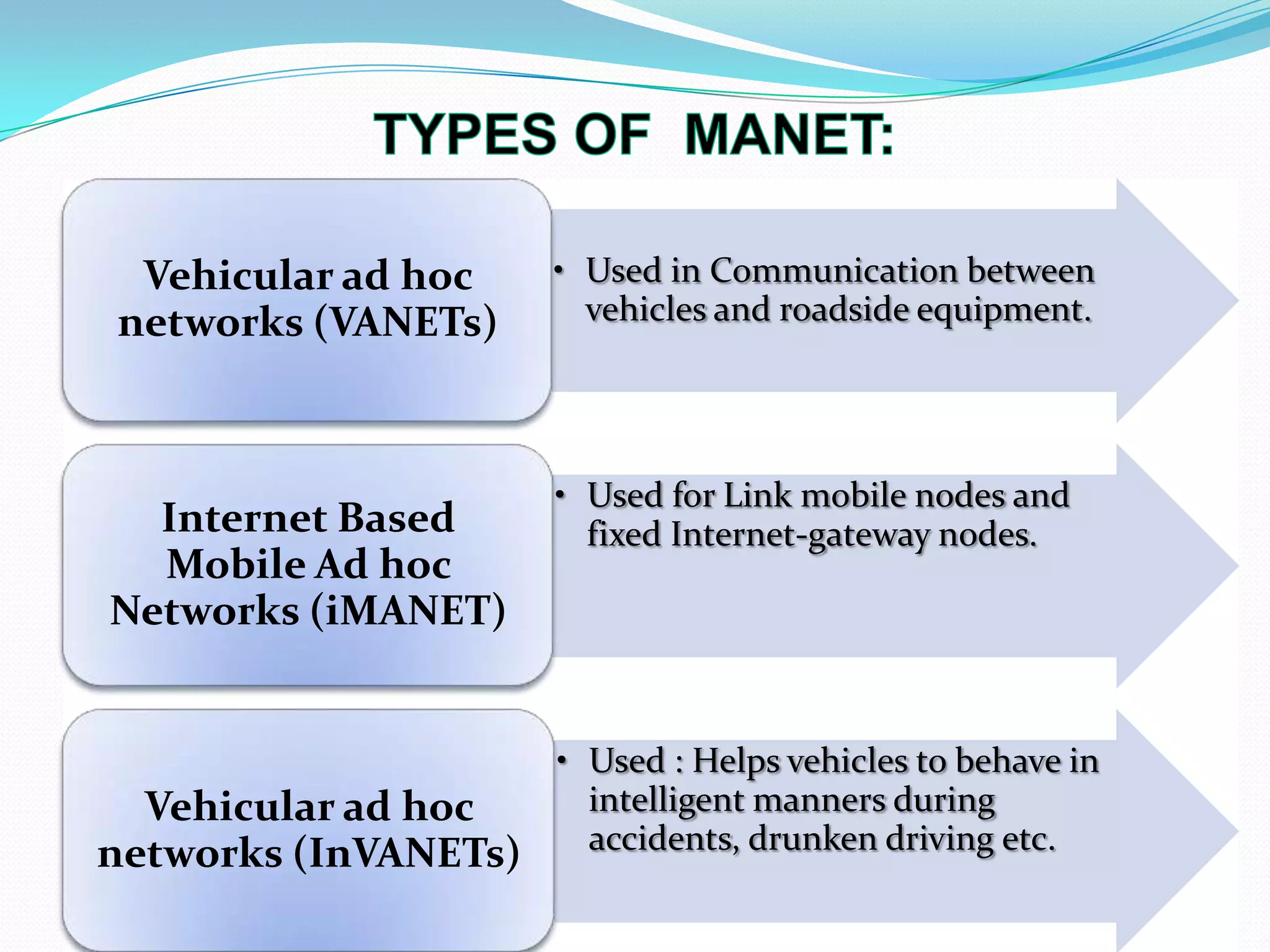
• Used in Communication between
vehicles and roadside equipment.
Vehicular ad hoc
networks (VANETs)
• Used for Link mobile nodes and
fixed Internet-gateway nodes.Internet Based
Mobile Ad hoc
Networks (iMANET)
• Used : Helps vehicles to behave in
intelligent manners during
accidents, drunken driving etc.
Vehicular ad hoc
networks (InVANETs)
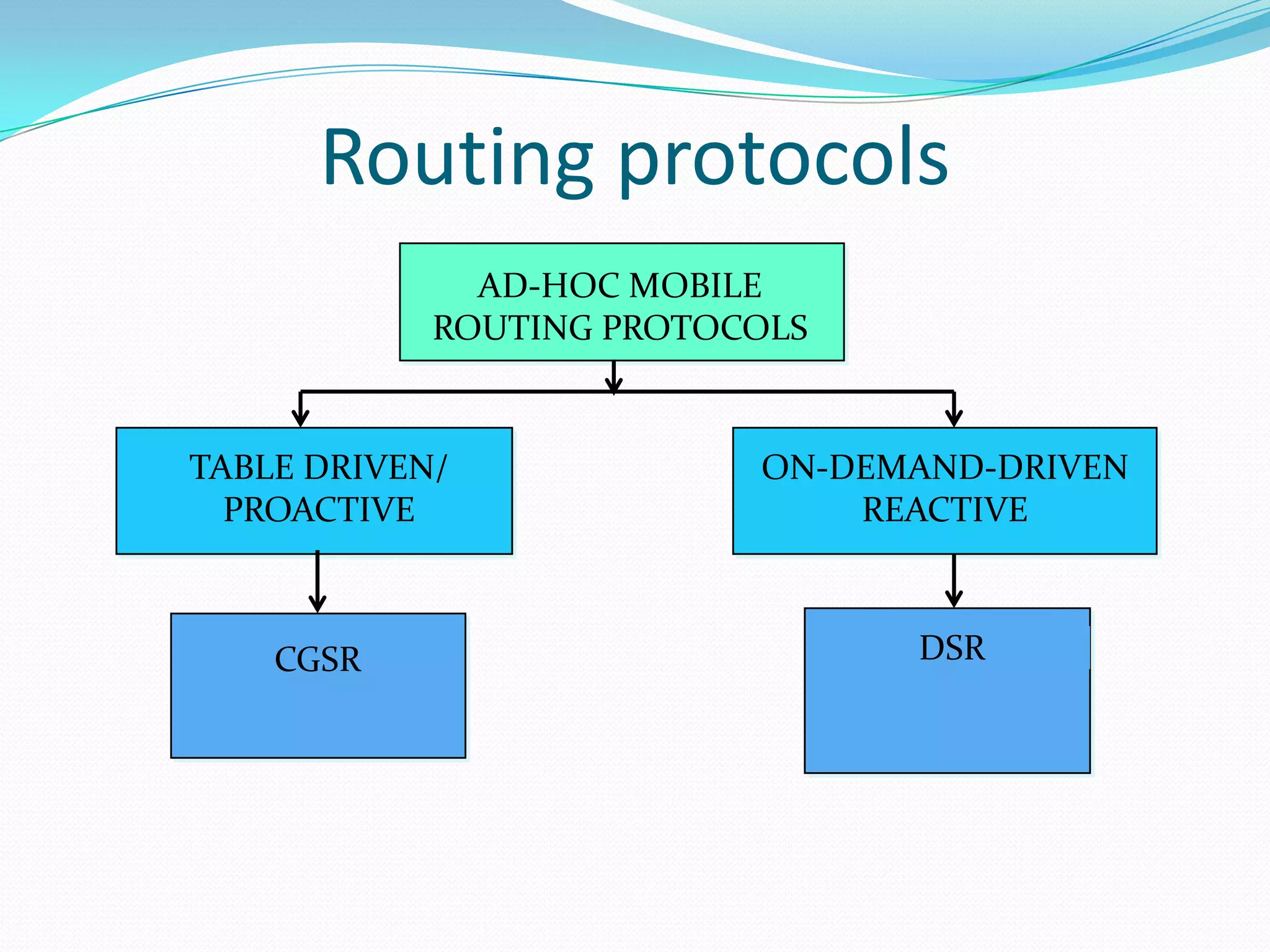
Routing protocols
AD-HOC MOBILE
ROUTING PROTOCOLS
ON-DEMAND-DRIVEN
REACTIVE
CGSR
TABLE DRIVEN/
PROACTIVE
DSR
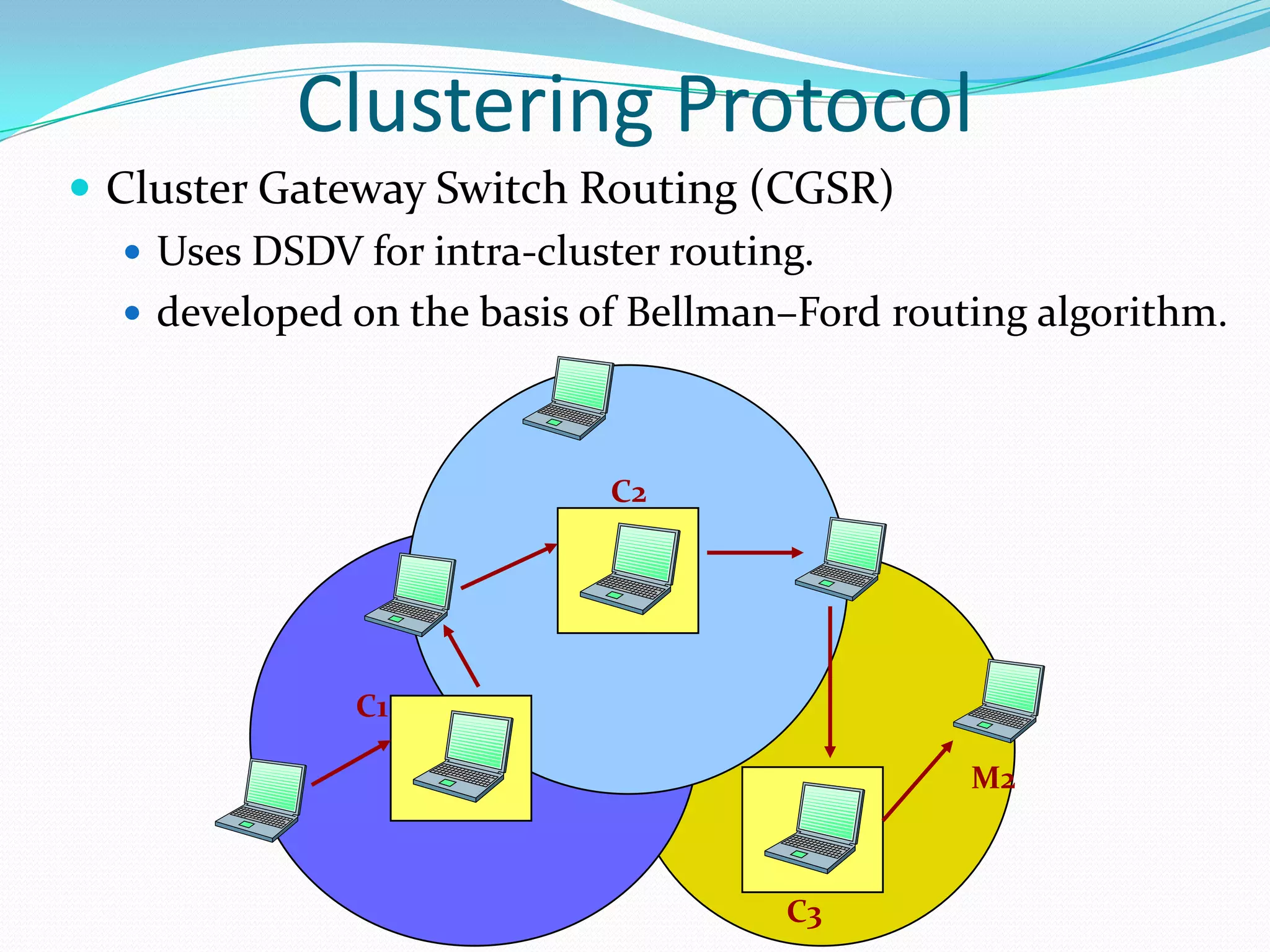
Clustering Protocol
 Cluster Gateway Switch Routing (CGSR)
 Uses DSDV for intra-cluster routing.
 developed on the basis of Bellman–Ford routing algorithm.
C3
M2
C2
C1
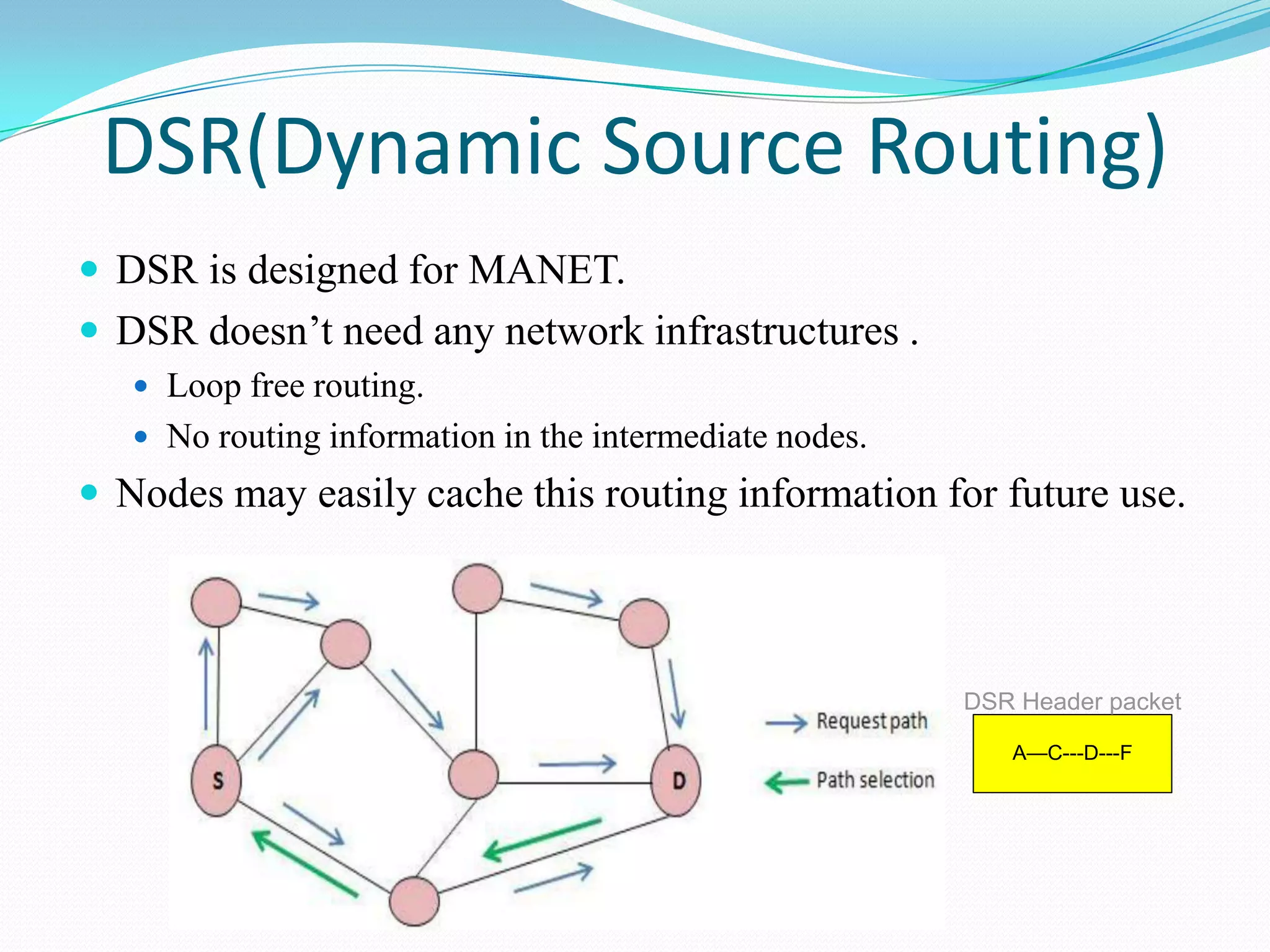
A—C---D---F
DSR Header packet
 DSR is designed for MANET.
 DSR doesn’t need any network infrastructures .
 Loop free routing.
 No routing information in the intermediate nodes.
 Nodes may easily cache this routing information for future use.
DSR(Dynamic Source Routing)
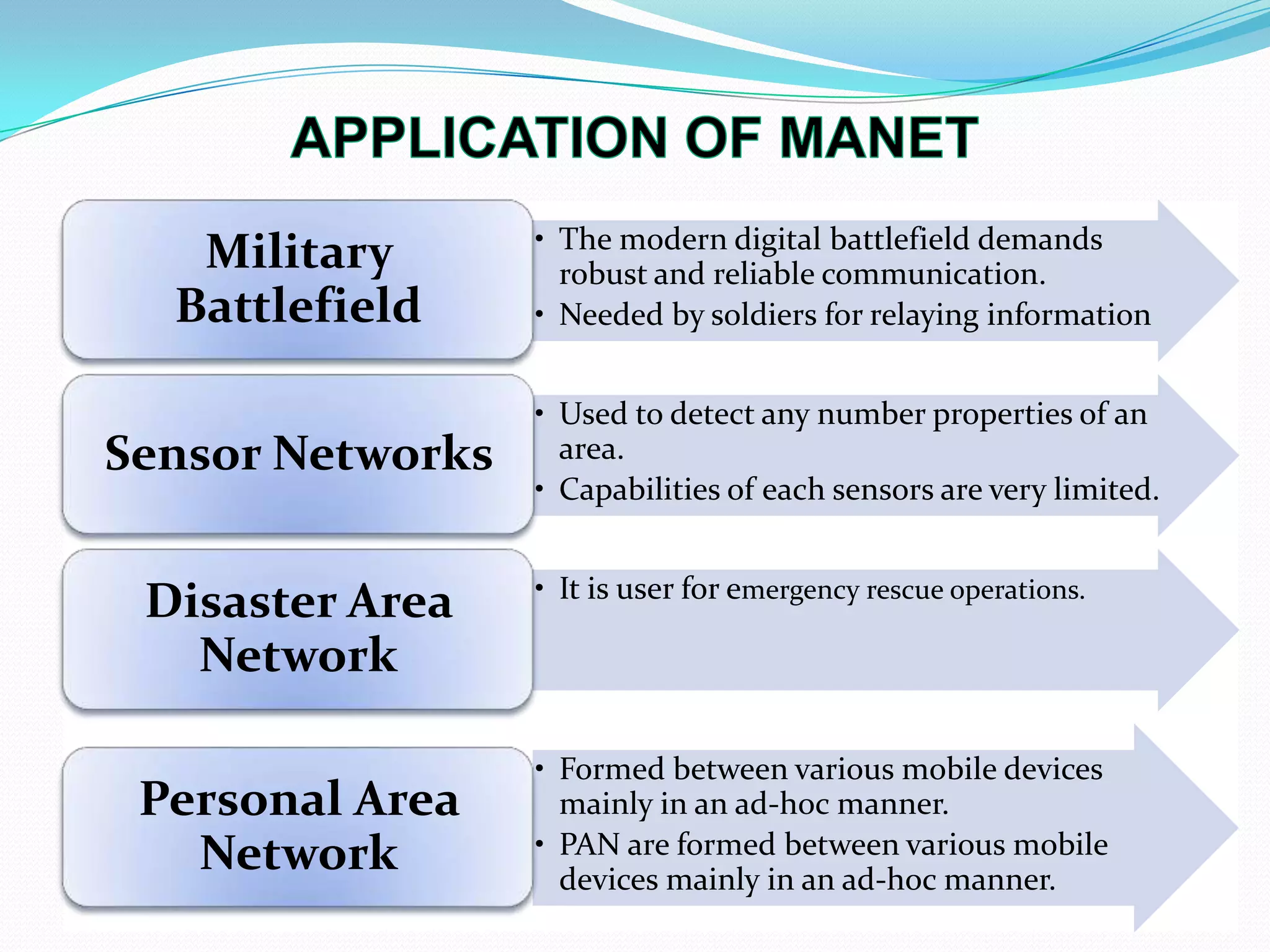
• The modern digital battlefield demands
robust and reliable communication.
• Needed by soldiers for relaying information
Military
Battlefield
• Used to detect any number properties of an
area.
• Capabilities of each sensors are very limited.
Sensor Networks
• It is user for emergency rescue operations.
Disaster Area
Network
• Formed between various mobile devices
mainly in an ad-hoc manner.
• PAN are formed between various mobile
devices mainly in an ad-hoc manner.
Personal Area
Network
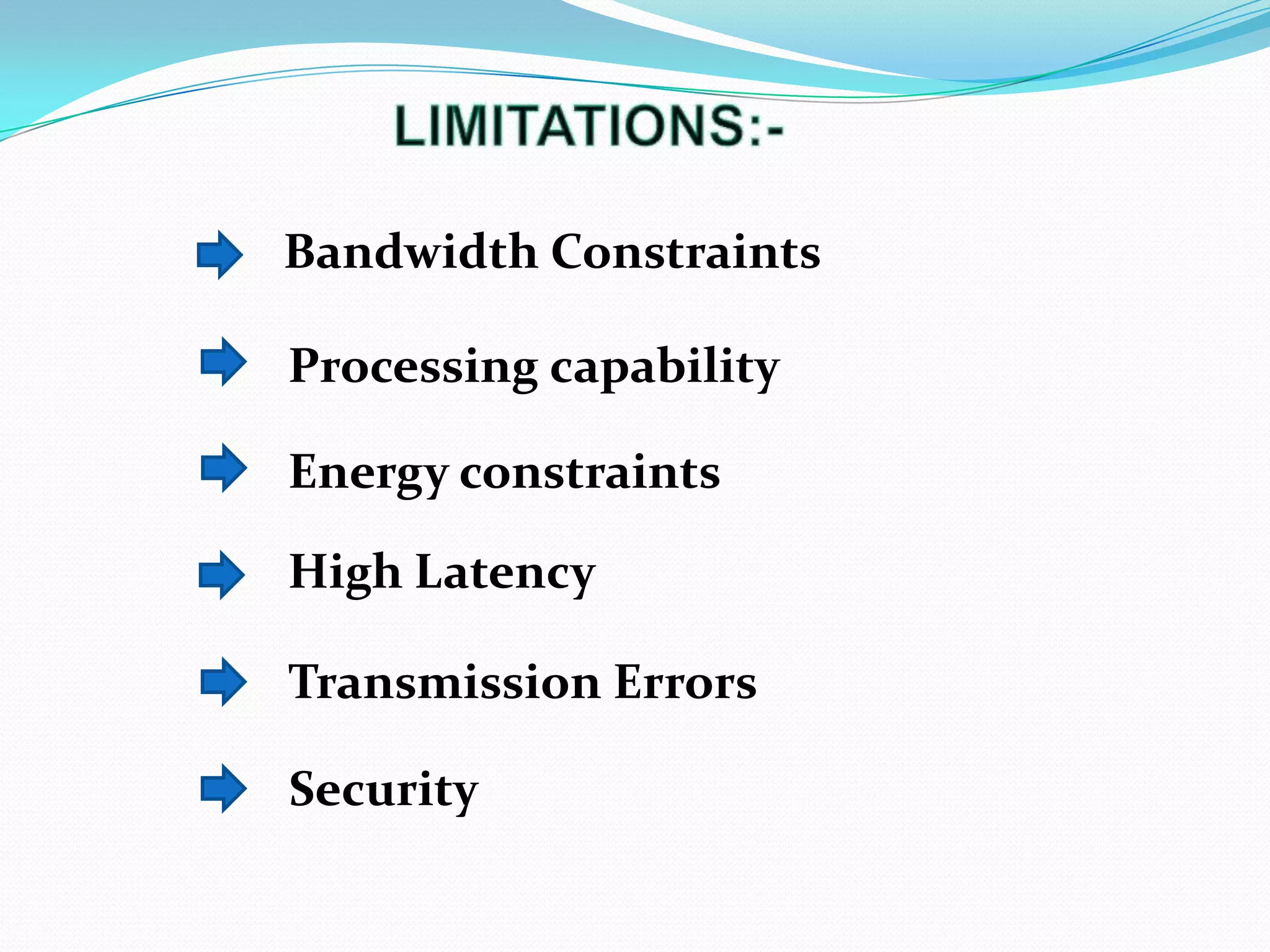
Bandwidth Constraints
Energy constraints
High Latency
Processing capability
Transmission Errors
Security
 I have presented a detailed performance comparison of routing
protocols for mobile ad hoc wireless networks. Reactive protocols
performed well in high mobility scenarios than proactive protocol.
High mobility result in highly dynamic topology i.e. frequent route
failures and changes. Both proactive protocols fail to respond fast
enough to changing topology.
 Security is one of the fundamental issues in mobile ad-hoc
networks. I've highlighted different security requirements, along
with a possible solution to secure transmission in these types of
networks. The proposed security solution is one of several ways to
protect data communication in mobile ad-hoc networks.
 However, there's a solid need to deploy more efficient strategies to
resolve various issues besides security in mobile ad-hoc networks.
Contact us
Sukanta Roy
E-mail id: sukantaroy558@gmail.com
Subhankar Chakraborty
Mobile ad-hoc network [autosaved]

Mobile ad-hoc network [autosaved]

  • 1.
  • 2.
    CONTENTS: Introduction. History of MANET. Featuresor Advantages. Types of MANET. Routing protocols. Application of MANET. Limitations. Conclusion.
  • 3.
    What is Network? Anetwork is a set of devices. Interact with others to exchange the information. What is Wireless Network? Connection between two nodes may goes via a access point. Nodes are connected using Wireless data connection. Node A Access point Node B
  • 4.
     A MobileAd-hoc network is a wireless ad-hoc network.  It’s an infrastructure less Wireless Network.  Each node is willing to forward data to other nodes.
  • 5.
    ‘Ad-hoc’ Latin wordmeans ‘for this’ or for this only. Mobile ad-hoc networks could be categorized into the first, second, and the third generation. Packet radio networks was the first ad-hoc network system. Use radio frequency technology to transmit and receive data. Ad hoc networks were the PRNET sponsored by DARPA.
  • 6.
    Known as SurvivalAdoptive Radio Network (SURAN). Developed : Global mobile information Systems & Near term Digital Radio (NTDR) Known as commercial ad-hoc network systems. Bluetooth was first introduced in 1998. Eight devices can communicate with each other in a small network.
  • 7.
    Each node actas both host and a router. Supports Multi-hop routing. Nodes can join or leave the network anytime. among the nodes. The control and management operations are distributed.
  • 8.
    • Used inCommunication between vehicles and roadside equipment. Vehicular ad hoc networks (VANETs) • Used for Link mobile nodes and fixed Internet-gateway nodes.Internet Based Mobile Ad hoc Networks (iMANET) • Used : Helps vehicles to behave in intelligent manners during accidents, drunken driving etc. Vehicular ad hoc networks (InVANETs)
  • 9.
    Routing protocols AD-HOC MOBILE ROUTINGPROTOCOLS ON-DEMAND-DRIVEN REACTIVE CGSR TABLE DRIVEN/ PROACTIVE DSR
  • 10.
    Clustering Protocol  ClusterGateway Switch Routing (CGSR)  Uses DSDV for intra-cluster routing.  developed on the basis of Bellman–Ford routing algorithm. C3 M2 C2 C1
  • 11.
    A—C---D---F DSR Header packet DSR is designed for MANET.  DSR doesn’t need any network infrastructures .  Loop free routing.  No routing information in the intermediate nodes.  Nodes may easily cache this routing information for future use. DSR(Dynamic Source Routing)
  • 12.
    • The moderndigital battlefield demands robust and reliable communication. • Needed by soldiers for relaying information Military Battlefield • Used to detect any number properties of an area. • Capabilities of each sensors are very limited. Sensor Networks • It is user for emergency rescue operations. Disaster Area Network • Formed between various mobile devices mainly in an ad-hoc manner. • PAN are formed between various mobile devices mainly in an ad-hoc manner. Personal Area Network
  • 13.
    Bandwidth Constraints Energy constraints HighLatency Processing capability Transmission Errors Security
  • 14.
     I havepresented a detailed performance comparison of routing protocols for mobile ad hoc wireless networks. Reactive protocols performed well in high mobility scenarios than proactive protocol. High mobility result in highly dynamic topology i.e. frequent route failures and changes. Both proactive protocols fail to respond fast enough to changing topology.  Security is one of the fundamental issues in mobile ad-hoc networks. I've highlighted different security requirements, along with a possible solution to secure transmission in these types of networks. The proposed security solution is one of several ways to protect data communication in mobile ad-hoc networks.  However, there's a solid need to deploy more efficient strategies to resolve various issues besides security in mobile ad-hoc networks.
  • 15.
    Contact us Sukanta Roy E-mailid: sukantaroy558@gmail.com Subhankar Chakraborty